Imagine you’ve successfully built a business from the ground up, reaching a massive peak, only to watch your revenue start to shrink year after year. Our guest today found herself in that exact position: paralyzed by a plateau that most entrepreneurs face when their original growth strategies simply stop working.
She was an expert at her craft, but she realized she was hiding behind busy work and relying on a single source of referrals that had completely dried up.
Instead of giving up and returning to a corporate 9-to-5, she made a series of bold strategic moves that transformed her pricing and her outreach, allowing her to turn cold leads into consistent, high-value clients. Today, we’re going to deep dive into the exact shift she made to claw her way back to the growth she deserved.
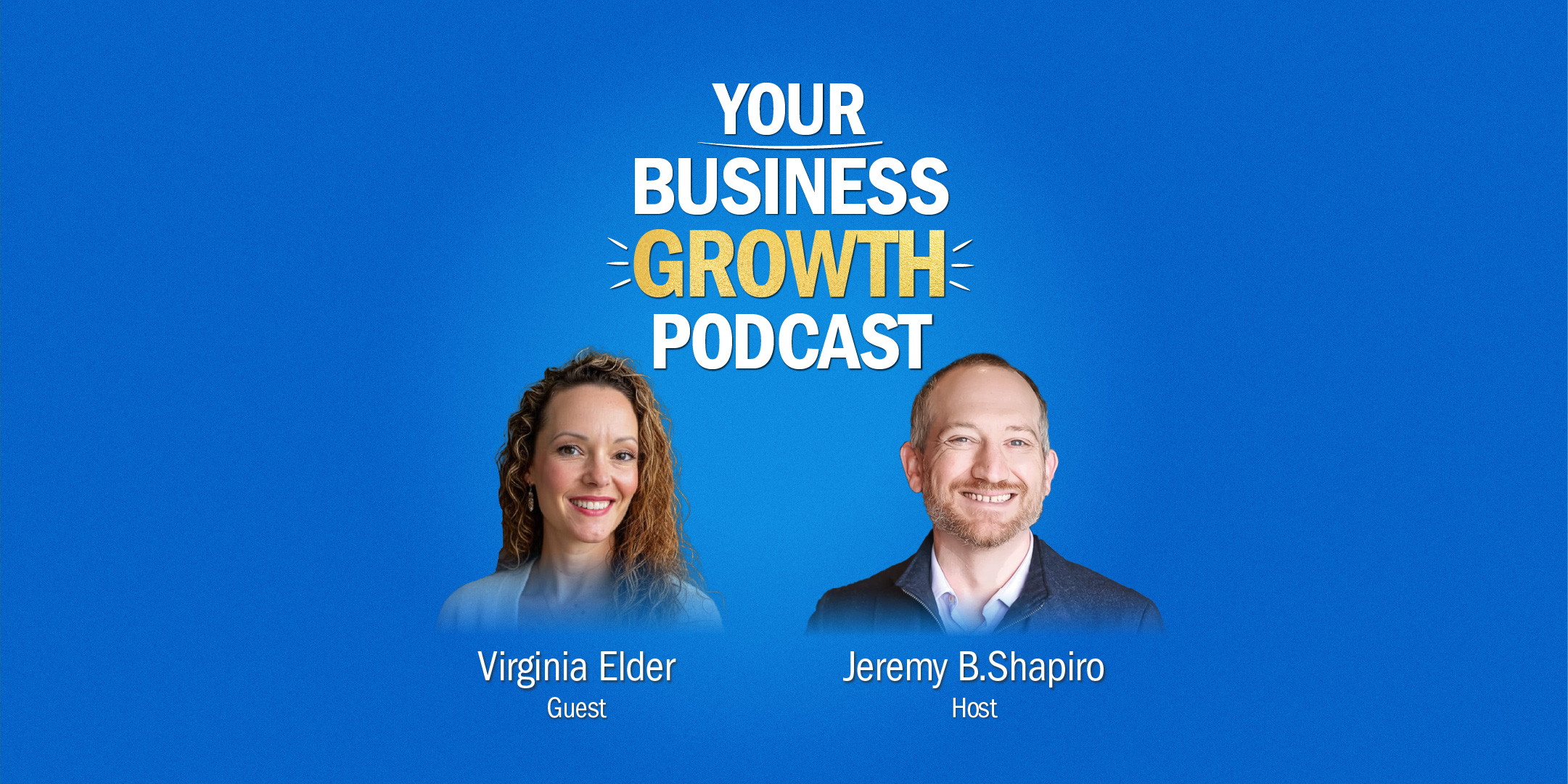
Welcome to today’s episode of Your Business Growth Podcast. I’m your host, Jeremy Shapiro, author of Your Business Growth Playbook, and my guest today is Virginia Elder.
About Virginia Elder

Virginia Elder is the founder of Podcast Abundance and a dedicated podcast strategist for financial professionals. She works with established financial advisors, CPAs, CFPs, and financial coaches who want their podcasts to function as high-performing client-acquisition assets rather than just content channels. Her expertise lies in designing the strategic architecture—including ideal client alignment, messaging clarity, and conversion pathways—that guides what happens before, during, and after every episode.
Virginia’s conviction for this work is deeply personal. Years ago, she and her husband navigated one of the most difficult financial seasons of their lives while raising two children and managing $80,000 in debt. By immersing herself in personal finance podcasts and implementing the tools those experts recommended, she was able to lead her family to a debt-free life within three and a half years. This experience shaped her view that the microphone is not just a tool for sharing information, but a powerful leverage point for strategic business growth.
Since launching her business in 2019, Virginia has utilized her understanding of financial terminology and compliance realities to help her clients build authority and generate qualified leads. Through her proprietary frameworks, such as the Trust-to-Traction Method and the CRAFT Formula, she helps clients refine their positioning and turn listener attention into measurable engagement. Her goal is to ensure that a business owner’s marketing plan is executed strategically so they can remain forward-facing and focus on sales conversations.
Virginia is known for making podcasting simple and effective for busy entrepreneurs who feel their current efforts are not fully aligned with the growth they expect. By moving beyond simple production and into strategic direction, she helps hosts stop being stuck behind the computer and start enjoying the mental space and freedom that come with a structured marketing plan. When every piece of the podcast infrastructure works together, her clients are able to accelerate trust and elevate their authority in a way that feels natural to their audience.
Connect with Virginia Elder
Speed Round Answers:
- All In Lead Source: Conference Speaking
- Books: Traction by Gino Wickman, Your Next Five Moves by Patrick Bet-David, High Performance Habits by Brendon Burchard
- Unlikeliest Mentor: The Competition
Like This Episode? There’s More!
Subscribe!
Your Business Growth Podcast is available on all major podcast platforms. Subscribe today!
Get the Book!
Pickup the #1 Best Seller, Your Business Growth Playbook today online or at your local bookseller!
Meet Jeremy!
Book your Blueprint Discovery Call with Jeremy today and get back to the growth you deserve!
Virginia Elder Episode Transcript
I actually ended up doing about 30 episodes of that podcast. This is where the big shift happened. People heard that I had launched my own show. Suddenly I have other financial professionals coming to me saying, really, you should launch my show, which was not part of the plan, right? That was also why I stopped at the 30 episodes.
Imagine you’ve successfully built a business from the ground up. Reaching a massive peak only to watch your revenue start to shrink year after year. Our guest today found herself in that exact position paralyzed by a plateau that most entrepreneurs face when their original growth strategies simply stopped working.
She was an expert at her craft, but realized she was hiding behind busy work and relying on a single source of referrals. That it completely dried up. Instead of giving up and returning to a corporate nine to five, she made a series of bold strategic moves that transformed her pricing and her outreach.
Allowing her to turn cold leads into consistent high value clients. Today we’re gonna dive deep into the exact shift she made to claw her way back to the growth that she deserved. Welcome to today’s episode of Your Business Growth podcast. I’m your host, Jeremy Shapiro, author of Your Business Growth Playbook, and my guest today is none other than Virginia Elder Virginia.
Welcome to the show. Thank you for having me, Jeremy. So I love going back to the beginning. So of these origin stories, and you started in a difficult spot, like you had a background in corporate accounting, a pile of personal debt, and you launched a business. Tell us how you got off the ground and found yourself in business for the first time.
So as I was driving back and forth to work every day, I did have a long commute. And you mentioned the personal finance hole that we found ourselves in. And I started binging personal finance podcasts. And you know, they say there’s all kinds of disclaimers on there. It’s like, this is not. You know, advice do not do exactly what we say, but I mean, I consider myself a reasonable person.
And so some strategies I’d hear it and I’d be like, yeah, that’s not for me. But others seemed doable. And so I started plugging away. And, um, soon enough, actually three and a half years in, we went from 80 grand in debt to debt free. And yay. And along that journey, I also started investing because of course I’m hearing all of this good advice and I’m thinking like, you know, we can’t just wait until we’re debt free to then invest.
Like I’ve gotta figure out a way to invest a few dollars here and there like, and build up as we go. And so like complete transformation thanks to personal finance podcasts. And at that point I am just, uh, financial professional as far as work goes. And institutional finance, some people would say, or, um, you know, basically we were doing sales tax audits.
That was my specialty here in Texas. And personal finances are totally different. So as I. You know, kind of cleared this hurdle and. Originally felt so alone in this space. I thought, you know, no offense, but everybody I’d been listening to were a bunch of dudes, white haired, white dudes, and I was really thinking about how it would be so nice if there was a woman in the space, a mom maybe similarly aged.
Kids, maybe a similar family structure, things like that. And that was the podcast that I initially launched. A few things that I wanna call out, one as a podcast host for any of our listeners who have a podcast. It is wonderful to hear about podcasts, making a difference in someone’s life and, uh, getting a result.
That’s, I think, a goal for so many of us. So I love that. Um, but you touched on something interesting there that I think is really good for our listeners, and that is understanding your market. Right, knowing who they are and how you identify with them versus creating products or content or whatnot for the void.
So. Um, for our listeners, make sure you know who your market is and how you differentiate. So I wanna ask you a little bit more about that. Like, when you got started, you shared with us why the financial podcasting space was valuable for you, but talk to us more about that gap, right? Clearly all these dudes were out there competing against each other for listener share.
Um, how did you find your place within that, that busy marketplace of other podcasts people can listen to? Yeah, absolutely. So I actually ended up doing about 30 episodes of that podcast, which in the podcast space, that’s a very short life. Being someone’s first show, someone’s first foray into content creation.
I mean, that was a huge deal to me. I, um, of course was on Facebook and like the different mom groups and things like that. ’cause that was. My life. That was me, that was my experience, and that was who I was trying to reach. Um, the other thing I did that was really, truly the most powerful, and we’ll get to that in a second, but like, you know, attending conferences and finding spaces where.
I thought, you know, sure there could be a client here in this space, but really just trying to immerse myself in a space of other content creators at that time, right? Like I’m new to the podcast space, um, that let me go learn some more. And so I started going to a financial conference that’s literally four.
Content creators. So everyone there is like a blogger, a YouTuber, a podcaster. I mean, I just was ecstatic to be surrounded by these folks. And this is where the big shift happened was, you know, at that conference, people. Heard that I had launched my own show and suddenly I have other financial professionals coming to me saying, oh really?
You should launch my show. Which was not part of the plan. Right. So that was, um. Something that changed, and that was also why I stopped at the 30 episodes on that particular podcast. So how did they know you launched your podcast and like how did they seek you out and find you? What, what was the, the connection there?
Just so at that conference, everyone, I, I mean, we’re all introducing ourselves to each other. Ooh, what’s your channel? What’s your show? What’s your website? What’s your blog? What do you do? Who do you coach? Whatever. Because it’s all a bunch of who I was at that time. Money coaches, financial advisors, planners, um, real estate folks, like anybody in the financial space that had a channel or a podcast and who was trying to reach people.
So we’re all sharing. Insights and secrets and oh, this is where like my, uh, most active followers are on this platform. And here’s what I do and here’s how many posts I do a week. And I mean, this is back in 2019, so the landscape was a little bit different. Um, but, but that’s what it was. We’re all sharing tips and.
You know, when the conversation comes up, like, you know, what do you do, whatever. And I say, well, you know, I launched a podcast and you know, I’ve been working with this many ladies and I, you know, I’m looking for this type of client and here’s where I’ve been, uh, finding the most success in these Facebook groups.
And, you know, we’re just sharing things like that. And everybody’s like, hold, hold, hold the phone. You launched your own podcast. Tell us about that and so, so very quickly I was like, oh, oh, this is a thing people are interested in. You know, it’s interesting, I hear two really important things there. One is that you figured out a niche and you went after that, right?
Well, many people I think like to go wide and just serve anyone who’s gonna be a customer. If they can fog a mirror and they have a credit card, right? You dialed into exactly who it was you were serving, and that in turn serves you really well. The second thing I think is interesting. Is that when you take action and do things, people wanna know how you did that.
So when you write a book, everyone asks you, how did you write a book? Can you help me do that? You launch a podcast, people say, how did you, how’d you do that? Can you help me do it? However you’re seeing success or doing something, people seek you out and want to know how to do that. And my takeaway there is like, go do things and like, you know, write in public as it were.
Um, and be visible in the work you’re doing because that often attracts, you know, folks who are interested. So, okay, so Virginia, you saw some great success by niching in and starting to attract these, you know, this, this change profile of your ideal client, right? And you saw growth, which we love, but that doesn’t always go on forever.
What were some of those early warning signs you saw that maybe the business was plateauing or starting to shrink a little bit. So yes. At that point I realized, okay, these are my people. These are the people that I wanna help. You know, just going through some pricing structures and experiencing the first few podcast production clients at that time, you know, for a short period, I found myself almost like running two businesses, which was really challenging, you know?
Financial coaching over here and trying to keep that podcast alive and then launching some other people’s podcast, which is also a financial show. So I couldn’t do that, and that’s where I stopped that first version of my podcast and stopped coaching clients there. Completely shifted to the podcast production piece.
And um, again, we mentioned this is like pre 2020. Um, during the pandemic we actually saw an influx of people who wanted to launch online things, whether it be a course, a program, a platform, coaching, podcast, whatever. Everybody wanted to be online ’cause we were all stuck at home. Um, so that was great. Some of the clues, I’m gonna say were around like 20, 22.
Of course, you always have this client drop off and you’re always looking at, okay, my typical client that joins. We produced their show for about eight months. Let’s just say it’s like a podcast launch. Um, for various reasons. It’s not necessarily burnout or, or that the podcast wasn’t doing well, but various reasons people drop off, whether they switch to a different provider or whether they’re coming in from a different provider.
But at that point, a lot of our work was actually in the copywriting space supporting. Um, one particular client where she was actually attracting folks in to launch their websites, to launch their podcasts, to, to really help them get their real estate investing business going. And so. As most of our work was with her, I started to think I love her, but this is risky.
And at the same time I’m seeing less people joining. Uh, meanwhile I’d been continuing to attend that same financial conference I had pulled back from the Facebook groups. ’cause again, that was, you know, moms and, um, a lot of like personal finance advice. There are. Facebook groups for podcast production, but you get in those groups, a lot of DIY folks and a lot of like questions about certain editing platforms, and I knew early on that that wasn’t.
My jam, I’m not, uh, gonna get into the weeds about sound engineering and a specific platform and what every button does, and like the education piece about how to edit a podcast. So, um, I was trying to be really intentional about where I was showing up and who I was attracting, and it was still very much those financial professionals.
At that point, another factor that was going on is that the, the whole video podcast thing was storming the scene, and so you saw this shift of people going. Oh, well, you know, I wanna really focus on YouTube and if you had an opportunity to talk with them further, what you would discover they were trying to do was a video podcast.
But at first, if they just heard podcast production, they were like, oh, I don’t need you. So there was this like entire shift going on in the podcasting lands. Not necessarily the financial professional landscape, but the language that was being used. Um, so I really had to adjust things. Are you enjoying this episode?
Make sure you hit that subscribe button right now. That’ll help you get more episodes automatically as soon as they come out. So hit that subscribe button right now, and if you have a minute, leave a quick rating and review that helps support the show. You know, I think it’s interesting when you are working with folks at a different phase in their business or.
Program, product launch, et cetera. You hear early on when someone like is I call like a entrepreneur or early stage founder hasn’t sold anything yet, et cetera. There’s a lot of like, how do I questions, right? How do I do this thing? What is the tool I should use? There’s not much contribution. It’s mostly a like, I need a lot of help.
And then you get over the hump to the folks who are doing it, making it happen, actively engaged in whatever this is. That’s where there’s less questions about how do I, and more of the sharing of here’s what I’m working on. And that stuff I find so valuable. Like there’s value in, in both, but like one is like an advisory group and one is more like a peer group and those are very different things, and mixing those does not always go great.
So. Alright. Now during this phase in the business sort of, uh, shift and all, not everything was always the highest and best use of time. Um, you shared with me how you were busying yourself with like activities that weren’t really built around bringing in new clients. Like how did you differentiate between like that busy work versus the productivity and where were you getting caught up as a business owner?
So, you know, any new business owner. Probably experiences this, but at first it’s wild. I mean, you are establishing a email subscriber platform. You’re trying to create content. You’re trying to establish a profile everywhere you’re, you know, processing client work. So many activities are required, and this was.
Um, before I had established a team and, you know, I kind of recognized that like when I am editing an episode, um, and not mine, at this point, I had not picked my own show back up. So client work, which is important, but if I’m doing everything, I have absolutely no time to. Talk to people to like browse LinkedIn and find new clients, to message people, to go to networking events, to do nothing, right?
Because I am just executing the work. So that was a big piece of it, was recognizing like. I need a video editor, I need an audio editor, I need an admin. I need these, these different pieces. And then figuring out how to hire, what to pay, all these things. Um, some of the most, uh, just the busy work that took my attention away, um, was often kind of like in the weeds of creating someone else’s show.
And. While I still very much do that because I’m focused on helping folks create their strategy around their show, and then I’m listening for the words that they’re using. Like, okay, is this connecting with the listeners? Um, but I was either editing an episode or reviewing what my editors had done, you know?
Word. Word for word. And um, that was just really taking away from a lot of activity that I could be doing. So how did you shift out of that, that busyness mode to higher level productivity? Yeah, hiring team of course is a huge deal. We also implemented the, um, EOS strategies. I’m sure you’ve heard of them.
Attractions back there. That’s a book I’m gonna recommend to folks. Uh, you’ve got it there too on my bookshelf too. Yeah. Yeah. And, and I love business content, so there’s various, you know, things that I’ve, um. You know, gathered and taken. But hiring team was a big piece of it. Uh, minimizing meetings and then, believe it or not, minimizing physical networking.
So that kind of sounds counter, um, counterproductive, I guess. And at least what I found in my area was that a lot of quote unquote networking groups were. Not established businesses. They were a lot of really small businesses struggling to just sell candles or you know, it’s like, I dunno how to describe it, but like a very mom and pop feel, not.
Um, something with systems established. So I actually pulled back from a lot of those groups. It was really hard. I felt like I was abandoning people, but, um, recognizing where my time was being spent, that was super important. It was more. Um, efficient for me to spend time on LinkedIn, message people, interact, get on podcasts, things like that.
So for the groups you did keep going to, like, how did you pick the right groups? Like what was your litmus test for figuring out which groups to go to? Okay, so this is something that I have just found. So here we are, however many years later from, from that moment, there is a group. That’s called Provisor, that I’m in the process of joining and I cannot believe y’all that I didn’t know about this group.
Um, and the more people I talked to, I mean, you just gave me this thumbs up, right? Like the more people I talked to, the more people knew about it and I’m like. Y’all, y’all are keeping secrets. Okay. So, um, but that was really the thing is like looking around at a group, any group that you visit and going, how long have these people been in business?
How serious do I think these people are? What is the price tag of every service or widget that these people are selling? And it’s not about. You know, the vibe necessarily of the room that is important. But I kept finding myself, um, just because I liked, uh, another mom in my neighborhood and went to her group.
That didn’t necessarily mean that she was even surrounding herself with the right people. Right. So really starting to be specific about the room that I was in. And along the way I’ve kind of found like halfway groups where like there’s a few successful people in there, uh, and then there’s a lot of like DIYers and help mirrors in there.
Um, so Provisor is what I’m gonna. Recommend now. Yeah. I know many, uh, many person who’s improvisers that has nothing, but you know, great things to say, so I think you’ll enjoy that. Um, so speaking of some of these pivots and changes, right? Like there are factors that we control and things we do that impact our business, and there’s also like those outside factors.
During the pandemic, there’s like this big heyday of like, everyone’s launching a new podcast and that’s great for your business, but when that shifted, like. How did you go from the world having this pandemic or excitement for launching a new show? What did you do? Like how did you shift your market to business model to respond to that?
Yeah, absolutely. So one big shift was the video. Uh, situation coming onto scenes, right? Um, little do folks know that Apple Podcast has accepted video for years. It’s just that podcast host accounts where you have to post your video, didn’t accept video, so that’s why. Everyone’s show was audio for so long.
Um, so those started to make shifts. Different podcast host accounts that I’m talking about. For the folks that are interested out there, there’s platforms called like Buzz Sprout and Podbean and even Riverside now has hosting for a podcast your host account then. Distributes your show out to Apple and Spotify and anywhere that folks could listen.
So, um, we adopted video as part of our packages. Um, first and foremost, I started just talking about video all the time. And while the company is very clearly a podcast company, um, I started using the phrase video podcasting very adamantly in any kind of real or content. On my website, we went through all the copy, all of that.
So that was a really intentional shift of going video first, podcasting. ’cause there are plenty of financial podcast editors as well, um, which is awesome to network with and, and meet and know that there’s more of us and bounce questions off. But you gotta find a way to differentiate yourself. Uh, the other shift was a little more recently where we’re starting to see this.
Influx of ai, whether you wanna talk about ai, help in product, uh, producing a podcast, or whether you wanna talk about. AI chatting you to it, saying like, what should my next episode be? Here’s all my things about my business, you know, help me outline an episode. I started to see a need for an actual human to strategize with the business owner.
And, and talk about, you know, your business. What products are you selling? What you know, email subscriber situation, do you have? What is this? What is that? What platform have you tried? All of the things. And then to listen to the episodes that they’ve produced and watch, right? And really consume and really third party view this person’s business and what their goals are and say, okay.
Here are the gaps. Here’s what’s going on. Here’s what I suggest you do. I’m seeing this. I’m hearing that AI cannot comprehensively match what you’ve done, what you want to do, what’s possible with your goals, right? And to be able to tell you, okay, in your intro. You’re telling me over here you want this, but I’m not hearing that, and this phrasing is throwing me off.
You know, your ideal listeners, this type of person, they aren’t gonna identify with that phrase. There’s gonna be unique things that I can do as this. Pre personal finance fan, right? Then adding that with all of my experience, and so it was just like this shift of like, how can I serve people better in every step of the way?
I want to just sidebar briefly, um, because you’ve touched on this, the audio versus video for podcasts, and there’s a whole debate in the industry and I don’t know if that’ll would be your right answer, like. You love video and have for quite a while. There’s also, I see a lot of arguments for people who are saying, forget that podcasts are audio only.
That’s the way others who, like I do produce an audio podcast, but we’ve record the video, but it’s not a video first or a video only. Like how have you found your way to the position you have now on audio versus video versus both, et cetera. Yeah, so we can talk about video first, meaning that the primary focus is we’re recording full length video.
Everybody’s gonna look good. Sound good? You have earbuds in, like all the requirements are met and the primary focus when we’re editing is even, how does the video look? Do, does someone need to shift? You know, is there something weird in the background? And, and we’re really looking at if there is a person that’s gonna sit down and watch the entire interview, what are they gonna see?
And so then of course, the video’s getting posted on YouTube. We’re posting it through a platform that accepts video so that it’ll get syndicated out to the podcasts. Um, and the video edit is then split off as audio. And, and there’s no further edits made. I have clients on all sides of the spectrum. I have clients that have come to me that said, you know, I really didn’t find traction in YouTube.
Of course, I wasn’t really trying, but we just like recorded video and just like slept it on YouTube and I just didn’t, you know, I’m just gonna go back to audio. Fine. That’s great. I will help you do audio. And she’s doing a great job at that. The, the one that’s coming to my mind. There’s other folks that they are really focused on video.
Um, and, and the kind of piece that I have to talk them into is like, Hey, just double post this as a podcast. Like don’t only post it on YouTube. You’re recording anyways. You might as well have folks listen to it. Um, I don’t think there’s a wrong way that you can do this at this point. You just need to be creating content that people can find and follow and binge.
Because at this point, if you’re not, I, I really think that you’re gonna be kind of left behind. So one interesting thing I’ve found is like, I know. By producing this as an audio podcast, but recording the video when we create the shorts, like I get tremendous volume on the shorts that are eclipse from our episodes that then lead to the full episode on YouTube.
Um, and that’s not for our audio only audience, but there are so many folks, which is astounding, who consume short form video content or enjoy. Watching or listening to that podcast on YouTube in the background. So like that was really eye-opening to me. ’cause that’s not my preferred format, but I’m not my own customer.
So, uh, thank you for sharing your perspective on that. Alright, so I want to talk about sort of like the different tiers you have in your business because one of the changes that you’ve shared with me is that you added in some lower tier service options, right? Sometimes we move up, sometimes we move down.
Sometimes we put a tier in the middle. Um, talk to us about how you’ve changed up your service offerings, uh, you know, over time based on what you saw in the market. Yeah, absolutely. So at first, you know, of course just podcast production and then the tiers were different levels of production, right? Like you can have video, you can have social media, blah, blah, blah.
Uh, that’s really just different services that are more expensive or less expensive than each other. So the shift in like the business structure and offers. Has become more of, alright, let’s say someone is a DIYer and they have a great show, they don’t need a producer. Awesome. They have an internal team.
I don’t know whatever’s going on, but they still need a third party perspective. They need some advice. Something doesn’t feel right. Uh, they aren’t growing as fast as they want to, whatever it is. Well, I can step in for a nominal fee. Take a look at everything like I was explaining before and, and really listen and gather all the details and look at their website and everything and share, okay, here’s what I see.
Here are some recommendations. So that became like the low tier entry level, you know, 500 bucks. I will spend this much time with you. You get a PDF, it’s amazing. Um, you can take those recommendations and run with them. And if you’re an implementer. Trust yourself, go with it. Right. Um, and then for the folks who aren’t comfortable making those changes on their own, but they want the recommendations.
But they also want someone who’s gonna meet with them next week and the week after and like make sure that they did it. And when they’re in the middle of implementing that recommendation and they get stuck, they want to be able to ask me, you know, five more questions and, and for someone to really hold their hand basically.
Okay. Awesome. That became another tier that is a more advanced, um, conversion lab is what we call it, level of. Strategy. Um, then of course you, you still have podcast production. That is another level within the, um, range of opportunities. But then of course, like that is a multifaceted thing. Like, do you want video?
Do you want reels? Do you want this, that, whatever. So it became this, you know, okay, average production client can be. I don’t know. Let’s just say 2000 a month for a weekly hour long show with video, um, ballpark. Okay. Depends. And so you’ve got that, you know, maybe 2000, 2,500, whatever it is, at that highest tier.
For a little bit less, you can get the strategy and the handholding for a little bit less. You get the strategy and the PDF instructions. So, uh, being able to break that out. So I’m hearing two things I I wanna highlight for our listeners. One is we talk about the, like this ladder of ascension, you have an entry point where someone comes in for an assessment, they move up to a higher level, higher level and beyond, um, which is great.
The second thing I wanna highlight that I love is that you figure out these different service tiers and gave folks the ability to enter at any of those points, move up or down as needed. And the third piece I wanna touch on that I love here. Is, um, in the book I talk about this idea of you can have the DIY, the do it yourself, the done with you, right?
Or the done for you. And those are three different price tiers. So, um, kudos on getting all those implemented in the business is huge. Alright, now let’s talk about finding new clients. One thing that I think you do a really great job with is this, this personal outreach strategy to bring in more customers.
Tell us what you’ve been doing, um, to fill that top of funnel from this personalized outreach that you do so well. Hmm. Thank you. Thank you. So this is a new strategy. It ha, I’ve been very happy with it, but much like how I shared, I would conduct, you know, let’s say a podcast audit or the podcast conversion lab piece where I am.
You know, seeing your profile, let’s say on LinkedIn, Jeremy, let’s say I found you go to your show, check out a few episodes. I’m looking at show notes, I’m looking at your social media profiles. I’m okay. You wrote a book, like, you know, I’m, I’m pulling in all of this information and, and recognizing, okay, here’s the service levels.
I might subscribe to a newsletter. I’m just, I’m being a detective, right? Um, with practice. This doesn’t take that long. It can take 10, 15 minutes. But for me to have this objective look at things and then say, you know what? Um, you would be a great client for me. I can help with X, Y, Z, and to be able to then.
You know, send you a message on LinkedIn and not just like pitch right there, but say like, Hey, um, I see your book, I see your podcast. You’re doing some really great work. Uh, and just like start a conversation there and, and they see you, they see your profile, they see your business title and all of that stuff.
So when, when I message someone, they know I’m a podcast producer, they know I’m a strategist in this space. So. A lot of my, uh, messaging is like, you know, can I answer any questions for you? How’s your show going? How, um, is everything feeling? Are you getting clients from your show yet? And just opening that conversation with an informed level of what I see as a consumer looking at your business.
It’s a noisy market. Like speaking as a podcast host, I get multiple pitches a day either. Garbage pitches for someone to be a guest on the show, but a ton more about getting on podcasts or finding guests or producing or all these things that serve podcast hosts. Right? And I don’t wanna say it’s formulaic, but there’s so much hyper personalized, very based on my latest episode and my LinkedIn profile and all this stuff.
Pitches that just get lost in the noise ’cause they mostly are terrible. How, um, how are you getting that response and, you know, staying away from being too salesy, um, and actually engaging with folks, like what’s your, what’s been your best practice there? Yeah. Yeah. So first I wanna say I get those same pitches from people as well.
You know, like, you know, your, your YouTube subscriber count is low. I can fix that. You know, and it’s like, if that’s your one-liner, go away. Seriously. Um, and I’ve said openly on podcasts that, you know, even in my email, I can see that it is a podcast pitch. I just delete it. Like I don’t even pay attention.
Um, because. They’re never right for the show anyways. Um, like I mentioned a little bit earlier is like through seeing what you’re actually doing and not just referencing your recent episode or who your recent guest was, um. You know, I can honestly say like, Hey, you know, I, I am very interested in your podcast.
I looked through a few episodes. These would’ve really helped me back in the day. Um, like a honest answer, you know, an honest outreach piece that’s not just so complimentary. ’cause I’ve gotten those two where they’re just like over the top complimentary kind of gagg and I’m like. Ugh, go away. So, so genuinely a, I wanna be connected anyways.
If you’re in this space doing the thing, like do you go to FinCon? Do you, you know, what, where can I see you? Where, where might we have a chance to hang side by side? Um, ’cause those are all honest questions I have as well. So it’s not just a pitch, it’s a true. Desire for networking and connection. Love it.
Yeah, so what I’m hearing there is the personal outreach has that important first word of personal and personal, not being, hi Jeremy. That’s not personalization folks. I get like the hyper personalization, which is so personal and also 79 paragraphs long. I’m like. I got it. Okay. Okay. Right. So personal, that’s, that’s my, my takeaway from what you shared there, Virginia.
Okay. Let’s talk implementation. Um, you put in this new tiered pricing tiered services, uh, model in place. Like what kind of impact have you seen that have on your business in terms of closing new clients, maybe who weren’t ready for your higher end packages or attracting more of the right folks? Like what’s been the impact of these new offerings you have?
So, as you’d expect, there’s totally different people purchasing at different levels now, which was the goal. You’ve got your, um, production clients that maybe were there or were, you know, looking at your would’ve come in anyways because that was the level that was always available. But then now even, especially in this like LinkedIn reach out and stuff like that, you can kind of gauge how the conversation’s going and they have a production team or they don’t, or they’ve been producing it themselves for several years, or they seem stressed and you can kind of tell.
How it’s going and say like, Hey, I offer this thing, would this help you if I took an objective look at your business? I expected that a lot of folks would be purchasing at that $500 PRI price point for just like kind of a basic audit. Yes, I look at everything, but you’re getting a PDF and you are in charge of implementation.
Um, and I, I just thought that because of the price point, like I felt like. If you’re serious about growing your business with a podcast, 500 bucks is a nominal fee to receive an in-depth strategy of, of what I’m seeing and what I think you should do as far as changes go based on experience. Right. Um, what I’ve actually found is that folks know.
Most often, whether they are or are not an implementer and whether they need that guidance. And so that actually is the most common tier, which is great because, uh, we get three calls together that are an hour long. We are deep diving into every platform and every piece of their business and fixing this and fixing that.
Um, sometimes they don’t. Fully know how to use the platform. They’re just on it ’cause someone told them to. Um, and there’s a lot of little pieces that I can go in there and say, Hey, like, adjust this, change that, or like, gimme your login and I’ll share a screen and, and I’ll change it for you. You could see me, um.
But that has been the most fun is just really handholding and helping and making sure that those changes were made. And then hearing back later like, Hey, that was, that was great. That worked. Or, you know, I got comments on Instagram about my podcast now, or whatever it was. That’s awesome. I, I love when clients share that back up by the way, right.
Of the impact that you’ve had on their business. Uh, it’s always like, I find so encouraging. So I love that your clients, uh, share that as well. So, alright, you, you clog way outta that decline and you have the new offerings, like what’s been the most significant, like, quantifiable change, like either revenue wise or profit wise as you’ve changed up the business model.
Yeah, for sure. I’m gonna say the, the profit margin is a bit different now because, um, and, and there could be a challenge to this, um, in the foreseeable future because when I do either an audit or the podcast conversion lab, which is where I’m handholding through the changes, um, that’s me. That’s my FaceTime.
That is me as your strategist. And so that could be a bottleneck, right? Um, I have the team established to produce the shows, uh, for the production clients. And of course, I’m, I’m in there. I’m, I’m overseeing, I’m proofreading, I’m doing things that, uh, make sure that what I wanna see for our clients is being done.
But there is going to be a point where I either have to train another podcast strategist to look at financial shows the way that I do. Um, there’s gonna be something, something there, but for sure that’s all my time. There’s no team involved. There’s not a software cost. So the profit on that is. All me. So that’s been great.
Nice. Now, that’s some of like the tangible financial benefits. What were some of like the unexpected benefits of having this lower cost entry point, um, for existing hosts who just like need that professional audit? So, there’ve been folks that I wanted to work with, that I’ve seen at, at FinCon for years that have attended a webinar of mine.
And, and I was pleasantly surprised to see their name. It’s, it’s almost freaky to see someone, you know. On your webinar list, you’re like, oh, crap. Um, but, but it’s also very exciting. And I knew, um, you know, in the, in this case, this one that I’m thinking of, I knew he had a production team. I, I see his content, I follow him, like he’s, he’s got it going on.
Um, but he still came to me for that podcast strategy. Was able to turn around and give that PDF to his team and have them implement the changes. And there’s an amazing case study now on my site, thanks to him. So, uh, some maybe non-monetary changes there is that we’ve been really intentional about creating case studies out of those, which I wasn’t necessarily, it’s hard to do for like a full production client.
You’re, there could be changes over time, but you’re. Focused on producing your, their show. You’re not necessarily focused on, here’s what you were doing before. Here’s your numbers from before, and here’s what happened and the, and the results Three months after these changes were implemented, that’s like a very clear.
Transition that you’re able to highlight. Um, so that’s been really cool. That’s fantastic. Um, it is so good to find those other tangible benefits like the, the proof, right? The, the testimonial, the case studies and so forth, um, and be able to leverage that. So really well done on that. So for other business owners, there’s often like the inventor archetype, right?
The person who’s just working in the business, creating the thing, but does not like the idea of getting out from behind that computer and like marketing themselves. Like what kind of advice do you have for folks who are afraid of getting out from behind that computer and marketing all they do that could end up growing their business?
Okay, so I am very much an introvert. I love to just. Be home, not talk to people, uh, just do my thing, tinker away, um, and chat. GPT and I have had several conversations about this. So, um, from experience I can tell you that, uh, there are. Blocks on my calendar for certain days where I am relieved to say that I don’t have to talk to anybody, don’t have to put on makeup, get out, do anything, right.
But then, um, the importance of. Your voice, your face, getting out. Um, I tend to block certain days for, and if an event happens on a day that I’m marked for sweatpants, sorry, not going, I need that downtime. And it’s not just that I didn’t wanna get dressed at whatever, it’s, it’s literally my energy is just absolutely drained.
Um, so some of the things that I’ve. Found is that it is so much less energy for me to sit here and chat with you, even though yes, I got dressed, I put on makeup, I, you know, put the dogs outside. I, I, I put in energy to show up, but it is a different level of energy versus going physically to a networking event.
So that’s a, a big consideration and that has to be spread out on my calendar. Um, the other piece is that. You know, searching over someone’s profile and checking out their business and sending them a quick message is a different, again, level of energy. Um, it is much easier for me to trade messages back and forth, send emails back and forth from whatever comfort of whatever I need, whether it’s a blocked off day or not.
Um, Facebook ads have been very helpful to build my email list in this way because it literally does not require me to do anything. Once you’ve set it, you have ’em running, you have a decent cost per click or whatever, and you’re happy with it, that just runs day and night and my email list builds by itself.
So I’ve really depended on that within the past six months to grow my email list, uh, without requiring. Additional energy. So I’ve constantly been looking for other ways like that. Um, the other trick I’ve implemented is webinars. The webinar itself requires your energy, but when all the folks emails come in as registrants to your webinar, your email list is growing.
So there’s. You know, I, I can say tricks, but things you can do that don’t require your physical outward energy that are still contributing to your business. I think it’s really important to identify what pieces you can do, um, that align with your energy that’s available. The key thing I’m hearing there is action.
It’s doing things, it’s, it’s putting systems in place that generate leads that. Build up the email list and so forth. And that is really what can make that difference in, uh, I don’t wanna say marketing while you sleep, but you put these things in place that work for you around the clock, whether it’s an on day and off.
And the second piece, there is a strategy I love and I’ve used forever. Is that time blocking is the block of a time on the calendar for a certain task, a well-defined outcome. Maybe that’s a, an introvert session of doing something that is totally offline. Maybe it’s extrovert, you’re out doing something, but it’s blocked on the calendar and that’s the thing you’re doing.
Then otherwise, as a business owner, you can, you can get caught up in the, the fire of the day. So, um, love that. Alright, crystal ball time. Knowing what you know now, what would you have done differently when you first noticed your growth started to stall earlier on? Yeah. Okay. I do think I would’ve implemented Facebook ads earlier.
Because that was something I was terrified to do. Um, I, I didn’t understand how it worked and I thought that, you know, if a certain ad took off, then it would just charge me a whole bunch. I didn’t really understand that there was like a daily limit on what you could spend, um, and some of the settings inside there, and that is a great example of just being scared of something and not even.
Checking into how the tool works and just not doing it. ’cause you’re scared. So that’s, uh, lived experience, folks. Don’t do what I said. Um, but yeah, I would’ve run. Adds a little bit earlier. Um, but the tiers of the business and, and putting myself forward as a podcast strategist really took me time to identify that.
That is my title. That is what I do. For a really long time, I was, you know, first a podcast editor and then I said, oh wait, we do more than edit. Um, okay, I’m a podcast manager, and that title stuck for a long time and it, it is truly that like. Identity that has to grow as a business owner. I don’t know how to fast track growing your identity, but that was the biggest shift and I wish I understood that.
I have unique insight as a podcast manager and that I could have positioned myself as a podcast strategist so much sooner. Well, one thing I’m hearing is. Try an identity out, see if there’s a fit there, and if not, you know, adjust. Alright. Before we wrap a few quick rapid fire questions for you. If you had to start all over again from scratch, what one lead source would you go all in on?
I would do more speaking at conferences. Nice. All right. Aside from, of course, your business Growth playbook, um, and you mentioned traction earlier, what are some of your top favorite business books? Mm. Okay. So there is your Next Five Moves by Patrick. Be David. I felt like that was a really interesting book.
Um, I also have Behind me, Brenda Bouchard’s High Performance Habits that really spoke to me. I remember being like. Like as he’s, you know, because I, I did the audio book while I was out on walks and I would just be making faces like, oh my god, you know, like while I was out walking, because I never identified as a high performer and just hearing that book, I just felt like, holy cow, he sees me.
Nice. Uh, I love that you’ve got a bookshelf of books. I know just a few behind you, but a ton more elsewhere. Much like me. This is one of many bookshelves. So, um, great. Last rapid fire question, who was one of your un unlikeliest mentors? I sort of think a competitor actually. Um, and I never looked at it as being unlikely.
But I think hearing it from outside looking in, you would think like, you know, why would someone who’s already a podcast editor for financial shows help you? Right. But he, he has been instrumental in my business growth journey. I actually love that because, uh, so often people look at their competition as like the enemy to keep away when, if you look at like co-opetition, right?
Or what you can learn or how you can collaborate, like there’s. So many ways to make the pie bigger. It’s not about fighting over the slice of pie. There’s so many ways to learn from our quote, quote, competition. So that’s, I think, a great, great, uh, answer. Alright, so to recap for our listeners, you move from a successful but shrinking agency model to a more resilient structure by rebranding to your own niche, creating tiered service levels that offer an easier path for new clients, and leaning into personal outreach to turn leads into long-term partners.
Sounds good. So for our listeners who wanna learn more about you, like where should they go right now? Yeah, so you can find everything@podcastabundance.com. You can find the show Podcasting for Financial Professionals at podcasting for financial professionals.com. Outstanding, Virginia. This was a ton of fun.
Thank you for sharing with us your journey. Um, I’ve learned a ton from this. I always enjoy the book recommendations, but the biggest thing that I always enjoy about these kinds of conversations is everyone’s had their own journey, right? We may be going in a similar direction, but how you got to where you are and where you’re going from here is so unique and there’s so much to learn from that.
So for our listeners, uh, on behalf of our listeners and for myself, thank you for joining us and sharing with us your journey. Thank you. Thanks so much for listening. Quick reminder, hit that subscribe button right now so you can get more episodes when they come out automatically. And remember to leave that rating and review right now.
Like This Episode? There’s More!
Subscribe!
Your Business Growth Podcast is available on all major podcast platforms. Subscribe today!
Get the Book!
Pickup the #1 Best Seller, Your Business Growth Playbook today online or at your local bookseller!
Meet Jeremy!
Book your Blueprint Discovery Call with Jeremy today and get back to the growth you deserve!