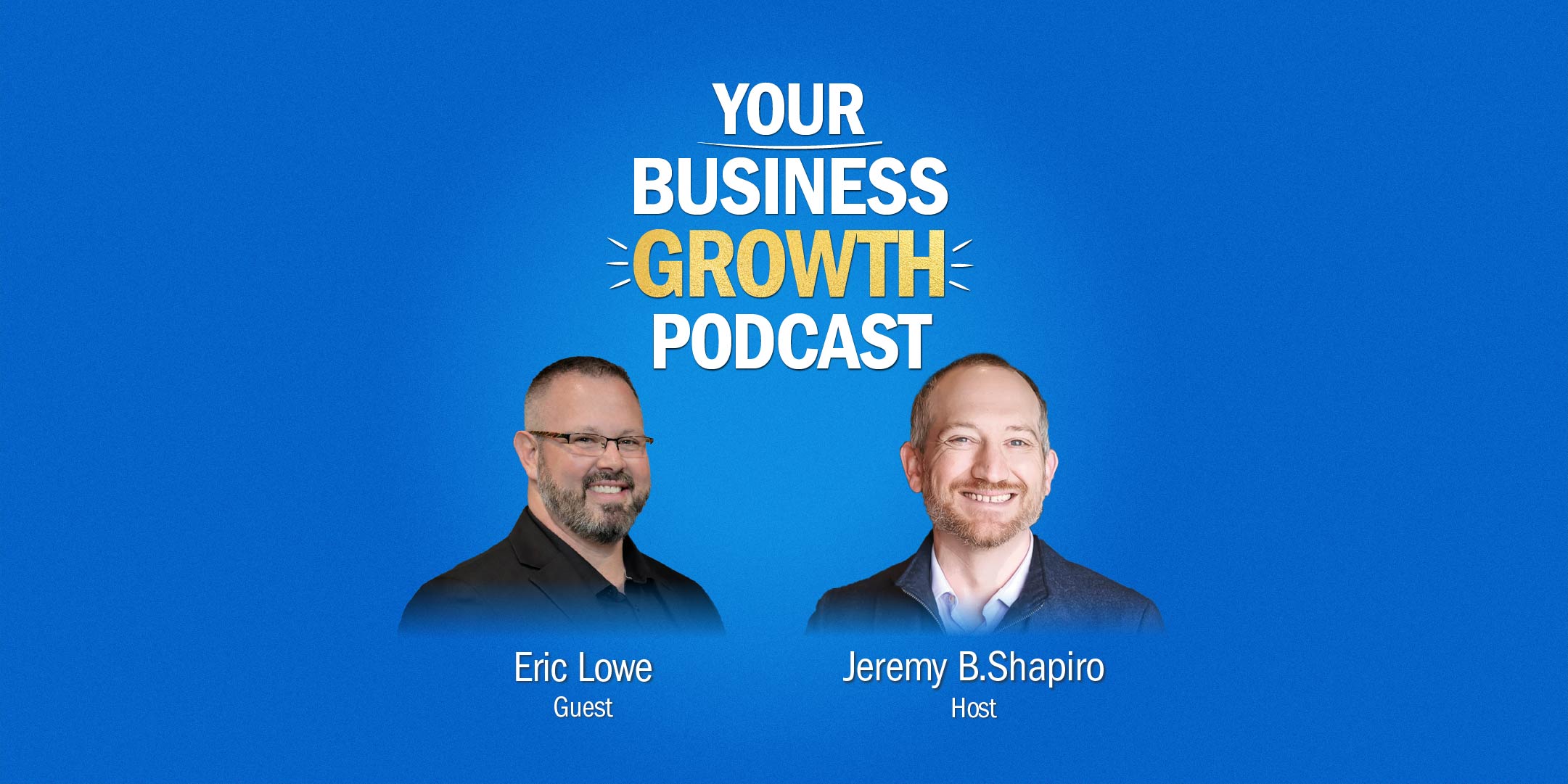
Imagine launching a specialized healthcare practice that is seeing steady demand, yet you suddenly realize your growth is being throttled by a bottleneck you didn’t see coming. You’re looking at your financials and realize you are paying 60% of a full-time professional’s cost but only receiving about 30% of the potential productivity in return.
Most leaders would try to just hustle harder or find more part-time help, but today’s guest decided to dive deep into the data and completely flip his operational model.
By taking control of his own supply chain and bringing specialized services in-house, he transformed an operational nightmare into a $30 million rocketship of a business.
Welcome to today’s episode of Your Business Growth Podcast. I’m your host, Jeremy Shapiro, author of Your Business Growth Playbook, and my guest today is Eric Lowe.
About Eric Lowe

Eric Lowe is the CEO and Co-Founder of Aptiva Health, a rapidly growing outpatient healthcare platform built to scale access, quality, and operational excellence across multiple clinical specialties. Under his leadership, Aptiva has expanded into a regional healthcare system with a bold vision to become one of the largest outpatient healthcare organizations in the nation. He focuses on maintaining the culture, clinical integrity, and human connection that define great care while achieving durable growth.
Eric’s leadership philosophy is grounded in the belief that the hardest problems in healthcare are solved by asking the right questions and then building systems strong enough to support the answers. This mindset shapes how he designs organizations, aligns clinicians and operators, and builds scalable care models that balance expansion with sustainability. He spends much of his time building high-performing leadership teams and refining operating models to create healthcare platforms that work for patients, providers, and communities.
In addition to his executive role, Eric is the author of Be the Broker, where he challenges leaders to think differently about value creation, alignment, and long-term strategy. His work consistently sits at the intersection of healthcare delivery and enterprise value creation. Whether in his writing or at Aptiva Health, he remains focused on disciplined execution and translating an ambitious vision into practical, high-performing systems.
An early adopter of innovation, Eric believes that technology like AI should be used as an enabler of better decisions and deeper relationships rather than a replacement for empathy. At Aptiva Health, he applies technology responsibly to strengthen patient understanding, improve engagement, and reduce unnecessary complexity across the care experience. His goal is always to build healthcare systems that provide human connection and perform at scale.
Connect with Eric Lowe
Speed Round Answers
- All In Lead Source: Employees
- Books: Success Principles by by Jack Canfield
- Unlikeliest Mentor: Business Partner
Like This Episode? There’s More!
Subscribe!
Your Business Growth Podcast is available on all major podcast platforms. Subscribe today!
Get the Book!
Pickup the #1 Best Seller, Your Business Growth Playbook today online or at your local bookseller!
Meet Jeremy!
Book your Blueprint Discovery Call with Jeremy today and get back to the growth you deserve!
Eric Lowe Episode Transcript
Take a step back and look to solve the first problem. Don’t look at solving all the problems at once. Just solve the first problem. A lot of people have fear, and when you take the fear out of it, take it from, it’s not fear, I’m not having an emotion. I have a problem I have to solve. We’re never gonna stop.
We’re gonna continue to solve problems. We’re gonna continue to grow. We’re gonna continue to seek out opportunities, evolve or die. If you sit there just like fruit on a shelf, it’s gonna rot. Imagine launching a specialized healthcare practice that is seeing steady demand, yet you suddenly realize your growth is being throttled by a bottleneck you didn’t see coming.
You’re looking at your financials and you realize that you’re paying 60% of a full-time professional’s cost, but only receiving about 30% of the potential productivity. In return, most leaders would just try to hustle harder or find more part-time help. But today’s guest decided to deep dive into the data and completely flip the operational model.
By taking control of his own supply chain and bringing in specialized services in-house, he transformed an operational nightmare. Into a $30 million rocket ship of a business. Welcome to today’s episode of Your Business Growth podcast. I’m your host, Jeremy Shapiro, author of Your Business Growth Playbook, and my guest today is Eric Lowe.
Eric, welcome to the show. Yeah, Jeremy, thanks for having me. I look forward to the conversation. Likewise. So when you and I have talked about your journey, I love sort of the origins of this and was hoping you could share more of that with our audience. How’d you first get started in the healthcare space and what led you to co-found Optiva Health?
Yeah. Uh, so one word, luck. Uh, I really didn’t plan on it. That wasn’t what I set out to do from a career path, uh, standpoint. Uh, my, my background was, you know, undergrad and, uh, communication and political science was gonna law school. That was my plan to become an attorney. And, uh, just happened to help move the world’s heaviest couch for, uh, my best friend’s uncle while I was in law school.
And, uh, he, he was a doctor and we started having a conversation. Uh, that was around the time, uh, post oh eight. So this was probably 2010 when, uh, a lot of businesses stopped hiring, especially law firms. And, uh, you know, some things happened in life that, uh, set me on a, a different path that than I had expected.
And that conversation that we had, uh, two years prior really, you know, stayed in the back of my mind. And, uh, that was a, a conversation that it entailed a, a general surgeon. Uh, that, uh, was going back to independent practice. He had two partners that one was, uh, medically retired and one went on mission and decided not to return.
So, uh, he, he decided to start an outpatient clinic, and that’s really where I got my first foot in the door, so to speak, for, for healthcare. And, uh, you know, I’ve credited a lot of what we’ve been able to do, uh, at Ftva Health. Uh, from being an outsider in, in the typical healthcare space. So I think that’s what, uh, you know, sets us apart and what’s allowed me to, to really see things differently.
Two things you touched on there, Eric, I really love. One is this, like, looking back, we see things as luck or these dots connect and it’s so hard to see those looking forward, but in the rear view, oftentimes there’s a little bit of created luck and a little bit of serendipity and whatnot. That, uh, leads us to that path.
But so much of it is about getting out there like you did. And the second thing I love is that you had this outsider perspective. And when we look at disruptors in an industry, it’s rare. It comes from someone in it, it usually is someone like yourself with a legal background, sort of seeing medicine from the outside and having a fresh take on it.
So, um, really well done on on disrupting the industry. So. You launched with a virtual practice model and you saw some early wins, uh, in the beginning. Tell us about what that virtual practice model is and like, what did that early growth feel like? Yeah, so the idea from a, a virtual practice model is that all the administrative burdens that, that typically, uh, a physician has to deal with on a day in and day out basis, instead of worrying about patient care took.
That burden on ourselves. So we are from the very beginning, our goal was to make it easy for physicians to treat patients. Uh, that shouldn’t be a novel idea, but, uh, the more technology sometimes with EHR that, uh, you know, all the EHRs that started coming on board in the early. To mid two thousands were really clunky, really difficult, and put a lot of the burden on physicians.
Then you add to that, having to deal with staffing, having to deal with marketing, having to deal with running the business of healthcare. There was a ton of burnout, and you see in that, you know, late two thousands, early 2000 tens, a lot of the physicians ended up going to the hospital systems because they weren’t necessarily equipped to handle all those things.
So our idea was. If we can take all those burdens off the providers, if we can make things easy from a, from a business standpoint, then they could just focus on patient care. So when we started, it was at IMS Integrated Medical Solutions. That’s a, a mouthful. One of the reasons we’re not called that anymore.
Um, but it, it was really to, to try to create a, a model where we had different specialists. Different physicians all under one roof. And to be able to do that, you have to integrate scheduling. You have to market a certain way, you have to make sure all the i’s and t’s are di dotted and and crossed when you’re doing referrals, pre-authorization, things like that.
I had benefited from starting a revenue cycle management company, so I had that background in revenue cycle management and for those listeners that don’t know what that is, that’s medical billing, medical coding. Pre-authorization, accounts receivable, follow up, all the things on the back end that, that get money in the door for physicians.
So where I had that background, I knew if we had, uh, 90 days a runway, we could bill and collect enough that we could provide guaranteed rates for the physicians. So that’s how we started. We started with the idea of let’s create a win, win win model. What I call a broker triad, where patients get better care faster.
Physicians benefit from guaranteed reimbursement without all the bureaucratic, overhead and administrative burden that they typically deal with. And the business IMS at the time, that’s now TVA Health benefits from the delta, essentially the, the margin in between from what I’m able to bill and collect for the provider services to what I pay them.
And in that model, everyone wins. So that’s how we got started, was providing guaranteed rates for physicians. No matter what. They didn’t have to worry about how the patients got there. How the billing and collections, uh, cycle was going. They knew every patient they saw, they were gonna get reimbursed a certain guaranteed rate for, for new and follow up and for every other service that they provided, and it took all those worries off them.
So all they had to do was focus on patient care. Now you’re jumping into an established industry at this point where everyone sort of knows just how things work, right? And you create this whole triangle model and disrupt that status quo. How did you differentiate and get folks on board? Across that triangle to your new model of doing things differently in a, in a well established space?
Yeah, so I, I take it back. It’s kind of like, uh, I, I always like to use the example of Airbnb. It’s kinda the chicken or the egg. Like you have to build out the, the inventory and the demand simultaneously. So we knew that there was demand based on. The, uh, the context we had in that specific region, it’s a hospital dominated region.
Uh, a lot of primary care physicians at that time had already been acquired by hospitals, and what happened was that created a real bottleneck for patients to be able to get in quickly. So we knew. You know, expedited appointments was, was gonna be important. Getting an appointment before four to six weeks really wasn’t a norm at that time.
And to be able to see a specialist, um, uh, essentially within 48 hours, that, that was unheard of. So we knew if we were able to build that, we would be able to create, you know, the, the demand and, and, uh. And what we really had to do first was attract the physicians to the model. So you have to have the supply to be able to meet the demand.
And the supply really came about from, uh, additional, uh, bandwidth for these physicians. So a lot of independent. Specialists, especially surgeons, will have a four day work week and take a day off on Friday, and that that Friday is usually to get all those administrative tasks done, to complete all the notes, all those things.
So we knew if they had one day of availability and we were able to build. All the, the patient base and be able to, to have a virtual clinic model where they could just come in, set number of hours, knew exactly what they would be able to make, that it really didn’t put any additional, uh, work on them and the, the benefit far outweighed any, any of that detriment.
So that’s how we started, was going into a model where there was a established practice. They had opened a second location. They didn’t use that location to its full ability. They had additional bandwidth on their schedules. So knowing that we could build up Yeah, you know, the demand and they had the additional supply.
It, it’s just a basic, you know, business economics question. So we were able to, to use that to our advantage to attract them to work with us because they didn’t really have any downside. They weren’t using the space. They had holes in their schedule. They needed additional, additional revenue to be able to support that second location.
So for them, it was really a no brainer. Uh, you know, I, I talk about this a little bit in, in my book, but I, I learned a term when I did parliamentary debate in college called a truism. When you can create something that’s structured so correctly that you can’t argue with it, because otherwise it would just be a logical fallacy, it, it creates a noose situation for you.
And that’s what we were trying to build with our business. We were trying to build a model that the providers at the beginning couldn’t say no. There was no reason to say no. Logically, it made all the sense in the world. It’s guaranteed they benefit from the business, they get to see more patients. It streamlined effective, and it helps them, it helps us.
Everybody wins back to that win-win win. You mentioned before, so the, the Airbnb comparison I thought was pretty good because nowadays you think about properties being bought and turned specifically into an Airbnb full-time. But like in the earlier days it was like this excess inventory, the extra bedroom, the the place.
You’re not using little bits here and there. So you did what many businesses do that are built around people, right? You scaled up with the, the spare time. Others had part-time contractors and so forth, but. That’s not without a share of challenges. You faced some challenges when it came to scheduling, um, early on with these specialist providers.
What did it feel like as you started to, you know, plateau because of these different, uh, scheduling conflicts? Yeah, so it, it, it was one of those things that what would get you here won’t get you there. So at the very beginning, it, it worked perfectly. We had, you know, all these pieces that, that fit together and we were able to do it on a, a shoestring budget.
But over time, especially after the first four years or so of operating, we saw that our, you know, demand continued to increase, continued to continue to continue, and the supply didn’t keep up with that demand because we only had limited availability for these providers that had full-time commitments at their own practices or at other practices.
Where it became a real issue was. When you have somebody that you know is dedicated to their full-time practice or, or their attention, uh, is focused on their day-to-day, if there is a conflict there, say you have a provider that’s supposed to come over to our practice, but they have an a PPA pa, or a nurse practitioner that calls out and they have to cover that clinic, well, they have to call us and drop.
Our extra day because they have to focus on their clinic and make sure their patients are taken care of. Well, obviously that puts us in a, in a bind because now we have to call all the patients. It’s a terrible look. And, you know, our, our, one of the, the big things that we wanted to focus on from the very beginning was not just patient outcomes, but experience.
We wanted it to be a customer service experience that was. Different than regular healthcare? Well, when your provider cancels on you the same day or the day before, that is not a good experience for anybody. So when that became not just a one-off, but happened two or three times, and over the course of one year, we started having to really look at, okay, if we want to grow this thing, if we wanna scale it, if we wanna have the ability to control, you know, the supply and the demand.
We’re gonna have to start looking at having our own full-time providers. And that’s where we started digging into the finances behind that question. And, and I like that it’s not just about the patient experience, which is huge, but there’s also the, the numbers piece of it. So walk us through those numbers.
I touched on this in the intro a little bit, that, you know, you’re paying a fraction of what a full-time person would cost, but getting a significant. Um, significantly less amount of productivity out of them. What, what are the economics of that look like when you change from part-time contract providers to full-time?
Yeah. So at the very beginning, you know, when you’re doing it, uh, on a, a shoestring budget, when you haven’t taken out these big loans, you have to worry about how much, you know, cash outlay you have at the beginning because you have to be able to have the revenue coming in the door to stay afloat, to pay everybody to.
To really be able to grow well, once you stabilize over that, you know, first 3, 4, 5 years now, it’s not just about surviving, it’s about thriving. So for us, it was looking at what are we paying these physicians to come in, you know, uh, 30% of their available time. Or say we only have two days or three days a week of, uh, a five day work week that are, are being scheduled by these surgeons.
How much are we paying them and how many patients are they able to see in that time period and how does that benefit or, you know, cost the business? And what we found is we were paying about 60 to 65% of what a full-time provider would be, but only getting about 30% of that productivity. So one of the things that we looked at is.
Again, going back to patient experience, if you have limited availability and say it’s only two or three clinic days per week, you have to fit more people into a shorter span time. So if you have, you know, 30, 40 patients on the schedule, you’re only able to spend, you know, five, 10 minutes with a patient.
Versus if you have somebody five days a week and you still have the same number of patients you’re gonna provide. More one-on-one time, better quality of care, better overall experience. And when we started looking at the numbers and looking at how we wanted to treat our business, we wanted to focus on, you know, not just the numbers, but the experience, the outcomes, and how we could really differentiate our model.
And that ultimately led us to the decision of, hey, there is some more risk here with hiring a full-time. Provider one, you, you have to be able to afford it, and two, you have to be able to track them to work with you. So, you know, it’s kind of a double-sided thing, but we, we knew, we had a couple physicians that had already expressed interest about coming on full-time if we were to do that.
We knew what that financial commitment would be, but now it was all on us. Uh, so the financial commitment’s all on us, but the additional supply and ability to serve more patients is also the benefit that we reap with that financial investment. So that’s ultimately what we had to decide. And that happened in about 2016.
We brought on our first physician, uh, full-time. And now all of our providers at Ftva Health are, are full-time employed physicians and, uh, between providers and physicians. I mean, there’s almost 50 at this point. Are you enjoying this episode? Make sure you hit that subscribe button right now. That’ll help you get more episodes automatically as soon as they come out.
So hit that subscribe button right now, and if you have a minute, leave a quick rating and review that helps support the show. Now, there’s many ways you could have chosen to scale, right? You could have just hired more and more part-time folks or changed the contracts or, you know, had redundancy. There’s so many different ways to skin this cat, as it were, but you chose.
The strategy of really working up that su supply chain and bringing those providers in-house a decision that can’t be taken lightly. So like why did you choose that strategy over the other things you could have done to, to continue scaling? Yeah. ’cause ultimately the only way to obviate the risk of somebody canceling last second was for them to be full-time committed to us.
Like we are their primary focus, we are their, you know, primary employer. And, and to do that you, you’re able to. Not just build, uh, a better relationship with your patients, but your. You’re able to build a better culture with your team. ’cause they, they now have somebody that’s there every day, day in and day out.
They understand the mission of the company. They are living out what we’re trying to convey to the public, and they’re really part of our team. They’re a hundred percent dedicated. We, we don’t have somebody that’s a free agent that comes and, and works with us on a once a week basis. We have somebody that’s dedicated, they want to build the practice, they want to build their name with TIVA Health and that, you know, joint interest of.
Serving that common purpose really was the ultimate deciding factor for us. Yeah, we could have attracted, you know, different physicians from different practices, but the scheduling conflicts and the, and in the nightmare creates for patients and for the staff that that wouldn’t, you know, be alleviated.
We, we would still be dealing with that even though maybe on a less, you know, time basis. Uh, so for us, it just made sense to, to have somebody that was fully committed to what we were doing at Adapta Health. And I like how it’s not just the financial component. Right. But you touched on two really important things there I wanna highlight for our listeners.
One is this, you know, we call it like the, the customer experience or client experience and your parlance the patient experience. Right. But also that culture piece, like what was it like when you were working with part-time physicians who primarily were somewhere else, uh, and had the culture of that hospital system, but then were part-time with you?
Like were they as bought in with the culture and, and as on-brand as they were, you know, versus being there full-time with you guys? Yeah, no, it’s, it’s just not possible. I mean, we, we had great providers that, that, that, you know, provided fantastic care to the patients, but ultimately, you know, you have. Two competing interests.
You have your daytime day to day, and then you have us. And where 90% of your income comes from the first one. The second one is always gonna be the one that you either ignore or you don’t, you know, uh, put your full effort into. And the the biggest thing, especially for the providers, and again we go back to that, it has to work for the patient, has to work for the provider, has to work for the business.
The frustration on the provider’s standpoint. Is you’re used to working with a team at your office day in and day out. When you come and work with us once a week, you’re gonna have an expectation that things operate the same way as they do in your, your, your regular gig. That’s not possible when you’re only there once a week.
So there, you know, you could tell that there was a, a bit of frustration, uh, at both, you know, from the staff and from the providers. And again, you know, it’s just one of those things that once it, we wanted to really solve that problem before it reached a boiling point. Because we’ve always done a good job of, of having high retention for, you know, our team members, and we want them to be happy at, you know, every day when they come to work as happy as you can be.
Um, so to be able to do that, we, we had to solve that problem, and that meant bringing on full-time providers so then they knew what to expect. They could build their clinic around it. The team knew what they were getting day in and day out with each of those providers. You build more comradery, you build, you know, that relational capital that I talk about.
’cause you’re working with each other on a day in, day out basis. And ultimately the patient sees and experiences that. Yeah. And that kind of transition is, uh, not always without its challenges. So, uh, walk us through from an implementation standpoint, as you moved team from these part-time contract roles to full-time in-house roles, uh, what were some of the challenges you faced in making that transition?
Yeah, so, uh, primarily it was, you know, making sure that as we brought on providers, that we were structuring clinic in a way that met their needs. Uh, it had to be efficient for, from a, a clinical operations standpoint, but it, but it also had to make sense and what we were trying to grow Atva Health. So once we knew we were bringing on full-time provider, as it wasn’t just gonna be one, it was gonna be multiple.
Uh, you can imagine, you know, at that time I think we had five. Probably five locations. And the goal is to be able to serve patients where they are, not have them come to where we are. So that means, you know, you have to create that same type of clinical atmosphere and operations at each of those different clinics.
And then you have to schedule out, okay, what day are you gonna be here? How are we gonna travel and cover these, uh, these clinics at, at these times? So scheduling, uh, was, was really one of the things that had the biggest learning curve. Uh, the other thing is, you know, it really. Part of the benefit, I’ll, I’m not just talking about the difficulties, but part of the benefit from a credentialing standpoint with health insurance, having those dedicated providers at those dedicated offices made it a lot easier for us to be able to bill, to do pre-authorization, to collect.
Uh, and then from our, our, our. Practice manager. If you imagine having 10 part-time providers in five locations versus having one full-time provider and a couple part-time, it made scheduling so much easier for her that, uh, we knew like, hey, this is, this is the direction we have to go. Uh, and now we have, you know, uh, dedicated locations based on not just providers but specialties.
So we have the Concussion and Sports Medicine Institute. I mean, obviously there you’re gonna get concussion testing and treatment and you’re gonna see sports medicine. We have the Spine Center of Excellence. You’re gonna get spine care there. So patients know. And what we’ve still done is we rotate providers, we rotate some of the, uh, apps so that we can go meet patients where they are.
We wanna be able to do, you know, the x-ray, we wanna do specialty care, we wanna do immediate injury care, physical therapy, all those things, as much as we can, as close to the patient as possible. ’cause that what, that’s what we found that the, the bottleneck in access to specialty care is really what is a big driver in.
People haven’t prolonged and protracted recovery ’cause they don’t want to travel an hour every time to see a specialist. So they’ll wait as long as possible. And then with the body, the longer you wait, the worse it gets. So if, if we’re able to go and help them where they are and get them in fast and get them that precise diagnosis and treatment plan as quickly as possible, everybody wins.
Yeah, the specialization piece there I think is key. Um, and for our listeners, we talk about this often, right? This, this niching down and having a specialist, um, to the point I love, Eric, that you have different centers dedicated to different niches that within a business, as we grow and we fill one vertical or niche, we can add more.
And that’s actually one of the strategies we, we talk about in the book, is rinsing and repeating that playbook. So, uh, really well done on that. Alright, so let’s talk leadership for a moment. Right. Starting out with one part-time provider to two to 10, to a dozen, so on is one kind of management. And then growing to all these different specialized centers with full-time staff and so forth.
That takes a, a certain kinda leadership of management to maintain that vision and keep everyone on the same page. Can you tell us about the management journey from the earlier, small days to the multiple specialized locations now? Yeah, so, you know, I talk about this a a lot in my book that’ll be coming out.
So, so one of it is, you know, what makes you very successful? A lot of, you know, entrepreneurs are type A personalities. It’s, it’s grit, it’s determination, it’s perseverance, willing to do whatever it takes, and at some point. You create the bottleneck because if everything runs through you and you have to control everything, it’s really difficult to scale.
So creating what we call, what, what I call the, the lasso, it’s the four pillars that, that we build everything on and it’s leverage. It’s alignment, it’s systemization, it’s optimization. So it’s not just creating a system once and setting it and forgetting it. It’s not the new wave oven. It’s, you know, you gotta have feedback loops.
You gotta be able to, to, to improve 1% over time. And the best way to do that is to give a voice to the people doing the job every day. We’re, we’re very big on, we want. Everyone to have input, uh, and not just think that it should be a top down approach. I, I am not gonna know the best way to make sure that we get pre-authorization every time for a specific procedure.
The person doing that job day in and day out is gonna have the best input on that. So we can create a system based on what we all jointly agree to. But creating those feedback loops and, and optimizing those processes over time have been key for us and what that does from a cultural standpoint. People are invested because they see that their voice is heard, that they are seen, and that when they have a good idea, we implement it.
So we really encourage people. Uh, we, we have all kinds of different, you know, incentives and bonus structures for, uh, you know, helping us recruit other employees, helping us come up with better, uh, ways to, to, to create systems or to optimize the systems that, that we have. Uh, all those things. It really creates that.
Team approach instead of the top down approach. You know, we, we want people to feel vested and heard and, and how we operate our business day in and day out. Yeah. So speaking of people, I want to touch on AI briefly, right? Uh, you’ve always been an early adopter of technology. How have you brought AI into the business to support your clinicians rather than just like replacing their human judgment?
Yeah, so it’s all about making everybody more efficient. We, we talk about, you know, B 2.0. And the way to do that is to take away those monotonous, repeatable tasks that we can easily systemize and have technology either automate or have ai, you know, work with you to, to try to automate. So what we’ve done, uh, we started with, uh, enterprise account Forche, EBT, and built out individual models by each department.
And we went to each department to find like, Hey, what are the things that are causing you daily aggravation? What, what are the things that are. Are wasting your time that we know that we can build a system for and we can automate. And by doing that, we now have people that are using chat CPT in specific instances based on if they have communication, if they have to do pre-authorization, if they have to do billing and coding, if they have to do ar, follow-up.
All those things have their own models. And the beauty with what Chet has done with the enterprise account is it has that company knowledge. So just like you have memory on an individual basis, if you have an individual account. The enterprise account has company knowledge, so the more you use it as a company, the more it learns about your company.
So we have, uh, one model specifically that’s for communication, not just internally, but externally. And it’s really built out and it’s fed specific knowledge as far as. Here is our APPA operating system. This is how we act, this is how we talk. This is, you know, our tone, our voice, our everything that we wanna convey to somebody else that we’re talking to.
And when you send out an email, we want you to be able to use that. So we know we’re getting that same messaging across every single time. And it’s really made people more efficient in their day to day. They can. Talk to it. They can have ideas. They, I mean, we’ve, we’ve done a lot with, uh, training. Uh, one of the hires that we made towards the end of, of last year was a CTO.
Uh, and he, you know, has worked in AI for a long time, and him being able to train and to go to different departments and find ways to systemize and automate those menial tasks that are done over and over and over, what we’ve conveyed to our team is. By, by having technology and AI be able to do those tasks, we’re able to elevate you to use your talent at the highest ability.
And those things that are causing frustration, those things that when you go home, you dread coming back the next day to have to do. That’s the problem we wanna solve. We, we don’t want you to feel like that. That’s where we wanna, uh, employ, uh, technological solutions. I love that supportive role you found, uh, for it and how you’ve personalized it, right?
It’s not just the, the individual plan, but it’s, it understands the company knowledge. So, um, that’s really powerful. And I wanna talk about scale a little more though, right? Like, you’ve gone from this startup mode to multiple locations to. A regional healthcare system now 30 million in revenue. Like what was one of the, some of the bigger turning points on your journey from zero to 30?
Yeah. So for anybody that was in business during COVID, it was COVID. Uh, I mean, the, the world shut down. We, we all know that. And, and what really impacted healthcare that I don’t think a lot of people discussed at that time was, I mean. Everybody was buying PPE when no one had ever bought PPE. So the box of gloves that we paid $5 for overnight were a hundred.
Uh, the, the same with mass. All those things. The one of the crazy ones that, that people didn’t realize it was lidocaine. Lidocaine is used in almost every type of interventional pain management, most surgical procedures, well, in states that were manufacturing lidocaine, they had heavy restrictions, so they just stopped manufacturing lidocaine.
So it became the proverbial. Treasure hunt every day to try to find lidocaine. I mean, we were, we had people driving three hours to go find a bottle. I mean, it was, it, it was wild. But you had to do what you had to do to be able to treat patients. And what we did really well during COVID was we automated, we mo, we employed and deployed technological solutions really quickly.
Telehealth solutions very quickly. Uh, we were able to navigate, you know, the different, uh, administrative regulations, the different advisory opinions that were coming about, about how you could operate, when you could operate, all those things. So being able to solve those problems really proved to our team that.
There’s not much else in business outside of a global pandemic that is going to be, uh, as restrictive as it was on your business. And if we’re able to solve those problems quickly, and we, we didn’t just, I mean, we had a month where we laid off our marketing team because you literally couldn’t go into any business to, we actually hired eight people during COVID.
I mean, we were one of the only healthcare, especially independent healthcare organizations, hiring during COVID. It was because we were able to adapt and change so quickly, and a lot of those, uh, changes became catalysts. Uh, in the future. One of the biggest is our mental wellness department. So during COVID.
And really the year after COVID, we started seeing patients come in and you know, you typically have an orthopedic injury, you have a spine condition that’s gonna be your focus, that’s your primary diagnosis. You’re living in pain, it’s making you miserable. You want to fix whatever’s causing that symptom to get back to life.
Well, post COVID, a lot of people were complaining of secondary psychological anxiety, depression. All these things with these primary diagnosis and it came to the point where every provider that we had came to me at some point and said, Hey, like there, there’s something here. We, we have a lot of people that are having, you know, these mental health concerns and we don’t have the ability to treat it.
Fast forward a year to, we brought on Dr. Lisa Manino from University of Pittsburgh Medical Center to that specializes in concussion care. Well, part of her research in that fellowship program was if you have a secondary either. Uh, diagnose or undiagnosed psychological condition that accompanies a concussion, your likelihood to recover.
Is six to 10 times longer than without them. And our issue when we brought her on is it was taking six to nine months to get somebody in for a psychological evaluation. So all those things working together led us to start our mental wellness department. And it, it, it literally from 23 we had one, uh, psychologist to now in 26 we have three psychologists, two nurse practitioners, psychiatrists, a medical doctor, psychiatrist, and.
Neuropsychologist, it just in that department. And we’ve seen phenomenal outcomes both with musculoskeletal conditions and mental, mental health conditions with concussion and in all the other psychological conditions we treat because a, again, we’re able to solve that problem and all, all those different specialties are available to our patients under one umbrella.
So two really key things I’m hearing there. One is that you were open to that feedback from the field when you were hearing things from your team members on the front line about where a need was. You were able to pivot, react, and do something with that. And there was huge opportunity there. Um, and I see this pattern all the time in businesses that it’s when, as a, as a founder operator, you are open to those ideas and your team knows they can bring things to you, is often where some of the biggest growth comes from.
Um, so that was really well done and seeing the, the need for new department there. Um, the second thing I wanna touch on is cost control, right? This, this has come up a number of times. Um, especially in your industry, I think there’s so many costs that feel out of control that you have no say in, and yet you’re reliant on.
Talk to us about, like, some of the other ways you’ve controlled costs, like, you know, uh, you shared with me about bringing radiology in house and looking at when you hit certain amounts of utilization. What do you do to control your costs and your business? Yeah, so we have, you know, large GPO contracts, but what we have is resourcefulness.
We, we have people that, that care about. Yeah, g uh, group purchasing organization. So being in a group, uh, purchasing organization gives us leverage a lot larger than our own free standalone, uh, business. So when you’re in that group, group purchasing organization, there might be 50 or 60 different, uh, hospital groups and independent practices instead of just AP Diva Health.
And by doing that, we’ve really been able to push down the cost of a lot. A lot of the, the supplies, the disposables, the uh, medications that we need. We also are big in direct contracting, so if we’re able to direct contract with a specific supplier for something that we know we’re gonna use a lot, by having that volume ability, you have a little bit more leverage to negotiate.
Those prices down, and that’s where we’ve seen success. We focus on what are the recurring and the largest line items that we’re purchasing consistently over time, and then who can we contact? And if there are three suppliers, how can we get them to be competitive against each other to give us the best pricing?
Because we will, you know, e especially if there’s two or three different. Um, types of products that are all same or similar. If, if we can get everybody’s buy-in to just focus on one and then go to those three different suppliers and say, Hey, we’re only gonna pick one company, but we’re gonna give you all of our business.
If you can give us the best price. That’s where we’ve seen us be able to really contain those costs. Nice. Now I’m hearing, uh, a bit of working up the supply chain, which is a strategy we love to use. We talk about it in the book. That also comes down to. Services that you not, aren’t necessarily paying for, but your clients might need to deal with or might spend elsewhere.
So when you looked at radiology as an example, how did you determine when to bring that in-house versus leave that as, you know, something done elsewhere? Yeah, so it, it’s really just, uh, watching very similar to when we talked about the. Part-time versus full-time. You know, you, you have these outsourced radiology groups that will do your reads and you know, first you have hospitals.
And hospitals are always gonna be, be the most expensive. That’s just the nature of, of the business. I mean, they have so many beds, they have so much cost, it’s always gonna be the most expensive. Well then you have, you know, the independent radiology groups. And if you’re a single practitioner, you’re only gonna have one specialist in that group.
And again, they’re only gonna have. You know, one person to be able to do the read. So time is the question and how quickly can they get things done? Because the longer it takes to, to get things done, the, you know, the angrier, the referring physicians, the angrier, the, you know, patient who doesn’t know what’s going on and hasn’t seen the radiology report get.
So our first solution was. Uh, after going through those two different iterations was finding a group that had different specialties that had 24 hour availability and that would guarantee reports back within 48 hours. All those things met our metrics. Now we’re to the point where we’ve grown so much that we are.
Right where we were at the beginning, where we’re 60 to 70% of what a full-time radiologist would be if they work dedicated for us. And now that’s really one of the things that we’re looking at in 26 as we go to 27, about bringing on our own radiologists. So they’re completely committed to Ftva Health.
That’s all they do day in and day out. And really they have a direct line of communication with all the surgeons and providers. That’s where a lot of imaging centers right now. The radiologist is separate and apart. It’s almost like a, a separate silo. So you have a surgeon that they see one thing and they order a test to find out something specific.
Well, the, that surgeon’s usually never talking to the radiologist. It’s just a description of what they’re looking for, and that’s usually confined to only two sentences. So it’s really hard to have a conversation to tell that radiologist what the surgeon’s looking for. So a lot of time there’s just that disconnect and the surgeons then looking at the images themselves.
And if they say, look, I, I’m seeing something different now. You’re trying to play, you know, tag on the phone to get each other, to be able to discuss it again if you have, if it makes sense for the patients, if it makes sense for the business and financially, the, the numbers are close enough, we have to take a hard look at it.
And that’s where we’re at today. Yeah. So speaking of this idea of like, you know, bringing more things all under one roof, right? You’ve talked about like the group purchasing and cost management in that way. Um, but you’d also shared with me something about a bundled surgery costs. Like what does that mean?
How does that make healthcare more affordable? Yeah, so it’s, it’s a big focus for us as far as affordable access to care. Uh, we have a, a page dedicated to affordable options on our website. It’s literally just called Affordable Options. Every single thing that we do, ATVA Health, has a cash pay price.
You’re able to click a button, you know exactly what it costs. You can purchase it right there, and you walk in with an alphanumeric code. We enter the, the voucher, you get the service, we get paid for the service. Complete transparency. So we took that a step further and we said, look, there are a lot of these large self-insured employers.
You know, especially in our region in in Kentucky, we have UPS, we have Ford, we have ge. A self-insured employer uses A TPA, uh, like Anthem or UnitedHealthcare, one of the insurance companies, they use their network to be able to administer claims, but ultimately, that self-insured employer is the one paying the bill.
So what, what they don’t have a good, uh, line sight on it or transparency into is what a specific surgery will cost. If you go to your primary care physician and they’re part of a hospital organization, typically 90% of the time they’re gonna refer you to that hospital for everything you need. Well, hospital care is three to five times what it is at an independent practice.
Similarly. Surgery at a hospital versus an ambulatory surgery center is five to seven times as expensive. So if we’re able to say. Okay, we can provide all these different surgeries. We can say the facility fee at the ambulatory surgery center is X, anesthesia is Y, the provider is Z, and bundle all those things together and have one price.
The employer knows exactly what it costs every single time without question and what they do for the patient to make it even more affordable. Is to make it to where there’s no copay, no co-insurance, and no deductible responsibility for the patient if they go to one of these programs. So we’re considered a center of excellence.
For that reason, our outcomes are very high. We’re very transparent with our pricing, and we do direct contracting. So there’s no guesswork on the back end from those self-insured employers. And for you, the patient, the beauty is. All the financial burden is now off you. You get the care you need when you need it from a great group at no cost to you.
And that to us is really how we change healthcare. The only way you get better transparency, better access, is to be really, uh, honest and open about pricing. If we’re able to negotiate a fair and reasonable rate with a self-insured employer that’s gonna pay the bill, and they’re able to pass that savings on to their employee, everybody wins.
You know, again, that’s what we always go back to. It’s that win-win win. You talked about it earlier and it keeps coming up. That’s so great. Alright, so for other business owners who are listening, maybe they’re feeling stuck in their business or you know, they’re concerned about, they’re outsourcing too much of their core values and so forth.
Like what advice would you have for them to be able to get unstuck and back to growth and keep those values, you know, on mission within their company? Yeah, so a, a big part of the advice I give a lot of people is take a step back. Look to solve the first problem. Don’t look at solving all the problems at once.
Just solve the first problem and then once you solve the first problem, solve the next problem and allow that to snowball so that you can really make the changes necessary to be able to impact your business. Over time. If, if you’re looking to try to solve everything all at once, you’re gonna get overwhelmed.
You’re gonna get flustered. And it, it really, it, it turns into this impossible task of I’ll never make it. It’s just solve the first problem, the one that’s meaningful. And it something that I said to somebody the other day. A lot of people have fear, and when you take the fear out of it, take it from, it’s not fear, I’m not having an emotion, I have a problem I have to solve.
And if you, if you approach it logically and rationally as solving problems, it takes away a lot of those emotional reactions that prevent you from getting the most out of your ability to, to, uh, to problem solve. And that’s ultimately what most businesses is being able to solve one problem and solve the next problem.
And eventually it compounds. They said, there’s a phrase I love when referring to business. It’s this great game of business. And when you look at it that way, it’s not like you just won and you’re done. No, you, you’re onto that next challenge, that next level, that next something. Um, but always comes down to, as business owners, we’re problem solvers, right?
We, we take those challenges head on and we solve that thing right in front of us and, and keep on moving. So great advice. Alright. Speaking of advice. Advice for yourself, knowing what you know now about that tipping point for bringing services in house. You know, what would you have done differently in the early days of tiva?
Don’t be afraid to have debt. Uh, you know, we were so focused on being debt-free and, you know, not having the, the looming loans or, you know, the potential paybacks. I think there’s a lot said to starting small, but once you see the momentum and you see the opportunity, don’t wait. Uh, we, you know, we waited probably a couple years longer than we should have, and we probably could have scaled a lot faster had we pulled some of those, you know, debt leverage levers earlier.
Uh, there, you know, there are a lot of banks, especially that once you can show that you have something that’s a differentiated model or, or that’s successful and you can scale it, they’ll get behind you and they’ll support you. So don’t necessarily see them as the enemy long term, you know, maybe short term it makes a lot more sense to be able to bootstrap things, but once you’re, you’ve proven the model.
Don’t be afraid to make that jump. And you know, I, I would definitely have told myself that, you know, early on. Well, certainly knowing what you know now, you would, uh, you’d be all in. Right, exactly. The benefits of a crystal ball. Alright, before we wrap a few quick, rapid fire questions, if you had to start all over again from scratch, what one lead source would you go all in on?
Employers. Uh, and so businesses, you know, if you are in healthcare, you have to advertise and market to either, uh, hospital systems or patients consumers directly. And, you know, you have to think that they’re gonna need you when they need you at some point in the future. Whereas if you go to a large scale employer, you can really, uh, know that.
They have all these employees that they have the joint interest in keeping healthy so they can continue to work. So they can either provide the service or product that they, that they’re, the business is selling. So by going directly to them and contracting with them, not just for, you know, their, their typical, uh, healthcare, but also for work injuries.
That’s really, you know, where you, you’re gonna have somebody that’s on your same team, you’re solving a problem that they have every day where somebody needs healthcare and if they can, you know, build trust and have transparent pricing with you, they’re gonna push people to you. Versus you have to go mass market to the public.
They have to learn who you are. You have to build brand awareness, and then they have to need you at some point in the future. Yeah, that’s very much like the whole world of referral partners, right? You find folks who are working with your ideal customer and you benefit them. When they refer a client to you, um, is huge.
So nice. Alright. Um, aside from your book, be The Broker and, uh, my book, of course your Business Growth Playbook, uh, what is your top favorite business book or books? Yeah, so Success Principles has been one, uh, over time that I think just has a, a ton and it’s. For young people. I, I coach little League football and literally for middle schoolers, I, I will recommend that book because learning that equation, the E plus R equals O, that there are gonna be events that happen, but your response is ultimately what determines the outcome.
The faster you learn that, the better off you’ll be in life, and there’s the things you can, uh, you can control the things you can. Right. And, uh, your reaction is certainly huge. Um, alright. Last quick question before I wrap. Um, who is one of your un unlikeliest mentors? I would say, honestly, my, my business partner, it’s, uh, we have a 10 year difference.
He’s, he is 10 years older than me. Uh, he, he’s been a healthcare executive for a long time. Uh, it’s funny because, you know, a lot of things that you, you we say about, you know, you’re in healthcare so you kind of have that, this is the way it’s always done. He, he’s always been, you know, somebody that’s willing to push the boundaries.
And, you know, being a little younger, especially starting out, I was, you know, just turned 29 when, when we founded, uh, you’re a little, you’re a little more likely to react to things that you, you don’t later in life. Uh, and having somebody that had been through some of those business challenges, uh, that I was able to, you know, ask and have, uh, live feedback real time.
Has been a tremendous benefit. So I, I give that recommendation to a lot of people when they’re getting ready to start business is, is find somebody that’s been there, that has lived experience, that has that knowledge to pull from. And that way you’re not tripping over your own feet and learning it all yourself.
You really need somebody that, that’s been there that, that can help you avoid some of those obstacles and pitfalls. Love it. So to recap for our listeners, you move from a model restricted by the availability of outside contractors to a data-driven strategy of bringing your team and specialized services in-house.
Which allowed you to scale into that $30 million regional system and proactively stay really ahead of those future plateaus. Right. Exactly. Yeah. It’s, it’s been, uh, it’s been a great experience, but, uh, the one thing that I’ll say is we’re, we’re never gonna stop. Uh, we’re gonna continue to solve problems.
We’re gonna continue to grow, we’re gonna continue to seek out opportunities. Uh, and that’s, you know, a big piece of advice I would give everybody is, you know, evolve or die. If you sit there, you, you know, just like fruit on a shelf, it’s gonna rot. So don’t keep going. Keep moving. Love it. So for our listeners, Eric, who wanna learn more about you, where should they go right now?
Yeah. So you can go to my website that, uh, talks about, uh, the upcoming book. Be the broker. It’s broker driven.com. Uh, and to learn more about APPA Health, it’s appa health.com. Fantastic. Eric, thank you so much for joining us and for sharing so much of your journey with us. Specifically around like really where you got stuck and the challenges you anticipated and the challenges you discovered along the way.
And most importantly, how you broke through and got back to that growth you deserve. And, uh, folks, you heard Eric here first. When you look back and see this, you know, national, global provider of a company, um, you’ll, uh, you’ll see these earlier steps in that journey. All along the way, were right here. Yeah, Jeremy, I appreciate it.
Thanks so much for listening. Quick reminder, hit that subscribe button right now so you can get more episodes when they come out automatically. And remember to leave that rating and review right now.
Like This Episode? There’s More!
Subscribe!
Your Business Growth Podcast is available on all major podcast platforms. Subscribe today!
Get the Book!
Pickup the #1 Best Seller, Your Business Growth Playbook today online or at your local bookseller!
Meet Jeremy!
Book your Blueprint Discovery Call with Jeremy today and get back to the growth you deserve!