Many entrepreneurs chase the prestigious “million-dollar month” only to find that their massive revenue is actually masking a catastrophic collapse.
Our guest today reached the pinnacle of eight-figure run rates, supported by a large team and aggressive ad spend, only to see it all come crashing down into a high-debt bankruptcy.
He had to rebuild from the ground up, but this time, he ignored the industry’s obsession with gross sales and focused on a single metric that allowed him to work less, earn more profit, and design a business that supports his life and his dreams.
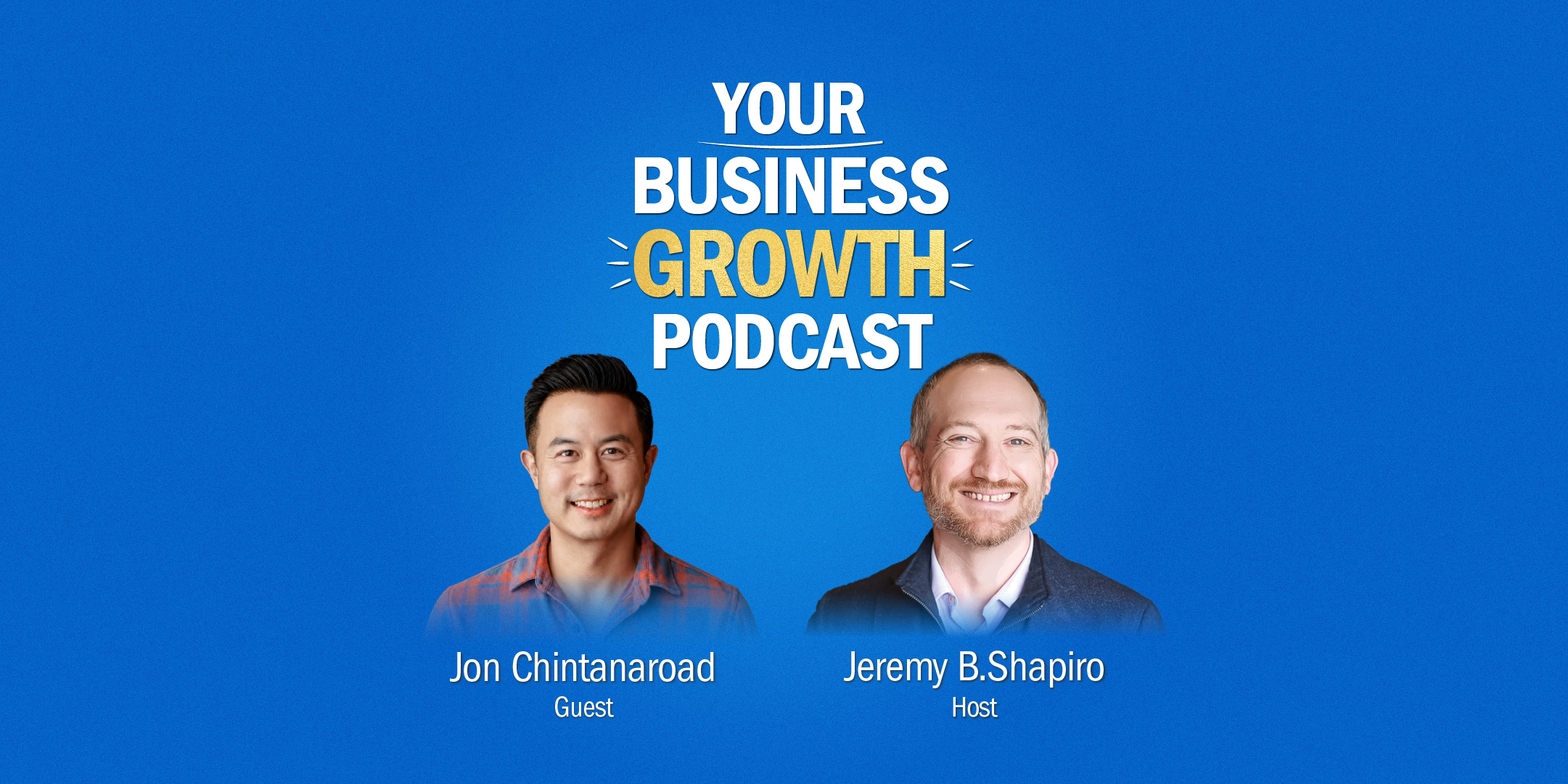
Welcome to today’s episode of Your Business Growth Podcast. I’m your host, Jeremy Shapiro, author of Your Business Growth Playbook, and my guest today is Jon Chintanaroad.
About Jon Chintanaroad

Jon Chintanaroad is a veteran of the recruiting industry and the founder of Recruiting Launch. He leverages years of experience to help professionals and established business owners add high-margin recruiting as a new revenue stream. His program has successfully guided over 400 people in launching their own recruiting businesses, often resulting in significant placement fees within the first 90 days.
Early in his career, Jon successfully scaled a recruiting coaching business to $100,000 in monthly revenue. However, the business eventually collapsed under its own complexity due to overspending, high overhead, and relying on projected rather than actual revenue. This period of stagnation and debt led him to a complete overhaul of his business philosophy.
Jon now specializes in helping others diversify their income without adding unnecessary complexity. He focuses on a lean, profit-first business model that utilizes organic marketing and systematic LinkedIn outreach. By focusing on actual profitability, he helps his clients leverage their existing relationships to land new clients.
Based in San Francisco, Jon is currently focused on achieving a specific enough profit number to support his family’s goal of world-schooling while traveling abroad. He works with individuals who want to build a brand and scale their business the right way, ensuring that growth never comes at the expense of family time or financial stability.
Connect with Jon Chintanaroad
Speed Round Answers:
- All In Lead Source: LinkedIn
- Books: Profit First by Mike Michalowicz, The Gap and the Game by Dan Sullivan and Dr. Benjamin Hardy
- Unlikeliest Mentor: Rolex wearing, lambo renting, neck tattooed, marketing bros.
Like This Episode? There’s More!
Subscribe!
Your Business Growth Podcast is available on all major podcast platforms. Subscribe today!
Get the Book!
Pickup the #1 Best Seller, Your Business Growth Playbook today online or at your local bookseller!
Meet Jeremy!
Book your Blueprint Discovery Call with Jeremy today and get back to the growth you deserve!
Jon Chintanaroad Episode Transcript
I had the brilliant idea to take out a $350,000 SBA loan and talk my wife into co-signing it. “Don’t worry about this, just sign here.” That got burned through, like, in, like, three months. And I’m like, “Oh, . Like, $800,000 in total debt.” You know, there’s no amount of operating I can do to dig myself out of this hole.
Many entrepreneurs chase the prestigious million dollar a month only to find that their massive revenue is actually masking a catastrophic collapse. Our guest today reached the pinnacle of eight-figure run rates, supported by a large team and aggressive ad spend, only to see it all come crashing down into a high-debt bankruptcy.
He had to rebuild from the ground up, but this time he ignored the industry’s obsession with gross sales, and focused on a single metric that allowed him to work less, earn more profit, and design a business that supports his life and his dreams. Welcome to today’s episode of Your Business Growth podcast.
I’m your host, Jeremy Shapiro, author of Your Business Growth Playbook, and my guest today is Jon Chintanaroad . Jon, welcome to the show. Thanks for having me, Jeremy. Excited to be here. Jon, I always love going back to the origin stories of a serial entrepreneurs and finding out about how this all got started.
How did you first get started in the recruiting industry after leaving your career as a recruiter employee? Yeah. So I was, uh, you know, worked as a recruiter for 10, 10-ish years in both the agency side and the corporate, uh, at Google. And then, uh, after… A- and then when I got laid off one day as a recruiter, a couple of my clients said, “Hey, we’ll follow you.
Why don’t you go solo?” And I remember at the time thinking, “Okay, that’s exciting.” I’d been thinking about it, I just didn’t know how to do it. So I tried it, uh, on my own through trial and error. Took a long time, made a lot of mistakes, uh, but ended up growing my own agency. And did pretty well, but then around the year five mark, I was getting kind of like…
I had that creative itch to do something a little different. And, uh, I felt like with recruiting it was a lot of rinse, wash, repeat. Get a client, and you know, find a candidate, get a client, find a candidate. And then I met some- Friends of friends who were in this, uh, what’s called online marketing, internet marketing space, and they were showing me, they’re talking about their numbers.
I’m like, “Holy cow,” like, “Teach me how to make some of this internet money.” Lit- literally what I said to them, “How do I make some of this internet money?” And then I think, uh, a buddy gave me Sam Ovens’ consulting accelerator course way back when on how you, you know, how anyone can have their own course and coaching program type of thing.
So I went through it and just followed it, and, um, that’s kind of led to what we do now at Recruiting Launch kind of through different iterations. So you were in, like, a one-on-one coaching model earlier before going to, like, the larger scale of digital business, yeah? Yeah. I did a few one-on-ones, and then I quickly, uh, kind of drank the Kool-Aid of like, oh, everyone needs to have a group coaching.
That’s the way. It’s scalable and, you know, all that stuff. So then I quickly built a group coaching program called Recruiting Accelerator on how, like, anyone can learn how to do this. It worked and it scaled, as you mentioned. Uh, but, you know, profits and numbers aside, that that was, you know, like the… our, our pitfall.
But realizing that a- as a group coaching only, it’s like a one-to-many thing, right? I mean, it’s designed to be one-to-many so you can sell more and, and, and enroll more people, but the problem is then it… you lose the high touch that you really wanted to. So at one point my wife’s like, “Why are you always, like, looking so stressed?”
And I said, “Well, I have, you know, all these mouths to feed, the ad spend, all this. And then also people, like, are needing help.” And I, I f- I told her, “I feel like I’m running a, um, sales and marketing company, not a helping people company like I started off with.” So that was kind of one of the turning points of many that made me, you know, ultimately pivot and rebuild.
Yeah, I like how you identified that you’d built a business but it wasn’t the model you were looking for. And, and like your wife saw that and called you on that, which is, which is great. Right? Oftentimes people look at someone else’s business model, they see the result Right? They wanna chase that and not, not thinking about what that model actually looks like.
Um, I was in a mastermind with somebody who had a coaching program, and at a certain point she’s like, “Fine, I’ll do one-on-one coaching,” but, like, only at a six-figure mark, right? Like, so clients paying her, you know, over 100K a year for the one-on-one coaching. And she had a few clients who took her up on that.
And even though she was now making over $100,000 a year per client to do one-on-one coaching, she was like, “I really hate this one-on-one coaching.” Right? Other folks are looking, saying, “Uh, that sounds like a pretty good deal,” but if it’s a model you don’t like, then wh- why, why pursue a model that’s not gonna support sort of your goals and the business model you want?
Yeah. I think in the beginning we kind of s- learn from other people and like, “Oh, so-and-so is doing better. I should listen to them.” Or especially if you join a mastermind or a coaching program, and I’ve joined many, spent well over six figures joining coach- coaching programs and masterminds. Then the idea that I…
The, my, my narrative to myself was, “Well, I’m paying all these experts a whole bunch of money. I just need to listen to everything they say, like, as gospel.” And that just, you know, didn’t work out that way, when you just kind of, uh, naively just follow, you know, suit without really having the experience and nuance, uh, which is, you know, you get from hindsight 20/20, to be like, “Oh, wait, that applies to me.
That doesn’t apply to me,” and so on and so forth. Yeah, and sometimes we only get that hindsight from doing what you did, is going out there and doing it and trying it, and not everything works. But when it does, we learn it. When it doesn’t, we also learn. Yes. Uh, yes, we do. I often see that, you know, growth comes in, you know, these plateaus, like ones and threes, right?
You know, you hit that $10,000, that $30,000, that 100,000, that 300, and so on. And you had this interesting pivotal moment where you guys hit that, that first six-figure month. You hit $100,000 a month. Talk to us about, like, what that was like. When you, when you hit that, like, what got you there? What made that a win?
What was that like for you and the team? It was amazing rollercoaster up right before the crash. Like, uh, and a few things that kind of, like, were my aha moments I remember. Uh, when I first hired, uh, a salesperson, and like, before when everything was just all through me, all my marketing, and I did the sales, I did the delivery.
And then, uh, because my, you know, we were, we were pregnant at the time, so she was, like, literally we’re at the hospital about to give birth, and then I got a message from my salesperson saying, “Hey, just closed a deal.” I’m like, “Oh, like, this is working. Like, I’m, I’m here. I’m away. They’re taking care of it.”
And it’s like, so just that was, like, the first thing. And then when that salesperson, you know, brought on more people, then we hit that 100K mark. It felt like a, uh, achievement level. It’s like a, like a game, like achievement unlocked. Hit the six figure a month. And I felt like I was part of this club of other, uh, online marketers saying, “Hey, I’m doing six figures a month.
I’m doing six figures a month.” Uh, and it was cool and it was exciting to be a part of that club until I realized that- It was full of smoke and mirrors that no one was saying, “Oh, here’s how much profit I was,” or, “Here’s how my life is doing.” It was just, you know, uh, it was weird. Like, you know, I, I… When I would join these masterminds, I’ve never been, you know, in, in real life, quote unquote, like, no one asks like, “Hey, what do you make for your salary at your company, W-2?”
Like, that’s like taboo. But then people are freely just talking about their numbers, like, as a measuring stick. Um, and so, so I, I kinda joined that Kool-Aid and got lost in it for a while. So when during that whole process did you realize that, like, despite the high gross revenues i- in your business and others, your business was actually heading, like, towards a cliff?
Yeah. When I hired a, a, a s- a bookkeeper, you know, and CPA, uh, much too late, and she was like, “Jon, you are, like, one bad month from, like, losing everything.” I’m like, “But I have all these, you know, like, we hit 200K in revenue, uh, gross revenue, and, you know, k- half of it’s cash collected, half of it’s payment plans, like, it shouldn’t be like this.”
And she’s like, “You really…” But by then it was like the Titanic, right? I was like, to turn that thing, you know, 180 was, would’ve taken so much. And, you know, part of me too was, um, I didn’t have the foresight, the guts, and the… Yeah, I, I wasn’t the type of entrepreneur to be like, “Okay, pump the brakes. Let me take, like, a, a day and just kinda meditate in the, in the park and think about this and come back and be like, ‘Look, we have to just massively fire, like, 80% of the team, and we have…’”
So I d- and I didn’t do that. Like, I didn’t… That was, that would’ve been too hard, and that was too hard for me. Instead, I, uh, took the advice of my COO at the time who said, “You know, Jon, just take out a loan.” Like, you know… Uh, and also him and then the, uh, I hired a, um, a done-for-you sales agency, a done-for-you marketing agency that are both charging me…
I mean, I was literally paying $25,000 a month for a marketing agency. That was running, like, $30,000 a month of ads. I’m like, I didn’t realize how backwards that math was. I was paying almost just as much in the, um, management fee as I was in ad spend, and I was paying all the salespeople and all the in, and then, you know, I was like Oprah Winfrey, like, handing out salary.
“You get a salary. You get a salary. You get a salary.” Um, ’cause I thought… And I was proud of it. I’m like, everyone’s hiring these, like, in- these, these cheap VAs overseas. I’m like, no, I’m hiring, you know, US-based, like, salary. I’m, I’m hiring… I have the best crew, uh, in town. Um, but it was bleeding me, and, uh, I didn’t have the heart to, like, cut them.
Uh, so I just took out a loan. I’m like, you know what? And so when the agency said, “Hey, Jon,” of course, hindsight 2020, right? Like, it’s in their best interest to keep me running, so like, “Hey, d- we just need a little more cash, Jon. Just inject some cash in the business. We’re, like, one month away from cracking this and scaling you to the moon to s- a million dollars a month.”
So I said sure. I just, just said yes, right? Um, I think I had dollar signs in my eyes at the time too, uh, and just kind of, um, unbridled optimism. So I had the brilliant idea to take out a $350,000 SBA loan, and Talk my wife into co-signing it, ’cause she’s the one with the stable nurse salary, and she didn’t really know what it was.
I’m like, “Oh, honey, don’t worry about this. Just sign here.” Like, it’s like, you know, it’s, it’s a done deal. I just… It’s a little thing for business. She’s like, “Okay.” And of course, like then that got burned through, like, in, like, three months. So, uh, three months later, I’m like, “Oh, $800,000 in total debt between the SBA loan, the credit cards, and everything.”
And I’m like, “Okay, um, I’m not gonna be able to… You know, there’s no amount of operating I can do to dig myself out of this hole.” So that’s when I had to, like, really face the music, um, and look at Chapter 7 bankruptcy. Which by the way, I know that we talked about off air, uh, this is the first time I’ve ever talked about this.
So this is not, like, part of my story, my hero’s journey that I tell everyone. Like, this is the first time I’m talking about this. So I appreciate the, uh, this, this, this platform as, uh, maybe a bit therapeutic for me. And you know, I mentioned offline too, if like this… Literally, like all, all… My intention is, like, if this can help one person not go through the heartache and the soul-crushing, like, pain of that, as you can imagine, like talking to my wife about it, explaining to her, “Honey, here’s what I did, and I up.
Like, whoops. I screwed up.” Like tell, telling her, um, man, like, you know, if that can help one person from that, that’s… I, I, I’d be, I’d be happy, so. I, and I appreciate you being honest and sharing about all this because, you know, like you said from those groups you’re in, there’s other business owners, you’re looking at the gross revenue and the big numbers, and everything looks amazing and great from the outside.
You have no idea how many of them may have been suffering through the same challenges you face but just weren’t sharing it, and how much more powerful that would’ve been if they were talking about the real numbers and what was really going on behind the scenes. Right. And their lives and the quality of life.
And funny enough, like this is ironic, but the, the person on stage, this mastermind who was making seven figures a month, a, a million dollars a month cash collected, after he got off stage, I just made a beeline straight to him. I said, “Hey, like that’s amazing. Um, who… Please give me the name of all your vendors, all the agencies you use.
I’m just gonna hire them and I’ll have the same results.” So I did. I hired them. I hired… These were well-known people. Um, and didn’t realize that, oh, just because you hire someone’s team and an agency that you’re gonna get the exact results. I didn’t factor in the offer, the market, the, you know. So I was just trying to…
It’s like I was the guy at the gym in, in his first week at the gym and look, you know, going to the bodybuilding guy in the corner and saying, “Hey,” like, “give me your workout plan and I’m gonna try, I’m gonna try to do your lifts.” And then just like- You know, crushing myself that way. So, right, like I know that makes sense in that, that context, but in business context I thought it was that easy.
Like, it was a… That’s why I told my, my wife, like, with so much certainty. It was absurd. Like, this is a surefire thing. It worked for this guy, so it’s gonna work for me. So I like that gym analogy a lot. Um, I find businesses at different tiers, right? If you get a mastermind group together of any business owner, right, the advice of what a nine-figure business owner is doing does not apply to a six-figure business owner, right?
Even what an eight-figure business owner is doing rarely applies for the seven. And so when you sort of are with similar sized businesses, they’re usually facing similar sized challenges. You know, following the finance, financial advice of a nine-figure business owner, um, they’re just operating at a different level, or the operational, uh, best practices of an eight-figure business, right?
Like, you know, there’s just different tiers and different strategies that you’re not ready for yet, much like your analogy with the gym, so. And that goes against so much, like, uh, popular, like, uh, uh, or commonly accepted knowledge, which is like, or the idea of like, hey, you wanna be the… You don’t wanna be the smartest guy in the room.
You wanna be around people who are above you so then you can, right, you’re, you know, you’re the average of your f- top five people you hang out with. So when I joined the mastermind, I was, like, barely able to make the cut at 100K a month to join this, you know, eight-figure mastermind. So I was like, “Great, I’m the lowest guy on the totem pole.”
But it, that’s, it stung for a second to be like, oh man, like, like, uh, I was so happy, like, a second ago to hit s- a six figure month. Now I feel like I’m, like, the, the smallest fish in this pond, but I get to be around these big whales and learn from them and copy their strategies. So it’s ironic, right? Like, you want to be around better people to get better, but then the advice they give you is not gonna apply.
So, uh, how do you reconcile that? I, I, I don’t know. It’s experience and wisdom. Yeah, I mean, you’re, you’re spot on. You do wanna be around the folks who will pull you up, but just be mindful of, like, where the advice that they’re giving applies in their journey, right? So are they giving you the advice that got them to be the size you are now or where you wanna go?
Or are they giving the advice that is applicable to a business of their size now, right? I, I heard a, a, a good framing from someone about this idea of you wanna have some folks who you’re able to pull up to where you are now, right, f- because you are where they were, and other folks who are where you want to be that can give you the advice for where you are now, right?
So it’s a matter of that, that timing and the journey of where the advice applies. So Jon, I wanna, you know, go back to that moment where, you know, you find yourself with that $350,000 in SBA, you know, debt that was just, you know, racked up like that towards ad spend and operations and salaries and all.
And that, that being part of, like, this, you know, $800,000 in debt. Like, how does that impact your daily decision-making, your operations, your visioning, planning, leadership, all that, having that kind of debt? I, I still have PTSD from it I think, ’cause I, it, it, uh… I was always living in anxiety and fear. Like, I’d be on the couch, so- I can vividly remember, on the couch with my wife watching a movie together, um, baby’s asleep, and the whole time I’m thinking like, “I hope we get some conversions tomorrow.”
I h- uh, you know, like, it’s, it’s… I’m looking at the, we got, we got 14 days left in the month. I th- hope my sales team pulls through. I’m thinking those thoughts over and over again, like, 24/7. So it was, yeah, it, it, it was awful. It was… I was afraid. I was, uh, anxious. And I had w- and I had to put on a, a brave face and smile out to the world and posting content saying like, yeah, like, I, you know…
It’s, it’s, you know, so I had to put on a good face for the world and my team and, and the people I work with, the people I’m talking to, while battling the secret, uh, inside. Like, you know, like, that, that I was, like, a hot mess inside and things were, you know, on the, on the, on, I was on the cliff. During all that, did you realize you had to, like, come clean to the family and talk about the true state of where things were for the company financially and all that?
Yeah, I think I, uh, had talked to a, a… I started interviewing bankruptcy attorneys saying, “Hey, like, what options do my, do I have?” They’re like, “You have none. Like, this is the only way.” And I said, “Okay, well, um, all right then.” And so that, that was it, and that’s when I, you know, took some time to really, like…
Oh, I mean, and, you know, I’d be lying if there weren’t tears. And it felt, like, soul-crushing ’cause… And part of me too, and I think a lot of entrepreneurs might be able to identify with this, but, you know, I grew up in a very type of like, um, yeah, high-achieving family and, and, like, my whole life was set, focused around achievement, goals.
I mean, I had the, the, the, the, what people used to call, like, a, this Asian tiger mom was like, oh, like, n- like, never good enough, never good enough. So that pushed me, uh, to take risk and to be, and have a chip on my shoulder. So, like, uh, yeah. So anyway, so, like, all that stuff kinda all kinda came at once. So then I had to have that hard talk with my wife saying, “Hey, uh, honey, here’s the situation.”
She’s like, “Okay, well, you’re gonna have to do that, right? Not me.” I’m like, “Uh, no. You remember that thing I said wasn’t a problem and just sign off on? That’s you too.” And so, right, um, very painful process. That being said, looking back now, it was a gift. And, uh, and we didn’t even talk about this offline, but th- what I mean by that, uh, I’ll give the, the short version, is that, like, that, uh, she said, hey, um, the next day she had a list of demands.
She’s like, “Hey, um- Okay, we’ll go through this bankruptcy together. I’m with you. I’m, I’m by your side, right? I’m like, okay, I didn’t lose my marriage over this. Um, she’s like, “But I have a list of, a realistic demands that I’m gonna need you to say yes to.” So I said, “Of course, honey, like, whatever.” And I completely assumed that number one on the list was you can never run a business again, and I wouldn’t blame her, right?
I literally just burned everything to the ground. And her list, her demands were, “I want you to be present with the family.” And, like, right, “I want you to, um, get therapy , see someone for help. Like, figure out, you know, what part of your brain, like, what part of your past, your inner demons made you take all these risks and, and hid the truth from me.
Like, I want you to get better.” Um, so, like, yeah, like, I mean, bless, like, bless her heart, right? Um, things like that. I, and I want you to be open and honest with me and communicate, be transparent. And, uh, I want you to think about, like, what do we really need as a fam- what do we really need and want as a family, not just what you think that you want to achieve because of, you know, ego and stuff.
Because when we went to these masterminds, on the flight back, I’m like, “Hey, honey, I think I need a, uh, an AP watch.” She’s like, “What?” I’m like, “I don’t know what it stands for, but it looks really cool, and everyone has that or a Ro- Rolex. It’s only, it’s, like, 50, 30, 50, 30 to 50 grand. I, I think I can swing that in a few months.”
And she’s like, “What? Like, who are you becoming? Like, you don’t even wear… I, I… You don’t wear watches. You know, you complain anything on your skin feels, like, heavy. Like, you don’t wear watches, and now you want to? Like, w- like, I don’t want… I…” She goes, “I didn’t like the person you were becoming. So I want you just to go back and pull it back and find out who you are and who you wanna be for the family.”
So that was the… Like, I, I wish I didn’t have such a thick skull that I need that big of a wake-up call, like an atomic bomb of a wake-up call to snap me out and be like, “Whoa, like, what am I doing with my life? Like, what, what am I doing to my family? Who am I, and what life am I lead- ” It just made me reflection everything.
And that journey of, and it’s been a year and a half of having weekly therapy sessions and the mentorship and guidance to really, like, grow as a person. So I’m happy to say now I think I am the person that she made that list for, to say, “Hey, I want you to be this person, um, that puts family first, that puts peace and happiness first.”
Um, and, and so, yeah, so it’s been, uh… And so, and now she, she actually said the other, other week, like, “Hey, I’m actually glad this happened because I see that, you know, you’re the husband and the father, you know, that I, I, you know, I hoped that you would tr- this would transform you into.” So yeah. But I, I wish I’d have learned that such a hard way.
Yeah, sometimes those lessons come from unexpected places at unexpected times, and in retrospect, it’s great we can see those. But in the thick of it or with that in front is, uh, is, is an awful spot to be. So, um, it is good to talk on the other side of this with that perspective. Uh, and I love that she, you know, she had that presence to, you know, to talk about what the future could look like from here So, I, I wanna talk about sort of that, that portion of the journey as you shifted from there.
You decided to get rid of, like, all this complexity and stop chasing the, you know, the eight, nine, 10 infinite to the moon figure business, um, and dial back the complexity and go for this enough concept. So tell us more about that, that reframe that got you more present and helped you to change what it was you were, you were aiming to become.
Sure. Uh, uh, I’ll answer that in kind of maybe, uh, two ways. One from like a philosophical, like, mindset, the other one from actual, like, practicality and tactics. But for me, like, the word enough f- even now feels like a, it’s a bad word. It’s like a icky word. Like, you talk to any high performer and you say, “Hey, like, what’s enough?
What’s good enough?” Like, when… It sounds like settling. Sounds like, “Oh, that’s good enough.” Like, “This is fine.” Like, I’m, I… The word content too, my wife’s favorite word. Like, she’s like, “I love being content.” I’m like, “Content is like, ugh.” Content, like that means you’re a loser. You, you settled. You, you stopped here when you could have grown here.
I had this, a beautiful analogy. She like, “L- look at a redwood tree.” Like, I’m here in California. You know, we’re both in California, in Muir Woods, right? Look at the redwood trees. Like, a tree doesn’t stop saying, “You know what? This is enough. Like, I don’t need to be taller.” Like, a tree grows as tall as it should be, and an entrepreneur should grow in, in, in size of business as much as, you know, he or she sh- should or could, right?
Like, and it was all like BS. And, um, and so I had to change my relationship with that word. So I still think I still have, like, those words still trigger me, so I changed it to sweet spot. Like, what’s my sweet spot where everything just flows and everything’s balanced, everything, everything works? Um, so that was one.
I had to change the, the definition of enough. Uh, I called it the sweet spot, and now I’m like, “Okay,” like, “I like sweet spot. That works.” And then in terms of the business, what I changed from that was like, okay, every month we gotta be profitable. Every month we have to have certain things, um- And that’s when I, I, you know, I s- I read the book Profit First and had like, oh, numbers and, um, metrics and to be like, okay, like, uh…
And I, I had to install guardrails for myself. Like, I still don’t fully trust myself from making that mistake. I have to like, I’m like the alcoholic who has to have someone like lock the ca- you know, like, not just like, you know, get, get rid of all the booze, but also like, you know, search my house e- every month and like flip all the mattresses just in case I have a static.
I need somebody there. So I had, yeah, I h- I have a bookkeeper, CP, that looks at my numbers and say, “Hey, your, um, operating OPEX should be around this percent, this percent, this percent.” And then if I’m off, we get course-corrected. So it’s not like the Titanic about to crash into the iceberg. Now it’s like we have radar detection.
It’s like, okay, let’s, let’s, let’s course-correct 2% here, you know, you know, starboard instead of, uh, having to be like, “All right, brace for impact.” So now that feels better just knowing that I have monitoring and guardrails in place and oversight, um, plus, uh, a different relationship, uh, in my heart about Sweet Spot.
It’s good to know where that is as well as how to measure it. Um, and I also wanna highlight for our listeners a key piece there, Jon, that you said, that you have what I would call an accountability partner, right? You, you ha- you surround yourself with the people who are gonna help hold you accountable, remind you of the guardrails, and get you back on track.
And entrepreneurship doesn’t need to be a solo journey. So, you know, especially for our younger business owners, like, having an accountant or a b- bookkeeper or someone else to call you on this stuff is so, so valuable early on and forever on, um, as well as partners, as well as other entrepreneurs and so forth.
So big kudos on that. Yeah. Like, thank you. And one thing I, I s- truly believe now is that, uh, and I wish I had, was someone that could look out for my blind spots, right? You ha- you know the saying, people say, “Watch my back,” right? As an entrepreneur, there’s this, you know, you have typically nobody to watch your back, and you don’t know that you’re operating from a blind spot until sometime, it’s like me, it’s too late.
So I have people in my life. I have systems and processes that call me out. They can veto my decision. They’ll be, “Well, no, I believe this,” and, and like- And they’ll push back and, you know, I have one chance to push back again, and if they push back again, I have to yield. So I, um, so now I see myself as the role of the CEO, but I’ve assigned a board.
You know, so I’ve, I, I’ve assembled a board, um, that can veto me, and they point me in the right direction, and my job is to execute. And there’s a COO that’s kinda like with me that makes sure day to day that I’m not drifting. So I’ve built those measures in so that… ‘Cause I do know, my wife said, “All right, you, you have another chance, one more chance to run your, a business again.
But at this time, then, you know, come on, like we gotta face the music. Get, get a 9:00 to 5:00.” I’m like, “Okay, honey.” So that’s, I think, that’s also probably why I took it so seriously because I do- I have one mulligan, and, uh, this is it. So got, you know, I get to… I’m grateful to be… I feel like I picked up a quarter at the arcade.
I’m like, oh, I get to, like, put the quarter in and this time play the same game, but now I know exactly what levels one through four look like, so now I’m, you know, not falling to those, uh, pitfalls again. You got that one extra life, but there’s only one in the game. I got the… Exactly. There’s only one quarter.
Yeah, I found it and this is it. Yeah, exactly. Are you enjoying this episode? Make sure you hit that subscribe button right now. That’ll help you get more episodes automatically as soon as they come out. So hit that subscribe button right now, and if you have a minute, leave a quick rating and review. That helps support the show.
It, it’s funny, I, I always remember, like, you know, playing video games as a kid, you know, getting that extra life, or even now is always this matter, you know, you get the power-up item, and it’s like, well, don’t, don’t use it. You might need that later. Hang onto it. This might be valuable. Uh, and, and, and you just don’t know.
So, um, Jon, I love that you followed that Profit First model. That is an excellent read, um, and excellent practices to have in the company, um, and it has been game-changing for so many of our businesses. Um, why did you choose to go with that Profit First leaner model over, like, the high overhead but significantly larger agency model you were working with before?
There’s so many choices you could’ve made there. Yeah. Uh, so it was because of two people I, I had met that opened my eyes. One was a person who was the person on stage at the mastermind making a million dollars a month. He ended up going into bankruptcy, too. And so I followed him off the cliff like a lemming, uh, ’cause that mill- that million-dollar business was built on high-risk financing.
85% of all revenue came from people with no credit, bad credit, and when that, you know, house of cards fell down, like, you know, he went down with it. So I’m like, “Oh, shoot.” I was following, like, the, the poster child, like the, the best of the best within that mastermind, and he had a, you know, broken business.
But, you know, no one talked about that. He didn’t even know at the time it was broken until it broke. So that was one, like, oh, okay. I’m chasing the wrong thing, right? And the second thing is I met another guy at the, the, at the same mastermind who was, you know, to me, probably one of the s- next to me, was the smallest fish in the pond.
He’s like, “Yeah, we’re doing about, like, 40K a month, but it’s, it’s, it’s, it’s, you know, like…” He said, “Yeah, we’re doing 40K a month, but it’s, like, mostly profit, and it’s pretty chill. And my, and my dad’s my partner, and we play golf.” And, and, like, at that point, you know, I was making, like, way bigger numbers on paper than him, but I was jealous.
I’m like, wow, like, you get to make 20K a month just MR. Like, you don’t have to worry about it? Like, he’s breathing easy. He’s laughing. He’s relaxed, right? He’s not just gritting his teeth and white-knuckling everything. Um, and that’s when I think I, I had to realize, and, um, I’m still working on this, is to realize that if you are running a business and you’re white-knuckling it, you are running, gutting, putting out fires.
It feels exciting, and I’ve, I grew up in this always chasing and striving, and it’s, that felt very familiar with me, like surviving felt. Uh, my therapist said, “Jon, you’re good at surviving, not so good at thriving.” So from surviving to thriving, uh, ’cause thriving feels awkward, feels quiet, like peaceful, like it’s…
But the shoe can drop at any moment, but things are fine. So, uh, he, he was just… Like, when I saw him, I’m like, “Wow,” like, “I’d rather be in your shoes. Just seems like you have a much better life. You’re relaxing. You get to spend time with your wife.” And, um, and yeah, you can’t, you know, talk about your Lambo and all these things, the million dollar months, but he s- he seemed to be the most relaxed guy in the room.
And so that kind of seeing both ends of the spectrum, I think helped me, uh, see the light. I wanna highlight for our listeners there that what you were seeing there is that sort of the outward signs of success aren’t always The real signs of success, and oftentimes some of our best mentors can be the quietest person in the room, the one who’s not having to constantly chase to, to, to scratch that itch and satisfy that, that massive debt number every month to maintain what they need, and dialing in that enough works well.
One of the earlier episodes we had, um, in the, uh, in this podcast, um, my guest was talking about this idea of, you know, yes, you can build your business number bigger, but also the lower your own personal monthly burn rate is, the less stress there is. And so he was talking about how, like, look, when he buys cars, motorcycles, houses, you know, whatever it is, just pays cash for them, and that way no matter what, he’s never worried about making a debt payment on something and having to chase for some number.
If he wants to take a month off, he can. Now, still builds million-dollar businesses, right? But that stress of having to cover some monthly nut and what it means if you don’t is gone. And so you can truly build what matters, not build just to pay someone else. Yeah. I mean, functionally, like I, I, I’m in that same situation now.
I’m use- putting… I put everything on a debit card, but I don’t have an option because I don’t have any more credit lines, so it’s a good thing. It’s a, it’s a, you know, you know, um, so it’s whenever I buy anything or pay for anything, it’s cash. Uh, and, and ironically, uh, you know, again, we don’t get this, like, we don’t learn this until it happens to us.
But when I said earlier that I was watching Sam Ovens’ consulting accelerator program like five years ago, and he says, “Oh,” the, the module on running ads, he goes, “We at the company, we’re doing like big numbers, but we run everything on one debit card. That’s it.” We could, we could max points, and everyone’s talking at, at these masterminds about how they get these free flights on their Platinum Amex and, you know, I wanna go have the Black Card and like you have to play this credit card game.
And Sam Ovens is like, “Yeah, you could do that, but we actually make more money by making better business decisions by paying cash for our ads ’cause the moment ads don’t work, we feel it right away.” For me, I had everything on cards, but, “Oh, this a- ads didn’t work out this month. I’ll just roll into next month,” right?
And just carrying this debt over month over month. So, um, you know, it’s… I heard that lesson like five years ago, but I didn’t get it. I thought it was stupid. I’m like, “This guy’s missing out on all these points. He doesn’t know how to…” But, you know, it’s simple. It’s scary simple, uh, uh, the foundation or the basics, right?
And everyone knows, like you gotta play good fundamentals in basketball. You gotta just dribble, shoot, pass, like have your foundation down before you try to get fancy and throw like hook shots and, uh… But it’s so, um… Yeah, uh, earlier I said, you have to tie it, to, to like tie that together is like that, uh, if your business is feeling you’re white-knuckling, running, gunning, and putting out dumpster fires, that’s not good business.
That’s not a healthy business. A business should feel sort of boring. If at any point you’re feeling like, “Oh, I’m just like I’m at McDonald’s. I’m making the same burger over and over again, and people coming in, we’re making burgers, we’re making money,” like there should be a point where it’s like, “Oh, okay, this is feels uncomfortably boring,” and that’s a healthy sign And I’m happy to say that I just kind of got to that place maybe a few months ago where I’m like, “Huh, okay, like, today is a regular day and there’s nothing going on,” and I’m feel, I feel like the soldier coming, like Rambo from Back to War, any moment, like, there can be gunfire.
I’m like, “Okay, at any moment, but nothing… Everything’s fine.” So I’m, I’m in the chapter now where I’m trying to, I’m working on learning how to live in a time of peace in business and not, not used to the explosions and things going off at any moment. So, um, not easy though. I’m, I’m still going through it myself.
If you look at where a lot of the money is in business, it is often from pretty boring cut-and-dry businesses, um, that are not in super hyper-growth mode. Like, sure, yeah, you can go chase your decacorn business if you’d like, but really, like, where are most of the multimillionaire business owners? Like, they have pretty boring businesses, and that is not a bad thing.
Um, they also done right means they have their nights and weekends and family time and all the rest of that and still do quite well, and those are okay businesses to have. So all right, I wanna shift around and talk, um, business model-wise. Right? We talked about this idea of, you know, um, throwing good money after bad, right, and trying to build up a funnel even though it’s not working, but pouring more and more money into it.
Contrast that with sort of this place you found yourself and that advice you got, which is no, like, you’ve got to prove the, the model out. It’s got to make money, right? And it shouldn’t make money because of debt. And one of the strategies I think you’ve used really well from a lead gen standpoint has been this, you know, organic LinkedIn outreach.
Talk to me about, um, why you chose that strategy, what that’s done for the business, and, and how you’re building using that. Yeah, absolutely. So yeah, this will be the fun part of the, um, the, the… for listeners about kind of like the how-to, so I’m gonna start going into the here’s what I did to change things around.
Um, k- all the tactics. There’s a… I skipped all the organic marketing in the first stage of the business because when I, I tried to do it, I’m like, “Oh, this is a lot of work, writing a post and recording a video and content, and this is not fun. This is like…” And I’m reading and then watching videos about if you are an entrepreneur on the content hamster wheel, like blah, blah, blah, you should be running ads.
It scales to the moon. You’re, you’re, you’re printing calls. You’re printing money. I’m like, “That sounds way better.” So I did that, and when ads stopped working, when, when, when the agency shut down, when, when, you know, things w- it plateaued, leads dried up because we had no other marketing. So now I had to go rebuild all the marketing that we skipped organically.
So we do currently a combination of a few things. One, we do outreach on LinkedIn ’cause my, my, uh, audience is all there. Uh, uh, you know, we work with recruiters. Uh, so they’re all, every recruiter’s on LinkedIn, so we go outreach, and we have profiles that reach out to people every day. Uh, and we, I post content on LinkedIn- Uh, every day, uh, five days a week, and then I’m starting to kind of reactivate my YouTube channel and sharing, you know, sharing content there.
And this way, that really just buys me peace of mind knowing, yes, it’s work, yes, I have to put in the effort, but it… If, you know, I’ll, I’ll never have a week of no appointments because people are seeing that, and it’s sharing value as well, right? It’s giving them a taste of my personality. So, but it’s, it… I had to whole- build a whole new system of how to do it.
And then I then quickly fell into the trap of outsourcing it, ’cause when I run ads, I’m like, “This is awesome. I’m not gonna wanna learn like a CPM and, you know, split test. That sounds boring and technical, and I’m not qualified.” So I just hired out immediately. So immediately when I wanted to do organic, I fell into the same pattern of hiring it out.
I hired a copywriter to write my v- in my voice. I hired a, a, a engagement person to, to comment other people’s posts and, and comment on, reply to people commenting to their posts, and I hired a YouTube editor, and then I was back in the place like, “Wait, I’m not making any money ’cause all my money’s going towards people doing organic.”
I’m like, “Wait, I’m paying all this money, like, you know, I don’t think I’m getting the, the number of calls that the… I c- I could run ads and get cheaper calls.” So, um, I had to un- I caught myself, right? Like I, I slipped back, right? I, I di- I didn’t just go cold turkey and saw the light. I, you know, three steps forward, one step back.
So now I do all my own writing. I do all my own, you know, uh, editing on YouTube. Like I just really adopted a DIY up to a certain point, right? Like thumbnails I get help with ’cause I’m just not, I- I’m not good at that. Certain things I’m not good at, right? Obviously you delegate if it’s a cheap thing. If it’s a $30 task, I won’t do it.
But, um, I’ve learned how to do it on my own, and that’s been better ’cause now the writing’s in my voice. It’s not a ghostwriter, right? The, the to- topics I talk about are stuff I, I feel passionate about. So that’s the… That was like, okay, build that foundation first, and that generates a predictable number of, you know, people interested and, and that’s…
And, uh, the business alone now, and, uh, is all re- all we use organic, so now we’re just thriving on organic. And until I max out the organic bucket, I’m not gonna entertain layering on paid ads until we hit a certain point. So, um, I had to go and build the pillars that I just decided to skip the first time around.
I heard a, a really, uh, important piece of advice earlier on in my career. It was, it was at this inflection point, we were looking at bringing on a copywriter, and a business coach of mine said at the time, like, “You know, yes, you can go hire a really expensive person to do a good job. But if you don’t know enough about it to gauge the quality of their work, then you won’t know if they’re any good or not,” right?
So there’s value to be had in learning enough of how to do something to gauge quality and know best practices and see some level of success in your own work before scaling it up and having someone else do it, right? So, you know, w- what you’re doing there, Jon, I just wanna highlight for our listeners, is Finding out what works on your own, right?
And then at a certain point you can hand that off, but you’ll at least now know what voice works and who you are and be able to provide a guide to someone else, versus just abdicating a result and telling someone to go do it and having no idea if it, if it’s valuable. And that really comes down to the differentiation between abdication versus delegation, right?
Many business owners think they’re smartly delegating when really they’re just abdicating to someone else to do something, anything, when no idea if it’s the result they want. Yep. I can give you a quick example of that. I, I… When I was kind of falling back into the trap of just h- hiring people to help me with organic, right, instead of paid, I hired a webinar agency, uh, recently.
Uh, and I’m like, “Okay, I’ll do organic, but I’ll do organic webinars and do an hour presentation, give them a chance to, you know, get to know me, build trust.” Um, and they’re great. “We know exactly the copy on your landing page. Your emails, we’ll write your copy for you w- in your voice.” But I read it and it was like, and because I had the experience and, and wherewithal of just, you know, um, learning my own voice, like of what sh- should sound like, what I sound like, when I read theirs, it was like, “Three spots left, act now,” right?
Like, “Your boss is stealing your money.” I’m like, “This is not… This is garbage.” And I, I rewrote all their copy and, and I- they pushed back saying, “No, Jon, this is the, the, the copywriting that converts.” And I’m like, “No.” So I had to fi- you know, so I fired them and, uh, I’m like, “This is, this is garbage, like this doesn’t sound like me and this sounds…
This is all cringey.” I couldn’t read it without cringing. But had I met them, you know, three years ago, I’d be like, “Sure, you’re the professionals, like r- you know, go ahead and deploy this,” and right? So, um, yeah, absolutely. Once you learn it yourself, then you can, you know where to go from there. You know, one of, um, my earlier businesses in the days when webinars were still a new way of selling, um, we put together a webinar presentation and much like you said, it was using the best practices that was working for everybody else, and the presentation did terrible, right?
It was not authentic to, you know, our voices and style and everything else. And so we brought in some help to dial in The messaging and a fair amount of it was going back to using our voice and being much more authentic to who we were. Yes, using some of the best practices, but not just effectively copying and pasting someone else’s script lines that worked for them that were totally out of alignment with where we were.
Um, so I love that you did that, and I wanna ask you a little bit more about sort of how you found that, you know, that personal brand voice. Where did you figure out what is you versus what does not resonate with your audience in terms of who you are? Right. I, I wish I could say that I really, you know, f- found out myself and learned about myself.
I can see my- I could see mirrors and, like, that’s not what happened. Uh, my wife called, called it out. Uh, she was like, “Hey, I saw this post you made. It… That doesn’t sound like you at all. Like, like, you don’t sound like this.” And they used a picture of, like, us, like a- I s- I think sent family photos for them to use a personal story.
I’m like, “That story’s not even true.” Like, and she’s like, “And it’s like cr- it doesn’t sound like you. This is embarrassing.” So luckily, my wife is, like, a, she’s a nurse. She’s a straight arrow. She doesn’t… She’s conservative, doesn’t take risks, and she’s the most down-to-earth, grounded person. So the moment…
So anything like that was just, like, yeah, uh, she was like flared up. She’s like, she’s like, “Ugh,” and, and I wish I would’ve said, “You’re right, honey,” and cha- I didn’t. I’m like, “Well, okay, let me just give them some pointers.” Like, the fifth time she’s like, she’s like, “Look, like, this is, like, embarrassing. Like, this is not you.
Uh, come on.” And so luckily, again, I had someone from the outside looking in, you know? I’ve, I’ve… Someone told me that it’s, it’s hard to read, like you… Or he said, uh, “You can’t read the label of the bottle when you’re inside of it.” So she could read the label, which is like, “This is cringey.” And I’m like, “What are you talking about?
This is great.” I’m like, I’m like the ketchup. I’m the ketchup inside the bottle, and then when I reread it again, I’m like, “Oh yeah, this is right.” And so I had to make those changes. But if she didn’t say anything, I’m like, “Hey, whatever. Copy works, right? Like, uh, you know, if it converts, it converts. Like, whatever.
Like, these people don’t really know me. How, how would they really know my real voice if…” You know, it’s like all this stuff, but it’s weird that, like, in the coaching business, if you think about it, it’s a relationship business. It’s a people-to-people, it’s a human business, but we’re doing so many, you know, artificial things out there, like running ads that don’t sound like us, talk- you know, like, doing this, hiring salespeople.
Like, you know, I, I had three salespeople. I’m like, they’re enrolling people that are had no business doing this, and my team was like, “This person can’t even open the computer. Like, why are they even doing this?” And I’m like, “I don’t know. Like, I guess they just would sell to anyone with a credit card.” So I had to, you know, scrap that.
So we, we just took a machete, I took a machete and scrapped everything that was not, yeah, not something I’m, I would be deeply proud of and my wife would be. So my wife is my, yeah, gauge on, yeah, whether or not she’s proud of me is a, is a, yeah, she, she’s r- always right about that. That’s a good sanity check.
Um, it’s funny, when I was writing my book, I wrote it in my voice and my style And when my editor was going through it, he’s like, “Look, you have a lot of bold italics. There’s exclamation points. There’s paragraph breaks. There’s some, you know, fragments. Um, you know, look, each author gets two exclamation points to use in their life.
Choose them wisely.” And I’m like, “Yeah, but like I, I wrote this in how I speak, right?” Like the audiobook version of this is, can be very much my style, um, and this is my voice, and this is what my audience knows. And sure, I could, you know, wash this down and make this a generic bland read, but that wouldn’t be me.
That wouldn’t be my voice. And so I, I did push back and he relented. But it was, it was good to have the perspective, but I’m also really glad, and as were my beta readers, that we kept my voice and my styling. And okay, we removed double exclamation marks, right? But we still kept it authentic to my style.
And I, I enjoyed that. Wait, when I read your book with the, the FAQ and everything, I’m like, oh, okay, like it, it, it … There was no fluff there. Like I got it, it made sense, and it was like speaking to me and I could … I got it. So yeah, good job on, on sticking to your guns. Yeah. Excellent. Thank you for validating that.
I hope your wife enjoyed it as well. So this model you shifted to, you talked about having a sales team and having these people who weren’t a great fit closing the wrong leads and all, and you really shifted your model from chasing these million-dollar, you know, months to having this profit first, higher profit lean model and all.
How has that impacted like actual take-home income versus, you know, the, the more glamorous looking business? Oh, it’s great. I mean, we’re, we’re profitable for, for a change. Before we weren’t. We had gross profit, but you know, after expenses there was nothing left over, and many months it was negative. I was just living off credit and lines of credit and, and with the, uh, dream and, and everyone promising me that we’re gonna scale to the moon.
So it’s like, okay, just bear with it. If I can white-knuckle a few months of, of being negative, it’s we’re gonna hockey stick growth. And now it’s kind of boring. It’s predictable. We … And every month it gets a little bit better and, and that’s fine, right? And again, I, I, I have to … I’m still learning that. Um, but I, I will share with the, uh, the, the listeners a few things I’ve done to achieve this kind of sweet spot.
So now I’m trying to build a business around what’s a sweet spot, and actually the numbers came as a result of that. So I didn’t map b- I tried to map, okay, how much money do I really need? And work backwards, how do I make that? Uh, I’ve ch- I’ve since changed it. So I’ve since changed it to be like, what does my life look like ideally?
So I took a step back and, and we talked about travel before too. So, you know, this time next year I wanna be world traveling, world schooling my, uh, our son, and go to Portugal and Spain and Malta and Bali and work from anywhere. She can quit her, you know, back-breaking, you know, um, nursing job, uh, that, that’s really sad.
And since my business is independent, location independent, we can do that and, and have tax breaks and, and all that. So I’m like, well, what does, what does that world look like for me? For me it’s working 30 hours a week, give or take. Like, I don’t wanna stop working. I’d be bored. I… Five would, five or 10 would be boring.
40 to 60 would be too much to really, like, I, I couldn’t enjoy as much as I want of, of being abroad. 30 hours felt right. Okay, so 30 hours a week. Cool. So now what do I wanna be doing those 30 hours? Like, what’s my highest leverage point? For me right now it’s doing enrollment calls and discovery calls because when I hired salespeople, like immediately the close rate went down, the sh- the, the show rate went down because they know they’re booking a call with a closer.
It’s like, yeah, you listened to, you watched Jon’s video, now you’re gonna talk to like, you know, Mark. I’m like, well, who’s this? You know. And they can’t find him anywhere on LinkedIn, and like he’s just some closer. But now they book a call, it’s like, “Book a call with Jon.” And so they come in with this like, “Hey Jon, I watched your stuff, and I, I feel like I know you.”
And so why not put me in that seat that’s highest leverage because there’s that, you know, um, the, the trust factor already kind of baked in. Um, and I get to hand select who we get to work with, so there’s no risk whatsoever. My delivery team is so happy that they never get to work with a problematic person because I filter them out.
If they’re not a good fit, I don’t make them the offer. So I’m like, okay, I want to be doing that, but how many sales calls? How many… Like, maybe like three a day would be good. Okay, that’s like chill. I can do other stuff too. Three a day. But do I wanna be doing every call, like ev- the first call and the sec- I’m like, no.
Maybe have someone on my team do the first initial call, someone on my delivery team, not a salesperson, my actual delivery team do the initial call. So if they’re not a fit, so I then, they, if they are a fit, they book it with me. So I do call twos. So, so now, like, and it just, you know, we’re not there yet, we’re building up to it, but in my perfect, uh, sweet spot is 30 hours a week, half a day doing sales calls.
These are s- pre-qualified, pre-vetted, financially qualified people, so it’s enjoyable. You know, it’s fun to talk to someone who’s like a good fit and it’s, it’s, it’s like draining to talk to someone who’s not. So I’m like, cool, that is, that person protects my energy and time. And then when I ran the math, what if I did, you know, 12, uh, three calls a day, five days a week, 15 call twos that were high, you know, like high quality, high intent, really good fits, and I, you know, I enroll 30% of them, just one out of three enroll, you know, ev- with high ticket offer, like that’s a big number, right?
That’s, that’s way more than my enough number. So initially my enough number was like this. Then when I just wor- instead said, you know what? What’s my, like, lifestyle look like and what would I wanna do? That number was much bigger. So I’m like, okay. So it feel… So going back to the tree analogy, so now the sweet spot is just like, okay, let’s just grow to that sweet spot and what do the numbers look like?
It, it is. It looks like, and that’s, that’s fine. So that’s kind of what I did. So I engineered it where, um, I do all these sales calls now. Eventually I’ll have someone on my team, my, probably my, my head of client strategy do the first call. Um, a- and then, uh, in terms of, uh, team, I, I moved everyone to hourly instead of salary.
So ’cause we had a couple months where we were down, I’m like, wait, but I… All the money went to my salary, to my team’s salary, so I was feeding them, not myself at all. And I’m like, wait, this is kind of broken. We need to be able to scale up and down with the business, so I had to make that hard call, be like, “Hey, guys, we have to move to hourly so that way when we’re all thriving, then we’re all, we’re all winning.
And if things are lean, we all tighten the belt together.” And the team was like, “Hey, we understand.” So that was nice. And then organic, you know, cutting out all the agencies and just doing my own, um, marketing, just with a little bit help from an editor and thumbnail person every now and then, but very minimal, and that’s a, a business I wish I had in the beginning.
Oh, and as- and, and one last thing for delivery, we went away from the group coaching model to a done-for-you model. ‘Cause, you know, having the benefit of doing this for six years now, we see patterns where people get stuck in the group coaching, right? They, they’ll pick the wrong niche. Um, they’ll… The, their, the branding will look off and, and people won’t reply.
Their messaging will sound every, like every other recruiting vendor, even though they’ll, they’ll deviate from our modules. Like, here’s instructions, follow it, and they’ll play jazz ’cause, you know, why not? People, people are their own people. Uh, they wanna be creative, especially entrepreneurs. And, a- and they’ll break the automation and systems.
So we’re like, “Okay, let’s take that off your plate.” Like, we will pick your– help you pick your niche. We’ll build your branding in-house. We’ll install the automations. You won’t touch any buttons, so you can’t break it. Um, and we’ll help you up. We’ll write the messages in your voice with our proven processes.
So now, of course, our clients are loving it. They’re like, “Oh, great. We launch them in two weeks.” And, uh, this is not a plug for, like, my program, it’s more like we just made it better for the people. Like, what would I want? And ’cause, like, I realized at this stage of my life, like, I don’t buy coaching programs.
Like, the last thing I wanna do is to watch more modules, right? Like, um, people, you know, I’m sure pe- people say so this is a common thing in, um, in coaching where once, once you get to a certain level, the last thing you wanna watch is more videos. I just want the thing done for me. So, uh, whether it’s my team, myself, or someone I hire, like a consultant.
So I’m like, I think people, our clients would enjoy that too. Like, and so when we tell people, “Yeah, like, you come in, like-” We’ll just do it all for you in two weeks, and, you know, you’re there one-on-one. It- we collaborate, you approve everything. It’s in your vision and your voice. And then when you launch, you, we’ll also support you one-on-one.
‘Cause I realized, like, yeah, I pay my team hourly, but I can afford to give one-on-ones. Like, why do I need to just be so stingy and make everyone wait in a Zoom room until, like, it’s their turn, and make them wait three days for a Zoom call, then wait 30 minutes for their turn to ask a five-minute question?
I’ve been on the, uh, on the other side of that in a mastermind. I paid $68,000 for a mastermind where I got a half hour per week with my account manager, and he would slam half an hour back to back to back. So he’d jump on, “So Jon, what do you wanna talk about today?” I’m like, “Shouldn’t you tell me? ‘Cause, like, I’m paying you how much, and this is…”
I’m like, “This sucks. Like, you guys suck.” And so, uh, and just being around bad programs, bad support made me empathetic to be like, “Wait, I’m not gonna put people through that bad experience. Let me… What can I do better?” And I realized that we could do it a- and still make money, and it’s, uh, it’s, it’s, it’s affordable, and people get better results, and that helps our marketing.
So, you know, these, like, le- lessons learned along the way of doing the wrong thing for so many years. So I’m not a, I’m not a smart guy. I just wish I had learned this besides the, you know, the most painful way possible. I wanna get to some more of those lessons learned. Um, but before I do, just wanna highlight for our listeners a few key pieces there, right?
Um, one is this idea of you proving the system out, and then bringing in team members to scale that. Um, oftentimes people will hire for someone to just get a result without knowing if that’s even viable. And so you prove that sales funnel out, then you can have folks, you know, be your setters before going to a closer or, or scale it up.
But you’re, you’re showing it happen. The second piece there is you’re, you really are living that profit first piece of this and having that team approach that we’re paying for a result and paying for work done. We’re not just paying you to be around even if there’s no work for you. So those are great pieces there.
Um, and then lastly, um, I wanna highlight for our listeners this, this concept you’re touching on, which in the book we talk about how you can have, like, a DIY solution. Like, people can buy your book, take your course, learn how to do it. You can have a done with you, right, model. That’s usually coaching, where someone is there with you, answers your questions, but you still do all the work.
And then the highest tier is this, like, done for you, right? Now, as a consumer, as a client Done for you means you’re paying for a result, and there’s a lot of value in that, right? But as a business offering a done for you, that is often your highest price point deliverable that you’re able to sell, but it also can get the best result and ha- can have the highest ROI for your clients, and it’s just a win-win all around.
So for our listeners who have a coaching program, look at how you can have the, you know, paid result. For folks with courses and books and so forth, look at, again, how you can have the coaching level and also the, the result level. Right. And one nuance of that is that we’re actually a hybrid. We’re done for you on the front end, where we do the heavy lifting of the, we call the build, the build phase.
So that takes us… That’s most of our expenses go into that. But then after two weeks, then we, we actually do back-end support, a back-end group coaching. We have eight calls a week they can jump on, uh, so more than any other program I’ve been in. Uh, I’m, I’m in them as well. Every delivery person is on the coach- coaching call, so it’s not like a random…
We used to hire our best students, you know, like our graduate people do that. Then we realized that wasn’t, like, the right quality, so now we have, like, the highest quality team possible. Um, and, uh, like, like my, my, my head of client strategy, he started and sold his recruiting agency and sold it for $7.5 million.
So no one can come in and say, “I know more than this guy. I’ve done more than him.” So that’s, I’m proud of, I’m proud of that, um, to recruit such a strong team, and they’re loyal and they’re, they’re amazing. I wouldn’t be… Yeah, like, I rely on them every day. But, um, on the back end, so the back end, it gets inexpensive to support ’cause there people are more in maintenance mode.
So we do have group coaching, but on the front end, we… It’s, so it’s a hybrid, so then that’s how we can enjoy profitability while delivering a very high level of support. And we sprinkle in one-on-ones throughout key milestones. We used to do one-on-ones, like, every month, every two weeks, but sometimes people wouldn’t need to talk to us and d- but they would book a call because they know they paid for it.
So it’s like, “Hey,” and they’re just, like, making small talk. We’re like, “Wait, so what do you wanna, like, dive into,” right? So now we made those one-on-ones on key milestones. At certain business milestones, we’ll come in and make sure that you kind of make it to the next marker y- so anyway, that’s kind of the nuances for people who want the, uh, yeah, brass tacks.
I like that hybrid approach of the done with you and for you, um, and having that front-end build-out that they can then go run. So that’s a, a very, very cool hybrid model. All right, um, before we wrap and get into some rapid fire lessons learned and all, um, I’m curious as a numbers guy, especially looking more profit first, like, what are the numbers or KPIs that you and the team track every single day now to make sure you’re hitting those profit goals?
Yeah. We, so I look at, uh, I, I have a weekly scorecard. Actually, after this meet- uh, this, this interview, I’m gonna go and fill it out. So I have a weekly scorecard that, you know, like, my, my board, uh, reviews that’s, like, number of calls, book- the boring stuff that I always skip ’cause it’s boring. Like, I think all entrepreneurs, especially, like, sales, uh, type entrepreneurs like me, just like a spreadsheet is like our, you know…
If I look at a spreadsheet, I get dizzy. But it’s a spreadsheet of, like, calls booked, show up rates, calls one booked, calls two booked, you know, percent of people enrolled, close rate, cash collected, MRR, profit. So- Those, like… So I try to find the sweet spot again of like, okay, let’s not over track like every little thing, but what are the main things?
Okay, how many people showed up and, um, and, and what that looked like, and then we can look for patterns in there. But I literally just started that like three weeks ago, so I’m still early in the data. Yeah. Um, I’m like, I gave up. I’m like, all right, I’ll do this weekly scorecard ’cause I realized, wait, like, if I’m doing this for real, and again, I only have one mulligan here, and I’m not tracking my numbers, like that’s…
Like I’ve… I, I want, I, I, I drove, I burned my business to the ground and filed bankruptcy because I ran it with no optics, with pure umbrella optimism and rough top-line numbers versus like, okay, I know my business. And, and people know that, but it’s kind of boring to actually track it. But y- it’s- It can be boring, but the result of it’s powerful.
Um, you know, and we talk about this in the book of knowing your numbers, and you just laid out for us beautifully, by the way, your funnel numbers and how to know what’s going in the top, what’s going through, what’s coming out the bottom. And by having that scorecard ongoing, what I want to highlight for our listeners here is that you can see the changes in trends.
If suddenly the close rate shifts, the show rate changes, the leads coming in the top change, any of these things, you now have a leading indicators to know about a problem before you’re looking at cash collected and seeing that number lower. So you get the, the good leading indicators. When you look at the bank account, that, that’s like, that’s the bottom, and it could have been caught earlier.
Uh, but for me, I think psychologically too, um, the reason why I kind of bought into the scorecard was more because I wanted to be able to look back a month and say… ‘Cause for me, I’m, you know, there’s that book, The Gap and The Game, right, where you can only measure success backwards. Otherwise, if you look forward and you’re, you’re, you’re never gonna feel happy if you’re not where you want to be.
So I have to force myself every week, look back, where was I a week ago, a month ago? Um, oh, a month ago, I was here, and now I’m here. And, um, you know, if I look back and even like to this day, like there, there are days that come up still that I’m like, “Oh, shoot.” Like, this is like, ugh, like what am I doing?
This is so frustrating. But then I’ll look back six months ago. Oh, six months ago, I was like, you know, filing bankruptcy, and like I didn’t, I didn’t know I could rebuild. It was just an idea that I could rebuild, but here we are and we’re, we’re, we’re humming away. And like, um, so for me, the scorecard is a, um, a tool that will help, hopefully help me a month, two months, six months from now look back and be like, “Hey, Jon, stop complaining so much because three months ago you were at these numbers.”
And so it’s a way for me just to be able to like look back in the rear view mirror every now and again and be like, oh, okay. Of course, catching indicators and then stuff like that. But for me, it’s just I just want to be able to look back every now and then and actually have something to look at and be like, “Oh, okay.”
Like just pat myself on the back, give myself a break, cut myself some slack. Things I don’t ever do or don’t really… I’m still learning how to do Well, as an entrepreneur, we’re always looking at the mountain in front of us of things that need to get done, and we don’t often take a look in the rear view and look at how far we’ve come.
And if you’re not tracking that or looking at those milestones or metrics or whatever else, then you won’t know all that you’ve accomplished. So you should give yourself the pats on the back, but that also should be based on what actually got accomplished, not just what feels busy, but actually is productive.
So Jon, before we wrap, a few quick rapid fire questions for you. If you had to start all over again from scratch, what one lead source would you go all in on? I would go in on where my market is, which is LinkedIn. So we’re all in on LinkedIn. Love it. Aside from, of course, your Business Growth Playbook, um, what are some of your top favorite business books?
You know, like Profit First obviously helped a lot, and the, uh, the Gap and the Gain, ’cause again, just looking back, um, at how far you’ve come really keeps you motivated to keep going. Nice. Who was one of your unlikeliest mentors? The Rolex watching, uh, wearing, you know, Lamborghini driving, uh, douchebags at the, uh, the marketing bros, uh, with the neck tattoos, everything like at, at the masterminds who were just like hanging out with each other and they wouldn’t even say hi or talk to anybody.
Yeah, it is. And I, I love that, you know, um, your answer to that unlikeliest mentor is not specifically about the, “Gee, I want to be like this,” but in some ways sometimes our mentors are counter examples of I don’t wanna be like neck tattoo, Lambo loving, you know, marketing bro. So that’s, that’s good. All right, so Jon, to recap for our listeners, you moved from a high revenue, high debt collapse to a lean profit focused recruiting model that prioritizes your freedom and utilizes systematic outreach to keep your calendar full.
Yes. Yeah, and content and yeah. And for our listeners who wanna learn more about you, where should they go right now? You can go to recruitinglaunch.com. Uh, you can learn about us there. So that’s recruitinglaunch.com, and Jon, thank you so much for sharing with us, um, so authentically and vulnerably about your journey.
Not just, you know, the, the highs, but the perceived highs, those lows, those plateaus, those valleys. Uh, those are often part of the journey. I think the outside world looks at us business owners and they see successful entrepreneurs on the outside, the duck smoothly going across the water, not realizing what it took to get there and the turmoil and swirl of water underneath.
And, um, it is not always a smooth straight line journey, and your story highlights that, and I love the model you’ve built, and thank you for sharing so much with us. No, thank you. I, I, I, again, I’ve, I’ve never even posted about this, so like my audience doesn’t know about this. So I just… This is my first kind of like baby step in being open and sharing.
Uh, so yeah, thanks for the opportunity. Beautiful. Thanks so much for listening. Quick reminder, hit that subscribe button right now so you can get more episodes when they come out automatically, and remember to leave that rating and review right now.
Like This Episode? There’s More!
Subscribe!
Your Business Growth Podcast is available on all major podcast platforms. Subscribe today!
Get the Book!
Pickup the #1 Best Seller, Your Business Growth Playbook today online or at your local bookseller!
Meet Jeremy!
Book your Blueprint Discovery Call with Jeremy today and get back to the growth you deserve!