For years, today’s guest built a highly successful genetic wellness company, reaching an impressive ten million dollars in annual revenue. But despite those big numbers, he hit a wall where the cost of finding each new customer was eating his margins alive.
Most founders would have simply poured more money into ads, but he did something much bolder: he shifted his entire focus away from the general public. This radical change in who he served—and how he incentivized them—allowed his business to scale to forty million dollars while turning his previous industry peers into his greatest sales force.
Today, he shares the specific tactical shift that transformed his lab costs into a scalable engine for growth.
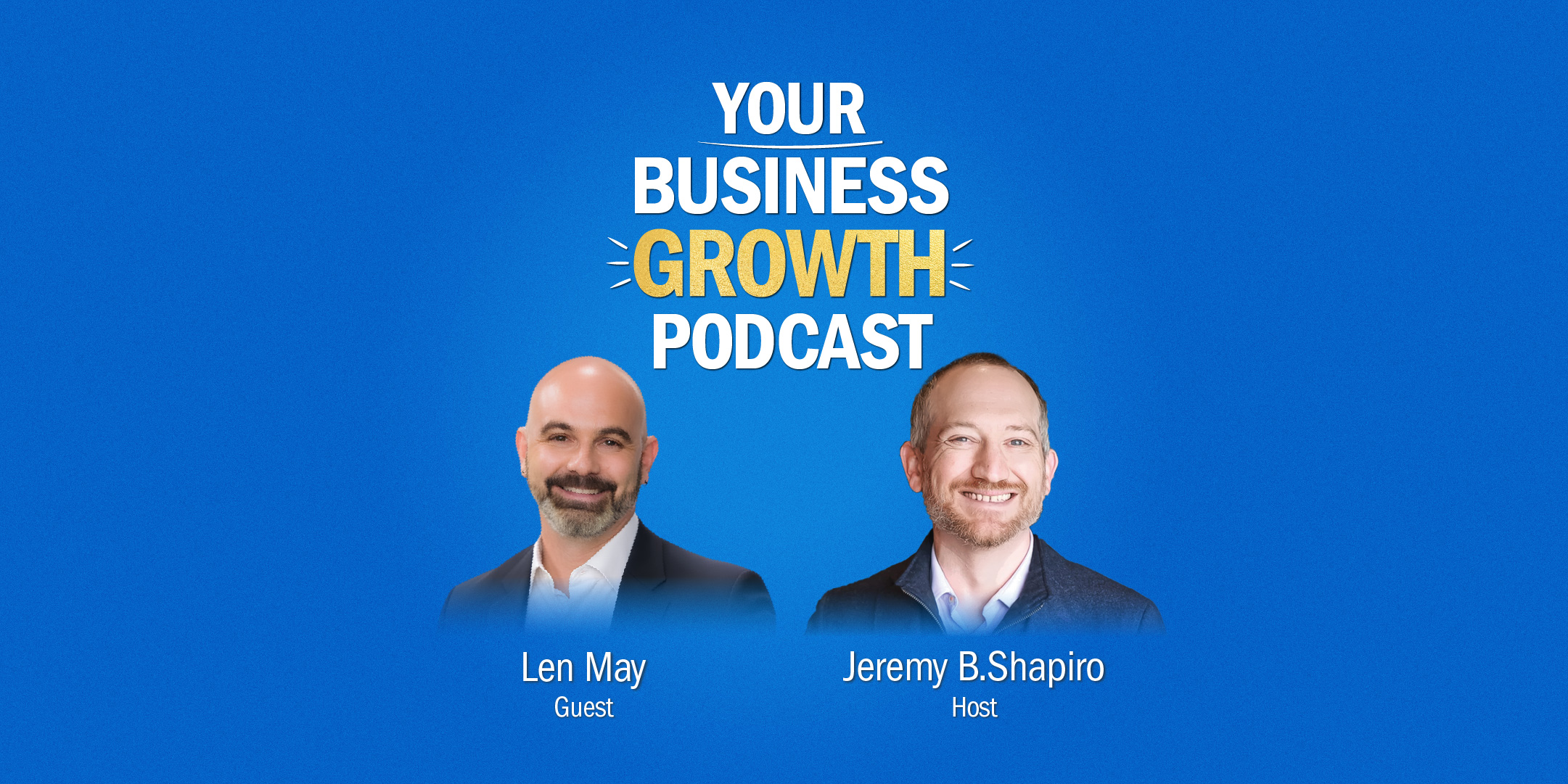
Welcome to today’s episode of Your Business Growth Podcast. I’m your host, Jeremy Shapiro, author of Your Business Growth Playbook, and my guest today is Len May.
About Len May

Len May is a polymath, global speaker, and recognized authority in personalized medicine, genetics, and human optimization. As CEO and Co-Founder of EndoDNA, he is pioneering a new era of precision health, using genomics and AI to help people understand how their unique biology shapes their wellness and fulfillment. With over 30 years of entrepreneurial experience, Len has spent his career honing scientific knowledge for practical, real-world applications.
Over the last 25 years, Len has built and exited multiple multi-million-dollar ventures while leading breakthrough work in genetic wellness. His company’s patented platform now powers personalized protocols across hormone health, longevity, cognition, and nutrition, serving thousands of patients and practitioners worldwide. He has also contributed to peer-reviewed journal articles and clinical trials that have advanced the understanding of the Endocannabinoid system.
Len’s story is deeply personal, rooted in a childhood diagnosis of ADHD. After years of believing his brain was “broken,” he discovered it was simply wired differently, a realization that inspired him to study genetics, dopamine, and flow states. He now develops frameworks that work with the brain’s unique wiring rather than against it, a topic he explores in his book, Jack of All Trades and Master of Some.
As the host of the popular podcast Everything Is Personal, Len interviews leading thinkers in science, wellness, and culture. He is also the author of Making Cannabis Personal and holds a Master’s in Medical Cannabis from the Institute for the Advancement of Integrative Medicine. Based in Los Angeles, Len continues to lead the way in using DNA as a support tool for clinicians and their patients.
Connect with Len May
Speed Round Answers:
- All In Lead Source: Functional medical doctors participating in CME training and conferences
- Books: Man’s Search for Meaning by Viktor Frankl, The 50th Law by Robert Greene and 50 Cent, and works by Malcolm Gladwell like Tipping Point and Outliers.
- Unlikeliest Mentor: Howard Stern
Like This Episode? There’s More!
Subscribe!
Your Business Growth Podcast is available on all major podcast platforms. Subscribe today!
Get the Book!
Pickup the #1 Best Seller, Your Business Growth Playbook today online or at your local bookseller!
Meet Jeremy!
Book your Blueprint Discovery Call with Jeremy today and get back to the growth you deserve!
Len May Episode Transcript
We are generating more revenue, but the profit, it felt like we’re stuck in the mud. We’re just going around in this hamster wheel doing the same thing. It was an extremely difficult thing to market. Kept getting shut down all the time. We pay for campaigns, we get them shut down. For years, today’s guest built a highly successful genetic wellness company, reaching an impressive $10 million in annual revenue.
But despite those big numbers, he hit a wall where the cost of finding each new customer was eating his margins alive. Most founders would have simply poured more money into ads, but he did something much bolder. He shifted his entire focus away from the general public. This radical change in who he served and how he incentivized them allowed his business to scale to $40 million while turning his previous industry peers into his greatest sales force.
Today, he shares the specific tactical shift that transformed his lab costs into a scalable engine for growth. Welcome to today’s episode of Your Business Growth Podcast. I’m your host, Jeremy Shapiro, author of Your Business Growth Playbook. And my guest today is Len May. Len, welcome to the show. Hey, Jeremy.
Thanks for having me. Appreciate it. Yeah, so Len, like many serial entrepreneurs, you’ve dabbled in a few different things. And earlier in your career, I love that you were in this space like commercial real estate, gas stations, and all that, and you shifted drastically, um, into an entirely different space.
Talk to us about sort of this serial entrepreneurship journey and what got you into the world of dispensaries and genetics. Yeah. You know, I, I think it started as a kid. So, you know, I was born in Lithuania, and I immigrated here when I was, you know, six years old with my, my family. And when I learned language, I went to school, and I would sit in class, the teacher would call on me, but my brain would be elsewhere.
And, uh, I wasn’t really paying attention because I wasn’t interested. And, uh, you know, it became disruptive. So my parents, uh, they called in, talked to the teacher, and, and then, uh, they took me to some doctors, and I was diagnosed with ADHD. Or at that point, it was ADD because, uh, they had a separation, ADD and ADHD.
I wasn’t a hyperactive kid. And they put me on prescription medication. Now, I can’t say that it didn’t work. It depends what– how you define it, but it removed my sense of self. So I wasn’t, like, overly happy, I wasn’t sad. I was just kind of coasting through life. And, uh, I think I was, like, in ninth grade, and I went to school, and these kids were hanging out, and they said, “Hey, do you wanna smoke a cigarette?”
I was like, “Yeah, I get to hang out with the cool kids and be cool smoking a cigarette,” because at that time, you know, I’m old, so at that time, smoking cigarettes was still cool. I never questioned why they had one cigarette. So they had one cigarette, and they passed it around. I took a drag. Didn’t taste like a cigarette.
I took another drag, and they’re laughing at me. I was like, “What?” And they put cannabis inside the cigarette. So when I went back to class, the windows that were open in my, in my brain, sort of like having a browser with, like, a bunch of different windows. That’s w- that’s what happens to my brain. It sort of narrowed and I could focus.
So I never told anybody, but cannabis became my go-to medicine. My parents weren’t very keen on that, so I would get punished and grounded. And I was, uh… When I was almost 18, my parents ended up calling the cops on me and trying to have me arrested, and then kicking me out of the house. So the irony of this is that my parents consume products in my company that has patents on now, and they’re proud of all that stuff.
But at that point, you know, we didn’t speak for a year, so I, I was homeless, you know. I, I had some money in my pocket, uh, like $500, I had a car. So I would get motel rooms, then I’d crash in people’s houses. Uh, uh, and, and then, uh, my grandma let me crash on her couch for a while. So I did that, and then, uh, I got accepted to Temple University and went to school there, and, uh, got a job at Tower Records.
So I was working at Tower Records, which is a, you know, something that kids don’t know these days. We had record stores with these, you know, objects that you put into a thing and you play. Anyway, uh, and then, uh, I started an internet company, and, uh, we built websites, basically. We created the first virtual mall, we called it.
So we had to explain to people. I, I walked around. I was, I was the sales guy, a partner, and my other partner would program with X Windows and all that other stuff way back in the day, Mozilla browser, 96 broadband modem, black and white. And I had to explain to people, “What is email? What is this?” So, but I was an entrepreneur.
Like, uh, when I was a kid, w- um, once again, I’m from Philly, I knew that it would snow. I would walk around to people’s houses, and I would get their names, and I would say, “Hey, tomorrow when it snows, we’re gonna come and, and shovel your driveway, 20 bucks or whatever.” So I don’t know, like, I had this in me all along because my parents were, you know, corporate people.
I never really connected to that. So, uh, it, that– So when I, uh, exited my company, I went to work for, uh, PW and then PwC, and I did some corporate stints along the way, and never really… It was great education, but I never really felt like I fit in. And I thought real estate would allow me to run my own business, which it did.
You sort of eat what you kill, which is a scary thing altogether. Like, you either sell or you don’t eat. You don’t make any money. So that was a great education for me. But using that to– And when I moved to Los Angeles, and y- you mentioned the dispensary business. So I was sitting in an office, and I think, y- you know, entrepreneurs have this sense maybe when there is an opportunity.
Like, people talk about luck, but- It, it’s sort of this antenna. Like, I talk to musicians all the time, and they’re like, “If you’re tuned into the right frequency, it comes to you.” And I think entrepreneurs, when you ti- when you’re tapped in, you recognize it when other people don’t, and maybe that’s what makes, you know, us unique.
When I… When these people walked in, they wanna open up a, an alternative pharmacy, and I realized that they’re onto something. “Can you unpack it a little more?” And they said, “Well, dispensary.” And I said, “Okay, great. Where’s your paperwork? What do you have?” And they had nothing. And when I helped them, I said, “I’ll help you.”
I helped them create, you know, put together the compliance paperwork, got them a spot and all that stuff. They offered me a partnership, and that became a foray. I said, “You know what? This is what I’m gonna do for a while.” So that’s exactly what I moved into, and, uh, uh, we opened up four more dispensaries under the same brand, and that was my sort of the next step in my career trajectory.
You know, what I hear there is something so common with serial entrepreneurs, is this seeing an opportunity, seeing a gap in that marketplace, and doing something about it, right? Like, not just seeing a problem, but seeing a solution, but most importantly is acting on that idea. And, you know, you did that, right?
From childhood all the way through, opportunity, business, opportunity, business, opportunity, business. Um, and that’s great. And, you know, that brings us a little more recently here to, you know, the period where you first got into exploring genetic sequencing. Like, that’s a, that’s a far cry from some of the earlier businesses.
Like, what got you into this whole space of, like, genetic sequencing, and, like, what was the gap in the marketplace you were looking to fill? I appreciate you saying that. I think that ADD, and I, I wrote a book about, uh, ADHD and polymathy. It’s, it seems like things are not connected, but in an ADHD brain, you’re connecting things that are, seem unrelated, and that’s what happens in your brain.
You’re like, “I’m putting a, uh, uh, the, a puzzle together with these pieces that practically don’t fit,” but they do. So wh- when I started seeing in the dispensary two people will consume the same varietal of phytocannabinoids and have a completely different experience, the ADD kicked in to hyperfocus. So I’m like, “I gotta figure this out.
There’s gotta be a solution for it. I don’t understand.” So I started researching, and I came across videos of people… There was two gentlemen that were sequencing the actual plant. They were doing genetic sequencing of the plant. They were showing videos of this. So I was like, “Well, I have to get involved in this.”
So once again, you take action, right? So I reached out and, and, uh, nobody was getting back to me. And then I get a call. “This guy’s gonna be in San Francisco. I’m in LA. He’s got 30 minutes to meet with you.” So I’m like, “Okay.” I got on a plane, and I flew, and we spent three hours together, and he’s like, “Come on board.
Let’s do something together.” And, and I became a consultant for this company called Medicinal Genomics, and they taught me how to extract DNA from plant material, how to sequence it, and, uh, you know, I’m in a lab in Waco doing this stuff and learning, and, uh, which I found really, really fascinating. We built the first genetic library of, uh, canna- cannabinoid varietals ca- and it’s called Cannapedium.
We put it on the blockchain. But their parent company was this company called Cordigent Life Sciences, and their specialty was pharmacogenomics, which is the study of how drugs affect individual bodies and contraindications. So I really started getting into the human side and spending time with the scientists there, and then I had a light bulb moment.
I said, “We have plant DNA here, we have human DNA here. Let’s bring those two together and guide people to a personalized experience.” They had no interest in it. They’re like, “No, we wanna focus on the plant.” They shut down the human side. So I’m like, “Great.” I got some smart scientists with me and launched endoDNA just with that.
I didn’t have any knowledge except for that, but I knew how to leverage other people’s knowledge to get to a point of having an actual business. You know, what I’m hearing there for our listeners is sometimes the opportunities we spot aren’t a fit for the current place or people or whatnot that we’re with.
That doesn’t mean it doesn’t have legs, you can’t do anything with it. Sometimes that almost is the permission you need to go out and launch that business or create that new thing that eclipses whatever it is that you were previously doing. I mean, I’ve experienced that myself. I’ve seen that with clients all the time.
Uh, and it’s really neat that you saw that exact same thing. So you guys now build this, um, chemical library of plants on blockchain, and, uh, tell me more about that business model. What did that mean, and what was that initial growth like as you started to commercialize this? Yeah. So when we launched endoDNA, our goal was to guide people to a personalized experience with their phytocannabinoid use.
So we created a genetic test. Uh, l- I had n- no idea about genetics except for the small, uh, short stint I spent in medicinal genomics, so we had to figure it out. So we said, “Who are the biggest players in the industry that are doing genetic sequencing?” It’s a company called Illumina in San Diego. So we drove, uh…
By the way, before that, uh, just to say, it, it, it’s- The business is the business of people. You gotta get the right people, and it’s always the right people. So I, I met a guy named Eric, uh, we just hit it off, and I was… Uh, it’s funny ’cause we were moving offices. I remember we met at a veggie grill, and I drew out on a piece of paper exactly what was in my brain because, uh, I’m not a programmer, but I’m also an artist, uh, so I can paint and all that stuff.
So I drew it out. I’m like, “With color pencils, this is what I envision in my brain.” I said, “But I need somebody to build it.” He’s like, “I build like 300 websites, and, uh, this and that,” and he’s a tech guy. So I’m like, “Hey, I have an idea. You wanna get…” So we end up b- uh, partnering on this. So having somebody that can actually get your vision to fruition is extremely important.
So we drove to Illumina, and we explained to Illumina that we’re looking to sequence and we’ve– I’ve done a bunch of research which ones. So they created a, uh, a chip for us. Basically, it’s a chip. Like the way you do genetic sequencing is the same way there’s a chip. You take saliva or blood, you take bio samples, you put it into a sequencer, and it looks for a certain pattern, a binary pattern, ones and zeros, and then a letter combination.
So your genes speak in four letters, a C, a T, an A, and a G. The combination of those letters are your unique genotype. So that’s what you’re predisposed to. So they created this chip for us. We found a lab. Uh, we started creating kits that are buccal swabs. It’s a big Q-tip. Swab the inside of your cheek, you register it, and you send it over to the lab.
We’ll get the results back in like a big spreadsheet file, and then we have to, you know, interpret that and provide reports. So then we said, “I think we have something novel and unique,” and we ended up filing a patent on that. So our first patent that we filed was, um, it is, uh, it, it’s in association with your genetic predisposition to the use of DNA to make recommendations associated with the endocannabinoid system, and we got that patent.
So it was, uh, uh, approved and issued under utility patent. So we became that company that is the only company in the world at that time that’s doing genetic sequencing of the endocannabinoid system and guiding people to that personalized experience. So you swab, you register, you get your results, and then it, it looks at your metabolic function for dosing, and it also looks for, uh- suggestions on products based on your ratio.
And the way that that worked is we get certificates of analysis of test results from different products, and we show you how close that product matches suggested ratio, and then somebody would get the product that works for them. So we’ve expanded that into 16 different countries, and, uh, you know, we’re shipping lots of kits to individuals.
And, uh, it was, uh, you know, we were generating revenue, and it was a decent business, and it was… And I started looking at the books, and I was like, “You know, it’s, uh, we’re generating revenue, but it’s not growing as rapidly profitably as we would like it to grow.” And this was a, a pure direct-to-consumer model, selling individual kits to individuals?
Yeah, it was a pure direct-to-consumer model. We were selling, uh, a DNA test, uh, to individuals, and we were selling it in, like, online. And, and, and I tell you, because we didn’t touch the plant, but it was such a difficult thing to be able to market, uh, through social media because we kept getting shut down all the time.
As anything has to do with the endocannabinoid system, the algorithm picks it up and shuts it down. So we pay for, uh, campaigns. We get them shut down. You’re no longer able to do paid ads. Google was doing the same thing. It was an extremely difficult thing to market. So a lot of it was, uh, you know, we were doing events, and that was one of the best ways to get the word out because nobody could block it.
So we were doing events, and I was signing up, you know, maybe distributors too. And we were signing up these deals with distributors, and we’re growing. And then, uh, I had some distributors who were like, “We’re, we’ll do 1,000 kits a month.” Great. The, you know, our margin is smaller there, but we have distribution.
But then COVID hit, and all the people that were doing events and everything that had to do with events, uh, stopped. Are you enjoying this episode? Make sure you hit that subscribe button right now. That’ll help you get more episodes automatically as soon as they come out. So hit that subscribe button right now.
And if you have a minute, leave a quick rating and review. That helps support the show. So you had some factors outside your control, like the pandemic and all. Um, it also sounds like you had increasing customer acquisition costs, just given the industry and some of the regulation and the public perception by a lot of the bigger companies.
Um, and you got to this point where you hit about that $10 million mark in revenue, and profits were shrinking, and the growth just wasn’t there. So talk to me more about that stuck phase. That was pandemic timing, you’re saying? Yeah, it was pandemic timing and after pandemic. So we had to- Changed a lot of things during pandemic ’cause as, like as I said, we couldn’t do events, so we had to let go a lot of our employees and, uh, we had to kind of figure out and regroup.
So a lot of it was, again, let’s, let’s start selling people. And, and the good thing is that cannabis was essential, uh, during the pandemic, so people were still buying cannabis. But I started looking at the numbers, and maybe it was the first two years of the pandemic, you’re like, “We have to do something different.”
So we kept scaling to different countries, and Brazil was an incredible country for us, and we scaled. But then once again, as you said, Jeremy, we are generating more revenue, but the profit, it, it felt like we’re stuck in the mud. Like we’re just, we’re just going around in this hamster wheel doing the same thing, but looking, looking at our, uh, you know, our bank account, and it’s not moving because we keep reinvesting in more marketing and it’s just a, an extremely difficult thing to, to do.
So I got a call from a doctor and, uh, this doctor said to me, “Listen, Len, I’m seeing a lot of women who are in, uh, their late 20s, early 30s, and they’re displaying perimenopause symptoms.” I was like, “Really? That’s really early. Um, I wonder if it has to do with, uh, you know, maybe hormones in our foods and water.
Who knows? But I’m just putting it out there, uh, that maybe that’s the case.” And then she’s saying, “I’m seeing a lot of women who actually have menopause, and they’re experiencing really adverse symptoms like hot flash severity, frequency, uh, weight gain, uh, sleep issues.” She said, “Is there a way that we can maybe able to get ahead of these conditions?”
So I have a tendency to say yes. I’m sort of the, the guy that’s like, uh, I’ll ask for forgiveness instead of permission. Maybe it’s this whole, uh, Gary Vee thing where I’m not afraid to fail. I don’t even understand what that is. It’s just all learning experiences. So I say yes. And I went back to my bioinformatics team and I said, “Can we build something like this?”
And they said, “Yeah.” So we build our first female hormone health test. And, uh, they said, uh, “Do you ever see male patients?” I was like, “Yeah.” So we started working the, on the male hormone health test, and the idea is that we can get ahead of some of these conditions from expressing themselves. And when I started thinking about this, I said, “Well, you know, Dr.
Blank,” whatever, said, “You… Would you sell this in your clinic?” And she said, “Absolutely.” I said, “Well, we can white label it for you, and you can sell this in your clinic, and we’ll give you, you know, X amount of price,” whatever distributor price, but there’s a huge margin that you can do. And she, and they’re being in Beverly Hills in California, so, uh, she could sell this for a lot more And I said, “One of the other things that you can do is it creates a flywheel for you because now you can provide specific protocols and products and all that stuff.”
And it was great. So worked with this clinic, then went to a, you know, another clinic. I was like, “Uh, well, wait a second. This advertising thing and the everything that we were dealing with before, we can actually get a doctor who becomes our partner and is incentivized to become a sales agent.” And I don’t know you, about you, but, you know, when a doctor tells you, “I recommend this,” most of the time you’re gonna say, “Okay.
Where… How much and where do I sign?” And whatever. So that, that sort of became a huge shift in, in our business. That industry has some of the highest levels of compliance in terms of when you are suggested to do something, you actually do as a patient. So I think it’s interesting then when we look at your direct-to-consumer model that one of the biggest ways that you grew was through distributors and having sort of the, the volume game, and you’re able to take that same playbook and apply that strategy here, but distribution in a whole different way.
So of all the different ways you could have grown this sort of, uh, new target audience and market, why’d you decide that doctors and the practitioners were, like, that right distribution model versus others who might be able to move volume of these? Well, first of all, you just said it before, that’s compliance, right?
When your doctor tells you you’re gonna do something, you’re gonna do something. Second of all, doctors started asking questions. They started asking, “Is there a way that I can differentiate myself from my competition?” And having a DNA test that, that focuses on precision health and wellness is a huge way to do it.
Number two, we don’t wanna take insurance. We are l- we are functional medical professionals that are cash-based. So this allows them to create an additional margin, not just on the kit, but also with everything else they’re doing because it creates all these different solutions and protocols. And third of all, th- we can start creating different reports to upsell to the doctors.
So the doctor, uh, you come into the doctor’s office, you do your m- you know, your regenerative health and wellness male hormone health report, and next time you come in, the doctor says, “Hey, I think you should take this, uh, cognitive, uh, report,” or, “You should do a nutrigenomic report.” So for us, it doesn’t cost– It’s only compute cost, but then we don’t have to swab them again.
So all you have to do is press a button, so it’s a win-win for the doctor. They don’t have any more expenses. They can upsell that to their patient. The patient gets their specific information, and it’s, it’s like longitudinal care that we have this feedback and it keeps going, going, going, and that doctor becomes a very happy Sales agent for us who’s creating a whole new revenue stream for themselves, so it’s a win for everyone.
I wanna highlight for our listeners a really key piece of what you just shared there, that there’s this sort of upfront customer acquisition cost and, you know, your cost of goods in all this. But once that’s in the system, each of those additional add-on sales that comes later is an additional transaction, but that upfront cost is, is already done.
You’re not incurring this new cost again. You’re able to just continue delivering value, and that does beautiful things to customer lifetime value. Now, I, I’m curious as well on the customer lifetime value side of things, having a brand that your consumers know versus going this white label route where the end consumer doesn’t know who you are, but it’s the doctors delivering this, how did that change in branding affect, uh, growth for you guys, having the white label program?
Yeah. It, it didn’t really affect growth for us, but our marketing people were really pissed, like, “Oh, you have to have the brand out there.” I’m like, “You know, we do have the brand because I learned from Intel. We are Intel Inside. It’s powered by EndoDNA plus Bios, but you have your clinic’s logo on there, and we have a little badge because we wanna be known as the engine that powers everything underneath.
We don’t need to have our brand displayed prominently.” And I think that way it becomes a collaborative, uh, uh, you know, opportunity for us. The doctors have their brand, and we are known as that engine that makes it run. The other thing, uh, Jeremy, that I learned through this experience is, mm, I’ll kind of whisper it, but doctors don’t really know DNA that well or epigenetics.
So that was a huge challenge for us. I was like, “Well, here’s the report.” And they’re like, “Do you have anybody that can interpret it for us?” And now I have to get employees to help, you know, counselors and all that stuff. So is there a way that we can overcome this? And AI is a big part of that. So we build our platform with, uh, we call it Bios, with a specific AI that allows you to ask questions of your DNA, your patient’s DNA.
Uh, it was– It’s funny, I was speaking at this event, and it was all doctors. At the end, I asked, I have my name and my contact information, my, my cell phone on there at the end. I asked if there’s any questions. There’s no questions. I was like, “Ah, man. I must’ve done a re- a really bad job. There’s no questions.”
And all of a sudden, like within an hour, I started getting emails and texts from different doctors that were asking questions they didn’t want their peers to hear that they’re asking a dumb question. So I was like, “Okay. What if you can just in- ask questions of, uh, the platform?” So we build this platform using, uh, machine learning, and we get a patent, a great patent, machine learning-based efficacy predictions based on genetic and biometric information.
Which allows doctors to interrogate the genome, ask questions, have an intelligent conversation, and a treatment protocol suggestion for the doctors, and the patient feels good about it because now you are having precision protocols specific for them. And the biggest question is: well, how do you know that a protocol is working for the individual?
And that feedback loop of an epigenetic test down the line allows us to know what’s working, what’s not working, and the AI is always learning on that. So all these are iterations, and you have to invest in that, but you have to do your, your assessment of what’s gonna, what’s gonna set you apart and all– listening to your customer.
They’re asking you for these things without actually asking you for these things. So going back to what we were talking before, tuning in. If you’re, if you’re listening, not just– but you’re really, really hearing what they’re saying to you, I think you can find solutions that work, and then it becomes like an extension.
They become an extension of your business. They become your advocates, and then you build a tribe. Now, I have more questions for you on that, but you did bring up the whole AI model side of this, and I’m curious, like, how did you guys go about building the guardrails into your AI models to ensure that doctors could, like, safely interact with this kind of genetic data?
Yeah, it’s a great question because that was the biggest challenge. I met a doctor at an event, and, uh, he goes to me, “You know, half of my business right now is spent talking to patients that came from other doctors. They gave them a, a treatment plan using ChatGPT, and it’s wrong.” So I’m like, “Yeah, that’s interesting.”
It’s like Dr. Google, now it’s Dr. ChatGPT. So the first thing we did was we analyzed all the different models that exist, uh, and we decided on Anthropic. So Anthropic came out with a health model. So we initially built our entire lar-large language model on– grounded on Anthropic. The other thing that we did was we actually created guardrails for that specifically based on all the things that we’re doing with genetics and, uh, and stem cells and all of this stuff.
Then we train it on the clinic. So if your clinic has a specific thing they do, like peptides or anything else, then we train and ground that based on that and provide the guardrails. We are an AWS shop. We’re HIPAA, we’re GDPR compliant on AWS, but it– that’s the biggest challenge, is to be able to make sure that your, your LLM is, has those guardrails in place and doesn’t really have hallucinations.
Can it be off a little bit? Yeah, but that feedback loop, that adjustment, it always adjusts itself. So that, that’s kinda how it came about that. And a lot of this is helping to move us in that direction of this dream of personalized medicine, which is really cool. So from a business model standpoint, Len, you know, you can sell individual units, right?
You can wholesale, right? You can consign. There’s all these different ways you can move volume. Um, talk to us more about how you got the practitioners to have a little more skin in the game and, you know, not just try and move inventory, but actually be bought into selling your products. Also a learning experience.
So at first out of the gate, I did… I had an MOQ of 250 units, gave them a really discounted price. You have to buy them because we have to make the boxes with your logo and all that stuff. And we did that, and we had a, a bunch of customers, and then we realized something that we’re not getting a lot of tests back from them.
I was like, “Well, why?” And I started talking to them. They kept the inventory. So they have tests sitting on their desk, uh, or in their, uh, in their closet, and they’re not using them. And the reason why is ’cause that’s not the way doctors do business. Companies send them tests, and when they send them tests, now when they get a patient, now they can pull out the test, use it, and pay for it.
So I said, “Okay, but there’s a lot of tests that are sitting there that are not being utilized. Why?” “Well, we don’t need them any,” not top of mind. So what I did was I started charging $25 a test. Not a lot of money, but it’s skin in the game. And for some reason, when they paid $25, it was top of mind, and I was selling packs of five instead of 250.
Five tests for, uh, for $25, so it’s $125. And then from there, now when they have a patient, they activate that test. They pay the remainder of the fee and charge their patient. And that was a huge, huge transition because now it… as we start working within the model the doctors are used to. Yeah. It’s funny.
I think about Aramark, right? If you go to baseball games or any of these big events, right? Those guys out there with the big trays of food and drinks and all, they’re typically going in the back. They are buying that tray of food or drink from Aramark or whoever the company is there. Then they gotta go out, and they’ve gotta sell it.
They have skin in the game because they’re now negative money, and they’ve gotta now go sell it. Far more motivating than just being given some product and told to sell what you can. Uh, and you guys implemented exactly that. So you’ve also done something really great, which is looked beyond your own product portfolio and found a way to be an affiliate of third-party offers like supplements and so on.
But you did a, I think, a beautiful job of tying that into your core product. Talk to us about, like, where you got this inspiration to combine, like, the human genomics side of things- With supplementation Yeah. Well, it’s, it’s a now so what kind of question. Like, I have the results and I, I know wh- where do I, where do I get the products?
What do I do? And the idea is I thought about like, okay, what if there was a shopping cart, right? So you have a treatment plan, and the treatment plan is provided into three sections. So the first one is pharmaceutical intervention. Okay, well, pharmaceutical intervention, c- is there a way for us to get paid for that?
Uh, eh, a complicated, uh, answer to that, but le- let’s say no. So the doctor is supposed to write a script and you’re not supposed to, you know, get any margin for that. They just get it from, uh, the pharmacy and that’s it. Okay. I said, “What about the second or the two other parts?” Part two is supplement intervention.
So it’s anything– And the, the third one is lifestyle. So on the supplement side, well, what are supplements? Well, you have your vitamins and your nutrients, all the, all those. So not every doctor has that. So if I can put in a third-party, uh, reseller and even white label for the doctor because they love to have, you know, their branding on it and get a percentage of that as an affiliate fee, I can add that as a shopping cart.
So when the doctor is making the recommendation, they can click the supplements they want, they can add those. But I also found that there is medical food products. There are peptides. There’s all kinds of different products that are not prescriptive in a way that we can also, uh, generate margin for both ourselves and our practitioners.
And then the third one is lifestyle modifiers. So lifestyle modifiers can be diet, exercise, et cetera, but it can also be red light therapy, and it can also be, you know, cold, hot, all these different things. Well, laser, there are products associated with that. And if a doctor wants that, you know, they can add those to their cart as well and we have an affiliate fee also.
And sometimes the doctors have their own products and their own lines, so they can upload them and create their own catalog and, uh, they just have to agree that we’ll receive a 10%, uh, affiliate fee for any product that’s sold on our platform. So look, it’s generative revenue, but these are specific products that you’re gonna buy anyway.
And I think the one thing that I also learned is feedback is so important to us. How do we incentivize feedback? Well, we create a point system. So now for feeding back, you can use those points to get other additional discounts for your specific products that you’re gonna buy anyway. So it becomes a win for everybody across the board Yeah, I really like for our listeners to understand that you were able to increase revenues by bringing on third-party products that weren’t even yours, right?
And integrating it beautifully into that checkout flow so it’s a natural upsell that you don’t have to fulfill, you have no cost of goods on, is just, you know, uh, is, is revenue. Um, and I also wanna highlight a really unique strategy you did there, which was you allowed your affiliates, these practitioners, to put their own things into the system.
That is unusual and a really unique model which satisfies, I think, all users in this, you guys, the practitioner, and the patient. Just listening, because some of the doctors are like, “I already have this in my practice. I wanna sell.” “Oh, well, let’s create a back end. Just upload your catalog and sell your own products.
Fine with me.” Beautiful. And again, for our listeners, that comes down to tuning into your customers, hearing what they’re actually looking for. Um, you’d be surprised the business opportunities that exist right in your own customer base simply by asking and listening. So awesome. Now Len, you guys made these changes from going direct to consumer to selling to practitioners, and that helped grow the business towards that $40 million mark.
What do you think was one of the most significant turning points in that trajectory from that 10 to 40? It’s all about the going B2B instead of direct to consumer. It, it changed everything, and it changed the way that we approach our customer and who we call our customer because it has exponential revenue over time.
As, as you mentioned, Jeremy, like the cost of goods for the swab, that’s one. But then you have ongoing reports, uh, and then you have other tests that you can offer. And when you have– when you build your tribe of, you know, your, your doctors, your resellers, your distributors, they are your sales agents and because they’re generating their own business for themselves and you’re getting a percentage of that.
So it, it limited how we market because now it’s a very precise laser-focused approach to going after a clinic and then holding their hand, which is a really important thing that some people don’t do enough of. Doctors, and I’m not painting a broad brush, but they really don’t wanna do much of anything.
They just want to doctor. When it comes to technology, they’re like, “Nah, it’s too much.” So we have an onboarding specialist. They’ll call them up, they’ll work with their manager or whoever, the practice manager or even the doctor depending on the, the practice, and we’ll onboard them for them, even though it’s super easy to do, but we’ll do it for them.
And that way we know that we have a user on the platform Once they’re using it, that’s it. They become, you know, sort of an extension of us and our, and our sales agents. So that is the biggest factor, I think, to making that change because that feeling, uh, I mean, I remember that feeling, like, “I don’t understand what’s going on.”
It is literally being stuck in, in mud. Your tires are rotating and spinning. You know, like, “I’ve done everything I could possibly do.” But did you really? There’s always something else that you can do when you’re stuck in that. Well said. So one of the things we talk about is this idea of adding an additional point for recurring revenue and repeat transactions, and you touched on the report side of things, which is now leveraging the existing data you already have to produce more output.
Um, but you guys also added an ad- additional report– uh, excuse me, additional testing, which you touched on. Um, tell us more about how you added in, like, the epi- the epigenetic testing and, like, what their recurring revenue model is on that, how often that should happen, the, the value to the customer as well as the practitioner, to you guys, and so forth.
Like, that was, I think, another important change there. I was sitting down. I was trying to figure out, you know, how do we know that something is working for our, uh, partners? How is it working for the patient, uh, a- and our partners? And so I started working with my team to try to map the genome to the epigenome, and one of the ways that you do that is, uh, you can look at what’s been methylated or unmethylated.
Uh, you know, not to get really science-y unless you want me to, but it’s, uh… Uh, like, I, I try to explain to people genetics. So when somebody’s born, they have, you know, all their genes. It’s, it’s sort of the encoding. So you have this information that’s encoded, and what you do with your lifestyle can either turn that on or off, which is methylated or unmethylated.
And the reason why that’s important is there’s messaging, and the messaging creates proteins. It creates new cells. So sometimes, you know, people take these tests, the- these epigenetic tests where the, the, ch- uh, tracks what’s turning on, but you don’t know what you’re turning on because you may be turning on something that creates cancer growth or some of that.
So I’m a big believer, do your genome, which is your life’s GPS, and then track to see if you’re on the right road, where, you know, the traffic jam or where the potholes are. So I s- sat down and started doing that, but then I did my own biological age test, and when I did my biological age test, I’m like, “Oh, well, this way I can track the epigenome and see what’s expressed.”
But my problem with this is, like, I’m 54. My biological age is 47. But I don’t even understand what that means. Maybe my liver is 68, you know, I did party when I was a kid, but maybe my brain is, uh, 12, you know, because, uh, I still have a brain of a 12-year-old. Uh, you know, I, I’m– I still laugh at fart jokes and stuff like that.
So it has to be something that has y- y– the biological age and the, and the, um, the methylation for different parts of your body, different systems. So, uh, I started researching, and I found a partner that is actually doing this already. So like, “Hey, and you can white label or not white label. That’s great.”
So we decided to do a deal with them, and it’s sort of a dual workflow. The doctor already sends the patient to get blood work done at week 12 or 90 day, whatever it is. So we can take some of the blood work, get into the workflow, and provide the epigenetic, uh, results for that. And it’s all integrated through an API into our platform, so they can actually ask the genome questions, they can ask lab questions, they can ask the DNA questions, so it’s fully integrated into the Bios platform.
Nice. Now, before we get to some of the lessons learned, um, I wanna just ask one last question sort of on the business model side of things. Uh, clearly you’re a big believer in data and the power of data and what you can do with a quantity of data, right? Like, we’re talking at the genome level. But also, you have hundreds of doctors who are now able to participate in clinical trials.
Tell us a bit more about that piece of the business. Yeah. So we are in the middle of four clinical trials now, uh, and we’ve done– we have 16 citations in PubMed. We have, I think, eight clinical studies right now that are going on. There’s f- no, nine. There’s five in Sham– Uh, no, there’s five in Wayne State in Michigan.
There’s, uh, three in Sham in Montreal. There’s a clinical trial on anxiety and stress in Harvard, and there’s a clinical trial on Alzheimer’s, on Parkinson’s, and now we’re starting an autism study. So genetic data is extremely important in clinical studies. And, uh, I had a light bulb moment again, uh, where I was listening to a talk on this brand-new drug for Alzheimer’s.
And I walked up to the CEO of the company after the talk and I said, “Hey, in your research, I’m just curious, is there a certain gen- genotype that this drug either works better for or it works– Did you look at any of that stuff, even your mouse studies or whatever?” And they’re like, “As a matter of fact, we started seeing that some people with a certain genotype, uh, they’re not showing, you know, efficacy.”
So I said, “Would it be important for us to be able to track that?” And they said, “Yeah.” So we basically started swabbing every single person in every single study. So that’s one thing to see, and if they have this genotype, they’re not participating in the study because the drug will not be effective for them.
That’s one part. The other part is for efficacy of different drugs or, or, or products or supplements, is there a genotypic pattern? So this, this gene with this gene with this gene, and maybe the way you metabolize maybe works better or, or worse for that. So before, when we first started this, we used to have big spreadsheets, and we used to have to go and analyze these spreadsheets.
But now, with machine learning and the AI, we just dump everything in there, analyze it, and it gives us really clear reports. So it’s, it’s a big, it’s a big part– It’s not a big part of our business financially, uh, but it’s a big part of our business for that data, that efficacy data, and it helps to legitimize us that we’re not just, you know, a company that’s, uh, that’s telling you that you have a cousin, you know, three, uh, three removed, uh, or whatever, or you have an uncle somewhere in Moldova that you found.
It actually helps to see what things work for individuals, and getting us to the point of what I’m really passionate about is this personalized health and wellness. And so that’s kind of the position we’re taking there. I like that you touched on this early on in our conversation about how, as a kid, you felt your brain was just wired a little differently and all.
And I see that often in entrepreneurs and founders, right? Y- We’ve got to be those select weirdos to even start our own business, let alone do it again and again, right? So if you were talking to a founder who feels maybe they’re wired a bit differently or they’re struggling to focus on one path, like, what advice would you have for someone in that, in that situation?
It’s the same thing that when I was diagnosed with ADD. So you have something that’s called attention deficit disorder. So now you’re wearing a badge, “Oh, no, I have a disorder. There’s something that’s wrong with me.” And you can use that as a crutch for your life. “Oh, I can’t do this because there’s something is wrong with me.”
We’re all different. We’re all individuals, and my neurodivergence is my superpower. And instead of looking at this as your crutch in life, look at it as- Why do I think differently and how do I think differently? And lean into that. If I… You know, in my research for my book, there’s, you know, a pretty significant percentage of billionaires who have some sort of neurodivergence.
And, uh, you know, this is something that we’re wired differently. Like my, my parents worked their whole life as, uh, an accountant and engineer. They, uh, uh, you know, they were in corporate. They love it. It’s like they go nine to five, and they do that, and my parents are retired, and that’s perfect for them.
It doesn’t work for me. And when you have that itch, like I don’t like, I don’t like authority. I never did. I don’t like to be told what to do. I like to do my own things. But it’s that lack of fear. I think it’s this, this notion of I am… I really wanna do this so much that I’m not afraid of it, and if, if it fails, okay, so I learned something.
And I, I think a lot of people are getting ready to get ready, and I hear this all the time. And I have people that work with me that are trying to perfect everything before we go out. “Oh, we gotta…” And I’m the person that’s like, “Sh- I don’t, I don’t know what’s per- There’s no such thing as perfect. Let’s go out and bring it to the market and get feedback and then tweak and tweak and tweak,” you know?
This 80/20 rule. So it’s, it’s… I- I don’t know if it’s inherent in all of us. I, I gotta research this a little bit more. But lean into your superpower and your strengths, what makes you different. And, you know, remove this, uh, safety net. Just go and, and take action because the world, the corporate world, your cl- They’re gonna give you that feedback, and you’re gonna make adjustments.
You’re not gonna get it right off the bat. But I think a lot of people… I’ll tell you one quick story. So my dad, who’s not an entrepreneur, decided one time, they went to this, uh, little, like, conference, and they were trying to sell them franchises. And my dad invested in a franchise. It’s a cleaning service.
And I, I was a kid, maybe, m- maybe 12. I, I don’t remember. Maybe older. Uh, but he invested in a cleaning service. So basically, y- they help you get cleaning people. You just provide the supplies, and there was a, a whole, uh, revenue thing that you can generate. Well, what was happening was the people stopped showing up.
So you would… It, it’s corporate cleaning, like offices. So my dad and I would go out, and we would clean the toilets, and we would clean the offices. And my mom gave him such a hard time that, “Look what you did. You invested in this business. You’re gonna lose money. You’re not doing this and that.” And that was it.
My dad never, ever dabbled again. For me, it was like, “Well, that’s exciting. This is cool. I can improve this and that.” So that’s, I think, what makes us, uh, a little bit different, entrepreneurs. Yeah, we certainly are wired differently. Um, but yeah, what I’m hearing there is a few key things One is don’t be, don’t wait for perfect, right?
The whole MVP model we talk about is take action now. Get that early feedback, iterate, improve, and listen to your customers, um, is huge. Um, and two is this idea that we often see the opportunities. We don’t see fail- failure. We see lessons learned and what we can do differently from that. Um, love it. All right, so before we get to rapid-fire questions, um, we love to talk numbers, KPIs, what numbers matter most.
Um, what are the specific, like, key performance indicators that you and the team track to make sure the sales team is, like, effectively bringing on and onboarding new clinics? Yeah, so we have, uh… I brought in a sales manager, so we have a specific quota. It’s not, not a big quota. Because I used to be in sales and I used to train salespeople, I think that there’s this balancing act.
So eat what you kill in real estate is extremely difficult. So if you have a family to support and you have nothing, so you need some sort of base, but you need to create an incentive that allows you for no ceiling. Like, I’m a big believer in sell, sell, sell, make, and, and be a partner in our business.
Make as much money as you can. We make money, you make money. So that key performance indicator, make sure that they’re hitting their numbers, is really important because we all get to eat from that. It all comes from sales. The second thing is that customer satisfaction and the feedback is extremely, extremely important to us.
Uh, you know, that’s the thing that makes me most upset when we are not as responsive as we should be, if we’re not, you know, putting our customers first. You gotta put your customer first. And we created, we built this, uh, live chat system that now is helping us to address a lot of these issues instantaneously.
So before, we would get emails and, you know, some things get lost, some they’re in spam. But this live chat system is, is a game changer because it allows our customers to tell us what’s going on right away. So those two things are probably the most important KPIs that I look at. You know, and then there’s the, you know, top-line revenue and all those other things.
Uh, we do have investors. We, we have growth. We have to, you know, position money, uh, back and forth. But I, I believe the health of the company is those two things. If we’re able to hit our numbers in sales, everything else falls in, in line, and then we get happy customers that actually tell other people that we exist and why don’t you try, you know, End the DNA and BIOS in your business.
So those are the things that I look at most. Nice. So I’m hearing, uh, you’re looking at the sales numbers and customer satisfaction, two really good numbers in the business. All right, before we wrap, a few quick rapid-fire questions. If you had to start all over again from scratch, what one lead source would you go all in on?
I believe the lead source that I would go after are- The, uh, functional medical doctors that participate in CME training, continuing ed training, for a lot of these events like A4M, uh, the CSN conferences, et cetera, that is my best customer. Those are people that are looking to expand their knowledge and are cash-based, uh, um, businesses.
Nice. And for our listeners, I wanna highlight there just how niche Len was in terms of where that ideal customer is. It wasn’t people who fog a mirror. It was super dialed in, uh, so that’s really good. All right. Books-wise, um, aside from, of course, your Business Growth Playbook, what are some of your other top favorite business books?
Um, I love… I, I mean, they’re not, they’re not all particularly business books, uh, per se, but they work for me. So my number one book that I read over and over and over is, uh, Viktor Frankl’s Man’s Search for Meaning. Uh, that’s one of my favorite books, if not my favorite book. Uh, you know, Carnegie. Uh, I also love, um, Robert Greene, so, uh, not just 48 Laws of Power, but there’s, uh, one book that he has called 50th Law of Power that he wrote with 50 Cent.
Underrated book. I mean, as much as you wanna talk about 50 Cent as a rapper, what a great business book. Uh, and, uh, I also think that I’m listening to a lot of audiobooks, but, uh, the… anything that is, uh, Malcolm Gladwell, uh, wrote. So anything that’s like Tipping Point, uh, Outliers, anything like that, those are my favorite books.
Nice. You, you got some, some of the big heavy hitters there. That’s good. But I also like the underdog recommendations. Um, speaking of, last question for the rapid fire, who is one of your unlikeliest mentors? Howard Stern. I discovered Howard Stern as a kid. I, I would spend summers w- in my grandparents’, uh, apartment in Brooklyn, New York, and they would go to sleep, and I would sit in the kitchen and kind of lis- there’s no…
didn’t have TV, so I didn’t wanna wake them, and I would listen to radio. And I came across Howard Stern on the radio, and I just became obsessed. And when he moved to Philly, uh, as well, I would listen to him, and I would miss classes. Here’s, here’s the thing that I find fascinating. First of all, his trajectory and growth and overcoming all the crazy obstacles he had to, uh, deal with with the SEC, uh, uh, you know, became extremely successful and overcame everything, how he dealt with competitors and all that.
But the other thing that I find fascinating is the way that he interviews people. I really believe he is probably the best interviewer, and that helped me a lot in communication with other people, to really try to understand where they’re coming from. Keep- pulling back the layers. So it’s unlikely, but that, that’s one of my mentors.
He doesn’t know that he’s my mentor, but he is. He will now. Love it. So Len, to recap for our listeners, you moved from a plateaued $10 million direct-to-consumer model to a strategic B2B pivot that leverages healthcare practitioners and white label technology to quadruple revenue while maximizing the lifetime value of every patient.
Correct. Yes. For listeners who wanna learn more about you, where should they go right now? So, uh, EndoDNA, endodna.com is our website. Uh, I’m all over social. Len May. I think on Instagram I’m lenmaydna. Uh, I also have a podcast. It’s called Everything Is Personal. I interview, you know, really in- people that I find interesting, so, uh, you can find it wherever, on YouTube or wherever you listen to podcasts.
And I just, uh, wrote a new book. It’s called, uh, Jack of All Trades, Master of Some: Uh, The Connection Between ADHD and Polymathy. You can get that on Amazon, wherever you get books. So yeah, I’m, I’m always available. You can reach me on any social platform. Oh, one more thing I forgot. I’m a huge music person, so I do something called Record of the Day, unrelated to anything I’m doing, but that’s a hobby.
So if you follow me on social, every day I’ll, I’ll get a record from my vast vinyl collection. I’ll play it and I’ll talk about that record, so follow me for that as well. Fantastic, Len. Thank you so much for joining us and sharing us, w- with us your story of really hitting an impressive plateau and then breaking through and getting back to growth, um, and the stories of what got you through that and what you learned along the way.
Appreciate you joining us today. Thank you. Thanks so much for listening. Quick reminder, hit that subscribe button right now so you can get more episodes when they come out automatically, and remember to leave that rating and review right now.
Like This Episode? There’s More!
Subscribe!
Your Business Growth Podcast is available on all major podcast platforms. Subscribe today!
Get the Book!
Pickup the #1 Best Seller, Your Business Growth Playbook today online or at your local bookseller!
Meet Jeremy!
Book your Blueprint Discovery Call with Jeremy today and get back to the growth you deserve!