What if you could grow revenue every year for 18 years — with no employees, no outside investment, and a business that shuts off at 5pm?
Our guest today built exactly that. But it didn’t start that way. He spent the early years of his agency doing 80-hour weeks, arguing with clients over hourly estimates, grinding through projects for people who cared more about the rate than the result.
Around year four, he made one change: he stopped billing for time and started pricing for value. The clients changed. The conversations changed. The hours came down. The revenue went up. And the model he built with his twin brother has now outlasted most of the “scale or die” agencies that launched alongside them.
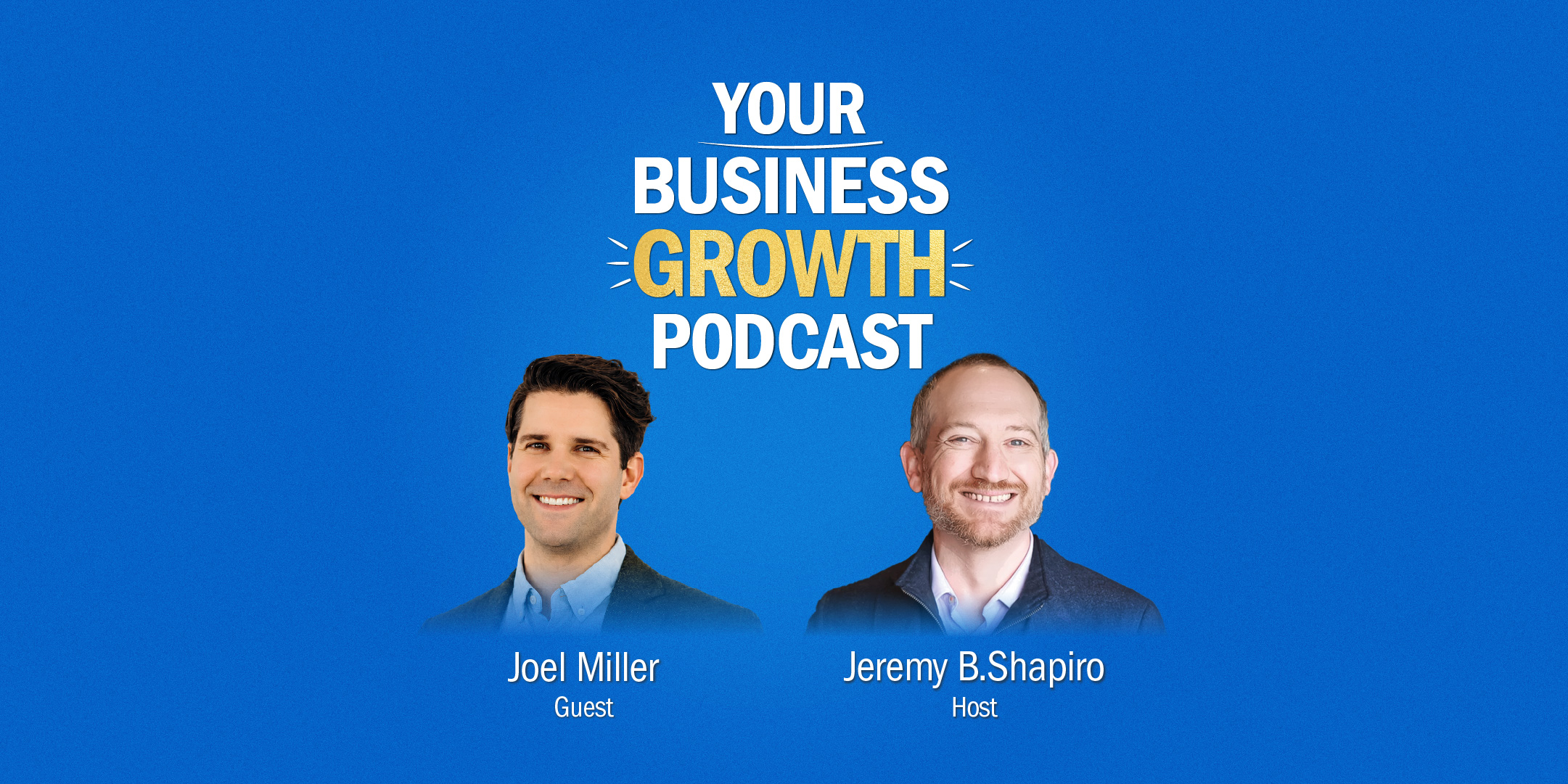
Welcome to today’s episode of Your Business Growth Podcast. I’m your host, Jeremy Shapiro, author of Your Business Growth Playbook, and my guest today is Joel Miller.
About Joel Miller

Joel Miller is co-founder of The Sky Floor, a boutique marketing agency he has run with his identical twin brother Alan for 18 years — two people, no employees, and consistent revenue growth almost every single year in business.
The Sky Floor works with service businesses: engineering firms, construction contractors, HVAC companies, occupational therapy practices, churches. Joel’s thesis is that most of these businesses don’t have a traffic problem — they have a trust problem. And trust isn’t solved with more spend or a bigger team. It’s solved by getting positioning and pricing right, in that order.
Early in the agency’s history, Joel and Alan were working 80-hour weeks, arguing with clients over hourly estimates, and grinding through projects for people who cared more about the rate than the result. Around year four they made a shift: stop billing for time, start pricing for value. The types of clients changed. The conversations changed. The hours came down. The revenue went up.
Today their average client has been with them for six years. Their longest client relationship is 12 years. They’ve had clients leave for large agencies, have bad experiences, and come back. The Sky Floor itself is the proof of concept: you don’t need headcount to build a valuable, sustainable business. You need the right clients, the right price, and the discipline to say no to both.
Connect with Joel Miller
Speed Round Answers:
- All In Lead Source: Word of mouth and relationships
- Books: Nine Lies About Work by Marcus Buckingham and Ashley Goodall and Million Dollar Weekend by Noah Kagan
- Unlikeliest Mentor: A friend who helped him be who he wanted to become
Like This Episode? There’s More!
Subscribe!
Your Business Growth Podcast is available on all major podcast platforms. Subscribe today!
Get the Book!
Pickup the #1 Best Seller, Your Business Growth Playbook today online or at your local bookseller!
Meet Jeremy!
Book your Blueprint Discovery Call with Jeremy today and get back to the growth you deserve!
Joel Miller Episode Transcript
Scale or die. You’ve gotta be bigger, bigger, bigger, bigger. If you’re not out there growing your business, you now have 18 years of evidence against that. You have to define success your own way. Maybe success isn’t building a 50-person team. You don’t have to accept that, this narrative. If you want to just keep it small and simple, but you can still grow revenue, you don’t have to do someone else’s version of your life.
What if you could grow revenue every year for 18 years with no employees, no outside investment, and a business that shuts off at 5:00 PM every day? Our guest today built exactly that, but it didn’t start that way. He spent the early years of his agency working 80-hour weeks, arguing with clients over hourly estimates, grinding through projects for people who cared more about the rate than the result.
Around year four, though, he made one change. He stopped billing for time and started pricing for value. The clients changed, the conversations changed, the hours came down, and the revenue went up. And the model he built with his twin brother has now outlasted most of the scale or die agencies that launched alongside him.
Welcome to today’s episode of Your Business Growth Podcast. I’m your host, Jeremy Shapiro, author of Your Business Growth Playbook, and my guest today is Joel Miller. Joel, welcome. Hi. Thanks for having me. I’m so excited to have you here. Uh, you and your brother, Alan, have done some really unique and interesting things with your agency that I wanna jump into.
Um, but let’s start with your brother. So you and your twin brother, Alan, have run The Sky Floor together for, like, 18 years. How did you guys get started in the business, and like, was it always the two of you? Was it gonna be something bigger? Like, tell us about the origin of all this. I mean, I think the origin is probably just us being womb mates.
Pardon the pun. But, uh, I mean, we spent a lot of time together. We weren’t those twins who were like, “We have to be…” We’re different enough, but we didn’t think we have to be separate from each other. Uh, we have to really define it, each other as, as such different entities that we didn’t like each other. So we’ve always sort of worked together and been creative.
In junior high, we were always coming up with business ideas. You know, we’re mowing lawns, making flyers, selling sodas outside our parents’ garage sales. And so the idea, I think, was always ingrained in us that- That we could find something people wanted and charge them money for it, and that seems like magic.
So I- it was almost a question of what will we do, and not that we would be entrepreneurs. Did you think it would be just the two of you, or did you invi- envision having, you know, hundreds of employees and, you know, all the rest of this? Like, what was the, the vision for what that might be? Just the two of us, honestly.
We’re not opposed to growing in different ways in the future, but in what we do now and have done for the last 18 years, the model of growing by hiring people just never appealed to us. And, and at the core of all that is just our twinship, uh, that we love working together. We like bringing our different perspectives together, and then solving problems for people and out in the world.
So, like I’m not sure that we had envisioned it any certain way besides knowing that that was gonna be the core of the concept. Now, did you two always lean into this twin angle, or is that a, a later development in the agency? It’s a later development. We did not really advertise that we were twins. We’re identical twins born on Leap Day to make it even more
I always joke, like, it may be known to the state of California to cause cancer if you switch between us. I don’t know how it works, but there’s like … Yeah, we d- we didn’t really, like, talk about it for some reason. And I think it was actually around COVID where, uh, through a mutual connection, we were asked to be on a PBS special about Leap Day, and, like, we’re Leap Day twins.
So we did a little video. People loved it. We ended up putting it up on the website. And then we were like, “Why are we ignoring that we’re twins? It should just be right there on the f- on the homepage in the, in the nav.” And so that’s what we’ve done since then. Yeah, you have a really neat page on your site talking about all these interesting stats about not just twins, but Leap Day twins and, like, the, the, the narrowing nerdy numbers of it, which I, which I really enjoy.
Yeah. I’m, I’m always like, if you find another agency owned by Leap Day twins, you should hire them, but introduce us so we can have the first, the world’s only Leap Day twin marketing agency conference. That would be a wonderful gathering of the four of you. Yes, exactly. So when you and Alan launched the business, um, what was the business model out the gate?
Like, how has that changed? How are you guys pricing projects, specializing? Like, tell us about the, the early years of the business. Yeah, the early years were basically, what can we … Who will hire us, right? You’re, you’re in that kind of just grind, hustle mentality. I gotta get some work and, and build a portfolio.
And we kinda … It started because we had people asking us, “Can you do this type of work? Can you do this type of work?” So it sort of went from, like, logo design and, and a lot of, like, Photoshopping of things to, “Can you make websites?” Okay, great. And then, you know, so people start asking, “Can you do Google Ads?
Can you do this kind of stuff?” So it sort of built organically that way. I don’t think in those first four years we were really super intentional a- about business building and working on it. It was more just that survival stage of, of, okay, this is sort of working. Let’s, let’s just keep pushing. Well, businesses in those earlier years are often doing exactly what you’re talking about there, trying to find their way.
What is that specialty? And you’re sort of saying y- yes to everything. So by a- around year four, like by your own account, you guys are working these 80-hour weeks covering all these different things your clients are asking you about. And, uh, what was that client experience like? What was the, what were those conversations like?
And what was the work life like at that point? Yeah, it’s terrible. When we were hourly billing, so everyone comes to you at that stage. And I don’t know, to me, it seems like this conversation isn’t happening anymore for anyone because we’re so far away from it and that no one asks us, “What’s your hourly rate?”
anymore. But But, you know, they’re coming to you and saying, “What is your hourly rate?” As if that’s, like, some sort of barometer for the value they’re gonna get out of it, which it’s not. It’s so arbitrary, right? Like, somebody charges $200 an hour. I’m charging 30. It doesn’t mean… You have no idea how long it’s gonna take someone to do anything, and that’s not what you’re paying for at the end of the day.
So it was awful because every invoice you send, you’re fussing over every line, making sure you tracked your time correctly or guesstimating because you didn’t track it that well or your, you know, context switching makes it hard. And then sometimes you send that out, and they write back and they say or call you, “Why did that take 10 hours?
It seems like a five-hour task.” And you’re like, “I don’t know. It just did. Like, what, what do you want me to say?” And so that is an awful experience to have to constantly be defending this thing that you’re doing, and you d- I… We did it well, but you’re still in defense mode. And we were like, “You know what?
There’s gotta be a better way to do this.” So how did you get out of that, like, debating hours with clients space? I don’t know if I read, uh… I don’t know if you’ve ever run across Jonathan Stark, uh, but he has a book called Hourly Billing is Nuts and a great daily email that he has. Um, and I, I started… I ran across him and started thinking, “He’s right because I’m living this hell.”
“So it is nuts. How do I get out of this?” So I think I read his work and started just thinking, “We need to get out of this-” just cycle of, of doing it this way. And it became clear that we were talking about the wrong things with our clients. So instead of just coming, them coming to us and bringing a laundry list of things to do and us saying, “Yeah, we can do that.
Yeah, we can do that. We think it’s gonna take this long,” we started taking more of a strategic angle. So why do you want us to do that? What do you really need right now? Why are you trying to hire us instead of anyone else? Uh, have you thought about doing it for cheaper or for free with a free option? So like really diving in and so almost like it’s not mind games, but it’s, it’s essential to To ask a lot of probing questions in the very earliest processes so you understand exactly what they’re looking for, and then you can answer the real question, which is what outcome, what value am I providing to them?
And is it valuable enough to them that they’ll pay a premium price and stop asking how long it took? Yeah, now a piece of that comes down to this idea of, like, controlling that conversation. And you and I have talked about this, you know, previously, and I thought this was a really interesting approach you guys had, that you previously had clients who would be saying to you, like, they’d be setting the terms and the parameters, right?
Like, “We need a website and AdWords, and can you do this, and, and, and,” and you kinda just have to follow along. That’s how you get paid. You shifted that in terms of who controls that conversation. Tell us about that change and how that has worked out better, what the challenges were with, with that. Like, catch us up there.
Yeah. The chal- I mean, I think the number one challenge to asking a lot of probing questions in the initial client call is when you first start doing it, one, it feels a little bit, like, awkward or dumb, ’cause I, I also … You have to ask a lot of stupid questions like that you might actually kinda know the answer to already, but you don’t learn anything by not putting it out there.
‘Cause, uh, oh, 90% of the time someone says something surprising when, uh, I think I know the answer already, even if I knew the first part of it. So there’s that awkwardness to get over, and then just confidence really. Like, you can, you can actually ask anyone anything you want. If they don’t wanna answer, they’re not going to.
But it’s amazing how often they’ll tell you something you wouldn’t think they would share just by throwing out … I mean, something as, like, “All right. That division, how much money is that division making in your company right now?” And it’s like, “I just met you. Why are you gonna tell me that?” Well, if you … I just sit there and look at them.
They’re, they’re like, “Okay, I’ll tell you.” ‘Cause, because it, like, leaves that pause. And, and that also does something which is form that trust layer very early on that, that they’re like, “Okay, this person’s asking these questions not ’cause they wanna rip off my business or understand it or copy it. They wanna know how it works so that they can help us.”
I, I don’t know if this explains … You know, you and your brother as kids, but I was always one of those kids asking why, why, how, what, where, who? And maybe to the annoyance of adults around me, but it’s, I think, one of the ways we explore and better understand our world. And even now, like, whenever I hire, I always wanna know what questions people have.
And when people don’t have questions, that makes me nervous and uncomfortable because I’m wondering, like, well, why wouldn’t you have questions about your career? Don’t you wanna know things about this? So, like, question-asking I think is so valuable, and I even view as a sign of intelligence, of curiosity, and, you know, a lot of really good positive things.
Yeah. This magic thing happens when on a inquiry call, if you’re asking a lot of questions and you can get the client to talk, like, 75% of the time, 70 to 75% of the, the call, at the end they think that the question-asker is a genius ’cause they got to share all this stuff that they’ve been thinking about- And, and it’s so counterintuitive because when you first start out, when we first started out, it feels like I have to be on this call to impress them.
I have to be on this call to s- to show my expertise. And actually, like, you show your expertise by asking the right kinds of questions and then doing really a good interview. Can you imagine, like, walking into the doctor’s office and you walk in like, “Here you go,” and they hand you a pill. You’re like, “But don’t you wanna know what I need?”
Like, “All right, fine. Here’s one question. All right, here’s a pill.” You’re like, “Eh, this is not quite working. We, you know, we want the questions so we can get that personalized, um, prescription, that solution that’s just for us.” So really, really well done. So was there a, a moment during this change where you realized, like, this hourly billing model of just doing everything that the clients are looking for, that the whole model is broken?
Like, did that only scale to a certain point? Like, did that hit a, hit a wall? It definitely hit a wall of just pure frustration, but there’s no, like, cutoff for when we just automatically started doing project-based, value-based billing. And, and that’s because, like, even though we transitioned some clients, a lot of them were still stuck kind of in that way of thinking, ’cause, you know, they came to us thinking that way.
A lot of times, I- in our experience, not everyone, but the people who are focused on the hourly rate and how many hours everything took tend to be in a scarcity mindset in their businesses and in their lives. And so they’re not quick to, to be like, “Now what do you want, you doing? You’re saying you want me to pay you a certain amount per month, or you’re saying you want me to,” whatever.
So what ended up happening is that we started getting a lot of new clients on this n- new billing way of, uh, system, and some of the old people kind of had to fade off over time. It, it just was a natural and slow progression. You know, it might have taken two or three years fully until it was like, I haven’t thought…
Made an hourly invoice this, this month, and that feels so good. Yeah, I was gonna say, that’s probably a good thing, um, for, for you guys and for them. So we get it. Hourly, not great. There’s a lot of limitations and challenges and frustrations there. Um, how did you figure out what you’re moving to? Like, how do you price the results and the value you’re bringing your clients?
And most ideally, you do it by understanding the business outcome that you’re providing them. And so i- uh, I’ll give you the idealized version with some fake numbers, right? If you come in and you ask some, the right questions and you’re asking them, “Well, in a year, what do you expect the outcome will be if we nail this project?”
And they say, “Well, we think we, we can make 100,000 more dollars.” Well, and that’s year one. So now if I charge you 50, you know, maybe hourly that would’ve been a $5,000 project, you know, it could be that crazy, and I can charge you 50 and I can demonstrate over that year that you’re making double that and then more in the future, you know, then I, then I, I, I have a baseline for pricing that out.
So I really look at it as like a multiple of what I think the business outcome will be. And, and sometimes, you know, it comes down to like- other factors and other things, but that’s like my, uh… And there’s some gut in there too. There’s a little bit of an art to it, but, but that’s like the, the baseline thinking is like, can I demonstrate this provides what kind of value?
And then I wanna make it profitable for me and profitable for them, and we all win. Well, that also sounds like that changes even the kind of work you’re doing, that before if you had someone coming to you saying, “Hey, can you Photoshop this? Can you make a website?” Those are all, like, things, but we’re not looking at the impact it has.
Now you’re needing to find the impact and result it will get for your client and do those kinds of projects. How have you asked the right questions a- and structured things so that you can demonstrate that? I mean, essentially what it comes down to is that if someone doesn’t want that kind of work from us, I don’t think we’re a fit anymore.
Because I’m not… It doesn’t, it’s boring to me to just make things or just… Like, I’ll always interject a little bit of what I think they should really be doing, but, like, I wanna be in the strategic conversation with their, well, whoever it is, but someone on the executive team typically, who is trying to make the decisions that actually move the needle for their business.
And if I don’t get to be involved on that level, I’m usually not interested anymore. And so it kind of goes hand-in-hand. I don’t know which, the chicken or the egg there, but, like, if since we’re in those types of- conversations, and that’s the only thing that interests me, that’s we basically say no to any project that is just a deliverable and not based on what outcome’s gonna have come from it.
Now, if I’m looking to work with a vendor and one of them is just saying, “Sure, I’ll, I’ll do whatever you need me to do. Don’t care, I’ll make the money,” and someone else is saying, “Hang on, I only wanna work on things that are gonna make you money and grow your business,” who do I wanna work with, right? The one who will just get on the grunt work or the one who’s gonna help me grow my business?
So really, really good differentiation and pivot there. Yeah, yeah, exactly, and I think that’s right. The other kind of person … I mean, hopefully your employees do that too, but that just, that sounds like a junior ac- someone just who executes, you know? And that’s, you can hire that person. If you’re getting outside help, it better be able to
Someone who can give, bring a new perspective that actually moves that needle for you. And that is worth so much more than a salary, than, you know, a, a, a, a boc- a, a rock pusher, you know, and so forth. So all right, shifting over just for a moment, Joel. You know, your wife Kate, um, you shared with me she’s a wedding photographer and went through this interesting change in her business, which, which feels like I should be talking to her as well.
But, um, you shared the story about how she had doubled her prices overnight, and on the one hand that’s a strategy we talk about all the time, you know, increase your pricing, but there was, like, the, the terrifying negative outcome that I think people fear that came with that, and that came true for her.
That the leads just, like, dried up completely. But then slowly rebuilt at a higher level. And you guys, you and Alan at The Sky Floor, went through almost that same arc. Tell us about that transition period of increasing your pricing or making a pivot like this and seeing the change in leads or lead flow, you know, adjustments.
What was that like for you guys? Uh, and, and it’s a little different with the photography business. That had, like, a constant string, uh, of leads coming. Like, the volume I think in the seven years that she was doing it, we had something like 5 or 600 leads come through. So it was a lot. Like, it was more like how do we filter these people out more than anything.
So and price, and publishing price became a, a, a method for that, where as at first we were, like, keeping it kind of hidden, and then we were fielding so many calls and meetings where we had to discover that they could never afford us. And so you’re like, “All right. I gotta put some kind of filtering up here.
I can’t do this level of, of work.” So for us it’s a little different because while we get a steady stream of leads, it’s not like people looking to get married, and it’s much higher ticket, uh, prices. Uh, so the … Yeah, I mean, the, the, the arc is that you, you have to feel out who your current audience is, and you, it tends to grow over time.
It has in both of those businesses, where we Were with, like, people who had a cap of what they could afford no matter what, right? Mentally. And so a lot of times in the way that you ask questions, you can sort of get a, a feel for that and then price it accordingly. But as you kind of start pushing the envelope, you start meeting more and more people in their spheres who expect that the work, valuable work is, is costly, I would say, not expensive.
Um, it costs something because it’s an even exchange. So, so yes, there’s like a transition period where, like, now if you told 10 years ago me what we’re charging per project, I would be like, “That’s impossible. That’ll actually never happen.” And, and now we’re routinely doing it. And so it’s like, yes, you have to.
There’s a little bit of a journey. There’s a pathway to get there. There was a, a client I was working with who was on site working with a client, and this was a bigger company. And so the CEO found out at that point what the company was paying her and was like, “That’s not enough,” and like turned to his assistant and was like, “You need to pay her a lot more.”
And no matter how much we talked about, “You should be charging more,” it wasn’t until a client was saying, “No, we’re underpaying you. We need to pay you more,” that it kinda clicked for her to realize, like, “Oh, I guess I can be charging more.” So your, your 10 year ago you, like how, you know, w- what needed to change from there to now that got you comfortable at the higher price points?
Well, some of it is just, like, getting over some mental roadblocks, and I don’t know, like, what it is. Maybe it’s just kind of being a, a nice guy or like growing up with some kind of notion of morals and values. I don’t know. Like, I’ve never been, like, a shark kind of person, so I’m not… I don’t approach most relationships wondering how much money can I get out of them.
And so there’s, because of that, there’s this, like, underlying, and someone listening to this I’m sure has had this experience, this underlying kind of guilt complex sometimes when you start asking for more money than you ever have, thinking like, I wouldn’t even say it’s imposter syndrome, but you’re just like, “Is this Right.
It feels weird to, to put that out there. So I, I have a few little tricks that I did back in that era to overcome some of those things. One was to create my whole proposal and then sit on it for 24 hours, and then at the end of the 24 hours, I just add 20% before I send. And I go, “All right. Well, if they don’t book, they don’t book.
I, I have work. I don’t need this.” So, so you start to just, like, taking, kind of being, uh, disciplined about the idea that I’m worth a certain amount and I’m probably undervaluing as I’m getting over this complex that underlies some of the psychology here. And then the other one is just if I’m nervous about the price, I mean, this doesn’t really happen anymore.
Um, but if I’m nervous about the price, I’ll do a scheduled send on the email that contains all the information so that I know it’s gonna go out in three hours and I’m gonna go do something else. And it takes just this weird little bit of, of pressure off of that pressing that button and feeling like the world’s on the line when it’s not.
It’s not. It just puts it into perspective. Those are really good tips. You know, we often talk about when you increase pricing to, especially if you’re presenting verbally, right, or in person, um, versus in a written proposal, of practicing. You practice f- it, you practice it in front of the mirror until the words come out comfortably and you don’t, you know, throw up in your mouth or laugh or stutter over it.
Um, and what you’re talking about of taking that number, adjusting it. It’s okay if it’s uncomfortable. Sleep on it. Delay the send. You know, do something to give yourself a little space from it and, and find that comfort. So, um, a- I’m curious. You, you touched on this earlier about, like, publishing prices versus not.
Like, what are your thoughts on On the website, you know, upfront elsewhere, giving an indication to roughly where you’re gonna come in price-wise with clients to sort of disqualify or attract the right clients. I think it’s a good thing to do most of the time, honestly, on some level. Like, it hasn’t ever stopped the conversations that we need to be having with a potential client.
I’m sure it’s filtered some people out, but we tend to think of only the negative impacts of this kind of thing. “Oh, if I put my pricing up, I’m gonna stop a conversation from happening that, that I might have had and maybe I could have sold them.” Well, maybe. Those usually aren’t the best relationships either, though, if you have to really work hard to get them to say yes at a certain price.
And, but on the flip side of that, someone may have a budget in their head already, and if they see no pricing, they either assume it’s way too expensive, so maybe beyond their reach, or they assume that they don’t know, like, that you’re actually … ‘Cause co- like, price is a, is a value signal, and so they might see nothing there and, and then have no information.
They might see your price and then go, “Oh, they’re, they’re charging that much? They’re w- probably worth it on some level. I should find out more about this.” So it doesn’t always have to go negative, and I think there’s something to adding that filter out there so there’s a expectation that you’re, you’re worthwhile.
That’s smart. Are you enjoying this episode? Make sure you hit that subscribe button right now. That’ll help you get more episodes automatically as soon as they come out. So hit that subscribe button right now, and if you have a minute, leave a quick rating and review. That helps support the show. Yeah, you know, I’ve definitely played with it both ways with clients and my own businesses over the years about publishing the price very clearly upfront and everywhere, and using that to qualify and disqualify, versus tucking it one level back, versus not having it until a pricing presentation and so forth.
And I, I’ve found that the higher the price point, the more premium the service, the more it makes sense to be a little more upfront with what caliber you’re working at. Um, that’s great. Uh, I also found it fascinating. We’ve had times where, like, even on the landing page, we have the price point. On the application form, we have the price point.
On the call, the sales call confirmation page, we address it. In the follow-up email, we do, and then what’s one of the questions on the call? What does this cost? I’m thinking like five different ways we’ve covered this. To avoid there being any surprises. You talk about sometimes that, uh, we ask these dumb questions, or I sometimes think of them as like the Columbo questions, right?
Those, those, uh, questions that sometimes I even preface with, “This may sound ridiculous, or this is maybe a dumb question,” right? To kind of soften it. But you ask the question and let that silence sit, and that often works so much to our advantage. W- what have you found like, what are the things clients tell you in that silence that maybe they didn’t wanna tell you, and what’s been the value of that?
Yeah. It’s typically that they end up revealing something that is, I wouldn’t call it confidential, but something that you would think someone would wanna keep a little closer to the vest. I think it really is like 75 to 80% of the time those questions get answered instead of dodged, especially if you like maybe sometime it like gets skipped past and then you k- circle back because the same topic came up.
And so… And it’s usually a follow-up question that I’m talking about. Like, typically the dumb question is the gateway to that next ask. And, and then I wish I could, like, think e- exactly of a specific ex- uh, example, but it’s, like, typically something that I’m surprised that someone would admit to. Even if it’s a good thing.
But that gives you information to tailor your proposal and the future work in a way that makes you look like you’re clairvoyant. ‘Cause a lot of times they don’t even probably remember that this exact thing came up in the exact way it did. And so when you start to address that deeper pain point based on real information, it’s, it just demonstrates that you listen and that you know how to solve the problem for them.
I’m always amazed when I have an idea in my mind and I’m like, “Hang on. Don’t say it yet. Ask some more questions.” And you do, and you realize how off-base you were. And you’re like, “Oh, thank goodness I didn’t open my, my mouth and, and make that statement or try and solve that problem or offer that solution because that was so off-base.”
And it’s a good reinforcement to ask those good questions. Right. It almost always brings up something else, too. Like, if you’re the sort of person who maybe you don’t think of add-ons, uh, something that you can offer up in addition to what you were planning on offering and that they’re asking you for, those kinds of questions will almost always surface something that’s like, “Oh, this is…
Yeah, we’ve tackled this same thing for another client, and now I know you have that issue, so we’re gonna … We’re, we can help you even more.” And that’s like, again, it’s … That’s exciting usually to the client, not like, “Oh man, this guy’s just a sales guy.” One of the things I’m hearing as you, as you’re talking about this is that, uh, this relationship building even upfront, it’s not just like someone goes to the website, clicks add to cart, they buy now, and, and you do something.
There’s actually this relationship building from the beginning that goes on from there. And often with agencies, we see this sort of transactional relationship, and really what you developed is these long-lasting client relationships. I think you shared with me that, you know, your average client tenure is around six years.
Some of your clients with you for, you know, 12 years or more. Like, how do you How do you get those relationships to stay with for so long? ‘Cause that’s incredible for your customer lifetime value. It is, and I think it just comes down to building trust and, and s- and staying honest. We see so many agency relationships that we’ve come in afterwards or alongside for a time, and there’s
It, it gets quite toxic sometimes on both sides of it, where they’re … People are making a list of wrongs so that they have the, the … It’s like a bad marriage. So they have the thing, when things go wrong, they can pull out the list. “Well, you did this that time. Remember that?” And, and then there’s all the spinning that happens, like, there becomes a lack of honesty a lot of times on the agency side, ’cause they want everything they’re doing to look good.
And, and we all know on the service provider side that it’s possible to do that. We can tell a lot of stories with data that may not actually be the honest story. It may … I’m not saying anyone’s lying either, though. But w- we overcome those things and build those long-term relationships by being honest and open and saying, “Here was my assumption.
This one didn’t work. Here’s why. Here’s what we think we can do next time.” And just being willing to, like, bring anything and everything to the surface, and even when it looks bad for me, and that means they come back for the next project over … And we’ve had people come to us and leave and then come back, and that’s one of the reasons they came back, ’cause they didn’t have that with the in-between agency, and they desired that ty- type of partnership.
I’m also guessing you don’t just yes your clients. You might, you know, a- ask them uncomfortable questions or say unpopular things from time to time? Definitely. Yeah. Oh, yeah. I g- … Oh, there’s a lot of times where I’m on a call and I’m like, “Wait, what? Why does that work that way? Has anyone been asking that?”
‘Cause we should be. Nothing should … There’s no sacred cows in my view, whether it’s my idea or someone else’s. The only thing that matters is where we’re headed. And, and if something isn’t getting you there, it should be jettisoned. It’s not, it’s not worth keeping just for ego. Well said. Now, with a higher customer lifetime value and clients who stick with you a longer time, that opens up a lot of different possibilities.
What have you found starts to become possible when you have these longer term relationships and clients who, you know, have a … not just recurring billing f- with retainers or ongoing projects, but have this length of time with you as you’ve seen their business grow alongside you for all these years? What becomes possible under that scenario?
Our longest term clients are the ones where we’ve learned the, the new skills most frequently. And so … And that’s because if someone comes to us and they say Have you done this kind of thing before? And the answer is, “No, but we think we can.” Some of them will say yes, but, uh, most often they’re like, “Ooh.
Okay, that’s … Hmm. I have to think about it.” But if I’ve been working with you for five years and I see a new gap that has nothing to do with something I’ve done before, but they already know how our brains work, how we think, how we problem solve, they’re so much more likely to say yes. And then the beautiful thing about that is you get to usually earn a little bit more business from them.
If you follow through on that and they love it, they just think you’re even more of a genius, and now you have … That skill has been hardened up in a way that you can offer it to the next client. Yeah. That now becomes that upsell, next project, add-on, so forth for the entire client base and, and new clients.
Uh, it’s so well done. Now, not everything lasts forever. You’ve had clients who’ve, you know, left for various years, like we all do in any business. There was one story you’d shared about a client who left for not working with Leap Year Twins, but the alternative of a 50-person agency. Spending a ton of money over there, but then, like, a few years later they circle back to you guys.
Like, what did you learn from that experience, or what did they learn from that experience of trying out the, uh, the greener grass? Yeah. The, the call when they came back was essentially, “Things are going in all the wrong direction, and we thought we needed a more full service experience with more staff and, and we were wrong.
Like, we, we remember that there’s some of the things that you o- offer that we never took you up on. And, and h- having such a good experience with the work you did do and then this experience, we wanna know if you’d be willing.” Like, it was more of, like, you know, “We left. Would you be willing to take us back?”
And, and I always liked working with them. And one of the things we do is we don’t burn bridges in these situations. We’re very clear on that. We have no hostage situations, we call it, when it comes to our work. So we make sure that the client owns as much as they want to own. And then when there’s a transition, like to this other agency, I was on the phone or on Zoom with that agency over and over again to help them get the assets and the things that we had the keys to.
And so all of those things just, like, build up that I can return to you and maybe even, like, put u- us at the top of the list for that, ’cause it’s happened before. And then what they learned, I think, is just, like- And it’s not for everyone, and there’s probably some agencies out there nailing it. I don’t know.
But they learned that some of the things I don’t like about the big agency model, which is things getting miscommunicated when you only talk to the owner or someone on the executive team when things are going wrong. Uh, it takes too long usually to turn an idea around, and this is a business with some time-sensitive concerns sometimes, and the 50-person team can only get to it three weeks later.
Uh, so they learned that all of those things are kind of our main pitch. We work with you. We own the work. We’re nimble and flexible and, and speedy, uh, that we follow through on those things. And so we’ve been now with them for another three years. Since we took over that w- we … Leads are up 40%, and their revenue, which halved after COVID, is about to hit their all-time high.
Outstanding. What a great turnaround. Um, so I, I wanna just double, double-click into something for our listeners. You shared how, you know, it’s not about having long-term contracts that they can’t get out of or holding their assets hostage or doing any of these things that can keep a customer with you longer but don’t really support a good, healthy relationship.
And you sorta took the contrarian opposite side of like, “Look, all, all the stuff is yours. The, the only reason you should be, you should be staying with us is because we continue to deliver value.” And that really helps you guys to not burn bridges and, and stay well-loved by your clients past, you know, and present.
So that’s, I think, a valuable strategy. So speaking of value, um, one of the neat things you guys do is you do learn when something new comes up, and that helps you as a business grow and helps your clients. Um, and when you see things, you proactively jump in to help out your clients. And there was a story you shared with me about a CRM situation with one of your clients where the way it was set up was just a mess.
And even though this wasn’t really your wheelhouse or thing you commonly do, you got proactive about it. Tell us about that, that CRM fix and what you did there and what that meant for the client. I mean, basically they have a Salesforce instance that has been modified and customized so many times over the years that it’s probably about 50% cruft.
There’s fields in there you don’t, you know, need … you’ll never use, but they’re still present and, and it really wasn’t made for how their business operates. And there’s so many slapped-on add-ons in order to get anywhere close to how it should function. So I’m watching this over the last few years just going like, “This is driving me as mad as it’s driving them.”
So I’m, like, taking notes this whole time. Every time I hear a problem, I’m like, “All right. I’m gonna remember that or put it into my note And then one day it just occurred to me that, uh, I can probably make a demo of something that behaves much better than what they have. And maybe it’s a future project.
Now, it’s a little… I don’t believe nec- typically in mowing someone’s lawn and then sending them the invoice. Like, “Hey, you owe me money now ’cause I did the thing.” But I have such a long-term relationship with this client, I thought it was worth the risk. So I spent quite a bit of time. I mean, I think I w- had, like, something like 350 code commits on the project before I showed them anything.
So I spent a lot of time on it, but the point was I wanted them to be able to see what was possible, and I didn’t think, knowing them, that, that it was going to work if I just described what was possible. And so it’s, it’s happening. I mean, we’re, the, the project is signed, and we’re, we’re working on finishing things up.
It’s gonna take a while to transfer everything, of course, and all that. But, but yeah, so, like, I was able… And they, the things that they said about it, I should… I mean, I think I need to put them on the website because it was so glowing just that we observed their problems, took good notes on it, and then came up with real solutions without them even asking.
So where does that instinct come from? ‘Cause I, I don’t see that in many businesses. I don’t know. I, I think some of it’s personality. I mean, that’s kind of like, not to get too far into, like- I don’t, I don’t know. I think you can change these things, but I’ll… The only thing I can think of immediately, if you ask my wife, this is how I am in our marriage too.
So, like, I, I just love, and with my friends, I love s- looking and finding the problems that people are having or the needs they have and trying to meet them, and I just imply that same thing to our, our business. I’m like, “Well, I’m in a relationship of a type with you, and so if you… If I’m seeing this problem and I know I can fix it, it would be weird not to.”
Got it. So what I’m hearing is, uh, Kate loves when you just solve problems for her? Yeah, yeah. So speaking of family, um, you observe something, uh, that I f- find so valuable and I learned in my own life and m- my relationships over the years, um, is that you turn it off at 5:00 PM. No notifications, not after hours, not on the weekends.
I know my own story behind that, and I love when other people sort of see that light. What had to change, like structurally, mentally, business-wise, personally, whatever, for that to be a reality that you could turn off business hours? I think before it was even possible, I did turn off the notifications. So I was like, “I can’t p- keep getting…”
And people can get to us in an emergency, but I can’t keep getting notifications on my phone all weekend long and every night after hours. That’s taking me away from dinner. So the first step was just saying like, “I’m not going to get these.” And what’s interesting is that you start to set the expectation that that’s not gonna happen anymore, and so clients stop thinking they should try it.
So there’s one layer of that. They… It starts, they, they limit themselves because they know I should only reach out in a true emergency. Uh, but the other thing is just tied to that idea of value pricing and getting out of this like, if ev- if the only way to produce more income for yourself is to work more hours, then you’re gonna start overworking.
It’s like, because it’s not… And you can’t just go and say, “I’m gonna raise my price from $30 an hour to $50 an hour.” None of the clients you have will bear that typically. Maybe, you know, 5% of them. So you know you can’t do that, so you’re like, “I gotta just work my butt off.” And that isn’t tenable. You can’t, we can’t keep doing this.
It’s, you, you will just burn out and die, and a lot of people do. So getting to that point where we’re filling out and then some our income without h- when it’s not, it’s tied to what we deliver and not how hard we work at it means … And we work hard, but we work s- efficiently and smart, and the client doesn’t care ’cause we’re focused on what we’re giving them, what they get from it, and, and not just how long did you push the buttons.
It all comes down to that result and what we call value-based pricing. Um, you know, I think back to when my wife and I were first dating, I think it was, like, our second date. We’re out for dinner and, you know, my phone buzzes and I look down, and I get back to a client and put it away, and I think it buzzed, like, a second time and I’m like, “What am I doing?”
Like, I’m sitting across the table from this beautiful, amazing, interesting, incredible woman, uh, and I’m, like, half tuned in. Like, everything is wrong with this. And it was really one of those, like, deciding moments. I’m like, “Oh, well, well, that’s done. I’m, I’m not, you know, taking calls or texts after 5:00 on the weekends and all that.”
And it was just over. And, and much like you said, people are, like, terrified about this idea, but you, your clients realize, like, oh, yeah, I’ll hear back in the morning. Like, I’ll, I’ll hear back when he’s, you know, back in the office. Um, and that’s an okay thing. And you might actually be helping them because some of, right, some of them may be stuck in the cycle where they’re working all the time.
And maybe that doesn’t change it so that they aren’t doing that in every facet, but now you’re not one of the pieces of that- … problem for them. And I really think that’s something, to, like, take a, something off their plate after 5:00 too. Yeah. I, I remember there was a vendor we were working with in one of her businesses years ago, and she would almost get annoyed if she got a message or an email or something outside of her, her o- She was off, like, a f- two or three time zones.
If she got a message, she felt she had to get back to us, and she was trying to make it, like, our problem. Like, “Hey,” like, “when you message me in the evenings and weekends,” like, “I need to get back to you.” And, and I was sort of thinking, like, I feel like that’s, that’s your boundary to enforce. Like, you shouldn’t be looking at these messages.
When we send an email, an email is an asynchronous thing. Like, that’s just meant to be in your inbox on Monday, you know? It just, if you’re offline, like, that’s okay. We respect that. But don’t make that on us. Like, it’s okay to have that boundary. All right. So we often hear in the world of business, you know, there’s endless videos on this and content which annoys me about this scale or die.
You’ve got to be bigger, bigger, bigger, bigger. If you’re not out there growing your business, your competition’s eating your lunch, and all this, like, really toxic scarcity nonsense Right? There’s only so much business and someone else is taking yours. So it- especially like in the agency space, it’s almost like a religion there.
You now have 18, 18 years of evidence against that. What would you say to, you know, a business owner who is sort of stuck in that bubble and that belief system of scarcity and scale or die? Yeah. I think it’s that you have to define success your own way and what a win is for you. And so if you’re feeling that tension, you…
Maybe success isn’t building a 50-person team, and that’s okay. You don’t have to accept that this narrative that f- sometimes it feels like it’s being pushed on us. I mean, it took me some years to feel like I wasn’t a failure because I didn’t, you know, I wasn’t a billionaire by 30. I mean, I’m joking about that, but we all read these Forbes articles and things that, like, are so glowing and definitive about certain ideas that it feels like it’s impressed upon us, but you don’t have to listen to it.
And if, if you want to just keep it small and simple, but you can still grow revenue, which we’ve proven, with other mechanisms, do it. Don’t… You don’t have to do someone else’s version of your life. You can pick your own. Yeah. That’s really well said. Um, I… And I think when you’re in it, it’s hard to see that.
And so when we, when we have the examples that prove otherwise, like yourself, that’s powerful. And a question I always love to ask, not just in business, but even socially or on vacation or with the family, and this may sound ridiculous, but is asking about what that definition of success is. Um, and for me, like one of the first times I heard that is I was heading away on a weekend trip to a friend’s lake house, um, and she asked us, like, “Hey, before we all head away for the weekend, like, uh, what’s your definition of success?”
I’m like, “Uh, I thought we were gonna be hanging out.” Like, but it was really valuable because one person’s like, “For me, it’s, it’s playing games.” And someone else is like, “Oh, I wanna go on hikes.” And someone else like, “I wanna go in the lake.” And someone else, “I’m cooking meals together.” And once you saw all that, I was like, “Oh, well, we can do all that, and now we get to the end of the weekend and everyone can say, ‘Yeah, my box got checked.
I got the thing I wanted,’ and a bunch more,” as opposed to not knowing what success is and then feeling at the end of the weekend disappointed. And so in business, with family, with trips, all this stuff, it’s a really great question of what is our definition of success? Right. And it’s one to ask your clients if you’re in a service business, right?
Because if they can’t def- if they can’t tell you that, you can help them, and I think that’s worthwhile. But if you enter into an engagement without anyone knowing what it is expectations will be missed, and there will be disappointment on both sides. Agreed. And if in your business you don’t know what success looks like, you will forever be following someone else’s example, doing what you see others doing, and not hitting any measurements of success because it’s not defined.
So all right, before we get to some of my, uh, my fun rapid fire questions I have for you, um, if you’re talking to a business owner right now, maybe they have a service business, they’re still billing hourly, and they haven’t really made their shift, what’s the first thing you tell them to do to, to start to make that transition out of hourly pricing to value-based pricing?
Well, I think first off, if you, if you change your default mindset so that when someone… And this actually goes deeper. If someone asks you on any call or inquiry what you charge right away, if you… The hourly billing notion tends to offer that information right away very quickly, ’cause it’s like, “I know what I charge.
We charge $50 an hour,” or our senior people get whatever. And so change your mindset th- so that pricing isn’t even on the table, and take it off your website if you have anything on there. This is a time where I’m gonna say get rid of it so that you don’t have… You’re not setting an expectation that, that this is how you bill anything.
And if someone’s asking early in the conversation, there’s no way you can possibly know what it’s going to cost typically, unless it’s a productized thing, because you, you don’t know what problem you’re solving yet, and you don’t know what it means to their business. So I think it’s really just like that full reset when you come into a conversation, and you don’t even have to go so far on that first conversation to even know what you’re gonna say, because that’s a- actually a later part of the process typically.
Money’s off the table. You’re there to discover things. Start it on the next inquiry call, and, and then start building from there. Yeah. What I’m hearing there is thematic to what you were saying, uh, earlier, Joel, as well, is that this comes down to asking good questions, right? “I don’t know what I charge yet, ’cause I don’t know what you need yet.”
Right. Right. You’re not there to be interviewed about what you do and how you do it and what it costs. You’re actually there to interview the person who has the problem, and y- and you’re not trying to win their business, because it’s not… The person with the paycheck doesn’t have all the cards. You should be valuable enough in what you offer that it’s worth the money you think it is and more, uh, and it’s an exchange then.
Love it. All right. A few quick rapid fire questions before we wrap. If you had to start all over again from scratch, what one lead source would you go all in on? I think probably the same thing that has worked all these years, which is word of mouth. Well, how do you start word of mouth? You have to find connections where you are.
And I, I just realized this the other day, ’cause someone was asking me, “How do I start?” And I was like, “Well, there’s people in business where you live, and so… And you, you’re at a starting point. You can charge more than you think, but probably not as much as I am. So if you go to the chamber of commerce in your town and start shaking hands, is that old school?
Yes. Will it work? Yeah. You’re gonna find someone who needs your service, you’re gonna start relationships, those connections will grow, and eventually that’ll become business around the country if you work digitally. But you gotta start somewhere. Start around your, around the h- the corner from where you live.”
Well said. Uh, books-wise, you know, you have a wonderful bookshelf behind you, as do I. You know, we’re, uh, most business owners, we’re avid readers. Um, aside from, of course, your Business Growth Playbook, what are some of your top favorite business books? Uh, I’m gonna go with Nine Lies About Work always comes up f- in my head.
Uh, even though it almost doesn’t apply to what we do because I don’t have employees and it’s a lot about teams and, and that kind of structure, it still gives you a window into the psychology of the types of businesses we work with and, and what really works and what doesn’t. So I love that one. Uh, I love, uh, Million Dollar Weekend by the guy, I can’t remember his exactly, I think it’s Noah something, who runs, uh, AppSumo.
And that book is great just because he’s like, “You have an idea, test it this weekend. Pre-sell something and see if it has any legs and value to the audience you’re trying to reach.” I think that’s brilliant. If you’re interested in entrepreneurialism, that’s, that’s a great book. Read that one. Um, I could keep going, but I’ll stop there.
Those are great, and I absolutely have tested ideas out and launched multi-million dollar businesses over a weekend just testing, so that’s awesome advice. Um, excellent. All right, last rapid fire question for you. Who was one of your unlikeliest mentors? A story that comes up immediately is in high school we had, like, a f- big conflict in our friend group.
A- and one of the girls in the group was the one who came to my brother and I, because we were both involved, and said, “I know who you say you want to be, but are you actually acting and living out the way you wanna be?” And, and we were like, “No.” And so she facilitated a reconciliation with some of the people involved, and, and that’s always stuck with me, just, like, the courage in high school to, like, come to some of your guy friends and be like, “I’m calling you to the higher thing you already say you, you, you believe in, but…”
Wow. What a, what an incredible friend to have had. That’s beautiful. All right, so Joel, to recap for our listeners, you guys spent the early years grinding it out through these 80-hour weeks with clients who cared more about the rates than the actual results, and around year four, you made this really key shift from hourly billing to this value-based billing.
And then everything downstream from there changed. Better clients, fewer hours, longer relationships, and a business that now has that average client tenure of six years with no employees and consistent year-over-year growth for 18 straight years. Yes. Yep, exactly. That’s our story. And for listeners who wanna learn more about you, Joel, where should they go right now?
Head on over to theskyfloor.com, and that’s our website. You can meet Alan and I on there. Uh, start a conversation if you want. I, I blog semi-frequently, not as much as I used to. And there’s … Just look around and get connected. I’d love to t- to meet you. Outstanding. That’s theskyfloor.com. Joel, thank you so much for taking the time to share with us your journey.
Congratulations on these 18 years, that year-over-year growth, and for doing so many things right, creating your own definition of success, and really just delivering again and again for your clients, and finding those key ways to adjust your levers and increase not just the amount of the transactions but also that frequency of the transactions.
So, so well done. Thank you so much for having me. Thanks so much for listening. Quick reminder, hit that subscribe button right now so you can get more episodes when they come out automatically, and remember to leave that rating and review right now.
Like This Episode? There’s More!
Subscribe!
Your Business Growth Podcast is available on all major podcast platforms. Subscribe today!
Get the Book!
Pickup the #1 Best Seller, Your Business Growth Playbook today online or at your local bookseller!
Meet Jeremy!
Book your Blueprint Discovery Call with Jeremy today and get back to the growth you deserve!