Imagine starting with nothing but a napkin sketch and a vision to protect the world’s most valuable technology
You spend years in the trenches, iterating through designs while revenue barely trickles in, facing the isolation and self-doubt that come with building something brand new.
But then… you find a way to get the largest logistics companies in the entire world to do your selling for you—at zero cost
Today’s guest didn’t just survive the grind; he turned his brand into a verb within a multi-trillion dollar industry
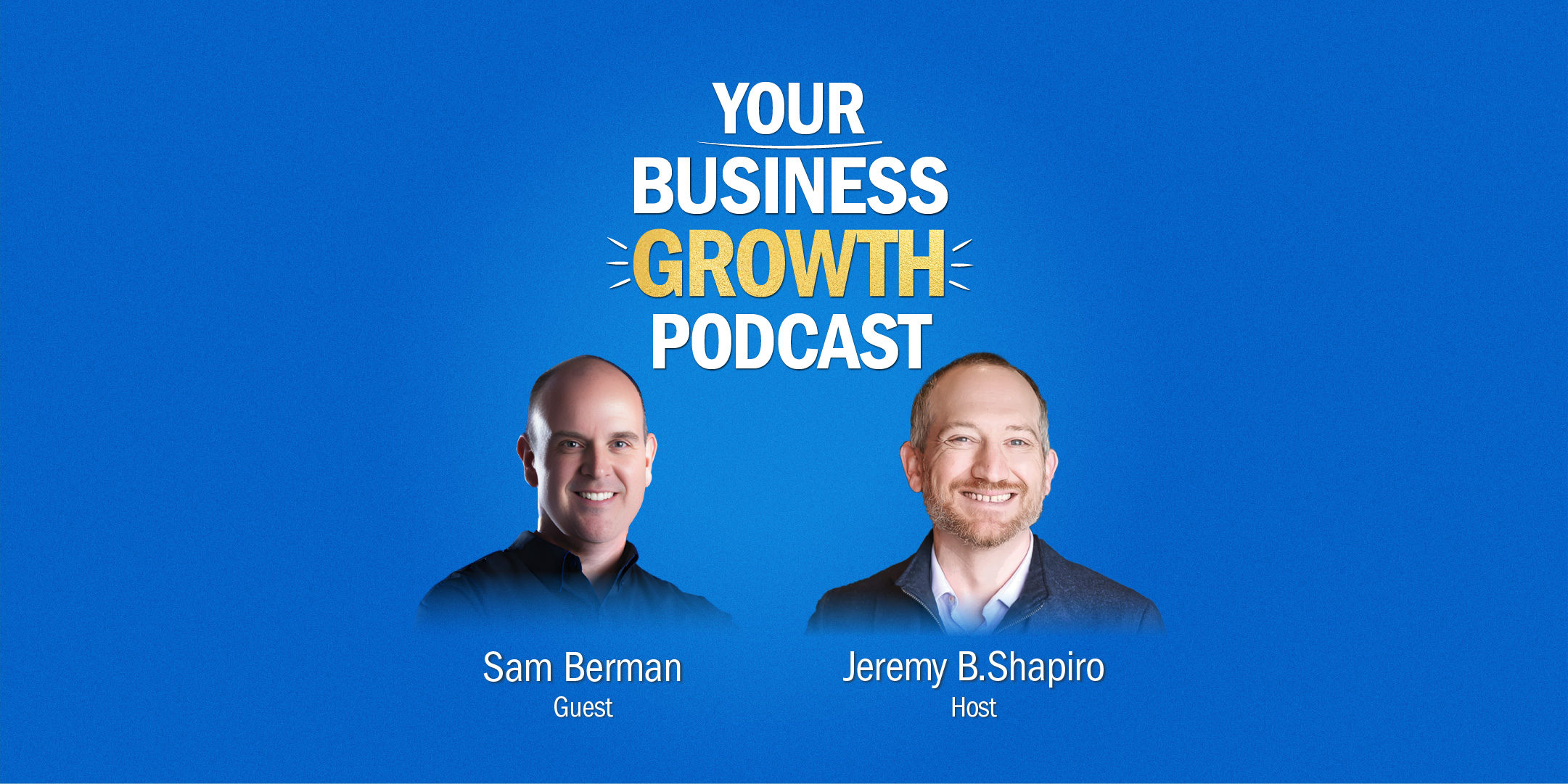
Welcome to today’s episode of Your Business Growth Podcast. I’m your host, Jeremy Shapiro, author of Your Business Growth Playbook, and my guest today is Sam Berman.
About Sam Berman

Sam Berman is the Founder and CEO of Logistics Advanced Research Center (LARC), a technology-driven company based in Nashville, Tennessee. He is a lifelong builder and serial entrepreneur who has spent decades dismantling outdated systems in supply chains and global operations. Under his leadership, LARC has become one of the fastest-growing reusable packaging platforms globally, specializing in protecting mission-critical technology and aviation products.
With over thirty years of experience, Sam has built and scaled multiple startups and led high-performing international teams. His “Beyond the Box” philosophy challenges industry conventions through disruptive packaging designs and state-of-the-art IoT platforms. These innovations deliver faster deliveries and lower costs while reducing transit damage through real-time business intelligence.
Sam is also the author of Militant Mind: The Psychology of Building What Doesn’t Exist, a field manual for founders navigating the isolation and pressure of innovation. His work explores the inner discipline required to build paradigm-shifting companies when success isn’t yet visible. He frequently shares these insights as a consultant and early-stage investor to help emerging startups turn ideas into market-ready products.
Outside the boardroom, Sam is deeply committed to developing people and communities. He mentors men through The ArcLight Gatherings, challenging them to pursue excellence, leadership, and service. Whether he is shaping the future of logistics or supporting fellow entrepreneurs, he is driven to leave a lasting impact on the industries and people he serves.
Connect with Sam Berman
Speed Round Answers:
- All In Lead Source: Partnerships
- Books: 1776 by David McCullough, Is Paris Burning by Dominique Lapierre and Larry Collins
- Unlikeliest Mentor: Those Who’ve Done It
Like This Episode? There’s More!
Subscribe!
Your Business Growth Podcast is available on all major podcast platforms. Subscribe today!
Get the Book!
Pickup the #1 Best Seller, Your Business Growth Playbook today online or at your local bookseller!
Meet Jeremy!
Book your Blueprint Discovery Call with Jeremy today and get back to the growth you deserve!
Sam Berman Episode Transcript
If you can build this, we will buy this. You would think that they would beat a path to my door once we did build it, but that’s kinda not how that worked. It takes about three or four years to iterate. We went through three generation. It was brutal, but anything worth doing is brutal. Nobody said no.
Everyone said, “Yes, when it’s done, we’re going to use this.” Imagine starting with nothing but a napkin sketch and a vision to protect the world’s most valuable technology. You spend years in the trenches iterating through designs while revenue barely trickles in, facing the isolation and self-doubt that comes with building something brand new.
But then you find a way to get the largest logistics companies in the entire world to do your selling for you at zero cost. Today’s guest didn’t just survive the grind, he turned his brand into a verb with a multi-trillion dollar industry. Welcome to today’s episode of Your Business Growth Podcast. I’m your host, Jeremy Shapiro, author of Your Business Growth Playbook, and my guest today is Sam Berman.
Sam, welcome to the show. Hey, Jeremy. Good to be here. Really look forward to the conversation. Uh, it’s been some time now and, uh, here we are. Here we are. Well, y- we, we often talk about these, you know, ideas on the back of a napkin. And what I love is you literally had that backstory of sketching out this business idea.
So bring us back to where this whole idea came from and that, you know, t- that, um, that heroed napkin. Yeah. Yeah, I actually can’t see it, but it’s actually framed in the background. It is, it’s a real napkin sketch in a restaurant, the typical Silicon Valley story. You know, I’d spent 20 years, uh, and a career there, um, working for, um, high-tech firms, supply chain and so forth, marketing.
Um, and, uh, happened to be kind of retired from that and was having lunch with a gentleman who owned a very large wood crating company. He’d asked me to come in and help him sort of diversify his company ’cause that business kinda has only so many pathways, right? Uh, and in typical Silicon Valley style, the kinda thing you would see, like from a movie, uh, he took a phone call during lunch and got off the phone and said, “Hey, I’ve got 300 server racks for data centers coming in every, you know, every week for next eight weeks.”
Um, and I asked him, I said, “How much do those things cost?” And he said, “Oh, they’re about 12 to $1,400 each.” And didn’t take much math to figure out that, uh, hey, that’s, that’s a lot of money. And so very jokingly I said to him, I said, “Why don’t you just stick a big giant toilet paper tube over those things?”
And, um, he kinda laughed and, and, uh, then, you know, went to the restroom, and I grabbed a, a pen and a napkin from the waitress and sketched a, a just a real quick idea in my head. I said, “I think there might be a better way to do this.” Went home, did a little bit of research and realized, oh my gosh, there is- Millions, hundreds of millions of dollars spent on packaging, and it’s, it’s such an afterthought.
You know, I’d been in logistics forever and handled some packaging, but I had never realized, you know, how gigantic that industry was because if you think about it, everything is in a package. Uh, and so if you could do that better, dr- drag it screaming and yelling into the 21st century in a better way, um, you might have something there.
And so the numbers, you know, it’s… Y- you think h- how, how incredible could, could packaging or crating be? But when you start to look in the numbers and they’re, they’re in the billions, and you look at the industries that are using them in data centers, AI, robotics, and this starts to look very, very sexy very quickly.
And so, uh, was gonna actually start it with that gentleman. I, I kind of brought it to him and he, he declined, and so I said, “Well, I think it’s too good of an idea.” So I, I went out and did it myself, and that was 11 years ago and, uh, here we are today, um, working with some of the largest companies in the world.
So this was a pretty well-established industry. How did you, like, go from this napkin idea to jump into and compete, like, with all the established players already in the space? Oh, I, well, I don’t think jumping into it competing was, was early in our space. I mean, we’ve been at this for a long time. Um, you know, it was a very, it i- it is a very established industry.
I have a joke that I kind of say that, you know, there’s wood crates found in Egyptian tombs, but it’s not a joke, right? I mean, they really are there. The only difference is that one’s sitting in a museum in Cairo and the one that you just spent $2,000 on is in a burn pit in Mexico, right? So it’s, it’s a very, you know, there’s a very big delta in that.
And so going after those entrenched established players who are already working with the largest companies out there takes time, right? You have to make a product that unlike the standard Silicon Valley s- method of put out an MPV, you know, or, or, and, and y- you know, minimum viable product, MVP, go out there and, and just start going.
You can’t do that here because you’re moving a $5 million server rack. So we had to spend years iterating design and making this thing the best it could be. And what we did was a ground up build, which is take everything wrong with current packaging models, they’re heavy, they’re expensive, they’re dusty, they have mold, mildew, they break off, they…
You can’t get them close to data center floors, and remodel that as if we knew nothing about the industry and someone had come to us as an engineering firm and said, “We need this solution. How would you do that today in 2011 or whatever, 2014,” whatever year it was. And so that’s what we did, and we’ve continually iterated and make it better in the field.
And you start small, you move a few things here and there, and then next thing you know, you get a call from the VP of development for a major data center, says, “We need your, we need your engineering prowess. We need to design a solution.” Um, so becoming the overnight suc- successes we have then has taken about a decade.
I love that people often see businesses from the outside with that, that duck floating effortlessly across the water, not realizing what it took to get to that point and what’s happening under the water and, uh, and you guys have certainly seen that. So you were competing with, I believe the term is, like, the, the box and ship model.
Like, how did you engineer from the ground up something so different that upset the industry? Like, what, what was that approach to innovation? To know me, I’m a pure entrepreneur. The worst thing you could ever say to me is, “That’s the way it’s always been done.” If you say to me- Mm-hmm … that, that’s a challenge to me.
I, I’m going to pull the sword out immediately and just start swinging wildly in all directions until I come up with a solution. But we wanted to do it not just… We, we looked at it from a perspective of a box or a crate is sort of the end of the supply chain, the afterthought, the necessary evil. And we thought, “What if we moved it to the front and we made it more important in the chain?”
Because it is, when you think about, you can optimize your loads with it, you can make it lighter and save money on aircraft, you can engineer it to, to not cause damage. But what happens if we take that, just that physical product and then we wrap it with services? And we said, “Okay, what happens now if we partner with some of the big logistics companies out there who don’t really handle crating themselves?”
And said, “Hey, what if we make this a revenue model for you? What if we make this a situation where, you know, you are providing an all-in solution for your, for your customers?” This is not just a value add now. This becomes a necessity in the space, because one, you look at a model like data centers, they gotta offload those things in four minutes.
Every minute those things aren’t online, they could be losing tens of thousands of dollars, right? So seconds count in this business, so you gotta make it faster. So if you wrap the services around it, optimize the load because you can get two more onto a truck, doesn’t sound like a lot, that’s one truck taken out of cycle every 10 trucks, right?
That’s real money. So at scale, this really starts to add up. So we looked at it from a services model and said, “What if we made packaging as a service here?” And so we don’t sell crates particularly. We actually have a lease model where we can provide a far superior product with far superior materials that is stronger, faster, safer, and they can get it for far less money.
And within that model, people started to respond. The industries out there started to respond and said, “Wait a minute, you’re telling me I can get something that can hold 5,000 pounds safely, nothing gets damaged, I can track it, also, and you’re… I’m gonna save 30% or 40% off my current spend?” That’s exactly what we’re saying.
Now, the hard part of that is we had to convince people it was true. Um, but once we did convince them of that, everything changed. So we didn’t just look at our- ourselves as, “Hey, we made a better package,” we looked at ourselves as solutions providers, and that really changed everything. And when you mix those, those partnerships of the already established companies, it allows us to focus on engineering, allows us to focus on our core product versus us trying to solve every other problem out there.
So that, that was a real, that was a real game changer for us and the industry. I mean, we’ve, we’ve effectively changed the industry by what we’ve done. I think got you that early growth that set you on this trajectory. What was that, the, the early growth like? Some of, some of those earlier wins that showed you that you were onto something, that the idea was worth something, that the industry needed this?
Literally, the first week I thought about doing it, I sent an email to the head of the VP of sustainability at Google, and she wrote me back within 15 minutes. ‘Cause I had said, “Hey- If I were to build something like this, would this interest you? Because you’re not cutting down trees anymore, you’re re- you know, reusing, recycling.
Uh, she wrote me and said, “Absolutely, please come in and talk to us.” I didn’t, I hadn’t even put pen to paper yet. I just wanna know if the, the idea was, you know, viable. So I I had to hire a, a industrial designer real quick and design some images and kind of put some things together, and went in and met with, like, 12 people at Google.
Uh, and they all said, “If you can build this, we will buy this.” Uh, and the other thing was I met with some folks, at the time it was Facebook, uh, and they said, “Hey, well, if you could do it, but you could do it so we could on- and offload these things in four minutes, we’d be very interested.” I think we can do that.
We actually now can do it in about two and a half, three minutes. So I knew from the industry really early on that there would be interest in this. Having said that, you would think that they would beat a path to my door once we did build it, but like every other business, that’s kinda not how that works.
You, you still gotta grind through, ’cause there’s always someone who says, “Well, you have to prove it to me still.” So we had to, we had to go through a lot of proof cycles to, to get to the point of being trusted, but now we are a very trusted entity. So you test market that idea, prove that there is interest, hire the designer, right?
Then there’s, like, I believe it was like a six-year period that you were iterating and working before, like, real money came in. Like, what, what was that underwriting period of R&D like? Yeah, I came out of Silicon Valley, so I, I’ve, I’ve started a number of companies. So we raised money locally. Um, we’re in Tennessee now, but we raised money locally and just sold the idea to people that we knew and trusted, and what we call smart money, guys who had a lot of brains, a lot of experience, and, and knew us personally.
And that’s how we funded the whole company. So we did have some runway there. It takes about three or four years to iterate. We went through three generations before we were comfortable putting it into the market space. So we knew that that would be a, an issue. And then, of course, you know, we, we started getting out there and then, you know, COVID hits and all this other craziness you have to kinda deal with.
Um, but we, we knew that we had to get that product right, and even now we still iterate and make it better and better all the time. So h- what was it like? It was brutal, but anything worth doing is brutal, right? Anything worth doing is going to take your time and focus and energy. Uh, but we knew we were onto something because the feedback just kept coming in better and better, and nobody said no.
Everyone said, “Yes, when it’s done, we’re going to use this.” And I’d never been involved in a company where you didn’t have naysayers. We just didn’t have naysayers on this one. So, uh, we just kept pushing and pushing, and we knew that every time we, we got better… We, I mean, we still have our old models and they look like something out of a Frankenstein movie, but we learn, right?
And this is something I actually tell a lot of young entrepreneurs, is you gotta, you gotta fail fast. So we tried to fail as quickly as we could, and then reiterate and reiterate and reiterate, and then gen three came out. We said, “Let’s go take this to some of our customers, see what they think.” And lo and behold, they started giving…
We started getting some orders, and since that time they’ve just gotten more and more. You’re in, um, a unique space in terms of dealing with hardware and that side of things. Um, I think for a lot of- softer businesses like in SaaS, for example, right? Like, you can launch something and iterate and get going and, and get to revenue quicker, but your model had this longer R&D period where I think for many founders, the idea of not generating revenue and still working on the idea for so long is a scary prospect.
Like, how, how did you guys as a team deal with, like, that emotional toll of wondering are you onto something? Does this have legs? Is this gonna work? Are we alone in this? Is- are we doing the right thing? Like, how did you guys overcome that? Well, we were alone in it, um, which is, which is a good thing. We kind of still are.
But, um, it, it’s just, part of it is, is just personality types, right? When you’re a company like Lark, you have to hire people who are pure entrepreneurs, who are willing to be risk-takers and understand and believe enough that every day they’re gonna just continue to just fight up that hill. Because the, the initial feedback was so good, that’s rare in…
when you’re starting something like this. And one of the reasons I was in California and moved to Tennessee was because of that actually. Th- th- California couldn’t see the idea of hard-sided product, right? They… If it wasn’t zeros and ones or used to support zeros and ones, then they weren’t really that interested.
But when I got to Tennessee, this was kind of a different mentality where logistics was, was much more focused on and people understood that the movement of goods, the logistics industry is, it, it’s unfortunate. You know, incredibly, it’s the most massive industry in the world. People don’t think about it, but everything moves, right?
So we were able to, to get believers in us. And, and part of the thing is you gotta find people who believe in you as founders, um, who are going- who understand this is gonna be a longer road. And so we didn’t really have that anvil hanging over our head so much. Towards year four, you kind of go, “Okay, we we gotta get some stuff going.”
But, um, we were trying to upend an industry that I, I, I mean, literally is thousands of years old, so, and is very entrenched. So we knew it was gonna take some time, but we also knew once we got there, once we got into that space, we’d be very sticky. So you know, it’s just, it’s kinda, it’s kind of, we’re kind of old school guys, right?
We’re guys… We’re all older guys, so w- we, we’ve been through it. We, we don’t feel the pain so much because, you know, we’ve survived a lot. So I think part of it is just- You gotta gut, gut it out. And having said that, most people aren’t gonna be able to do that. They… You, you… This only works with, with guys and people who have been through this before, who have started other companies and understand what that’s gonna…
‘Cause I’ve started software companies, I’ve started other, you know, things, but this one I knew would be different. But I also knew at the end, the pot of gold, the reward was so big, the, that, that we had to keep on just grinding that out. So there was a little bit of pure entrepreneurship greed in there.
I’m hearing a, a theme that comes up often, which is that, you know, entrepreneurship is not for everyone, right? It’s for us select weirdos. But even more nuanced than that, Sam, what I’m hearing you share is that the company that takes a long time to get to the revenue point is not necessarily the best startup for a first-time founder.
That’s better for your more seasoned, experienced founder to back and know what’s on the other end of that, that R&D period. Oh, with- without a doubt, Jeremy. Th- this is not the kinda thing if you’re 22 years old and you’ve got a great idea. You, you know, you’re, you’re not gonna survive this. There, there’s no way.
You’re, you’re out year one. There, there’s no way because you’re thinking the world’s gonna beat a path to my door. But when you’ve worked in places like the Silicon Valley, when you’ve been all over the world, when you’ve started multiple companies, you look at this and you say, “Okay, I get it. I know what this is gonna be.”
But you can also see, you know, a- as, as a, as a husband, as a father, you know, you’ve, you’ve lived a lot of life, you’ve raised kids, you’ve seen… You, you see how things kinda slowly develop over time, but you also understand what’s at the end of that. And so you don’t have that perspective when you’re young, right?
Everything needs to happen now, especially these kids today because, because they, they… Everything’s instantaneous to them, right? I don’t come, and you don’t come out of that life, right? We actually had to write our own papers, not use ChatGPT, right? We didn’t have cell phones that had the world’s, you know, entire library at your fingertips.
We had to go to library. My gosh, we had to use the Dewey Decimal System, right? So because we’re kind of an old school industry that we’re bringing into, like I said, kicking and screaming into the 21st century, we knew it would take some time. And we’ve met a ton of resistance. I mean, the, there’s… A lot of this is relationship based.
“Well, we’ve used these wood guys for 1,000 years.” I got it, but we’re 30% cheaper and 1,000 times better. We’re giving you a Lamborghini for a Honda price. So you gotta get people past that, and you gotta get people past the relationships. But at some point they start to look a little bit ridiculous and not pulling the trigger on it, so it does happen.
I wanna talk about one of those trigger pulls, which as a story you shared, I’d love for our listeners to hear, and this is around that first big major data center move that you guys, uh, that you guys got. Um, tell us about that deal and, and what that meant for the company. Early on when you do something with a hard-sided product like this, you, you do kinda live off the scraps.
You get five here, 10 there. One day I was sitting at lunch and I get a, a text message from a number I, I don’t know who it is, and the guy says, “Can you please call me? I work for… I can’t tell you the company, but I work for this major data center company.” So I called the gentleman and, uh, he said, “Hey, we need– We, we know about you guys.
We need your help developing and designing and deploying a rapid, you know, deployment sy-system between our data centers.” So we went and met with him, and lo and behold, they said, “We know you guys have the engineering capability to do this. No one else is able to do it.” And so we actually went out, within six months, designed, developed, engineered, and manufactured a product for this company that to this day is used every single day hundreds of times by this company.
Um, and that really launched us because, one, now we knew that we were playing with the big dogs, right? And that, that we could, and that we had something special about us that the, the, uh, industry couldn’t do. They kept trying to solve the problem with old school solutions. I mean, if you think about a wood crate, for example, how much more wood are you gonna put on this thing?
Right? You’re just gonna keep making it heavier? And they’ve sort of reached an engineering maximum, 4,000 pounds. These things are starting to collapse. We keep hearing about they’re falling through crates, like $2 million server racks falling through crates, that kind of thing. And so we had to come up with a new paradigm that said, “Okay, we can do this better, but in order to do it, it would be too expensive to utilize these, you know, cutting edge materials, this level of engineering.
So we’re gonna change our business model to this packaging as a service model, so you can get a lot more car for the money,” right? You can get a lot more box for the money, and people love it. Um, now we have met resistance. “There is no way I’m leasing these crates.” Okay, then we’re not gonna bend our business model to that because these other guys have now made it a best practice, not only in the case of cost, but because, um, sustainability is such a big issue.
If you need to move 100,000 server racks a year, you’re gonna have to buy 100,000 wood crates, or you’re gonna get 8,000 to 10,000 of mine. That’s a really big delta, right? Not just financially, economically, but it’s also a big delta sustainably. We also, because we’re an engineering company, we’re not– And we’re, we’re, you know, more mechanical engineers, we don’t look at things the same way.
We’re not coming out and saying, “This is how one does this.” We are open to doing all kinds of different… I mean, we came off a napkin sketch, man. So w- a-anything goes. The sky is the limit for us. So we had a very large customer come to us and says, “We have a huge security problem. It’s been a big problem lately.
Can you guys solve it?” So we made what we call our Secure Tech solution. It is the most secure system in the world for shipping product. It has its own chain of custody. It’s electronically trackable. It’s physically locked. You know, we had one of the largest, um, in fact, you know, one of the largest telcos in the world come to us and say, “We have a massive theft problem on our phones.
Massive.” They switched to using our Secure Tech solution. They haven’t lost a single unit in that whole time in over a year. So we really are coming up with solutions, not just a platform. Are you enjoying this episode? Make sure you hit that subscribe button right now. That’ll help you get more episodes automatically as soon as they come out.
So hit that subscribe button right now. And if you have a minute, leave a quick rating and review. That helps support the show. So one thing I’m hearing there I wanna highlight for our listeners is that you are really tuned into what your customers and prospects are looking for And by being able to be nimble and innovate, you’re able to solve those solutions that are otherwise previously unsolved in the industry, uh, which is r- really important, especially, um, you know, in your space, you’re able to innovate on the hardware side of things and really deliver.
Yeah, absolutely. I mean, I think you write about this in your book about, you know, a value to a customer and what’s a, what’s a lifetime value of a customer, right? Yeah. So be- by coming up with solutions, like we have… You know, Schneider Electric’s one of the customers I can talk about. You know, they use our crates for moving their product, but then they came to us about a year ago and said, “Hey, you guys are really good engineers.
Can you solve this problem with these sheet metal carts we have? We need better sheet metal carts.” And so they’ve ordered 100 from us now. We designed this new sheet metal cart. It’s lighter, it’s faster, it’s less expensive, and they, they, they order those from us. And they came to us because they knew we could solution that.
And so you talk about lifetime value of a customer, right? They’re not just using our platform. They’re looking at us and saying, “You guys really are solutioning things,” right? And so that adds a whole lot to the mix, right? And so they, that builds loyalty around, around you as a brand and, and not just you as a brand, but you as individuals, right?
There’s a great deal of trust that gets built up that way. So yeah, there, the, we, we don’t look at ourselves as packaging company. We look at ourselves as a solutions and engineering company, and I, I just got off the phone right before this, this interview with, with another massive company out in, uh, California, and they said, “We need, desperately need help with our packaging.”
And they said, “Come out. We’re gonna… W- we want you guys to solution all of it for us.” And so, um, you know, it’s, it’s a great space. This, this focus on really being a solution provider, not having a product or a service, but being known for being a solution-oriented company, and that helps that customer lifetime value hugely so.
So there, there’s a piece there, Sen, that I’m hearing which is at least, like, this partnering with your customers almost, right? But partnerships I know has been pretty big for your company. So talk to us about your shift to working with these large scale partners, uh, versus, like, more traditional outbound marketing tactics.
Like, what do, what do these partnerships l- look like? Someone told us really early on, because they realized our product was really impressive, right? Everyone’s… This was a venture capital guy out in California. I, I wanna say caveat, we don’t work with VC typically. But, um- But, uh, said, “You guys are like a, a couple of guys walking into a gorilla cage with bananas tied around your neck.
You understand that, right?” And he said, “How are you gonna deal with that?” I said, “Well, if it’s a bunch of 800-pound gorillas, we’re gonna find the 1,200-pound gorilla and make friends with them,” right? It’s kinda, it’s kinda like prison thinking, right? Get the toughest inmate and, and, and make prison, you know, and make, make friends with them.
So what we’ve done is we actively searched out some partners in the spaces that we were working in for the logistics side, because we knew they already had those relationships, right? And then eventually some of the even bigger ones came to us. Some of the biggest logistics company in the world came to us, said, “We wanna partner with you.”
‘Cause our customers were calling in and saying, “Go partner with Lark.” Um, what this does, in effect, is allows us to really focus on our core competencies of being the best engineering firm in the world and the best solutions firm in the world. So I don’t have to solve for problems of how things get returned or how, um, how we go out and build massive sales force, ’cause now I’ve got a massive sales force out there selling for me, right?
So when you look at the, the upfront cost of early startup, sales is probably one of the things that costs you the most, right? Sales, development, relationships. And you also get to, at some level, and this was more early on, you get to kind of, uh, ride their coattails of, of their, um, uh, uh, of their reputation, right?
Because who are you, you guys? You’re a small company in Nashville, Tennessee. Well, now I’m a small company partnered with the largest logistics company in the world, so talk to them, right? Um, so th- that, that helps a lot to, to kinda lend kinda street cred to us, if you will. Um, but really from a cost perspective, it, it’s a massive win for us, and we actually end up selling for them too.
We go to our customers say, “Well, can we bring in our logistics partner?” And they say, “Oh, absolutely.” They… ‘Cause they already have this thing modeled out, right? And it’s gonna save you from having to go to your purchasing guys, have to purchase transport, they have to purchase crates, they have to deal with what happens to those crates afterwards.
Now we’re just bringing you a whole soup to nuts solution. So that really is the way for smaller startups with really innovative ideas to not have to raise $100 million. You can actually do it sort of bootstrapping it and just focus on we’re gonna make the world’s greatest hamburger that everybody wants to line up and eat like In-N-Out Burger, right?
So that, that is, that is the way that we have chosen to do this. Now, having said that, it takes a little more time to do that. You’re gonna grind up the hill a little bit more, but the, the result is significantly better because now, like we’re going just– I’m going next week to Virginia because one of our partners is hosting a huge summit and they’re bringing in, you know, 12 customers, uh, and want us to meet them.
So that’s 12 warm leads, very warm leads- that I now have that I didn’t have to pay for. Yeah, partnerships is such a powerful strategy in all the ways you’re sharing. And what I’m hearing there is a few things I wanna highlight for our listeners. One is you touched on this acquisition cost, right? Your customer acquisition cost or, you know, CAC, is much lower when it’s a partner bringing a deal to you, uh, which is great.
And secondly is they are feeding that top of funnel. They’re bringing you guys qualified customers, and because of that partner relationship, that often can lead to a higher transaction amount and also a higher customer lifetime value. It’s just an all-around slam dunk. Oh, and it’s a, it’s a huge value add for them, right?
If you look at the logistics industry, it, it really is just a matter of no one’s offering you anything new. It’s just I can… They’re all using the same planes, same trucks, same concept. They, so really I can offer you better services. But you bring something like this, it’s a soup to nuts solution, suddenly people go, “Well, that’s very innovative.
You guys are thinking differently.” Right? And so that changes the landscape for the customers ’cause they’re always looking for this and never getting it. I mean, I was in that space for 20 years. I get it. It’s the same pitch, same deck, same nonsense. But now some- somebody’s thinking, right? I think General Patton said if everyone’s thinking the same way, someone’s not thinking, right?
So we- we’re really bringing a different view to it, and we’re actually changing the view of packaging. It’s no longer just a, a necessity, a nice to have. It is, it is absolutely something that can change the space and change the game on how things move, lighter, faster, stronger. It changes everything. So it, it really does, um, upend the industry a little bit.
And I, I, having said that, Jeremy, I wanna say you mentioned something about partner with our customer. That’s also true. You gotta do it on both sides of, of the equation, you know? Um, because I, I, I was talking to a customer today. I said, “Listen, this is the way we operate. We’re a partnership company. If you wanna treat us like a vendor and beat me up over pennies, I don’t want the job.
I don’t want the business. But if you wanna treat us like a partner, we’re gonna save you 20, 30%, and you’re gonna love us. We’re gonna be your best buddy.” So i- that really… A- and the industry has come become so complex, supply chains are so complex now, that if you don’t do that hand in glove with your, with your suppliers, you’re not gonna make it.
It’s just too complex now. So let’s dig into this partnership piece a little bit more. Like, walk us through, like, what those conversations looked like in getting these, like, the, these are the world’s largest logistics companies we’re talking about, getting them on board to effectively be your sales reps moving your product at zero cost to you.
How did you go from having none of those to having a number of these doing the same thing and building the business for you? You know, it started out with me t- talking to old connections from when I was in the business saying, “Hey, would you guys…” With the kind of the smaller medium guys, the specialist guys.
And what ended up happening is our crates started being seen, seen around the, the kind of the world, and it became a little bit easier. And once we sent our crates to some of these partners, said, “Hey, can we talk to you about this?” They said, “Yeah, this is, this is really, this thing’s got legs. This is really interesting,” right?
Uh, and so we went from the small to the medium, and then the large started calling us, like, and the ultra-large started calling us. So that really, um, that was kind of an interesting, uh, evolution there. Um, but people realize that their customers are starting to say, “Hey, we really need a better solution, and LARC seems like a good solution.”
The reason we are partnered with the largest logistics company in the world right now is ’cause one of the largest data center companies in the world told them to. They said, “Call them.” And I got a call from their senior vice president one day and said, “I’m supposed to talk to you about your boxes,” or something.
I said, “Okay, let’s have a conversation.” Um, and so we, we now actively ship with them, with absolutely massive companies, and that, that business is growing all the time. I’d be remiss if I didn’t ask you about, like, the IP side of things. You guys have a great run on the hardware side. Um, what have you guys done to protect the, you know, the IP you’ve created from larger players, you know, competing against you, insourcing and so forth?
Well, two things. One, we do have hold a number of patents on our products around the globe. Um, and the way we, we manufacture, uh, we try to protect, we do it in various areas, right? We don’t do everything at once. It’s not to say someone’s not gonna try and copy us. I mean, patents only protect you so much in certain places, right?
But because we, we’ve been around for a long time, we’re a first mover advantage. Our name, LARC, is actually an acronym. It’s Logistics Advanced Research Center. But it has become almost like, “Hey, put it in a LARC,” right? We’re- we’ve kind of got, like, kind of like the Saran Wrap of, of, of the, of the space now, right?
So we, that, that has protected us a lot. And plus it’s not easy to do what we do. Even if you try and reverse engineer it, we’re steps ahead of you. We’re generations ahead of what you’re seeing in the market now. So if you were to do that, we’re gonna, we’re just gonna jump on top of you with our next iteration that’s gonna be significantly better.
So first mover advantage is big, but you… And y- obviously you, you hold patents on things, and we, we do hold a lot of very tight patents that we’ve, they’ve not been challenged yet, knock on wood. Um, but, uh, we will, we will defend those patents vigorously, obviously. Uh, and by partnering with those 1,200 pound gorillas- You can take us on, a small company here in Tennessee, but you’re not gonna take on, you know, a $90 billion company who’s gonna bludgeon you to death, right?
‘Cause you’re stepping on their toes now. So again, part- partner with the, with the toughest guy in the prison, right? I’m hearing a few things there for our listeners. One, obviously, is the traditional legal IP route, as you guys have smartly gone. But also being m- you know, the first mover advantage is big.
Um, brand, which I wanna get to in a second here, is powerful. And lastly, I love that you touched on the partnerships again thematically coming up here with one more perk of the partners is that they are there on, you know, on your behalf as well. Let’s talk brand for a second. You did something very few companies have done, you know?
We take for granted now talking about, “Let me Google that for you,” or, “Oh, WhatsApp me,” right? Or using these various brand names as a verb, right? And you guys are at the point where within your industry, companies talk about Larking things. So how did you get there, and how has the brand’s growth changed since you’ve been verbified?
I think, um, a couple things happened there. It, it’s funny, you know? Pe- people look at things and they, they don’t necessarily hear you right sometimes. They think the container was called a Lark container, like it’s like the product. And so I think that was kind of what happened there. A few people have heard it that way, and so some of the bigger players saying, “Just put it in a Lark,” or, “You guys use, use Larks,” right?
And we’ve heard that. We’ve heard a number of our partners come back and say, “Oh, we were giving a presentation and said, ‘Oh, you guys use Larks.’” You know? And so I think it was just that people were mistaking our, our, our product names are Alpha, Apex, Atlas. But people just looked at it and said, “Oh, that’s, that’s a Lark.”
And so th- I, I think that’s just how that evolved over time. But another thing that happened was we kinda changed the industry because we’re reusable in this space. We sorta shifted the wood crate industry. They used to be one and done crates, which they loved, right? 12, 1,400 bucks, use it once, pay 100 bucks, throw it out.
But what happened was because of us, larger players started telling the wood crate guys, “Well, these need to become more reusable,” right? And so we sorta shifted their entire economy there too. Suddenly their crates had to be $2,000, $3,000 ’cause they’re only using them five times. And really you can only use a wood crate three, four times before it starts to collapse on you, whereas ours you can use hundreds of times.
So we thought that was kinda funny that they’re trying to compete with us on that s- that level. That, “Hey, well, you can reuse yours five times. You can use mine 500 times, so the economy’s not gonna work for you.” But that did kind of from a brand perspective, people started saying, “Well- Not just from brand, but from, from mechanics, we need to look at the industry in a different way.
We need to go to reusables because, one, the indus- the world is demanding it. Two, we gotta stop cutting down two trees every time we ship a server rack. You know, we gotta be get a more clean approach. And three, we need to have better engineering and better p- protection. And so I think those two things kinda came into play where we, we shifted the ground on the industry, but also I think honestly, Jer, I think it was just a mistake in people understanding our product name.
So it may have honestly been our fault. We probably didn’t market our product names well enough. Um, but that’s okay now because now people look at it as, as almost like a standard. It’s kind of interesting. Yeah, it’s funny how sometimes the biggest successes aren’t the ones we planned for or de- design intentionally, but that come along by, by nature of us being out there and doing it.
And, uh, that seems like that was a r- a real big win for you guys. All right. From the sort of plateau of not having any of these partners to breaking through and having the world’s largest logistic c- l- logistics companies partnering with you guys, what’s, what’s been the impact for you growth sales-wise on having those partners selling for you?
We’ve seen tremendous growth when that happened, right? I mean, it was, it was double, triple, quadruple year over year, and we’re kinda seeing that still. I mean, I don’t give out our numbers obviously, but we have seen tremendous growth, and we have seen tremendous, um, contact points, right? Suddenly, you know, where we are…
We had some of these large companies as customers. Suddenly they’re all talking to us, right? Like I said, I’m going next week, and I’m talking to f- like six or seven of the, uh, of them. We already use, but they’re trying to expand it. So y- you know, that, that really… As I’m, uh, as I… I can’t preface enough to your listeners on this that street credibility is, is really important.
People, if they don’t know who you are, you’re not gonna get a lot of traction at trillion-dollar companies. But if they said these guys believed in you enough to partner with you, it’s kinda like, okay, then you’ve got some merit. Now we don’t have to rake you over the coals to prove that what you do is legitimate because these guys are already using you Right?
So that, that I can’t, again, I can’t tell people enough that if you, you can go raise $100 million, start a company and try and do all this on your own, most of those actually fail. It’s the guys who actually bootstrap and scrape and grind and, and, and bleed and get creative about how they pay the bills that are going to make it.
And so the way you stay in that space, and the way as we grow, mine says that Lark stay hungry and entrepreneurial and, and feel like someone’s always nipping at our heels, right? But the way you stay in that space is to go to the established channels, uh, and do it in a way that makes sense. And what I mean by that is don’t, don’t give away the ranch because these guys are a big name.
They need you more than you need them actually, because they’re not as innovative as they need to be. They’re, they’ve got too many layers. We have, we have one layer, m- myself and my, my co-founder Chris Taylor, right? Like, we’re, we’re going to make the decision on how things work, so we get to fail fast, solve fast, be fast, and, and we get to be the ones that can kinda undermine the system out there because we don’t have the same rules of, you know, file this report and go through this VP and this committee.
So it, you know, it really, you wanna stay lean. I, I, I like to tell people you have to have sort of rogue entities, and there’s been some com- big companies that have done it. I actually just met with Bell Helicopter yesterday and I… They’re always interesting to me ’cause they had what you used to call Baby Bells.
They would, anytime something would get big, they, they, they’d put these rogue element groups out there and say, “Just go wild. Here’s some budget. Come up with something amazing,” right? Uh, we don’t, we need those kind of rogue pirates and, and, and people out there who are gonna say, “You know what? Let’s solve problems.
Let’s really solve them, not l- let’s paper them over. Let’s, let’s really solve problems.” And you know who else? I, I think it was, it was like Columbia or Patagonia, one of those clothing companies used to do that. Anytime a group got over 100, they’d break it off into its own little thing because it got too big, too bureaucratic.
So the world needs Lark out there. The world needs small, you know, aggressive players because solving complex problems at big companies is damn near impossible these days, and they’re just getting bigger. So I think that, that plays a, a massive role. And so the way you continue to be able to do that is partner with the guys who are already in those channels.
Smart. Uh, that’s, it’s just one more form of leverage. Um, not the financial leverage, but that, um, that interpersonal connection, right? The leveraging those relationships for everyone’s mutual benefit, and you guys have done great with that in terms of partnerships. You mentioned the financial side. With these partners, sometimes they’ll back you financially on a deal, right?
They’ll say Hey, a, a giant customer will come in and say, “We wanna do this.” And we’ll say, “Well, okay, but we, you know, you guys need to pay, pay it forward a little bit here.” And then our partner will come in and say, “We, we, we’ll backstop it. Like, we’ll make sure that happens,” right? Because they see, they see that if they’re using our crates and moving, it’s hard to get that out from a competitor.
Our competitors are not gonna come in ’cause they can’t offer that solution. What are they gonna say? “We’ll give you wood crates”? So, you know, it do- there is a huge financial side to that as well if you, if you structure that properly. Yeah. It’s funny, um, similarly, when I had some of my SaaS companies, a strategy we’d occasionally use is when a customer’s looking for certain functionality that might help some other customers, but, like, it’s definitely heavily weighted towards their benefit, we would have the opportunity for, like, “Look, do you want to effectively in- invest in this, backstop this, underwrite it?”
Right? “You get the functionality, everyone else will as well, but, like, that helps move it up.” And oftentimes customers are happy to financially invest in a solution that’ll benefit them, even if it helps the rest of the industry as well. We’ve had a number of very large customers ask to invest in us, and we’ve said no every time.
Um, now our partners we would do that with, but I- customers I certainly wouldn’t do it with, only because, you know, the, the, the next customer will say, “Well, if those guy… Uh, I, I don’t wanna do it.” So, you know, we’ve had to be careful with that, but certainly partners have wanted to. In fact, we’ve had… I probably get an offer to buy the company once every week or two.
That’s a good problem to have. Yeah. And, and, and, and to clarify there, I, I don’t mean invest as in, like, you know, invest in the actual company. I mean underwrite the functionality they’re looking for. Yeah. Well, w- so our customers will do that by just prepaying stuff. So we, we structure our economics that way, um, which works out great for everybody and allows them to get a lot more innovation through, through their pipeline.
Uh, but you do have to kinda… The timelines are never what you want, right, with these big guys. Can we get a PL? Yeah, like six weeks later, and then they’re screaming at you, “You’re six weeks late delivering.” So it’s, uh, it’s always fun that way, but we, we, we will always go to the nth degree to deliver, uh, those things even, even then on time.
I do wanna ask, just because you brought it up. So it’s not unusual that you, you know you’re on the right path when you start getting inquiries of, you know, legitimate buyers who are in, uh, who are interested in buying the company. What is your indicator for when that time is right, or which conversations to entertain, or, like, what the parameters are that you would need for there to be an exit?
You know, it’s, it’s interesting. People ask me this question a lot, and I, I always like to preface it by saying I don’t build companies to sell them. I, when I build companies, I try to build empires, and the reason I do that is because decisions you make that way will add so much more value to the company.
And at some, at some point, you’ll just know when the time is right. You’ll kinda, you’ll kinda sense it. But I think that companies who say, “We’re gonna build this widget for the e- sake of selling it to, you know, mega corp at some point. They make decisions that cut corners. They try to move too fast on things.
They don’t build with the level of quality, uh, and the level of vision that you need to. So my, my take, and I’ve started a number of companies, my take is always build an empire, and you’ll know if it’s time, and if, if it’s never time, then you just build a super empire, right? But I just, I- having spent all the time I have in the Silicon Valley and traveling the world, I just know that tho- those companies tend to, the companies that try to sell quickly, they, they just, they miss something.
They miss something in the value of the, of the people around you. They miss something in the relationships, and they, they miss something in that extreme value that you can get by your customers. They, if they know that you’re just in it for this, there, there’s gonna be no loyalty there, and so I try and build loyalty.
Love it. Loyalty is the theme I’m hearing there, and that comes down to that well-communicated vision. So talking about other companies and, and founders and all, what piece of advice would you have for an earlier stage founder who is still in that isolated pre-revenue grind? Don’t stop. I mean, th- this, there’s no magic to this.
Uh, you gotta believe in it and just don’t stop. I know as cliche as that sounds, there are gonna be days when you’re just absolutely beaten to your knees. It just means that you’re on the right track. You’re gonna… When you’re meeting resistance, it means that your, your product has legs. Um, because the, the, y- the, the, the world doesn’t wanna change, you know?
But i- if you know your product does something that’s provably better, just keep going. Um, find a way. Uh, you sometimes you have to pivot a little bit, but find, find the way. The, a- again, I, I, you know, I wrote a whole book about the psychology of being a founder. It’s called “Militant Mind,” my story, and it is a story of isolation and grind and pain and suffering.
But it’s in that suffering that you become better at what you do. Um, it is in suffering that you refine your product, that you refine your vision, um, and that you, as you gut it out, become better as not just, uh, a founder or business owner, but as a person. And something really interesting about the psychology of starting companies or anything of value is that as you grow, the company grows.
Most people, and you probably understand this, right? Like when, when you’ll, you’ll know when you’re firing on all cylinders ’cause the company is. And when you’re not, y- you really are so tied to it, almost like a bloodline, that you, you know that I have to physically, emotionally, spiritually get myself in the right space.
That I can’t let Um, you know, the darkness run me down, that there are dark parts of me that I need to use, whether it be through anger or, or that fire that you need to refine that in yourself and that you need to… You know, I always tell people entrepreneurship is a funny thing. It’s the greatest dichotomy in the world.
You have to be arrogant enough to believe you can do it, and then humble enough to actually do it, right? ‘Cause you’ll be slapped down many times. But to start it, and you know this, Jeremy, you’ve done it yourself, y- people will tell you you’re kinda arrogant, you’re kinda angry, you’re kind of aggressive, whatever.
But at the end of the day, there’s a lot of humility in it, too. And so you have to be that person can, like, walk both wa- sides of that aisle. So the, the answer is just keep going. You know, the darkness will be there. The tough times will be there. And the last thing I’ll say about this is one of the things that I find interesting about founders, especially of v- very successful companies, almost universally, if you track our history back, there’s some giant wound in our lives or something that hurt us, that broke us.
And so we are very resilient souls. And so don’t get into it if you’re not that, right? You… And if you have a great idea and you’re not that, find the person that is that. But you’ll know them. Y- you can… We can almost smell each other out, right? Like in a room, go, “I know you,” right? I, you are… There’s something about your past that wiped you out, and there’s something about you that had to prove to the world wrong, that you were, you were better than that.
And so again, it all boils down to just, it’s just get it done. Take action and don’t stop. Love it. Now, that’s advice for somebody else. But with hindsight, looking back to your earlier days of trying to validate the logistics model and everything else, like what would you have done differently knowing what you know now about the industry, your company, and so forth?
So the number one thing, I’m asked this question a lot and I’ve given this a lot of thought. The number one thing I would’ve done is given up on bad ideas faster. Um, sometimes, and this is where the arrogant and the, the humility, the arrogance, humility kinda comes into play. You, you think, “I’ve got this thing down.
We’re gonna do this thing,” and then you realize six months later that you should’ve killed that idea six months ago. Um, and so I, I think I would fail faster. I think I would have a little bit humility, more humility in, in looking at things- Mm-hmm … and saying, “Okay, let’s, let’s look at this thing w- more outside of the emotional side.”
So what w- one of the things, Jeremy, about, about entrepreneurs is we are emotional souls, man. Like we, we are… People, people say you, you, you’re just… y- your emotions are on your sleeve, and that’s true, and I think we have to be in order to do what we do, especially at the level, especially when you’re paradigm shifting.
So I think we have to give up on our emotions a little bit and look more at the numbers. I think, you know, haven’t completed your book, but I’ve r- reading through it. A lot of it’s about measurement and a lot of it’s about looking at the real picture, right? And understanding what you’re looking at versus just charging ahead up the hill without knowing what enemy’s over the hill.
So I think that I would measure things a little bit more, right? I would look at things, um, more critically, uh, more with a subjective eye, I think. Uh, so that was probably my biggest mistake, uh, and the thing I would change the most. Um, the other thing I would probably do is seek those partnerships earlier, I think.
Um, we, we kinda thought the world would just, the big companies say, “Oh yeah, we’re gonna stuff this, you know, in the pipeline.” I, I think I would find those, those partners sooner. Um, so as far as from practical standpoint, I, I would definitely do that. But in general, you know, would I give up the grind or the hardship?
Probably not, because it’s just made me a better person, made the company a better company. I wanna double-click into the start of your answer there. You were saying, you know, giving up on the bad ideas earlier. How do you, or how would you differentiate between what, in retrospect, you recognize as a bad idea versus what seems like a good idea?
Oh, like I said, you have to drop the emotional side of it. You have to, you have to analyze it more. Again, it’s, it’s that, it’s that shift between arrogance and humility, and becoming the person you need to be. You, you gotta really spend more time and honesty on that and say… Because people will tell you, if you look back and they go, “That’s not working.”
Like, “It’ll work, it’ll work, it’ll work.” They’re, “That’s not working.” And so you gotta kind of analyze it a bit more. I think entrepreneurs don’t tend to be, um, at least the, the, the first founder of a company don’t tend to be as analytical, you know? Uh, or, and they don’t have analysis paralysis, as, as kind of big companies have.
They, they will charge forward, and I always tell my team, “Hell, let’s just get the boat out of port. We can, we can polish the brass later,” right? And you do have to do that to some extent, but once you’re out there, right, among the monster, the sea monsters, right, you have to kinda say, “Yeah, maybe we should patch that hole,” you know, “before we sink.”
So I, I think that, uh, I think for me individually and for founders in my space, especially when you’re, you’re going against a massive, you know, entrenched system, you do have to drop the, the emotions sooner. And I think that’s more of a personal sort of flaw in founders or a, a timing, I would say. ‘Cause you do have to have that arrogance for the first however long, but then it, it, it almost immediately flips once the team starts to build and y- you don’t have all the answers anymore.
You, you need to listen more. Uh, you know, first you listen, and then you come up with stuff, and you need to be a little less, um, in your own head space and know that other people around you are smart, uh, and not be the smartest guy in the room. I think that’s really important. And, and, and especially when you, we have a, a team like we have at Larva, just amazing people.
So Sam, before we wrap, a few quick rapid-fire questions for you. If you had to start the company all over again from scratch, what one lead source would you go all in on? Partnerships, for sure. Those big partnerships. I, I, I would go, I would go wild on that, absolutely. That tracks. Um, all right. Book-wise, aside from The Militant Mind and your Business Growth Playbook, what are your, some of your top favorite business books?
You know, it’s interesting. I don’t read many business books. I read a lot of literature. I read a lot of history, ’cause I think history informs us. I’ve been in business so long, I’m- pretty salty dog, so I, I’ve lived it. So I, I sort of look to my own counsel and the counsel of the people around me. I know how to do the accounting and all this, so the sort of rote stuff is not really an issue.
And I kinda don’t wanna listen to what other people have to say. I want my team coming up with unique ideas. I know that’s a strange answer. I’m a voracious reader, you know, but I don’t spend a lot of time reading business books. I did when I was younger. You know, I read all the marketing books and all this kind of guerrilla marketing and all this kind of stuff.
But I think that, uh, I don’t wanna be, like, the, doing what the next guy is doing. I, I want to be doing what Lark is doing, which is incredibly unique. So then maybe not top business book, but, uh, some of the most influential books for you personally more broadly. Yeah. Um, like I said, I love history, specifically American history.
I think one of my favorite books on that is 1776, and the reason is what the founders went through, is the grind and the level of belief that they had to have in that. I’m gonna look at, I’m gonna look on my bookshelf right now and see some of the things I’ve, I’ve read recently. I’m, I’m a very religious person, so I do read my scripture a great deal, and that informs me.
But history has been my thing because I think that, um, you know, I, I… There’s a, there’s a… One of my favorite books is, is Paris Burning. It’s about the, uh, the Nazi occupation of Paris and how the Americans drove them out and the sort of stories behind that and the efforts it took. I love stories of effort.
You know, you think about the 300 Spartans at Thermopylae, right? I, I just love the fact that people don’t realize that’s actually a true story to some extent, right? You can actually go there and see the statues and where it happened. You know, these are people who, who believed enough in something that they held the line against incredible odds.
I mean, like we do here every day. What we’ve done, you know… G- giving an interesting story, I, I actually used AI one day to ask about Lark and what the, the odds, you know. I don’t have a college degree, for example, you know. We built this up. It said, “Your, your odds are like fraction less than 1/10 of 1%.” Yet here we are, right?
So I, I love reading things about overcoming odds. I’m catching that theme, and that shows up a lot in history. You, you wanna talk about being a founder, talk about founding a country, right? E- exactly. You know? Exactly. Who would you say is one of your, uh, unlikeliest mentors? Who… You know, this is also gonna sound kind of strange.
I don’t have a lot of mentors, you know. My, I, my father passed away when I was very young, and so I’ve been on my own for a long time. And so a lot of what I’ve done is just kind of learned on, on, on my own. I take people from history a- as my mentors, you know. I, I study my own history a lot. I, I’m actually a direct grandson of, uh, Robert the Bruce of Scotland, and I love his story.
So my mentors come from history a little bit because, again, they’ve overcome incredible odds like I have, and so I, I, I take great joy in that Um, I do, I, I look at sort of the, the big entrepreneurs out there, the Steve Jobs. You know, I actually met Steve a couple times, and the, the stories are always the same.
These guys have just overcome incredible odds, and they’re, they- we all get the same pitch, right? You guys are hard charging and too hard to deal with and all this kind of stuff. But all of who’ve done this understand something about this. So I kinda take people… I mean, you’ve done it, I’ve done it, other people have done it, so I kind of look at that as those are my mentors, is I, I look at the people who have done the things that I want to do.
But I don’t really have anyone I’ve ever really sat down with and said, “Do this, do this, do this.” I just, I’ve just been on my own too long. And so, um, I know those aren’t always the answers that, that people expect, but that’s, it’s a fact. I don’t have a lot of people in my life who have said, “Do this.” I’ve just, I’ve kinda had to invent it as I went.
Sometimes we’ve gotta find our own way. Um, and that, I think, is common amongst entrepreneurs as well, is that we are the ones who, who, who scout ahead, who go out into the unknown. Yeah, absolutely. So Sam, for our listeners, as a recap, you moved from a humble napkin sketch through six years of intense iteration and self-doubt to a strategic partnership model that turned your industry’s biggest players into your sales force, effectively scaling your brand into a global leader in protective logistics.
Correct. Yeah. That’s us. You got it in a nutshell, man. And for listeners who wanna learn more about you, where should they go right now? So you can go to our website, shortest website in the world, L-A-R-C.co. I always tell people it’s CO ’cause we didn’t wanna pay for the M. Um, and then, uh, you can reach me, um, through LinkedIn, Samuel Berman.
I’m very active on LinkedIn, would love to hear from people. Even young entrepreneurs who wanna talk, I, I love to give advice. I even teach at some colleges, which I find funny ’cause I never graduated from college. Um, so yeah, please reach out to me. I, I love to have those conversations. Love it. Well, Sam, thank you so much for joining us and sharing so much of your story, and most importantly, those lessons learned along the way.
Um, this has been great, and I appreciate you joining us. Thank you, Jeremy. I’ve enjoyed it a lot, and, uh, appreciate what you’re doing out there. Thanks so much for listening. Quick reminder, hit that subscribe button right now so you can get more episodes when they come out automatically. And remember to leave that rating and review right now.
Like This Episode? There’s More!
Subscribe!
Your Business Growth Podcast is available on all major podcast platforms. Subscribe today!
Get the Book!
Pickup the #1 Best Seller, Your Business Growth Playbook today online or at your local bookseller!
Meet Jeremy!
Book your Blueprint Discovery Call with Jeremy today and get back to the growth you deserve!