Three years ago, a business valuation came back at just one-quarter of what the founder expected.
The reason for the low number was a shock: the entire business model was seen as vulnerable to being replaced by artificial intelligence.
Instead of giving up, he took that wake-up call to completely overhaul how he worked, moving away from high-effort custom projects to a system that allowed him to step back and watch his profits soar. Today, we’re diving into how he transformed a stagnant agency into a regional leader with sixty percent recurring revenue.
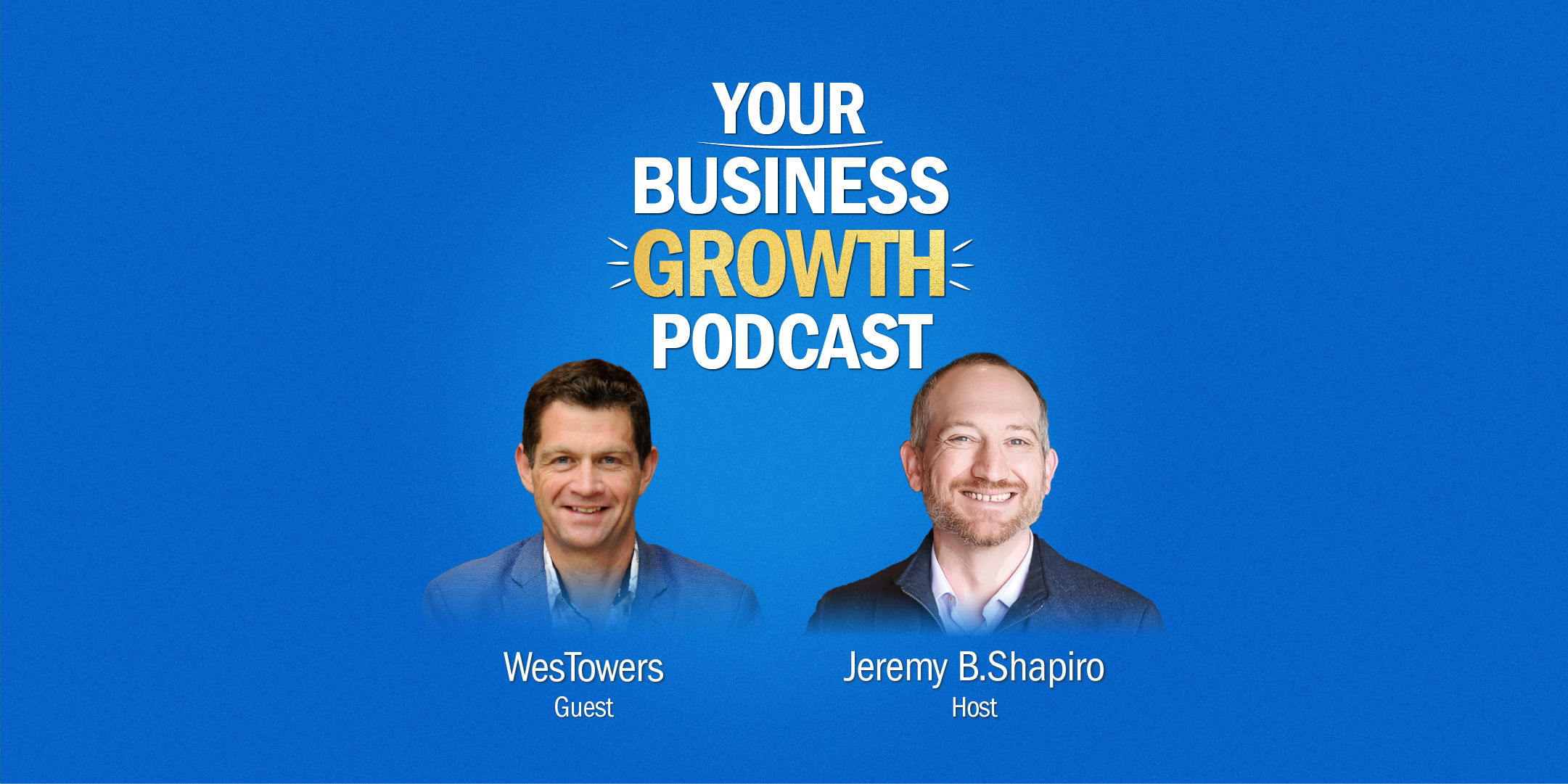
Welcome to today’s episode of Your Business Growth Podcast. I’m your host, Jeremy Shapiro, author of Your Business Growth Playbook, and my guest today is Wes Towers.
About Wes Towers

Wes Towers is the founder of Uplift 360, a specialized web and growth agency that serves trade, industrial, and construction businesses. He focuses on helping these brands transform their websites into trust-building assets that attract high-quality clients and convert more inquiries. With a deep understanding of this often-underserved market, he works to bridge the gap between where these businesses are and where they could be.
Throughout his career, Wes has developed a philosophy of continual enhancement, ensuring that his clients stay ahead of the digital curve. His expertise covers bespoke website design and development, search engine optimization, and enhanced user experience strategies. By using a research-driven design formula, he studies top-performing competitors to ensure his clients maintain a competitive edge in an evolving landscape.
A major turning point in his journey occurred three years ago when a confronting business valuation revealed that AI could potentially make his traditional agency model obsolete. Rather than retreating, he used this as a catalyst to completely reinvent Uplift 360. He moved away from founder-dependent custom work toward productized offers and standardized delivery systems, integrating AI as a tool to lift output without adding chaos.
Today, Wes has successfully scaled his agency into its most profitable year yet, with approximately sixty percent of revenue coming from recurring sources like website hosting and content SEO. By niching into specialized trades, he has opened doors to work with significantly larger companies than ever before. He is dedicated to helping other business owners achieve entrepreneurial freedom by removing bottlenecks and building systems that scale with soul.
Connect with Wes Towers
Speed Round Answers:
- All In Lead Source: Networking (if no money), Online Ads (with money)
- Books: E-Myth Revisited by Michael Gerber, 4 Hour Workweek by Tim Ferris, Rework by Jason Fried and David Heinemeier Hansson
- Unlikeliest Mentor: Drug Addict
Like This Episode? There’s More!
Subscribe!
Your Business Growth Podcast is available on all major podcast platforms. Subscribe today!
Get the Book!
Pickup the #1 Best Seller, Your Business Growth Playbook today online or at your local bookseller!
Meet Jeremy!
Book your Blueprint Discovery Call with Jeremy today and get back to the growth you deserve!
Wes Towers Episode Transcript
I knew the concept of niching because we’re in marketing. That’s what we’re always talking about these things. It’s easy to tell other people to be specific and niche and you know, see the opportunities in business from an external perspective. But when it’s your baby, it’s just so hard. It feels as though you’re cutting off opportunities.
We took on one that was. I should never have taken it on. It was just a, a nightmare. It was nothing like we’d ever done before. At that time, I had a lead developer, or who I could see was getting bored and frustrated with the, the work we were doing. And when he said, yeah, I do, he did the proposal, I submitted it, we won the project.
But then he quit two or three weeks into the project, and so all of a sudden I was burdened with this project. No one else on team knew how to do it. I was left to figure it out in the evenings and the early mornings. Lesson learned the hard way. Really, if you deviate outside your niche for all of the wrong reasons, things can be costly.
Three years ago, a business valuation came back at just one quarter of what the founder expected. The reason for the low number was a shock. The entire business model was seen as vulnerable to being replaced by artificial intelligence. Instead of giving up, he took that wake up call to completely overhaul how he worked, moving away from the high effort custom projects to assist him, that allowed him to step back and watch his prophets soar.
Today we’re diving into how he transformed a stagnant agency into a regional leader. With 60% recurring revenue. Welcome to today’s episode of Your Business Growth podcast. I’m your host, Jeremy Shapiro, author of Your Business Growth Playbook, and my guest today is Wes Towers. Wes, welcome to the show. It’s a pleasure to be here, Jeremy.
Thanks so much for the opportunity. Yeah, I love going back and hearing some of these origin stories of how folks got started. So if you rewind back for us, Wes, how did you first get started in this whole web agency space? Sure. So, I mean, back in the nineties when I was choosing my career path website design development wasn’t really a thing.
You know, businesses didn’t have websites back then. So I studied, uh, graphic design, multimedia landed my first job in marketing. Uh, curiously, that marketing has evolved a lot since I first started in that, the year 2000 in Sydney, it was an award-winning marketing company, but they’d never designed a website.
However, they, uh, I was there about three months I think, and they won a project to design a website and they, uh, said, right, you are the young guy. Better figure out how to build that site. And so I did. They gave me plenty of time. They gave me a few little short courses and so on. Uh, to do that and I found I loved it.
I found, found the creative aspect, but also the technical aspect were perfect for who I was. And so I became their website person, and. Eventually, and a few short years later, it started my own company. Uh, naively I had a skillset and I had no business acumen whatsoever, so I didn’t know how to put a proposal together, how to, you know, uh, do client meetings, um, even basic bookkeeping.
I, I had no idea. I just saw what the boss was earning and charging me out at as an hourly rate and thought, Hey, I, I reckon I, I’d like a bigger piece of the pie. So, uh, that’s what motivated the start. Um, and opportunity popped up that I took with a few little clients to start with and uh, and it went from there.
You know, it’s, so often entrepreneurs start out. Hanging a shingle to run their own business, doing the trade, the thing that they were previously doing as an employee. Uh, and quickly realizing the things you did, which was all the rest of the parts of the business that you never had to deal with before are suddenly now part of, part of your role.
So you, you found an interesting sort of broader category that you were specializing in earlier on, um, this like industrial trade sector. Like why did you choose to go after that market? Like were they underserved not being, you know, sought after by the rest of the marketplace? What was happening there?
The niche kind of found me as opposed to me finding the niche it felt like, and I think great things happen when it feels like that. So, and I suppose it’s a combination of seeing opportunity, but also, um, seeing a great need in the marketplace and for whatever, for various reasons really. Uh, the majority of our better clients all looked and sounded the same.
They were kind of in similar industries. And I, I realized, hey, this is a really big opportunity. And I think a lot of the reason why was because. They were being underserved, and because technical people like web developers and agencies and so on can talk a lot of jargon. This just didn’t resonate with these types of companies and, and they’re often, they’re founder led businesses and they don’t want to hear a, a whole bunch of jargon and so on and, and be overwhelmed by that.
They want to hear about what the end outcome is and the results and so on. So I, I just found I related really well to these types of businesses. Um, the, the leaders of these businesses and even the marketing departments within the larger organizations, I, I did really well with so thought, hey, this is a golden opportunity.
No one’s really serving them to a high level, um, that that should be, uh, my niche. And, uh, I went for it. You saw some great success earlier on as you were building out that space. Like what was that early growth like? How big were you guys growing? What, what did you see that future, that shiny, beautiful, ideal future looking like?
I suppose I started the business with lifestyle in mind as well. So I was really conscious not to, um, not to be absorbed completely. Um, I had, um, eventually had kids and so on and, and wanted to build a, a lifestyle. Kind of business. But what that meant was that was a really good framing of, in my mind to think about how do, how does it look to, to, to set up a business that doesn’t depend on me all of the time.
And so that was the intentional goal from the outset. And I, I suppose because of some of the reading, the books I read and, and so on, um, you know, the E-Myth ma, uh, magnificent book back in the day that I read, read quite early on. Um, Tim Ferriss’s book, the Four Hour Work Week, really phenomenal, um, in terms of getting the mindset right and, you know, thinking about how you spend your time.
These sorts of things really, um, shaped how I thought about business because as I said, I had no, uh, understanding of how to run a business. So I, I always fortunate to stumble upon really great. Yeah. So I always wanted to set up a business that would support lifestyle and I, I, I realized I wanted to build it, so it didn’t depend on me, but I, I, I think.
Along the journey, you find yourself not in quite the position you want to be. So you’ve gotta find new ways of, of going about things. So building a business that was sustainable long term, I mean, it’s always felt like an industry that changes super fast. So you need to be adaptable and flexible in the moment.
But with the end goal in mind of what you’re trying to establish and build. And for me, that was an agency supported my creative, uh, desires as well. So I, I love design and development, but I also love the technical, and I, I love geeking out a little bit on the, on the technical stuff as well. So, uh, yeah, building sustainable business, uh, hopefully building a, um, a legacy that potentially, you know, kids and so on will, will benefit from as well.
Nice. So you see that growth, you’re on that path, right? Building this business that is supporting you and is not gonna be dependent upon you, and you hit that inevitable plateau. Margins were shrinking. Growth was flat, but you guys are still working just as hard. What was, what was that plateau like when you hit it?
I was just, uh, fumbling and stumbling along, along a little bit because it was doing just fine, but I think. There’s a human desire and craving for growth. And so when you hit plateaus like that, whilst it’s all fine, um, the motivation sometimes isn’t strong enough to push further, but I think it’s really important.
To continue growing. Um, because it’s just how, it’s just what keeps us ticking as, as humans. So hitting that plateau, I mean, the, there’s a couple of things that were happening, so obviously the technology improves all the time. So what once took a technical develop, you know, a developer and so on to, to build out.
All of a sudden is, um, it became more capable for just a, a regular, uh, person to, to do so that that skillset, the value of the skillset diminishes to some degree. Um, so there’s always that, that, um, pulling down. So, you know, building out a website was quite technical and complex when we first started. So, uh, the margin was great because, you know, people couldn’t do it themselves and um, and so on.
But as things develop, they become easier for anyone to do. And so the, and then. It kind of feels like a race to the bottom. Everyone’s starting to to charge less, less, less, less, less. Um, and then so that the margin’s not quite what it once was. And, uh, you gotta figure out ways to get through that. You know, those, so that plateau was just the, the pulling down of the industry to some degree.
And when AI hit man, that’s, uh, uh, you never quite know, uh. Listening to media, you know, they always have extreme headlines, you know, you know, job losses, and we’re all gonna be replacing all that stuff. You never really quite know if it’s true or, or not coming through the media because you just realize, hey, they, they just, uh, exaggerate things to, to get a click on their headlines.
Um, but when that, when the, uh, business value has said, Hey, your business in is in jeopardy, the whole industry, not, not just your business, but your whole industry is in, is at threat right now. That was a real wake up call to say, Hey, the media isn’t exaggerating. This is a real thing, and I’ve, I’ve gotta figure out what I do next.
To make myself viable. So tell us about that, Wes. Um, you went out, got a business valuation and it wasn’t what you were looking for. What, what were you expecting and, and what did you learn from that valuation process? Yeah, well, I’d actually been, uh, a little bit in that process, um, many years ago as well.
I didn’t get a fully, um, fully fledged business valuation, but I went through the process to a high enough level to understand. What the key markers were, so the recurring income and what people look for when they’re buying a business, simply because there was someone who approached me from Sydney looking to buy, um, a smaller agency like mine at the time to, to quickly grow into our state.
And so they offered to fly me up and, and do all this stuff. So I did some groundwork, hired someone to, to look at the figures and give me some rough understanding of what, what was going on and what the value was. That opportunity didn’t go anywhere. But it gave me a good ground grounding in, in what valuations look like and what they are.
So I had a bit of an understanding of what it might look like, but not a thorough, um, understanding. And then when I got the fully, what they call a court ready or a, a valuation, that’s a thorough, that was a real shock because, you know, uh, it seemed as though the business was valued at nothing. The main threat was ai, the rise of.
AI was the main threat subor to sub secondary. One was the rise of outsourcing, so the ease in which people can, um, get things done offshore. So those things in combinations. In combination. He felt as though meant my, uh, business was worth a whole lot less. He said, people don’t buy uncertainty, and that makes a whole lot of sense to me.
I wouldn’t buy uncertainty. I wouldn’t buy my business at a high cost. You know, I’d be looking to try and get a bargain because, you know, once you see something that’s a little bit, you know, flat or unpredictable. That makes a whole lot of sense. Yeah. So what I’m hearing is that the valuation was not about how much revenue you had generated or year over year growth or any of that.
It was far more based on the liability and risk side of what the future of the business could be. That’s right. Another factor as well, which I knew was going to be a concern, was the business was built around me, my person and personality from a marketing perspective. Now, the systems and processes and getting the work done wasn’t around me, but.
The client facing, you know, my public marketing, I, I use a lot of personal branding, uh, which is a quick and easy way to, to grow a business, uh, through a personal brand because you’ve got relationships and you can leverage those and, and build those out and build your reputation on that really quickly.
But you can’t pass, you can’t sell that. You can’t give that part of you away because it’s so dependent on you. So pros and cons of building a personal brand. Um. So, yeah, that was the other, that was the other risk. I knew that was a risk, but I, that was one I was prepared to take because I knew it was a quick way to grow a business through that way, but, um, I knew it was gonna have downside.
Yeah. So two takeaways I’m hearing there for our listeners, um, from a business valuation and in turn, exit strategy standpoint is one. You can have a personal brand, but that’s not as saleable as a business brand. Um, and two, when your industry’s future is at risk, that’s gonna negatively impact the present day value of your business.
And it’s like two important things to be mindful of when we look at that inevitable exit, uh, timeline. So, um, alright. Now when we look at what you did with this, like how did you respond to this valuation? What was your, what was your takeaway that drove you towards action? What did you do in response?
Yeah. Well, as, as I said, I was really, uh, process oriented always, but all the standard operating procedures were, were built according to what I believed was best. Because it started out as just me and it, then it evolved and grew, grew out team and um, you know, had people taking care of different roles.
But it was all around what I thought was best. Um, some of it was muddled on what I saw in the, where I worked as a, as an employee. Some of it was what I picked up through reading books and so on, and, um, just evolving over the course of time. But I realized, hey, this AI beast is bigger than. What one person can fully understand, even the, like the experts, the absolute experts who, who, who make AI don’t precisely know how it works.
How the hell am I gonna know exactly how to apply it to my business? So it was the very first time I, um, leaned upon my team to a higher level and said, Hey, what are you seeing in the standard operating procedures? What are you seeing? Um, new tools and technology? How do we adapt? And that was a real eye-opener and it was.
It. Looking back now, I feel like I was so foolish not to introduce, not to include them at that level. Um, some of the, some of the, um, you know, high-end developers that I’ve got, they’re phenomenal minds. They’re smarter than me in their, in their, in what they do. Certainly. So I was foolish not to lean upon them earlier on, to adapt and a adjust, adjust things earlier.
But, you know, the wake up call was a real, um, blessing in disguise in that it forced me to think about some of these things and, and to ask them, Hey, what are you seeing? What should we do next? And, uh, and rework everything and took a lot of effort and work to go through granular, every little step in every process that we we do, and adapt them, streamline them.
Um, but yeah, it was well worth it. Are you enjoying this episode? Make sure you hit that subscribe button right now. That’ll help you get more episodes automatically as soon as they come out. So hit that subscribe button right now, and if you have a minute, leave a quick rating and review that helps support the show.
Nice. So what I’m hearing is you got some bad news in terms of where the valuation came in, but you were able to turn that around and go to the team and then work with your team on figuring out. What do we need to streamline, tighten up and how do we course correct to respond to this and come back at a better valuation with a more future-proof business?
I’m not looking to sell or, or anything, um, but I, I really encourage people to, to think about. Exit even if you plan, if, even if you’re not planning to exit right now. Because what it’ll force you to do is thinking about, think about building a company in the right way. Um, because you can cover over and mask things that are not ideal or perfect just in, in your daily operations.
But once someone’s analyzing every little thing, um, you know, you can see where opportunities are for improvement for sure. So I would encourage anyone to go through the process, um, even to do a, a, a. There’s some courses that, that you see pop up from time to time about exit strategies and so on, or I, I think learning in in that field is a great way to advance your knowledge in, in how to build a company in the right way.
You know, looking at the future, whenever I talk with clients and we talk about what the future for the company looks like, it comes down to three different directions that your business can go, right? You can pass it on to your kids, which like no one does, you can close up shop. And just be outta business, which is what most companies do, or you can sell.
So given the choice of passing it on to kids who don’t want it, or closing up shop, which you know is killing the baby or selling the thing. That kind of leans most folks towards the direction of, well, what if we actually build this company with the idea of selling it at some point? Then what do we do?
We do the things like you’re talking about with the systems, right? With the bigger picture plans and the branding and the, the figuring out how you differentiate and stay ahead and so forth, and you build a business so that you can sell it. So really well done on that. Yeah, yeah, absolutely. It’s so important, uh, uh, even if, yeah, as I said before, even if you plan to stay in your business for the long term and, and pass it on to your kids, you, you would be passing on something that’s far more viable.
Um, you wanna set them up. If you are intending to set, set up your, your, your family and your kids. On that path, set them up in the best foundations you possibly can. Um, set them up for success. All right, so speaking of success, you and your team sat down, figured out what could tightened up and buttoned up, and one of the areas you guys tuned into was your market, your ideal customer profile.
So how did you dial in on not just trades broadly, but like your really specific narrow niche? Tell us more about that journey and and where you ended up with, uh, with niching. I knew the concept of nicheing because we’re in marketing. That’s what, you know, we’re always talking about these things. It’s easy to tell other people to be specific and niche and, and, and, um, you know, see the opportunities in, in their business, um, from an external perspective.
But when it’s your baby, it’s just so hard. It feels as though you’re cutting off opportunities. I mean, I’ve got some real horror stories of taking on clients that weren’t a great fit. And whilst we got through those project delivered, um, the clients were happy. They, it’s just so much more time consuming.
Um, we took on one that was, I should never have taken it on. It was just a, a nightmare. Um, it was a dating website and so, no, it was, I took it on for all the wrong reasons. Um, it was nothing like we’d ever done before. But, uh, at that time I had a lead developer or who I could see was getting bored and frustrated with the, the work we were doing, and I thought, Hey, there’s an opportunity to keep him engaged.
So I got him to do the proposal and everything. I said, Hey, I dunno anything about this technology that’s required, do you? And he said, yeah, I do. He did the proposal, I submitted it, I presented it, and so on. We won the project. Uh, but then he quit in a ca two, two or three weeks into the project. It was a project to take months.
And so all of a sudden I was burdened with this project. No one else in team knew how to do it. So I was, I was left to figure it out in the evenings and the early mornings it didn’t sleep and couldn’t take on other projects. Um, just because it was all consuming to get this thing done. We delivered, she actually sold that.
It was an online business. She sold that business and so on, went on. She was not. Not, um, aware of the, of the torment and anguish I was feeling and the stress and the pain of getting that thing done. But we got it done and I mean, I, you know, I lost, I lost money on that job, obviously with that, not so much on the job itself, but the.
The taking away, taking me away from what I should be doing, and that’s the marketing side and, and building relationships and bringing in more work. So all of that dried up. So lesson learned the hard way really, if you, if you deviate outside your niche for all of the wrong reasons, things can be costly.
Yeah, so what I’m hearing there is it’s good to have a niche and you can say yes to opportunities outside that niche, but be mindful of the real costs behind those. Yeah, absolutely. Absolutely. It’s good to, to stick in your lane. I, I really do believe you should stick in your lane. Now, there’ll be little aspects maybe on the proof rule that, that you take on as well, but as long as the thrust of what, what you’re doing is in, in your core skillset.
I think, uh, that’s the, that’s the best way to build a business because then what you’ll learn from one project is adaptable and applyable to the next project because you’ll learn some things that are, that, uh, work really well for a certain scenario and you can apply those, uh, learnings to the next one.
So they get success faster as well. So the results are better. The clients are happy, everyone’s happy. If you’ve got a C it’s kind of like they say, happy wife, hap happy life. Well, happy client, happy business, happy business owner. So I think that’s really true. Super true. And that’s, that’s just one of the many values in niching.
So, so you guys niched into this construction sector, right? And then moved from doing all this custom one-off kinda work to starting to productize a bit more. Tell us about your journey towards productizing your offers and what that meant in terms of how often customers did business with you, frequency of sales, profitability and so forth.
Yeah, so there, there was the, um. To reconsider. So we would start with a clean slate of custom design each and every time. For, for clients, which, um, has its pros and cons, it certainly makes a project a lot longer than it needs to be. So what I thought about and the team thought about is we came at it, um, from an ideal scenario and, and built frameworks and structures around.
What works best in the industry for the, for the construction industry. And so set up some frameworks that we can use as a starting point each and every time. Now, once we apply the design, uh, styles and, and everything, every, every project looks different, but the structures in which, where everything sits within the website.
Is mostly the same that you know, it might be 80%, the framework might be 80% of the, the structure, and then that last finishing touch. We can focus on getting perfectly right for the individual, but it just may means things are so much faster because there’s just, there’s less backward and forward as well.
Initially we were designing, you know, two, three design concepts, presenting those the client would have to make a decision. Um, and decision, you know, making options and, and choices just, um, slows down a project. But now, now we don’t do lots of concepts. We present one ideal, which we feel is the best option, and we.
We modify that according to what the client’s desires are and, and modify it till they’re happy. But just presenting one option, it just makes everything so much easier because when we were doing two or three, and I think that’s a common trait of custom website design, you do two or three design concepts and then they choose and they mix and match parts, and so.
Um, it’s making, it’s making it harder for the end client as well, because all of a sudden they’re sharing it around with their, their team and everyone’s got a different view. And so it’s just so overwhelming. Someone wants to develop concept one in a certain way and someone else in the another. You, one director might love this one, and if it’s a, uh, a, a, a, um, partnership, the other director likes this other design, and then there’s conflict and battles and who’s, which way we’re gonna go, and it just makes projects so much slower than they need to be.
But presenting one. And explaining why this we feel is the best for, from a conversion rate standpoint and so on. Um, it just makes things so much easier. So that, that was one aspect of it, but also the recurring stuff, um, focused in on search everywhere optimization. So adapted our search engine optimization to include showing up in large language models and so on, and thinking about it more holistically and, and trying to figure out, okay.
Where’s, where is all this going? And, and how do we, uh, how do we build out sites and, and optimization strategies that will stand the test of time? Uh, you know, as things evolve and adapt. So what I’m hearing there for our listeners is a few key things that you know. One is when you niche, you can streamline operations, right?
Also, your client communications and decision making was far simpler and easier. Um, and you are now able to show up far more so as a specialist, not just in SEO, but also in, you know, the, the GEO or you know, the LLMs and all, um, as well, which is great from a lead gen standpoint. So this guy, you guys. To an interesting point that I love, which is that you could now start to raise your prices with a specialization and get rid of some of the lower margin work.
Um, tell us about that part of the journey and how that impacted what kind of clients you were able to attract. The key benefit with that side of things was it took less time from my side. So, uh, and that’s always the way in which I’ve built the business. That’s always probably going to be the, um, the bottleneck, whatever I can.
Spring through the door. So, um, when things are too customized and everything’s a little bit different, it requires a lot of my, um, my input. But when things are, um. Systemized and, and structured in a way where it’s, um, repeatable and, uh, it’s far more easy to delegate. So that was the, that was a huge plus, um, the delegation process of getting things out of my head onto, into the system to, uh, so, so that, so it could be done much faster.
So cutting out some of that, that time-wasting jobs, I mean, the way I look at it. If it’s going, if it’s a smallish job and it’s going to take a lot of my time, then I, I really don’t want that. I really don’t want that kind of work. So, you know, if it’s a smaller job and it’s not going to take much of my time.
For example, we do website maintenance, so that’s super simple and it takes none of my time personally, so that, um, can just, the team can, can take care of it on a monthly recurring. It’s a small, it’s a small, you know, investment each, each month for a client. But it takes none of my time. And I’m hearing three things with that is that one is, it doesn’t block on you, your team can do it.
Two, it’s high margin and most importantly it’s three. It’s high value to your clients. Yeah, absolutely. And sometimes what happens is, uh, clients or even other people’s clients, they don’t do their website maintenance. And whilst it’s a small thing, if they were to do it monthly, they get in a position where they get their website hacked.
You know, we’ve taken on. Projects that have dev developed from from other companies, and then they get hacked and that becomes a bit of a. Headache and nightmare, a bit of a higher end task than it could have been, you know, to, to remedy those issues. So, you know, doing those jobs as well, uh, is really important.
So getting people out of a sticky spot. They’ve had the website developed by someone years ago, and then it’s hacked. We take that on, we’ve clean it up, we, and then we can improve and enhance upon it and get it, get them into our system for the recurring thing, because all of a sudden they value, um, they value the maintenance once, once they’ve been burnt by not having it previously.
Now I’m hearing there for our listeners that you are also now moving from like a one-time project to having a recurring revenue component as well, um, that delivers ongoing value to your clients where everybody wins. So, all right. I, I wanna touch on a topic I’d be remiss to skip over here, which is ai.
And, you know, everyone wants to talk about AI and all that, but you are actually using AI in some pretty interesting ways within your business. Um, tell us more about how you’re using AI as a tool to increase. What you guys are doing without letting it add chaos to the business. We certainly apply it a lot for, for the behind the scenes, how we run our operating procedures these days, but also from the content creation side of things for clients.
There’s, um, a big concern around creating content through AI simply because we’ve got that, you know, AI slop, that everyone’s been exposed to that, that sort of generic bland stuff. Um, so building out prompts. That will ensure the, the content for the, the client is on brand, is on message, is in their voice.
Um, we go through a process to make sure, uh, all of that stuff is done right. And so once the foundations have, we, we customize their prompts so we can use them each and every time for them. To make sure their blog writing, for example, is always, is always correct and, um, is, uh, saying what it needs to say.
So it’s unique and, uh, distinct to them. So building out, uh, little prompts. There’s a, there’s a few prompts that get us to create custom prompts just for the, for that one client, and then we can reuse those, those prompts all the time. It’s been phenomenal to optimize websites in that way. Um, so that’s one thing.
There’s also AI tools, uh, plugins and so on that we can use. So a plugin for those that don’t know is a little piece of software that adds features and functions to your website. And so there’s some really great ones to optimize that use ai. Um. Uh, I don’t wanna geek out too much on this podcast, but there, there’s one rank math, which is really great for search engine optimization because, you know, each page or post on your, on your website can have a, a title and description.
That’s what ideally will show up in Google if you’re lucky enough to rank. Um, but if you’ve got a website with, you know, hundreds of product pages, let’s say we’ve got some building material websites with lots and lots of, um. Products if they haven’t custom written those for each and every page and post it takes a long time.
But Rank Math does a phenomenal job of assessing each page, what, what it’s about, and writing a title and description, which will be engaging, and it will be specific to that one page. So with a few clicks of a button, uh, you can have it done where it used to take, you know, hours and hours and days and days to, uh, it felt like to, to build out all those pages.
Those simple little wins, um, are really have been powerful now. So I’m hearing two things there. One is that you’re using AI prompts to help you generate personalized custom prompts for individual client work. And the second piece I’m hearing there is that you’re using it to handle the volume work of, you know, helping some of the client sets to rank.
And all AI is only ever as good as the, the inputs you feed into it. So. That’s because it’s so powerful. People lean upon the tool too much for the thought leadership as well. So you’ve really gotta think about what value are you adding to, to this information and content. There’s gotta be con uh, information gain we like to call it.
So what’s something of new? What’s the something of genuine new value? To, uh, to the internet space and, uh, how, how are we gonna introduce that? And it, simple little things to think about to do that. You know, case studies, stories, examples, things that only you can express and share because everyone can talk generically about your industry and, and what it is, but only you can speak about the specific projects you’ve worked on.
That’s, that, that’s the beauty of working with construction companies. Some of them have built phenomenal buildings. Some of our clients recognized buildings all around the world. And so we’ve just gotta feature those things and only they can talk about them because they’ve actually built them. You mentioned rank math and there’s also Yost and also all kinds of other things.
Like what, what swayed you towards Rank Math versus other stuff? Just assessing. We assessed all of them. We looked at all of them and, and the AI capability of rank math was far superior, felt like it was writing a whole lot better than the others, and you can do so much, um, more quickly and also. In the free version that, you know, some of the features that you really want.
Uh, you’ve gotta get the commercial versions for things, but rank math is pretty reasonable for em. The free version, I know Yos has come a long way in a lot of their AI stuff, and I’ve used Yos for a bunch of things, and then I’ve tried Rank Math and a few projects as well, and. Uh, it’s always good to hear from folks which you know, which direction they’ll lean in.
Why? Yeah. And it’ll probably change. They’re always trying to outdo each other so we’re not wedded to it for the, for the long term. We’ve, we’ve certainly learned that over the journey not to be wedded too much to, to one plugin because things change quickly. So Wes, now that you’re looking at the recurring revenue component in the business, um, you’d shared about 60% of your revenue is now coming from recurring transactions with existing customers versus.
The whole hunting and finding new customer model. How has having that much recurring revenue changed the stability of your business or how you look at business growth? It’s been phenomenal and, and really so to talk about even the simple maintenance type scenarios, because it doesn’t depend on me and the team can do it.
It’s such a great, great business, um, model to, to run. The other benefit too with it is, um, a client will build a website today and they’ll be happy with it, of course. Launch it, but you know, a couple of years later, they’ll want to evolve and adapt and change. So if we’re, if they’re still part of our world, they’re less likely to go shop around and, and, and try and find a new web developer.
So they’re in our world every month they’re hearing from us because we’re doing the maintenance. So it’s just a great way to, to keep clients for the long term because, you know, as you can imagine, if you build something out, if you go project to project, you build it. And then there’s no reason to stay, um, super engaged.
I mean, you can have email lists and send them, you know, information and so on to try and keep them engaged, but there’s nothing like them actually investing, um, into, into a service with you so that they’ve, they’re an actual client because it’s far easier. To, to feel that connection when there’s an actual client.
And so when it’s, the time is right for the full, fully fledged new website, we’re, we’re front of mind and we’re ready to take that on. So, um, I didn’t think about that at the time when we thought about, okay, let’s think about. Recurring revenue and building that side of the business. I, I didn’t, I hadn’t perceived or sort of considered the, the knock on effect of how easy it would be to win new projects off the back of that.
So, um, yeah, it’s, it’s been really great. Even, even for referral based scenarios. So some of our maintenance based clients, they’re just wired in a certain way that they’re always referring, they’re, they’re always sending people. To us. So, you know, one client in particular, I, I should actually calculate what they’ve been worth to us in terms of referrals.
And we are only, they’re only doing maintenance. They’re spending very little with us directly. But because they’re part of our world, um, they’re always referring. And that’s the, um, that’s the kick on effect of. Building recurring income and a and a and a sort of a sizable client base. Um, you know, some people would just wide that way that they’ll refer.
Others may not ever, but those few that do really well worth it. Two really powerful things that I wanna share, um, with our listeners, if you didn’t catch one, is that when you have that recurring revenue piece, now, it’s not just some prospect on your list or a past customer, it is a current, active, engaged, paying client.
Who can come to you for new work and secondly, who can refer you new business. So just by having that recurring revenue component in place, you have so much more business that comes from that. Um, so huge win on having that. All right. So speaking about some of these knock on benefits, right? Um, when you niched and really found this specialization, what were some of the, the other benefits that you saw with that?
Did that let you start working, working with larger clients or attracting different kinds of companies to work with? Definitely larger clients and so the, the beauty of what we do is, for the most part, clients will let us have our, our, our brand at in the Fuller, just our name website by Uplift 360. So that’s hugely beneficial because what typically will happen for, for a lot of companies is they’ll go see what, um, other people in the industry is, uh, are doing.
And so they’ll see our brand at the bottom, and oftentimes that’s how they find us. So they see we’re working in the space. They’ll click on the little link in the footer and say, Hey, these guys specialize in exactly what we want and do. We are the obvious, tr obvious choice, and it allows us to get bigger clients where once, if once when we were more generalized, you know, we, it’s very difficult to, to win the larger clients because they’ll typically go to a large, uh, marketing agency.
Um, because you’ve, there’s no benefit of, of working with someone, a smaller, smaller team like us, but. Once we’re specialized, there’s a, there, there’s that recognized value that we can bring and only we can bring. So the bigger clients are, are coming on board. The other thing too with it is, you know, people who are imp we have, uh, the bigger clients will have marketing departments.
And so you’re working with the marketing manager or, or, or the team. They will change jobs as well. They will change, um, employment. And so you follow them around because you, you are one of their secret weapons, so to speak, of getting stuff done effectively. So, you know, I’ve had so many times where I’ve just followed the marketing manager to the next company.
And, and you keep, you, you retain the, the old client because there’s a new marketing manager there, and you keep building a relationship with that new person, but you follow the, the old person to the next company. And that’s just so much easier to win that work. Um, and they’re typically, they’ll typically stay in a similar, uh, space, similar industry, because that’s their, that’s their industry experience as well.
So. Um, the referral network again, builds out so much more powerfully at just following people around in that way. Yeah, I think that’s one of those really powerful benefits of specialization and niching is that you become so much more referable and as people do change roles or need to refer someone out.
They don’t think of they’re generalists. They think of the specialist, right? So having that niche lets you be the specialist they refer to you. So Wes, since this breakthrough, you’ve had some great year over year growth and you know, are just coming off of another record breaking year and you did something interesting in terms of the standardization, which I think is one of those other.
Powerful side benefits of niching. Um, talk to us about what you did standardization wise with your delivery and how that helped you out. Um, with gross sales and all this year over year growth, that’s the, um, the delivery. So there’s the operating procedures, which, um, building, building a way in which, um, you know, there’s so many different project management systems that you can use.
Clickup is the one we landed on. And, um, the beauty of it. In my view is we can have it email the, uh, the client when at different, at different moments in the, in the project. And it’s not forcing anyone to log into a system. So there’s, there’s a couple of ways of tackling it. So it’s more systemized. You can, you can have a system where people log in.
And, um, you know, give feedback on different times within a project. Um, but that’s, that creates a level of resistance in, in my view, because someone has to learn, even if it’s simple, they have to log in and they have to figure out how to, to do whatever it is they need to respond to. Whereas when it’s through email, it’s, it’s, it’s, um, something that’s familiar to them.
And so when they respond to the email, it goes back into the project management system, click up and people can start taking action on it, on it. And I haven’t even read previously. Uh, it would, you know, even we had a, a system beforehand, so, and, but people weren’t using it so much. They would email me and I’d have to put it into the system.
Now it goes straight into the system. Um, you know, so simple little things. It just sounds so obvious. Sometimes it’ll take, you know, the emails that come through aren’t always as clear. Sometimes it, it’s, it’s obvious someone hasn’t, you know, even proofread what they’ve written because it, it can be conflicting.
So on. It’s just like a, a brain dump sometimes in those scenarios, I’ll need to reach out and find out, get some clarity around that, but that’s greatly minimized. There’s, that’s, that’s rare. Um, so sometimes something will come in and the team will go, Hey, did they mean the first portion of the paragraph said this, but the second portion said that?
What do we do? When I need to get involved. Um, so I don’t need to get involved in every simple little thing that comes through anymore. Just those, those items where there’s, um, contradiction and conflict and things aren’t as clear as they should be. Nice. So by streamlining, streamlining the whole process, you are able to help not just client communication, but your team’s able to work more efficiently and deliver faster, more consistently, and so forth.
So. We, if you’re talking to another business owner and they’re feeling trapped like you were, right, the business is entirely built around them and they’re the bottleneck as a business owner, um, what advice would you have for them to get out of that mode and back into growth like you did? The first thing I would think about is looking at all the tasks that you do in any, in any given day, and associating value to them in, you know, value, in terms of money.
It’s as simple as that to, to think about. What tasks are consuming all your time that just aren’t creating profit for the business? And are they associated to a certain type of project? Well, if they are, can you, can you build a system so that you are not involved in it anymore? Or if you have to be involved, can you just cut it, cut that, um, type of project so you can focus on those that matter more at a higher value?
Certainly the, that, uh, is the biggest thing. So. Eliminating things is a, a really powerful, um, way to streamline and improve your business. So eliminating, you know, the kinds of clients you might take on, the types of projects you might take on, um, and, uh, you know, even thinking about, um, you know, where, where the, what types of projects will lead to other greater projects as well.
So that, um, you know, as I said, taking on the maintenance stuff leads to big projects as well. So thinking about what’s the, what’s the benefit of taking on a project for the long term, for the, for the business. So knowing what you know now, like why is it that you believe the subtraction or elimination of things like systems and so forth can sometimes be more important than adding and adding and adding and adding?
Yeah, so we were doing a, a bit of. Because my training was graphic design initially at university, so I would, we were doing the occasional, you know, print-based design work, so brochures or flyers and so on. And so it just was a, a real drain, um, because it wasn’t really what we wanted to do. We just did it as, uh, supplementary to, to the core business.
Um, but yeah, it just, it just is consumed far too much time from my side as well. And, and maybe because. Maybe I was too controlling in that field because it was my, it was my specialty, um, as well. So, yeah, removing that side of the business is really helpful. Um, because it just, it just, um, it was lower profit margin as well.
Part of the, what’s going on in the world, you know, the outsourcing piece, which I mentioned earlier, the design piece, the, the profit margins just, um, were smashed. Um. Because people can get it done offshore pretty easy or, and these days they can do it themselves with tools and so on. So, kind of removed ourselves from that as much as possible.
There’s very occasional clients where the project scope requires, uh, a brochure or a flyer. We will take it on if it’s part of a bigger portion of work, but we won’t, we won’t touch it if it’s just a standalone flyer or brochure. Um, you know, that sort of thing. So eliminating that was really helpful. Um, so we could just not dilute what we were really, you know, what we were focused on, what we were really, really good at.
The whole practice of removing is something I think most people. Business owners specifically can forget about, right? We’re always looking at what do we add on? We, what do we start doing? What do we start? What do we start, what do we start? And we don’t take that moment to think about what do we stop doing, right?
What do we no longer offer? What do we remove? But that can oftentimes be like you’ve seen, you know, so much more powerful. Absolutely. It’s a scary thing. Some of the best decisions you are make in business feel really scary at the time. Um, and you just gotta think through what, where’s this fear coming from?
And is, is it real, you know? Um, because we make decisions, um, so emotionally at times as well. So, um, you’ve just gotta step back and I think that’s really helpful to have mentors in your world as well, because you can’t see everything as clearly as, as an external party might see it. Um, so I’ve got a great connection of buddies who are all running businesses, different businesses to mine, but they, you know, we’ll often catch up over a beer or, or, um, you know, just social things as well.
You know, just talk about business. And they’ll, they’ll, they’ll say what they’re, what they’ve done and what they’re doing, and they’ll say, Hey buddy, you, you shouldn’t be doing that anymore. You should be focusing on this. And sometimes their advice is, um, really valuable. Sometimes they go, nah, that’s, that’s not what I’m going to do.
But it’s, it’s thrashing out different concepts and ideas. People who know, who have done it before or, or are doing similar things. Two things I wanna tease out for our listeners there. One is that as an entrepreneur, it can be lonely at the top. So surround yourself with folks also on that entrepreneurial journey.
And there’s so much to be learned there and so much value. Uh, and I love that you found that community. Um, the second piece, I, I wanna pull from what you just shared. Is this idea, you mentioned the word decide a few times. Um, one of the things I touch on in the book is like this whole, like linguistic etymology of this word decide actually comes from like desir, which means like to cut.
So when we talk about deciding it’s not about the thing you’re choosing to do, it’s all the other options. You are cutting off and removing, leaving you with just that one direction you’re going. So when we decide to do something. We are intentionally saying no to all the other options, and that is an okay healthy and normal good thing to do.
Yeah, a hundred percent. Because saying yes to everything is saying no to other opportunities and vice versa. If you say no to, to something, you’re saying yes to a whole bunch of other things. So yeah, oftentimes when we say no, we find the, the real opportunity was right around the corner that thank goodness we said no to the wrong thing because that allows us to say yes to the right thing.
So. Russ, before we wrap a few quick rapid fire questions for you, if you had to start all over again from scratch, what one lead source would you go all in on? Depends on the position in which, how, how financially, what I had to invest. So if I only had time to invest, like I was broke and just starting out, I would focus on building out my network.
Um, I would get to networking events. It is super time consuming. Um, you know, you’ll, you’ll meet a lot of people and hand out business cards and try and build relationships. A lot of events you go to and nothing comes from it. It’s a massive time investment, but if you’ve got no money, you’ve got time to spend and you’ve got no money to spend.
That’s what you’ve gotta do. And that’s what I would do if I was starting from a position where I had a little bit of backing financially. I’d be building my online profile. Um, now there’s things online you can do. For free, but to, to, um, supercharge it, you know, you really wanna invest into your online marketing and, and think about doing some ads.
And that’s, that’s a quick, um, it’s almost like steroids online to, to advertise, to get more eyeballs into your website and into your social platforms and, um, more engagement. So, and maybe it’s a hybrid of both. So if, yeah, if I, if I was starting out with zero, I would just be focusing on networking and, and I’d do, uh, online, which is for free social media, for example.
But if I had, um, the capacity to do so, I would be advertising to get as many eyeballs of my ideal type type of client into my world, engage them in some way. And sell to them from there. Nice. So with no money networking and with a little bit of um, uh, money building the online profile and running ads.
Yeah, that’s it. Absolutely. Alright, aside from, of course, your business Growth Playbook, um, you’ve mentioned some other wonderful books, but what would you say are your top favorite business books? Yeah, I mean, there’s so many, so many books. I’ve, I’ve listened to these, I listened to them more so than anything else.
But I, I guess the early influence ones, I, I already mentioned the E Myth. I would certainly still recommend, um, four Hour Work Week. Uh, I would certainly still recommend they were so, uh, influential for me at the timing, which I read them. Um, more recently, uh, I, I just re-listened to Rework, um, which was a powerful.
Powerful book. I think that’s really an important sort of philosophy for now as well, simply because everyone needs to adapt and evolve their business right now. So, and that, that touches on a whole bunch of ideas of cutting, cutting the fluff, eliminating things, as you say, the decision, the cutting away of things, um, and figuring out what works and how to, how to, how to, um, improve things, rework them.
So I think that’s a really important book writer. It was written before ai. Um, but I think it’s really important now to think about those concepts. Nice. And you touched on mentorship earlier, um, but I always like to ask who was one of your un unlikeliest mentors? Unlikely mentors is a, that’s an interesting one.
So there’s always something to learn from everyone in, in their, in their walk. Um, you know, even people outside of business that most, this is, this is an interesting one. So a, a mentor in a, a roundabout way. He was a, a friend of mine. Um. Who had a, a different background to me. He, he was, uh, um, as a youngster, he was into drugs and so on, and, um, life challenges meant that he went back to, to drugs and found himself deep in, into addiction.
But in, in a roundabout way, I, I learned a lot from him about he could always get what he wanted to get at any given time. That’s that addiction, that’s that drive. Um, you know, to find a way to get the thing that you want really. Um, you know, he would do anything to get that thing. So, to think about that in a positive light, if you set your life and business up to think about what, what is it you really want?
You will find a way to get. Um, because that’s how we’re wired. You, you. And so that’s the learning from him. That’s an unlikely mental, a drug addict addict to think about, what is it I really want? How do I go after it? Because you can get what you want if you’re just, uh, hungry enough for it. Nice. Um, see, I, I find that unlikely mentors so much more interesting than our, our, our typical mentors.
Um, thank you for sharing that. So, to recap for our listeners, you move from a low valuation and a high effort founder dependent model to a strategic reinvention of your agency by niching into the construction sector, productizing your services and leveraging AI to reach your most profitable year, yet with 60% of your revenue coming from recurring.
Yeah, yeah, yeah. That’s it. And Wes, for listeners who wanna learn more about you, where should they go? Right now? Uplift three sixty.com au. Uh, the obviously Australian website, but if anyone does visit there, they’ll see lots of brands, global brands, they probably, brands they recognize in the, uh, construction related industries.
So, uh, jump on there. You can book a strategy call, uh, with me directly on that. It’s a, it’s a free 45 minute session, so I would encourage people to jump on and, and do that. Love that. And of course we’ll have that link as well as everything else mentioned in our show notes. Um, Wes, this was wonderful.
Thank you for sharing with us about your journey, how you grew, how you got stuck, and how you broke through and got back to that growth, um, and have seen your best years over years yet. Um, such a great story and love that you shared that with us today. Yeah, it’s been, uh, fantastic, Jeremy. Thanks for the opportunity.
Thanks so much for listening. Quick reminder, hit that subscribe button right now so you can get more episodes when they come out automatically. And remember to leave that rating and review right now.
Like This Episode? There’s More!
Subscribe!
Your Business Growth Podcast is available on all major podcast platforms. Subscribe today!
Get the Book!
Pickup the #1 Best Seller, Your Business Growth Playbook today online or at your local bookseller!
Meet Jeremy!
Book your Blueprint Discovery Call with Jeremy today and get back to the growth you deserve!