What if you built a million-dollar consulting firm only to have your pipeline vanish overnight, leaving you with zero revenue and a family to support?
Our guest today faced that exact reality, and later, a life-threatening crisis in his own office that forced him to choose between folding or finding a radical way to scale.
He ignored the spreadsheets and made a bold, counterintuitive move involving borrowed law school classrooms and a marketing campaign that captured a massive audience at just the right moment.
This shift didn’t just save his business; it led to a rapid-fire expansion that involved acquiring nine companies in less than two years and a high-stakes coin flip that decided his final exit.
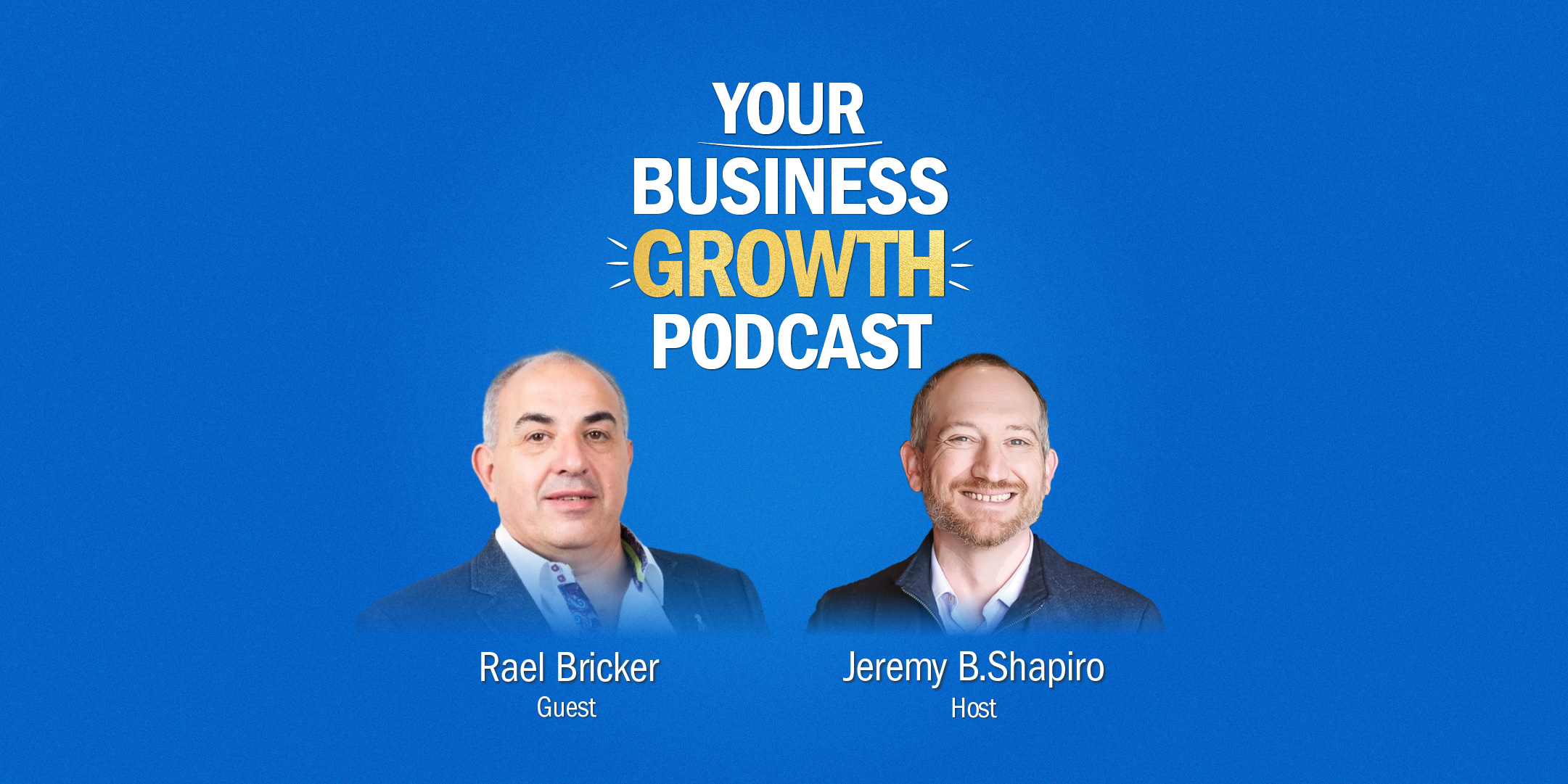
Welcome to today’s episode of Your Business Growth Podcast. I’m your host, Jeremy Shapiro, author of Your Business Growth Playbook, and my guest today is Rael Bricker.
About Rael Bricker

Rael Bricker is a serial entrepreneur with over 30 years of experience building and scaling businesses across finance, education, technology, and mining, He has listed companies on multiple international stock exchanges and his financial services group has settled more than $3 billion in loans over 20 years, Rael holds both an MBA and an MSc in Software Engineering, and he is a Fellow of the Mortgage and Finance Association of Australia,
His career spans multiple continents and industries, from working 6,000 feet underground in a mine to serving as the Managing Director of a technical education business with 4,000 students, Rael’s global perspective is informed by research interviews conducted with leaders in more than 25 countries across a vast range of industries.
A major turning point in Rael’s life occurred in 2013 when emergency stent surgery after a season of triathlons forced him to re-evaluate his relationship with work and health. This experience helped him find his purpose in sharing the journey of achieving excellence with business owners and entrepreneurs around the world. Today, through The Excellence Project, he helps leaders build resilience, culture, and optimism within their organizations.
Rael is the author of Dive In and its follow-up, Still Diving In, which share the business principles he gathered over three decades in startups and listed companies, He is also the co-host of the Excellence Podcast and has served in leadership roles for Professional Speakers Australia, He values the lessons from the school of hard knocks as his most important qualification and focuses on designing solutions that fit the specific needs of his clients.
Connect with Rael Bricker
Speed Round Answers:
- All In Lead Source: Digital guerrilla marketing to start and, once more mature, referrals
- Books: Radical Candor by Kim Scott
- Unlikeliest Mentor: Lindsay Adams, a respected speaking-industry leader, a long-time friend, and his “sanity board”
Like This Episode? There’s More!
Subscribe!
Your Business Growth Podcast is available on all major podcast platforms. Subscribe today!
Get the Book!
Pickup the #1 Best Seller, Your Business Growth Playbook today online or at your local bookseller!
Meet Jeremy!
Book your Blueprint Discovery Call with Jeremy today and get back to the growth you deserve!
Rael Bricker Episode Transcript
He started talking to them and then took off his jacket and was carrying an AK-47 rifle over his shoulder. He pointed the gun at me, he pointed at the students, and he said, “Next time he’s not gonna be so nice, he’s just gonna start shooting through the window.” That was in February, and I went, “Okay, it’s now time to leave this business.”
So that challenge triggered us to find a way of exiting the business. What if you built a million-dollar consulting firm only to have your pipeline vanish overnight, leaving you with zero revenue and a family to support? Our guest today faced that exact reality, and later, a life-threatening crisis in his own office that forced him to choose between folding or finding a radical way to scale.
He ignored the spreadsheets and made a bold, counterintuitive move involving borrowed law school classrooms and a marketing campaign that captured a massive audience at just the right moment. This shift didn’t just save his business. It led to a rapid-fire expansion that involved acquiring nine companies in less than two years and a high-stakes coin flip that decided his final exit.
Welcome to today’s episode of Your Business Growth Podcast. I’m your host, Jeremy Shapiro, author of Your Business Growth Playbook, and my guest today is Rael Bricker. Rael, welcome to the show. Morning, Jeremy. Well, morning for me, that is. Great to be here I’m so glad you’re here, and I love origin stories.
In looking back to your earlier years, how did you get that confidence as, like, a 26-year-old MBA to believe you could teach the world how to run business before you’d even run one yourself? Yeah, it’s funny, and I, I laugh about that story now, that the fact is that I guess coming out of the business school environment, you see yourself as bulletproof.
Uh, you see yourself as, as, “Wow, I can do anything,” you know? “I’ve been empowered through this business school to do anything.” And so I guess that was what was clouding our vision. We were sitting there and going, “We can do anything. We know everything now because we’ve been through business school.” In fact, the book I published in, in many years later actually said, you know, Lessons Learned Since Business School is the subtitle of the book, but it didn’t phase us one iota to go, “Yeah, we know everything, and we can tell people…”
And, and a lot of it was badly informed. My business partner had worked for a large timber business. I’d worked in, in for a large mining company, and I guess we were projecting our own frustration from the small-mindedness of those l- large, you know, divisions and divisions within divisions and divisions within division divisions, where people really were concerned about paycheck to paycheck and not really how they were impacting on the greater business.
And we came out of this business school going, “Wow, we know about 360 degrees view of business. Let’s go and tell people about it.” And we were a little like puppy dogs. We were excited. We were, we wanted to share this information with people, not realizing that we didn’t actually have a background to do that.
So despite all of that, you still managed to land a pretty big contract. Tell us about that, uh, that big contract with Eskom and what that meant for your future. So we, we did land the contract, and how did we land it? So my partner and I had actually found a video series from Harvard Business School… Uh, we’re very into this business school environment, on, uh, quality management systems, which is ob- obviously a massive business today, you know, 20, thir- 40 years later almost, 35 years later.
And we saw this video, and there’s a professor talking about a program that he had developed, you know, about quality management. And so we did the research as much as you could without the internet in those days, actually ordered online, uh, or not online, we phoned them and went and ordered the videos of this program, and we adapted that program And one of the, the things that he had done was work with an electricity supply company.
So we went out and contacted the Electricity Supply Commission and convinced them to appoint these two 26-year-old puppy dogs to develop a quality management program for them that we knew very little about. Okay, so what we had done… Le- let’s just put some context around this. We’d gone out to our friends who– And we had both studied at different schools, so by the way, so we had a bigger network of people, and we’d said to them, “Can you lend us your name and your qualifications to put on our letterhead?”
And so firstly, when we went and pitched for these contracts, we looked like 10 MBA graduates with varying experiences, but it was really the two of us. And when we needed to boost our numbers, we called a friend and said, “We’ll pay you 500 bucks. Come in for a meeting.” And we didn’t call them directors, we called them executive consultants or something in those days, but we looked much more impressive than we really were, and that’s probably how we won that contract.
And we worked damn hard to deliver. We actually delivered on a program that was, I would have to say, world-class, but then I’m probably biased. So what I’m hearing there for our listeners is that you guys looked the part, which helped you to land the business, but more importantly, once you got the business, you were able to deliver.
What was it like energy-wise for you and the team as you’re getting the group together and pitching and pitching and pitching and trying on this million-dollar look of a company that hasn’t landed the big contracts yet? It, it was about self-belief, and it’s still something that guides me today. You know, we absolutely believed that we would deliver value.
And so if I extend that to my current world that I live in today, I, one, I get really frustrated when I see speakers from around the world, and as a professional speaker, who stand on stage, and they’re great ’cause they jump around and they scream and shout and they rah, rah the audience, but they’re not really doing anything or delivering value.
And that, that… Since those early days delivering the contract to Eskom, I’ve always been about delivering value, and even when we had the education business in South Africa, which evolved from that business, it was about delivering value. We really cared about our students, and it was about getting them to a point of where they were employable.
And so that to me is what drove it. It’s that absolute belief in self, which I still have today, but it was about the fact that I knew I would deliver good value. You know, the concept of value is something we talk about a lot, right? I bring this up in the book, whether we’re talking about raising prices or launching new products or going after new markets.
It doesn’t really matter what that pricing, product, or anything else is. If you’re not offering value, no one’s going to buy that. And so you guys saw this and lived this firsthand. That doesn’t always get you all the way though, because despite the value, there’s always churn in business for factors and reasons outside of your control.
And you guys at one point had quite a large client that was a good chunk of your revenue, and this international firm came along and… Tell us the story about what happened with them convincing your client to, to go elsewhere. So the interesting, that, that firm was well known for coming in and promising massive savings, okay?
And how did they ma- ma- manufacture those massive savings? Their first thing was, “Well, get rid of all other consultants,” okay? And, and so that’s exactly what they do. They basically went to the Electricity Supply Commission, they were international American firm actually, and said, “Get rid of all other consultants ’cause we’re…”
And then immediately there was a bottom line because you’ve saved all the money in these other consultants and so, you know, put our budget aside, but, you know, look at the money we’ve saved you there. And so that was what they did. And yes, we had, we had left good paying jobs, we had backed ourselves into this business.
We delivered module one. We were busy process of delivering module two of the program, and suddenly we were told, “Sorry, we canceling the contract and, you know, you wanna fight us? Well, go and sue us.” We didn’t have money to sue them. We, we had no money to take the contract to court, so we sat down and went, “We…
What do we do now?” And we ended up having a meeting with a place called the Institute of Marketing Management, and we went there just to meet them and, and, and find out what they did. We knew nothing about what they did. We just had a meeting with them. They said, “Oh, you guys are so well qualified.” Again, going back to the 10 people we had on our letterhead, that was still part of the, the image.
There was no websites in those days. And they said, “You guys are so well qualified. Why don’t you teach our Institute of Marketing Management program?” And so we went, “Okay, that sounds like a good idea.” We were a little desperate for money, and so we went, “Let’s do that.” And so we started a business teaching their program, and managed to recruit 20 students in our first semester.
And there were lots of things we did, systems we built. I remember sitting and, uh, one computer that we had, only one computer, us designing brochures, three-fold, A4 brochures that were really, really amateurish. And my wife actually put us a, many years later, put a, a scrapbook together with some of those old brochures, and you cringe when you look at those.
And yeah, we, that’s what we did. We put this brochure together. We, we told people how good we would be at delivering the program. Again, total s- belief in self, total belief that we would be good, but we had no idea. Yeah, so you had this factor outside your control, this, you know, international company that came in and took away your pipeline, your revenue, your all of that.
But despite that happening, you carried on, you took meetings, and that got you into using the same knowledge, the same information, but an entirely different product, and now on campus teaching. So tell us about that campus life, what that business was like, and about what happened in your office on campus while you’re there.
Okay, so yeah. So we started the business. We had… We were working out of my partner’s lounge room at the time, as I said, with one computer, one printer. We bought a photocopy machine secondhand that was falling apart and went into his garage. And we literally did everything. We typed every single bit of notes.
We did everything there. And we got our first 20 students, and that was a breakthrough, and that was a bit of revenue. Jonathan and I started teaching the first programs, like we had to teach ’cause we couldn’t afford to get other teachers in, and that’s what we did. And we started it and… But then we, we kind of, you know, we obviously were teaching only 20 students, so we had time on our hands, and we worked out, “Well, where is our target audience?”
We didn’t do a formal analysis, but coming out of business school, that’s what we did. And we went, “Okay, let’s work out where our target audience is.” And we started phoning schools Every school, and there were lots and lots of them, and no one had ever done this before, and offered to come out and do career counseling.
And our career counseling was all about telling the students why they should do our program. It was under the guise of career counseling. But legitimately, we were delivering a good product. And in fact, you know, if I s- if I jump forward three years, our first graduating group who were writing external examinations, and they were measured against every other school that was teaching the same qualification, we ended up with the top student in our very first graduation, top student nationally, in our very first graduation.
So, you know, w- were we validated in believing that we’re delivering a good product? Absolutely. And so we, we started doing all this marketing, this guerrilla marketing. And, you know, today it’s very different because most marketing is, is electronic marketing today. This was very physical marketing. So in South Africa, kind…
I need to contextualize the timing. That was 1990, the year Nelson Mandela was released, the year the African National Congress was unbanned, and suddenly you had a, a country controlled by five million whites that suddenly was now, you know, there was this emergent market of people of color, of the ma- majority of Black people in South Africa who had terrible education.
The Black or Bantu education, as they called it, was at a horrible standard. People were leaving school with a graduation certificate with a 37% aggregate mark where their subjects were, you know, three languages and health education and, you know, some other obscure course, you know, Mexican basket weaving, I don’t know.
But they were clutching the certificate, the school leaving certificate, and saying, “What do I do now?” So there was this immediate hunger for education, and that was with being… There was a lot of being in the right place at the right time. We were exactly that. We were at the right place at the right time We then came up with this idea after about a year, I think, or two years, that once we’d started expanding…
So we still– we, we did our first course in Johannesburg, and then we said, “Why not? Let’s try duplicate this.” And so we opened, um, over the next few years, another five campuses, but using the same model, and we did lots of things to make the model work. But the one big thing in South Africa was that year 12 end of school results, there was no SAT, and so every state or, or province, as they were called, ran their own programs, uh, for year 12, but all results nationally were issued on the same day.
And y- people would run out and buy the newspaper and look for their name in the newspaper because it would take the school… It was normally between Christmas and New Year, and all the schools were closed, and the schools would then mail out a week later your actual results. But you wanted to see did you pass or fail in the newspaper.
And so we ran ad, uh, posters on billboards of A0 size. Now, A0 is a massive billboard. You wouldn’t… Even today, I look at that and I go, “Why did we even go that size?” Okay? But we ran… We dropped about 5,000 of these in each of the major cities where we had an office, and we went and im- literally got people off the street, so guys who were sleeping rough on the street, and paid them a few bucks to go and put these up on posters overnight.
Now, it was summer, so it was warm. It wasn’t like we’re getting them out in freezing temperatures to do that, and we literally paid these guys a few bucks to go and plaster the city overnight. And the next morning, when people woke up to go and get their year 12 results, there were 5,000 posters in each city that said, “Unhappy with your results?
Call 1-800 whatever.” And so we get these calls and going, “Oh, I didn’t get a good enough mark. I can’t go and be an engineer. What should I do?” You go, “Oh, have we got a program for you.” Okay? And simultaneously with that, we expanded from the marketing program to the chartered secretary, which is a, a financial qualification, a company secretary, not a, not a, a secretary as in a typing secretary And Institute of Personnel Management, we developed a course for them.
So again, total belief in self. We went out and said, “We’ll develop a program for you.” And they went, “Great, develop the program.” And so we did. We, we add these three courses that we offered in our, in our school, and that guerrilla marketing worked for two years because no one ever followed us, ’cause by the end of the next year, everyone had forgotten, but we hadn’t, and we did it again.
And it grew us from, you know, 20 students to 4,000 students over six years. Are you enjoying this episode? Make sure you hit that subscribe button right now. That’ll help you get more episodes automatically as soon as they come out. So hit that subscribe button right now, and if you have a minute, leave a quick rating and review.
That helps support the show. That’s incredible growth, and I wanna dig into that a bit more. Um, I also wanna highlight for our listeners a few things there that you touched on, Rael. One of them is that while these factors outside of our control can often present obstacles or challenges, they can also present opportunity.
And you guys saw that opportunity, you went after it, not by anybody else’s playbook, but with guerrilla marketing, and built a business because of that opportunity, which is tremendous. Now, back to that sort of topic of factors outside of your control, uh, you’re touching on an interesting point here historically.
Um, you’ve shared with me some stories about the political activism on campus and some of the challenges you faced, uh, you know, with offices and all. What all went on there? So the distinction, I guess, was that a lot of the activists… So universities around the world traditionally are hotbeds of political activity.
That’s what they are, right? It’s, it’s young, free minds who want to try and change the world and don’t know how to do it, okay? And so we chose, uh, interestingly, from a positioning point of view, we chose to have our offices across the road from the major university in Johannesburg. Why? Because when we spoke to students, we said, “You’ve still got access to the campus environment, the campus life.”
That was part of our marketing. But the downside of that, the activism on campus flowed to a private business. So we would get people walking in from the union demanding, “We demand,” which was what they would do at the university, and the distinction between a private business and a public university was somewhat muddied.
Okay? So that was the first thing we had to deal with, was explain to them, “Hey, this is a private business. We do what we do,” and whatever. The second one was we also realized early on that majority of our students weren’t having anything to eat before coming to school. They were traveling probably an hour, hour and a half commuting in minivans, ’cause there was no public transport network in South Africa, and then they would arrive, and they would have no sugar in their body.
So we gave them free tea and coffee and biscuits and something called a rusk, which is like a, a cake that’s sort of been dried out a little bit, but it’s good for dunking in coffee. But it’s good in c- in carbs and, and was great for them. And so we would have that as a free thing for all our students, even when we had 6,000, uh, 4,000 students So one of the days…
So, so then I mentioned the transport. Behind our big building in Johannesburg, which was 50,000 square foot, 5,000 square meters, there was a petrol station where a lot of these minivan taxis would park whilst after the major morning shift run before the afternoon shift, and they would wash their cars and everything else.
And one of our students reached out of a window and thought it would be funny, saw a guy down the bottom wa- washing his car from the fourth floor, and threw a cup of coffee out to dirty his car. Okay? Innocuous, right? Most of us would just go, “Whatever.” About 10 minutes later, a guy knocks on the door, or no, comes to the office.
My, my secretary says, “A guy wants to talk to you.” He tells me that he was washing his car and he saw the students from the fourth floor window throwing coffee out over his vehicle. Can he go and talk to them? I said, “Sure.” We went upstairs with him. He started talking in the vernacular Black language to them, and then took off his jacket and was carrying an AK47 rifle over his shoulder.
Okay? Um, now contextually, there was a war between the rival taxi groups, and so AK47s, you know, Russian AK47s, were fairly common assault rifles in South Africa. All illegal, but assault rifles. And they all had AK47s under their seat. Okay? It was sort of a weird situation. And he pointed the gun at me, he pointed at the students, and he said next time he’s not gonna be so nice, he’s just gonna start shooting through the window.
And that was in February 1996, and I went, “Okay. It’s now time to leave this business.” And so my partner and I looked around for a small listed entity. So that challenge triggered us to find a way of exiting the business, and we found a small listed company. We went to them and sold them the idea of face-to-face education in the new South Africa, the hunger for education.
And so we managed to reverse our business into theirs, and then both… We had appointed a CEO of our business at the time, and I became CEO of one of their other listed entities, and my partner and I together went on the acquisition trail for them. So that was the next phase. Yeah. So I wanna ask you a bit more about that.
This reverse listing approach is not that common, but you guys pulled this off. Can you dig into a little bit more about what that strategy is and how you approached that reverse listing? So it’s very common… It was very common in South Africa, and very common now in Australia, where instead of a, a company…
So this company was operating. It was running. It was very small. It, it had a stock exchange listing. But what we did is we took a business that was bigger than theirs and brought it in. They acquired us for shares, and so we became major shareholders in the business. And that’s a reverse… That’s effectively a reverse listing as opposed to a front door listing.
So a front door listing, you write a 100-page prospectus, you go out and raise funds. Reverse listing, you’re basically reversing a business into an existing business and changing the nature of the business. So in Australia, for instance, now in the, in the, in the current world, which is 20-odd years later, a lot of the older listed companies were listed for whatever, whatever their purpose was originally.
They don’t have a business running. A lot of the mining exploration companies now reverse into them, take over the majority shareholding, and use that structure to then go out and raise money, because it’s easier once you’re already listed than going out with a, a new listing. So that reverse structure, reverse listing is, is what they do by acquiring a shell, effectively an operating shell.
This company was not an operating shell. It did have operational businesses, but we… With our acquisition and the nine… the eight that followed it, we, uh, took it up something like 14 times. Wow. So you did this once, it worked well. You then sort of went back to that playbook again and again, and ended up acquiring nine different companies overall in a really short period of time.
In 18 months. 18 months, yeah. It’s incredible to do all that in 18 months. How did you decide that’s what you’re gonna do and execute that so quickly and with such precision, like a playbook e- each time? So it was interesting. A- at the same time, another group was forming of private education businesses, and they were also on the hunt, so it was…
became a little bit competitive as well. But we also made a decision to reverse… to expand the business. So we went from our business, which was, uh, how do I describe it in American terms? Probably a junior college. So it was offering diploma courses, not degree courses, but the diplomas were accredited as if they were three-year degree courses.
So it was sort of, sort of a very junior college, a community college, if you wanna call it that, in, in the US context. We then said, “Okay, well, let’s do two or three different expansion things.” Again, driven by our MBAs, business school idea of, you know, expanding what you can do, markets, products, et cetera.
And so we said, “All right, let’s expand product.” So we started looking for businesses that offered something similar to what we did, but also additional programs in the same target audience. So the same majority Black, coming out of school, terrible results, but needed to study. We then said, “How do we expand?”
And so we ended up acquiring a business that was actually offering an American university degree as a remote campus. So we expanded above the diploma to the degree, and then we said, “Well, let’s acquire a school as well, and let’s fully backwardly integrate from kindergarten to university.” Now- The school we acquired, the first school we acquired was a top-end private school, private education business.
The flaw in that model was it was actually just for scale because we only, and we didn’t realize it at the time, but the truth was their graduates weren’t studying through our programs because our programs were aimed at a different level. But from a market perspective, the fact that we, we expanded so rapidly from kindergarten to university became a darling of the market, as opposed to actually starting schools for the disadvantaged, which w- financially was probably not a good model, whereas this school was very attractive.
So our acquisition was at 7 million when our business was acquired. The school was 160 million. So, you know, it gives you the different size of the scale. Yeah. And so there’s a strategy we love to see and put into place where you look at your audience and you ask that question of, what else do they need, right?
What do they need before they work with you, after they work with you, and the rest of their customer life cycle? And you started out with this business serving people getting the test result they didn’t like. You then expanded beyond that, sort of in the next phase, and you expanded way earlier down to the kindergarten side, covering this full educational range and expanding that life cycle that you could serve, which is tremendous.
Really well done. So with these acquisitions and the listings and everything else, you’re bringing in a lot of different companies and team members and culture. I’m always curious when companies are, you know, going after this roll-up strategy, what they do to help the teams come to one culture within one company.
So a lot of that, uh, and I have to say, a lot of that happened after my time because, you know, we did the 18 months of acquisitions. I was CEO of another business called Mast Education. Uh, which was a, a related group. I was… It was also a listed company. And then I got to a point where I said, “I’m out”, and I actually left the group.
And I guess the structures were held quite separate for a number of years and merged very slowly afterwards. So part of the strategy, or lack of strategy, because we didn’t really think about it, and today we’d be far… And, and, and we admit it. Today we’d be far more tuned to culture and cultural fit and all those things.
We weren’t. We just went out and said, “Let’s acquire for growth. Let’s acquire for what the market is looking for.” And the business is still successful today. I was back in South Africa recently. The business is still successful and still operates today. The bigger issue was that I don’t think we addressed, we, myself and my partner, didn’t address the cultural challenges of bringing it together.
Those were done much later when they started, um, optimizing management and having general managers over certain sections and, and really focusing on, on how to bring those businesses together. We… Our phase, and we admit it as a flaw, was that it was the acquisition phase. So on the acquisition side, you obviously would see a change in the share price, not just from the acquisitions, but from that new business that is all these rolled up together.
How did you see that share price impacted or change from this acquisition spree? Well, it started out when we did our, our transaction, the share price was 90 cents. When we acquired the big school for 160 million, the share price was 14 rand. So th- that’s about a 17 times uptick on the share price, which is quite remarkable.
It was amazing Um, but it was also at a time, in that time in the, in the late ’90s where there was a hunger on stock markets for the next big thing, and education in South Africa was the next big thing. So, so it was, it… Again, right place, right time. Um, but we, we, we again delivered value. You know, at the end of the day, the group was doing something to build a better South Africa.
I don’t think we actually understood that at the time. We understood the value we were adding to individual people, but when I reflect on it some 30-odd years later, we truly were making changes in the infrastructure and the fabric of South Africa. That’s tremendous, not just to see the financial gain, but also the societal impact as well.
And that’s one of the coolest parts, I think, of having a business, is not just the financial side, but the charting your own path, the providing employment and jobs, the helping your community, the taking care of your clients and customers. Like, all this impact we can have, and the add-on ripple effects just by virtue of being an entrepreneur.
Speaking of entrepreneurs, one thing that I see you’ve done really well that other entrepreneurs struggle with is, in many of the stories you’ve shared, you took action quick. You moved on something, you did it, and you did it without thinking three times about it. Many entrepreneurs struggle with this, you know, analysis paralysis.
They’re looking at spreadsheet number 27 about evaluating their opportunities and everything else, and that’s not the direction you took. What would your advice be to entrepreneurs who are stuck in this analysis paralysis mode? So a few things. When we chatted before as a pre-interview for this recording, I used the term that, yeah, 27 spreadsheets is 26 too many.
So I guess that’s part of it. It is, there is this gut feel, and, and gut feel is something you have to have. You have to understand that your business itself needs to make sense. The, so does it make sense to you to do what you’re doing? Does the market need this product? But also, I guess the back of my book, the three lines on the back of my book sum it up.
It says, “Business is not complicated. Business is simple. Just dive in and adjust your course while you’re moving.” And I think the, the two things I see, or three things I see with entrepreneurs today, the one is they’re so wedded to what they’re doing, they’re married to the idea, that they don’t wanna let it go.
And so you might go down a road, as we did. We started out as consultants. We pivoted real- and pivot’s become the big word, particularly after COVID. But we pivoted without knowing it was a pivot, and so that’s the ability is to not be wedded to your product Be wedded to the vision of what change you wanna make in the world.
And so it’s that about… You know, I remember going to the bank when we started the business, and we wanted a loan, and we were frustrated because we actually ended up getting my father-in-law and my fa- and my partner’s father-in-law to sign security for us at the bank for a minuscule loan, like tiny little loan.
But when we went to the bank, they said, “Oh, you guys are in great position. If you are staying in your jobs, we’d lend you the money, but you’re not staying in your jobs. You’re leaving to start a business. Why would we lend you the money?” We’re going, “Because we’re young business school graduates. We’ll get another job at more money, and we’ll pay you back.”
And the bank couldn’t understand that logic, okay? And that was part of the frustration, was that, you know what? We were in good jobs. It was at the time where if you were well qualified in South Africa, you would get another job, and that was just a frustration that they didn’t understand that we had a backup plan if the business didn’t work.
The backup plan was finding a job. It wasn’t anything defined, but it was still there. It was a backup plan. That is not always the, the path that the banks understand. So you clearly work hard, and you have worked and you have hustled, but you’ve also seen the light, what that can mean in terms of this concept of, like, work-life balance, taking care of things outside the business, like personal health and all.
Share with us a bit more about the story of what happened in 2013 and sort of that, that wake-up call for you. So my wake-up call in 2013 was that I was still an arrogant whatever, and I thought my ego got in the way, and I thought I was bulletproof, and I had just finished a season of triathlon. So putting that into context, I was a state sportsman in my 20s.
I broke my kneecap. I had surgery on my knees in my 20s and didn’t… I did a lot of individual sport, and then in my late 40s, I decided to do triathlons ’cause that’s what you do when your ego gets in the way. And after doing a season of triathlon, decided to train for a marathon, and every time I ran, I got neck pain at about 10 or 12 kilometers of running.
And I’d think it’s ’cause I’m a big unit, as they say in Australia. I’m fairly well-built, and I thought, “I’m just moving a big body around. That’s what’s causing my neck pain.” I’d go for physiotherapy. It would go away. I’d run again. It would come back. And my doctor eventually said to me, “You know, there’s something else underlying here.
Go and have a CT scan of your heart.” And that is something I– A CT angiogram is something I recommend to everyone. I have no interest in, in, in radiology practices, so I’m not selling them that idea. But that was what saved my life. I went for an in- a non-invasive CT scan, and it picked up that I had two blocked arteries.
And so I was away in Singapore with my wife, with some friends. We were out drinking and eating and having a good time, and I got a call from my doctor, and the funny part of the call is he s- started the conversation with, “Don’t panic,” which is not something you wanna hear from your doctor while you’re overseas.
Anyway, he said, “Don’t panic. You do have two blocked arteries. Go and buy some aspirin and, and, and you’re seeing a cardiologist next week.” And so, you know, it was all very rushed, and I saw the cardiologist, and yeah, I ended up with two stents. And then I sat down and reevaluated where I was at. So I’d started a financial services group in 2001, and I’d sold a billion dollars of mortgages from stage.
My time on stage was defined by my late father. I speak about him a lot. My late father took me to Toastmasters when I was 15, and so I learned the skills of being on stage at a very young age. I was South African Toastmasters champion at age 20 And so I encourage every young person today to build the skills to be able to stand up and talk.
So we started the business 2001. 2003, 2004, I was approached by a big property group to start running seminars on their behalf for their clients, and the seminars were about investing, property, buying things, et cetera. And I spoke not like a banker, I spoke like a human being. I spoke in real English, not in bank speak, and I’ve sold a billion dollars of mortgages from stage by doing that.
So after the stints, I went, “Okay, what am I passionate about? What gives me joy? What gives me joy is being on stage.” And so I decided to actually take my experiences at that stage, which is 30 years of entrepreneurship, write, start writing a book, and start talking about how my stories can help guide other people.
And that, that has evolved over the last 10 years, but that’s essentially what that wake-up call was in 2013. Wow. We could talk for hours about each little piece of what you just covered there. But you did touch on you’ve written a book, Dive In, and y- the follow-up book to that as well, and I wanna understand a little bit more about went into Dive In and still diving in in terms of this experience you have as an entrepreneur.
So at my very first professional, “professional,” and I use inverted commas around that, speaking gig, um, I spoke in Melbourne at the mortgage conference, and I was so excited. I tried to cover 10 different points in 50 minutes, and I was rushing through it, but yet I had full rooms, and I… They asked me to redo the talk the next day because I had such a great response.
And I got on the plane, all I had was an iPad, and I started typing on an iPad because I wanted to get these stories down on paper. And so for the next nine months, I wrote that book, and then I got imposter syndrome big time, and I went, “No one wants to ever see this story or hear this story.” So I put the book away for two years, and I just carried on building my speaking business and getting speaking gigs and still doing mortgages and still doing finance.
And then I happened to be in South Africa, and I was having dinner with my cousin, whose wife had been the chief book buyer of a, of a major chain of bookstores for 25 years and had just started her own publishing business. And she said, “Send me the pr- trans- send me the book.” And I sent it to her and she said I need a few more thousand words, ’cause we need to cut words out when you edit, and I could think there’s publishable material there.
And so I worked with her for about eight months, and we revisited some things, added some chapters in, and published in, on the 18th of May, 2018, uh, was when we went live. And it was a great experience. It was a bit of a cathartic experience. It was, it was a dump of my own experiences, but it’s become a calling card.
I don’t actually make money out of the book, but it’s an oversized calling card. It’s what I use when I visit every corporate. I give copies out at conferences. I sell some copies, obviously, but there’s a free download on my website. So for me, it’s just about sharing that story because the subtitle of Dive In is Lessons Learned Since Business School So the arrogance that came out of business school environment, and it was how did I apply those lessons over the next 30 years?
That is so fantastic. And for our aspiring authors out there, a few things to highlight. One is that you absolutely need to have an editor. Uh, don’t just click publish. Have a third party set of professional eyes take a look at it like Rael did. That’s fantastic. Number two is the book is so valuable in many ways, but it is not often a money-making endeavor on its own.
It can be, but that is not the only reason authors publish books. So all right, before we get to some quick rapid-fire questions and wrap, I love metrics. You’ve talked about the excellency that you’ve had in your business and the productivity versus just busyness. What are the one or two numbers you look at or you have dashboarded in your businesses to make sure you’re on track and you’re moving towards excellence?
So in my financial services business, which is the most numbers driven, our numbers are settlement numbers. Uh, so we have three measures there. How many applications have we lodged with the banks, and, and dollar figure, not number of applications, but dollars. How many have been approved by the banks, and how many have settled?
And we do that on a weekly basis, and those numbers are disclosed to my entire staff on a whiteboard in the main area. And we talk about them, and we talk about why is the numbers down this week and what’s happening. And, you know, so those are the three critical numbers. I mean, the business is mature, and so cashflow-wise is mature in terms of the trailing income that we get off mortgages.
But my staff and I really look at those three measures, and that’s what drives everything in the business. And so from a dashboard point of view, that’s where we sit. And I want to point out a really important thing you just said there, which is that those are the numbers that drive the decisions in business.
If a number or KPI, a dashboard, a number doesn’t inform a decision, it’s a vanity metric, not a KPI or key performance indicator. So make sure you track the numbers that you make decisions off of. Okay, before we wrap up, Rael, a few quick rapid-fire questions for you. If you had to start all over again from scratch, what one lead source would you go all in on?
I… Today it would be, it would be some form of digital. You know, we had no digital in those days. Everything was print media But I would find… I would have to recreate our guerrilla marketing in some form of digital. That’s the key to it, and I don’t know what that is yet. You know, we have 14 and a half thousand people on the database, and we send regular finance newsletters out, and that does some informed marketing.
But a mature business like ours now re- relies on referral business. If I was starting again, I would have to really dig deep to find that one guerrilla aspect to doing what we’re doing. Excellent. Um, book-wise, aside from, of course, Your Business Growth Playbook, Dive In and its follow-up, Still Diving In, what are some of your top favorite business books?
So my favorite book of all time is a book called Radical Candor because it, it deals with four styles of leadership, but radical candor is the most powerful form of leadership that you can have when you care deeply about your staff and you guide them in the correct way, and that’s called radical candor.
And, and there are three other quadrants to that model that tell you you’re doing a bad job. And so radical candor’s one that really… one of those books that I read and I went, “I’m doing this already,” but it actually gave it a name. Nice. That’s the, the thing I like about frameworks like that. All right.
Mentors are always important to us entrepreneurs. Who would you say was one of your unlikeliest mentors? Well, I’m… my, my mentor and still my mentor today is a, is a guy by the name of Lindsay Adams who has a, an award from the government, an Australia, Order of Australia medal for services to the professional speaking industry.
He’s what I’d call the Grand Poobah of speaking. He’s served every role in the world in the speaking industry, and him and I run our podcast together, but we’re also great friends. We stay at each other’s houses now, and he is my sanity board. He’s five years older than me- And so much more experienced and so much more measured.
I’m still a bit of a hothead sometimes, and he’s much more measured. And as a mentor, he’s been my long ongoing mentor for, for many years. That’s beautiful. All right, so Raael, to recap for our listeners, you moved from a total collapse of a consulting firm to a massive education powerhouse by diving in without a perfect plan, leveraging aggressive guerrilla marketing, and using a reverse listing to acquire nine companies before exiting on a coin flip.
Absolutely. That was, that was a lot of fun. And, and I had fun throughout it. That’s, I think, the critical thing. If you’re not having fun, don’t do it. For our listeners who wanna learn more about you, Raael, where should they go right now? Uh, raaelbricker.com. Uh, contact me on LinkedIn. Link, connect with me on LinkedIn, but raaelbricker.com.
There’s a tab on the website called Free Stuff. There’s a whole lot of stuff you can download. Copy of Dive In, the first version. Dive In Two is n- is, still Diving In is not published yet. Um, there’s a couple tests you can do, your leadership matrix, your color pr- your color behavior styles, lots of different things I can do there off the website.
And send me an email. Um, I respond to every email personally. All those links, as always, are in the show notes. And for our listeners, that’s Raael Bricker, R-A-E-L B-R-I-C-K-E-R.com. Raael, thank you so much for joining us. This has been great. I love your journey, and thank you for taking the time to share so much of the journey and the lessons learned and how you had fun doing it, too.
Thank you, Jeremy. Been great here. Thanks so much for listening. Quick reminder, hit that subscribe button right now so you can get more episodes when they come out automatically, and remember to leave that rating and review right now.
Like This Episode? There’s More!
Subscribe!
Your Business Growth Podcast is available on all major podcast platforms. Subscribe today!
Get the Book!
Pickup the #1 Best Seller, Your Business Growth Playbook today online or at your local bookseller!
Meet Jeremy!
Book your Blueprint Discovery Call with Jeremy today and get back to the growth you deserve!