At just twelve years old, today’s guest was already acting as a professional bridge between two different worlds, helping her parents navigate the high-stakes purchase of their first home.
Decades later, she hit a common wall where her own success became a cage, leaving her working harder without actually making progress or finding balance. Instead of succumbing to burnout, she made a strategic pivot that allowed her to own a specific market niche so effectively that she now ranks as the number one search result in the country for her specialty.
By building a network that empowers others to do the work for her, she scaled her volume to thirty million dollars a year while finally finding the time to enjoy the life she worked so hard to build.
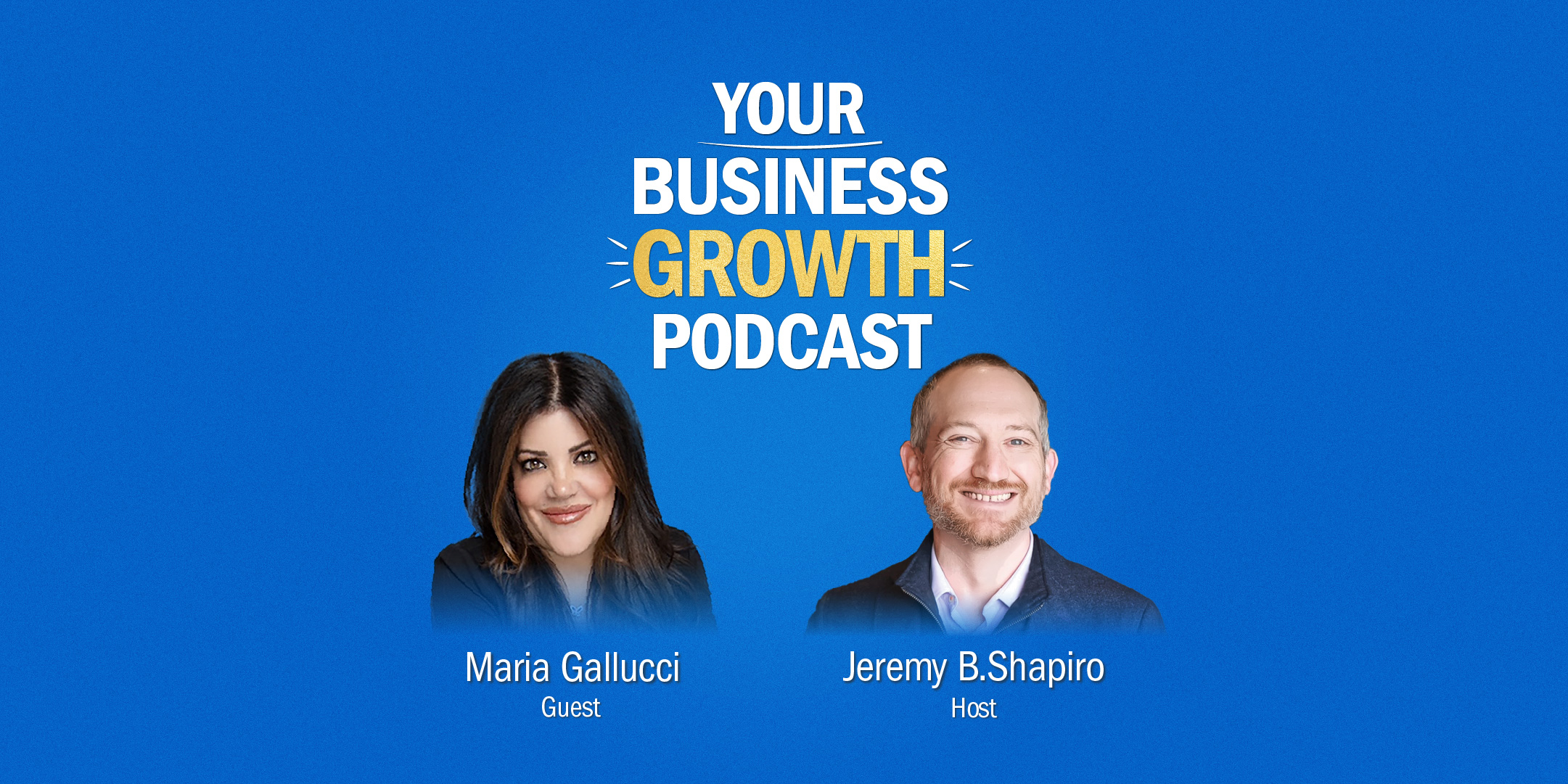
Welcome to today’s episode of Your Business Growth Podcast. I’m your host, Jeremy Shapiro, author of Your Business Growth Playbook, and my guest today is Maria Gallucci.
About Maria Gallucci

Maria Gallucci is a multi-award-winning Colorado REALTOR®, entrepreneur, and best-selling author with over three decades of experience.
As a Child of Deaf Adults (CODA), she learned American Sign Language (ASL) before English, a background that shaped her lifelong passion for communication and inclusion. She currently serves as a top-producing agent at Compass and is consistently ranked among the top 1.5% of real estate professionals nationwide.
Maria is the founder of Uptown Realty Group, Gallucci Homes, and ASL Realty, a national platform that connects Deaf and Hard of Hearing clients with ASL-fluent real estate agents. Her mission is to ensure that underrepresented communities are seen and respected throughout the home buying and selling process. She also founded the ASL @ Compass affinity group to support fluent agents and improve housing accessibility for the signing community.
Her expertise spans a wide range of real estate services, including residential sales, new construction, land, and duplex developments. Beyond standard transactions, Maria is an active investor who provides marketing and sales strategies for builders and helps families navigate complex property opportunities. Clients trust her for her ability to negotiate winning strategies that prioritize profitability while remaining low-stress.
Outside of her business, Maria is a dedicated advocate and speaker who serves on the boards of the Rocky Mountain Deaf School and the Colorado Association of the Deaf. She is the author of Raised in Silence, a memoir and guide focused on bridging communication gaps. Through her work, she continues to inspire others with her motto, “Just Try,” building bridges across differences and advocating for cultural inclusion in every space she enters.
Connect with Maria Gallucci
Speed Round Answers:
- All In Lead Source: Referrals
- Books: The Millionaire Real Estate Agent by Gary Keller, The Go-Giver by Bob Burg and John David Mann
- Unlikeliest Mentor: Her parents
Like This Episode? There’s More!
Subscribe!
Your Business Growth Podcast is available on all major podcast platforms. Subscribe today!
Get the Book!
Pickup the #1 Best Seller, Your Business Growth Playbook today online or at your local bookseller!
Meet Jeremy!
Book your Blueprint Discovery Call with Jeremy today and get back to the growth you deserve!
Maria Gallucci Episode Transcript
I remember looking at my calendar one day and realizing I’m working, like, nonstop. I was so busy and I had plenty of activity, but very little leverage. My business was running… It was running my life. I needed to build systems in place, not work harder, like work smarter. At just 12 years old, today’s guest was already acting as a professional bridge between two different worlds, helping her parents navigate the high-stakes purchase of their first home.
Decades later, she hit a common wall where her own success became a cage, leaving her working harder without actually making more progress or finding balance. Instead of succumbing to burnout, she made a strategic pivot that allowed her to own a specific market niche so effectively that she now ranks as the number one search result in the country for her specialty.
By building a network that empowers others to do the work for her, she scaled her volume to $30 million a year while finally finding the time to enjoy the life she worked so hard to build. Welcome to today’s episode of Your Business Growth Podcast. I’m your host, Jeremy Shapiro, author of Your Business Growth Playbook.
And my guest today is Maria Galucci. Maria, welcome to the show. Hi. Thank you so much for having me. I’m so excited for our conversation because you’ve really dialed in such an amazing niche and have a great story tied to that. But let’s go back sort of in time a bit. What was it like when you were helping your parents to buy their first home as just a kid of 12 years old?
I think for me it didn’t feel unusual at the time because I was always inter- interpreting for them. And so for me, I just thought I was going to the next closing that they were doing on their first house. So when I got there and I noticed that my parents were struggling with the pa- paperwork and they didn’t know what they were signing, and I was only 12 at the time, so I really didn’t know what the paperwork meant either.
And so for me, I just… It made me feel like they were, like, left out. So me jumping in to help them in- interpret the paperwork, you can tell that they just wanted to understand what, what was going on. And that for me, I always felt like I was never gonna let anybody feel like my parents did at that time.
And you then parlayed that experience and got into a career in real estate. Were you like most new agents and looking to work with buyers or sellers or anyone with a pulse just to be involved in a transaction? Or sort of what was your start into the world of real estate from there? I think for me, well, so I’m a teen mom, and so I needed a job right away, and I had already had that experience helping my parents.
And so for, for me, I’ve always loved showing houses and se- and selling that aspect of it. So when I ju- jumped into it, I was just trying to get anything at the time because you want buyers, sellers, like a- anything, anybody with a pulse and human. And so for me, I just jumped right i- into it, and it just took off from there, and I’ve been in it for 35 years now.
Wow. So you had some of that momentum early on of seeing some success. What did that feel like, getting that first transaction, the next transaction, and starting to get that flywheel of business going in real estate? I think for me you always, you always que- question yourself. So I’ve been through all of them, like the ups and downs of real estate, and we know how the market, it crashed in 2008, and it’s- Kind of crashed last year, so it’s just been, it’s j- just the, the momentum.
So for me it’s ve- it’s very exciting, and e- every closing gave me the c- confidence and ma- made me work even harder to help p- people get into, in- into their homes. And you just have to just stick, stick with it to make sure that you get through the ups and downs of real estate. Because I think a lot of people think that it’s easy, like you have your own hours, you have your own things, and it’s not.
It’s a struggle, I felt. Yeah, sometimes I feel real estate agents and brokers have some of the best parts of being business owners, but also some of the biggest challenges of the constraints of more of a traditional job in some ways. And that is a tricky spot to be in. Now, one thing we didn’t touch on for, for our listeners and viewers is that you grew up as the child of deaf adults.
Tell us about how that shaped your approach to communications and some of these high-stakes negotiations as you’re representing your buyers and your sellers. Yeah, so I’m a, a CODA, which is a, a ch- child of deaf, deaf adults, so my first language is actually ASL, so it’s American Si- Sign Language. So for me, it’s, it was more than just words ’cause I’m con- constantly wa- watching bo- body language, expressions, and j- just the way that the deaf and hard of hearing community, they communicate ba- basically.
And so for me, you have to know what you’re doing in your own l- language, and I think a lot of people di- disregard the deaf and hard of hearing community because they don’t know. And so they think that it’s not Spanish, it’s not a language, but it actually is a completely different language, and there’s a huge c- community out there.
So I wasn’t g- gonna let them struggle like my, my parents did, and I have a lot of clients say, “Oh, it was so, it was such a d- different experience this time around,” verse because they had me, who’s fluent in ASL. So I speak their language. I know their tr- traditions and cultures. And then for, for me, I wasn’t g- gonna let anybody feel like they were left out of it.
So how are these clients finding you or realizing what it is you do, and getting that experience that they’ve been needing for so long but didn’t realize was possible till they found you? I think it was my dad, I would say, because when I was younger and just g- getting into it, I got tons of referrals from my parents because they’re obviously in the deaf and hard of hearing world, and then they just like, I think it’s just word of mouth.
And then so now probably 80% of my clients are e- either d- deaf or hard of hearing. Now, when you became in this unique position of not just finding a really beautiful and wonderful and rewarding niche, but also being in a place of like a trusted advisor for the community- Did that end up in any way like sort of boxing you in or limiting some of your growth by being so dialed into your niche?
I feel like it was fr- frustrating because I had built exactly what I thought I, I wanted, but I didn’t really have any of the freedom or re- resources. And I loved my, my clients, but I realized that every problem, every phone call, e- every d- decision came through me because we, at the time, we didn’t have interpreters.
And so I had to fight forever to, to be able to get inter- interpreters at the c- the cl- closing table, and now it’s actually a law that you have to have inter- interpreters there. So they didn’t really have the, uh, the a- access to what they needed to be able to understand what they’re closing. So for me, it was pretty frustrating and a, a, a long fight.
And even with CHFA, which is out in Colorado, it’s one of their d- down payment as- assistant program you have to have… You have to take the classes. They had no closed captionings on the videos, and they would just expect them to go to these classes without interpreters. So like, I fought forever to get to tell them, “You guys have to have in- interpreters there.
Like, how are they supposed to know what they’re doing to buy?” And so, but it, it took a while, but I finally got, was able to get everything to go through that So the barriers for the buyers and sellers were so high, and then you’re stepping in to help bridge that gap, but you’re taking on that burden of all parts of this, not just tr- traditional real estate transaction, but also the interpretation piece as well.
And then your buyers and sellers can’t even get some of the education and things they need for the programs, and so you’re having to be an advocate for them in those places, too? Yeah, exactly. And it took… E- even now, pe- like, I’ll have title co- companies fight, saying that, “Oh no, we’re not p- paying for the interpreter.”
I’m like, “No, you have to. It’s an ADA law now. You guys have to.” Back then it wasn’t, but now it is, so I would always have to advocate for them and fight for, for them to get the a- a- accessibility that they needed. Now, have you always been doing all of this on your own? Or at what point did you start bringing in a team to help you out and support you in the, the day-to-day work of the business?
When… ‘Cause I’m in Co- Colorado, so I do m- mostly Colo- Colorado, and then my sister, who is fluent in ASL as well, is my assistant. So she was a- able to help me. But there’s not a lot, surprisingly not a lot of ASL agents out there, and so that, that, that’s why I developed the ASL Realty, which is a nationwide one that I can help deaf and hard, hard of hearing clients na- nationwide by connecting them with an, an ASL speaking agent.
That is so cool, and I wanna come back to that in a little bit about the whole network piece, because I think that’s really amazing what you’ve done. Was there a moment you realized with the work you were doing and your sister helping you out, that you were busy, really busy, but maybe not as productive as you wanted to be?
Like, how did you differentiate between those two? I remember lo- looking at my ca- calendar one day and realizing I’m working, like, nonstop. I, I answer the phone… I always say that I work 24/7. So even if my clients are, like, texting at midnight, I’ll still, if I’m awake, I’ll still try to a- answer them. And then, so I feel like I, I was, like, I was so b- busy, and that, that’s why I actually hired R- Rose and stuff.
So I feel like I had plenty of a- activity, but very little le- leverage. And so that, that’s when I knew that something had to change, and I’m like, “Okay, R- Rose, you’re gonna have to help me because there’s no way that…” Because I want everybody to get the same s- service. I want them… And I think if they’re te- texting you in the middle of night, and everybody gets mad at me for this, but there’s something wrong.
They’re stressing out. So they need help, you know what I mean? So I just wanna make sure that they’re okay, so I try to always a- answer an- anybody at any time, and then that’s why it’s just you have to have a team. You have to co- collaborate to make your, to make yourself sane. Now early on, most business owners are also in this full-on hustle mode of working 24/7, being available for their clients, which is a noble, wonderful thing, but that can often have some negative side effects for you as the business owner.
How, how did that feel being so available 24/7 and maybe not having the balance you need between the business and personal life? Like, when did that come to a head, and what did you do about that? I think that my business was running, like it was ru- running my life, basically. And so instead of su- supporting it, I missed out on time with my kids.
And then I’ve always worked since I was young because I was a teen mom, and so I’ve always had that… My dad always instilled, like, wo- worth e- work ethic in me, and so I always thought that I always had, have to do that. So s- sometimes I felt gu- guilty, but I would bring, like, my son to the closings with me.
And so I would try to, like, balance that. But then I realized that I wasn’t working and that, that’s when I realized that I needed to build sy- systems in place, not work harder, like work smarter. Yeah. That’s an important distinction. Very commonly we see people working harder thinking they’re working smart, but it’s actually just working, yet not being productive.
So how do you define that difference between, like, working hard versus working smart? Tell us about some of those moments for you. I think for me, you have to Like balance your- yourself. Like you, yeah, you have to remember, okay, you, you can’t be there 24/7 for everybody, and you need to build a team. And I feel like a lot of people might think that team is not a g- good thing because you’re taking everything away from yourself.
But if you do, if you ba- balance everything and you make it strategic, you can do both. And I think a team is a l- u- usually a lot be- better than d- doing it all by your- yourself, and that’s when you get burned out too. It is so easy to burn out trying to do it on your own, or not believing that other people can do the job as well as you or better than you.
Exactly. Oh, that was the hardest part, I think, for me, was, like, letting go. Like having … Like trusting someone else to do what you’ve always done for years and years, and that was hard. Me, I had to be, I had to keep telling myself, “They’re gonna do. You taught them. They’re gonna do exactly what you’ve b- been doing.
It’s not gonna ta- take away from you.” Tell us about one of the times that you had a hard time letting go of those reins, but it was okay. It was pro- ’cause I, I also did pr- processing, so I d- I would do, like, all of the, the deals by m- myself, and it was like having Rose or s- or someone take over from the beginning, and I’d be, like, looking in the background just to make sure that it was done right.
And it always was, and so that… But it did ta- it, it took me a while to, to be able to let go because you’re, you h- you ha- you have to do that in order to balance and keep sane. Are you enjoying this episode? Make sure you hit that subscribe button right now. That’ll help you get more episodes automatically as soon as they come out.
So hit that subscribe button right now. And if you have a minute, leave a quick rating and review. That helps support the show. Yeah, one of our favorite strategies we love talking about is niching, right? And it can be niching, we can talk about from a marketing standpoint of who your customers are, but also even within your own business of choosing where is your specialty in the business that you’re gonna specialize in so others can shine and specialize in those areas as well.
For example, in the processing side are the things that Rose is doing. So speaking of niching, there’s a million directions you could’ve gone, and especially with real estate agents and brokers, I find, especially the newer ones, you ask them, “Who do you help?” And they say, “Oh, buyers and sellers and big and small and every zip code everywhere anyhow.”
And that’s not a great specialization. You could’ve gone any direction, but with your background and your connection to interpreting with ASL and so forth, you chose a very specific niche that you wanted to serve. Tell us about that, when you made that decision and really leaned into your identity there and who your ideal customer’s gonna be.
I think for me, I didn’t wanna just generate leads. Uh, so I wanted to change the conversation, and I feel like even with my, my book, it opened doors to a- a- advertising that n- that it, I never could un- understand, and I feel like I was trying to help people understand the process of it. And so for me, because ASL was my first language, I was always comfortable, like, talking in ASL because I, like, I, I’ve stuttered my entire life, but I don’t stutter in ASL.
So for me, it’s just, it’s always been comfortable for me. And then when I realized, like, how big that the community actually is and that they needed help, like, ’cause they, it’s such an underserved community everywhere, like na- nationwide, and I think that was when I realized, oh, I need to be h- helping them.
I n- I need to help anybody who feels like they don’t belong. And you touched on this earlier and now you just brought it up again, and I wanna dig into this. You created this national referral network instead of just expanding your local team. Tell us more about this network, what led to the creation of that, and what that piece of the business is.
‘Cause that’s something that most any real estate agent or broker you talk to wouldn’t even think about doing, and you’ve done it and done it successfully. So tell us about that national referral network. So for me, I was helping everybody here in Co- Colorado, and then I realized that I was getting a lot of calls from people outside of Co- Colorado that I couldn’t really help because I’m in Colorado.
And so I thought, you know what, because it is such a big community and people don’t realize, like, how big the community actually is, and so, and just in Denver alone, just the me- the metro is over 300,000, so you can imagine there’s millions na- nationwide. And I kept getting phone calls and, “Hey, c- can you help me?”
And I couldn’t help them. I’m like, you know what? I’m just gonna d- develop this referral n- network to help people like that, that are not in Co- Colorado. Yeah, and there’s sometimes the idea of in business you can have a corporate expansion, you can have franchises, you can license. There’s all these different models, one of them being Getting the lead and then handing that lead off to someone else and doing the lead generation side.
In specialization, I just wanna highlight for our listeners that you took specialization and used that for the lead generation, and then built a business around effectively reselling those leads to, to specialist agents around the country. And you wouldn’t know, Zach, I wouldn’t have known, and you meet so many of the, the d- d- different agents nationwide, and if they s- have s- someone in Co- in Colorado, they’ll refer it to me.
So it’s like a huge back and forth re- referral ser- service that nobody would even have known, and I feel like a lot of people think that it’s always about competition and everything. It’s not. If you collaborate and you work together, e- everybody can get to the s- the same goal, and I think that’s very important.
Yeah. There’s a term I love, a co-opetition. Yeah, exactly. Oh, I like that one. They do something similar to what you’re doing, but there’s so much opportunity to expand that pie, especially when you have the niche like you do. So one of the things I love to ask my guests about is lead generation. You’ve touched on referrals and having other agents and people refer clients to you.
But you also have a book, you’ve used speaking engagements, and you’ve been filling your funnel that way. Tell us about some of the strategies you’ve used to increase that visibility through your booking and speaking engagements. I think that the, the book opens doors to ad- advertising that nothing could, and I f- I feel like it teaches people who I am before actually getting to, to kn- know me.
And sp- speaking engagements and podcasts let me educate and he- help people about communication. And so I think that for me, it’s, it was about let- letting, about spreading aw- awareness with being inc- incl- like inclusive with the deaf and hard of hearing people because I feel like people just don’t try.
And so they think, “Oh, th- they’re d- deaf, so we’re not even gonna bother ta- talking to them.” And so for me, the b- the business na- naturally follows because pe- people c- connect with being your au- authentic self, and I feel like that that’s what the book and the speaking engagements helps just to spread awareness of that.
Yeah, and I wanna highlight for listeners too something brilliant you’ve done there, is that when you do have this niche and specialization, that gives you something to write about, something to talk about. You’re easier to refer business to. When you are generic, “I serve and help everyone,” there’s not a great book topic or speaking topic or reason to refer business to you if you’re just a commodity.
So again, a huge kudos on that hyper-specialization. That’s something you’ve been able to do so much with in the form of the book, speaking engagements, and so forth. And I love that angle you’ve taken. So- How have you found the expansion side from the referral network and your team and all helping your clients out in terms of making sure that level of service is where you want it to be?
For many business owners looking at expanding, there’s always that concern of like, “How do I maintain quality and level of service and make sure that the clients are taken care of?” A- and you’ve done that, so what do you do to set that bar for quality of care and to make sure that these clients from referrals are all being taken care of?
I think learn to let go, which was like my, my thing. I think that every entrepreneur struggles with believing that nobody can do it as well as they can. And so, and that was, like, like I was saying before, that that was one of my har- my hardest struggles was to learn to l- let go, and I had to shift my, from expecting people to be me or whatever and h- helping them become the best version of themselves while maintaining the same level of s- of ser- service Yeah, that’s, I think, a challenge for some business owners is that letting go.
But on the other end of the spectrum is not just abdicating and saying, “Well, I’m sure it’ll be fine.” That’s careless. But actually delegating with some of those guardrails and good definitions in place. So, okay, we were talking about lead generation, and these days we’ve gone beyond just being found on search engines.
Now it comes down to how are you having AI send you leads and recommend you and know you’re the specialist? And you have done something really cool, which is you’ve gotten not only top search engine rankings, you’ve gotten top rankings on AI platforms for your specialty as well. Tell us about what went into that and how that’s been beneficial for you.
My as- assistant actually was the one who told me that, ’cause he was looking for some, an ASL-speaking agent in another state, and I popped up. And so he’s like, “Do you realize that you’re actually the first one that pops up in AI?” I’m like, “No, I didn’t even know that.” But I think I focused on becoming helpful, and I’ve been in it for thir- 35 years, and I used to be the, one of the only ones who was fluent in ASL.
So for me, I was always getting the referrals. So it was just a, I con- like I just consistently created con- contact or like con- content and everything for that, so I would go up there. But I think it was just from me being years into the bi- business and me being one of the only fluent ones that knew it, and now it just expands from there.
So again, we come back to the power of niching really narrowly. You can be the absolute expert for that in search engines and AI results. That’s excellent. Has your team done anything to maintain that, or you just keep on doing what you’re doing and you’ve maintained, maintained the rankings? I’ve, I’ve just kept on what I was doing, and then I d- developed like a you- YouTube channels for the ASL, and I had some of my clients do like te- testimonials in sign language and so that like r- reaches out to pe- people as well.
I think that if you just con- consistently put yourself out there, like on social media and the internet, that that’s where everybody look- looks for anything. That’s great. Really good job with that. Now, within the real estate space, there have been some changes over the past number of years. We don’t have to get into all the details of it, but at a high level, you wanna recap for us what changed in the industry and regarding commissions and disclosures and all that, and how you as a business have navigated that?
So for me, I’ve always believed that if you know your value and communicate it well, even with mar- market changes, and we know we’re going through another like m- the mar- market shift with the, the interest rates and everything, I feel like that, that if instead of it being obstacles, it ben- benefits you.
And so for us in Colorado, we were d- different because we already did d- disclose always, and so we’re always a very d- disclosed. We were one, one of the few states who already used all of those disclosures that now are i- implemented. And so I think that, I feel like if you always communicate with your buyers and sellers, there should be no mis- understandings, and I feel like the, the mi- misunderstanding comes when you’re trying to either hide something or not communicate it well.
And I think an interesting thing there is, in your business, these are some of these factors that are outside of your control, but all of us in our businesses have factors that we simply have no say or control in that happen. But what does matter is what we do and how we proactively prepare for that or react to it or change that challenge to an opportunity.
And you’ve done that really well, whereas I think other folks may not have reacted the same way or may have done nothing. So how we react to these situations is really important. I agree, especially when r- real estate always will have up, ups and downs, like always. I mean, we’ve gone through so many d- different mar- market shifts and crashes, and I think that a lot of people just either give up and they’re like, “Oh, well, I’m not gonna stick in there.”
But I even thought to my- myself when the market was crashing again in 2023 and 2024, I, I don’t know if I would even be able to do anything else because I’ve always been in r- in real estate. It’s always been my life, especially since I was 12. And so for me, I’m like, “I don’t even know if I could ev- I don’t even know if I would want to do anything else.”
Well, it’s easy to be a fair weather real estate agent or mortgage broker or any of these trades when the industry has so much business, right? But when it’s more challenging Yeah, exactly. Everybody wanted to be an a- agent in 2020, like, ’cause that’s when the market was, like, going insane. But it’s the ones that actually stick with it and go through it, and you always…
To me, I feel like you really need a, a full-time agent because they know the markets, they know the shifts of everything, and you can’t really help or guide anybody through it unless you’ve been through it your own self. Yeah. Well, that’s just it. If you’re also still able to be in business when rates are high or regulations are tight or no one’s buying or no one’s selling or whatever’s going on, that’s when you know you’ve got a real business, because you can ride those waves and you’ve been through that.
And you also, to your point, are able to differentiate from the part-time agent who is doing something else full time but sells a, a house every year or so. That’s not, maybe not the person you wanna work with. It makes it a little bit different. And they, and we lost so many agents after the… Well, 2008 we lost a bunch of mortgage brokers, ’cause I have my mortgage license a- as well, but I do that just to keep it, just so I know what the customer’s doing.
‘Cause, you know what I mean, ’cause sometimes they’ll go to you to ask for fi- financial advice, too, and you… That, that’s why I’ve always had that as well. But we lost so many mortgage broker dur- during that crash, and then even after the 2020 craze and what happened in ’23 to now, we lost agents, too. But I think you just have to ride, just ride the wave, especially if you really want to be an agent or mor- a mor- mortgage broker.
You have to g- go through the bads, the ups and downs. Yeah. And you have. So coming out of that, you have grown the business and continued to scale in a great way, and it’s gone from being a solopreneur getting started in this to bringing on your sister, to other agents, to referral network, to bigger. How has that growth changed your view on scalability or how or why to scale a business?
I think that, that nu- numbers you’re always pr- proud of, but I think what I’m most pr- proud of is bui- I built something and I’m, I’m building s- something that isn’t completely dependent on me. And so I do have my team me- members help, and we all c- collaborate with us, with, with each other, and we, we always he- help each other.
And that, for me, I think that’s the real gr- growth, is bu- having the collaboration with the team. That’s awesome. And with that scale as well, you’ve looked at things outside the business. For many people, their business is their job. That’s the employment, and that’s where they generate all their income.
You’ve done something that I think the fewer savvier business owners have really understood, which is starting to invest outside the business and leveraging some of your expertise and career. Talk to us about your expansion on the real estate investment side and what you’ve done and the opportunities you’ve seen in that space.
So I think being an, an investor made me be a better agent, because now I’m in it per- personally, and I think that because I, I see the re- the real estate from both sides, so I’m not just helping clients buy and s- sell homes, I’m help- I’m helping them think about long-term wealth and op- o- opportunities and that they may have not considered.
So for me, knowing that side of it, because we had bought homes, and then now we have to rent them out because we’re, because of the mar- the market shift. But to know, but you just have to r- remember in your head is it’s a long-term investment. So it’s okay that you, you have to take a hit now and r- rent it instead of sell it, because you’ll be able to ca- capitalize on that later on.
But I, but that does take a mind, like, shift to, to do that, ’cause you’re like, “Ugh, what am I doing now?” Well, what I wanna highlight for our listeners that you’re doing so well here is that you have a tool belt of options, right? You’re not holding a hammer looking for just the nail, and if it’s not a nail, not knowing what to do.
You’re able to look at the market and say, “Oh, this one won’t sell. I can buy it. Oh, it’s not a good time to sell the property I’m holding onto. I can rent it. The market is up. It’s a good time to sell. Let me sell this.” You have all these different tools at your disposal, and you’re able to look at the market opportunistically and do what makes sense at that time versus only having one solution.
Exactly, and I feel like people, like they… And I’ve been that as well. “Is it gonna sell, like, right now?” Like, they wanna sell it right now, but if the, the o- opportunity’s
not there, just rent it and just hold onto it, and then y- you can sell it later. So what I’ve been doing lately, because the mar- the market has shifted in Colorado, I’ve been putting it on for market and rent, and so whichever comes first is what I’m, is what’s, is what’s gonna happen. Nice. And again, you can pursue multiple options, and the one that makes the most sense will come through, so that’s great.
So now that you have this business that is able to generate income whether you are there at a closing table or not, and you have these other sources of revenue and things you’re doing in the real estate space which are so cool, that model has let you put some time and focus towards your advocacy work and your writing and all.
Tell us what’s happening in that side of your life on advocacy and writing. I think building a more substantial b- business gave me, like, the freedom to write and to speak and to serve on the non- non-pr- profit boards and to be a huge a- advocate for that, that community, and I think that’s the part that, that fills my heart because it was s- something I’ve always wanted to do, and it’s s- something that I’m able to because I do have the, the freedom of having a team and being able to build it up.
So on the writing side, tell us more about your book, Raised in Silence. So Raised in Silence isn’t just about my story. It’s really about communication and human connection. And so yes, there, there’s stories in there of me growing up as a CODA and gr- growing up with d- with deaf pa- parents, but readers often tell me, even th- if they’re not connected to the deaf and hard of hearing community, “Oh, I’ve never put myself in that perspective.”
Like, they, they didn’t know. Like, “I never even thought… Like, I, I would have n- never thought that per- perspective if I hadn’t read y- your book.” So it’s not just about the deaf and hard of hearing community. It’s about how we can be better at connecting with people and communicating. So for a business owner or an agent who is worried about specializing like you’ve done so well- What advice would you have for them to maybe get over that, that, that concern or make the jump into dialing in their specialization?
I think don’t be afraid to become known for s- something, because I feel like we’re all… We don’t try because we’re afraid. And so I think that… ‘Cause, I mean, you don’t have to be per- perfect, but that’s why my motto’s always been just try, because if you just try, it’ll be, it can change their en- entire day, and you don’t have to…
I think that when you’re trying to appeal to everyone, you become forgettable. And so for me, when you’re known for solving a specific problem, like getting an interpreter for their sales meeting or if there are things like, like that, people will remember you and will, w- they, they’ll refer you and say, “Oh, my boss is great.”
‘Cause even with my mom, like she, she loves her boss at where she works because they make her feel included, and they’ll bring an interpreter. They, they’ll bring that. So I think that for me, ni- niching down actually opens more doors for me, and, and I think that that could open up a lot of doors for everybody.
Yeah. Speaking of opening doors, you’ve touched on how you’ve helped to bridge this gap and how now some of your ag- advocacy work and laws have helped to close some of those gaps more. But for business owners who do want to be more accessible to the deaf and hard of hearing community, what are some easy things that they can do today to start bridging that gap, and what are some of the longer term ones that might take some more time or effort, but they should roadmap or consider doing?
I think that I would build sy- systems much sooner. I’ve always believed that years of I had to do everything by myself. I had to g- get the interpreters, and l- looking back, I would have invested in people and l- and letting the b- business l- leaders know sooner to get an interpreter there. And because a lot of people think that they could just put the closed cap- the caption on the TV, but if you’re in there, and you, and everyone’s talking, the in- interpreters will talk for everybody, so you’re still not being in- inclusive.
So for me, it would be don’t think that they can just read the closed ca- captioning, ’cause that also makes their focus not on the meeting, because they’re try- they’re busy trying to read. So for me, it was just having access to an inter- interpreters or even a V- VRS, which just, which is just a TV with an interpreter on there.
And I think that act of kindness makes a, a big world to them. That’s excellent advice. I think a lot of business owners can use that for these days, not just the in-person meetings, but also the virtual as well. So speaking of sort of this advice, knowing what you know now, looking back earlier on in your career, what would you have maybe done differently?
I would try to a- advocate, ’cause I was trying to do sign myself all the time, and I would have probably adv- advocated sooner to get interpreters to the closing table, because I think that I was just so used to doing everything by myself. I always interpreted for my parents. I always did all that stuff.
But I think that even though I am fluent in sign, and I can teach them, I think it’s such a big- difference having an actual interpreter there at closing instead of relying on me. So I would’ve done stuff su- sooner. Nice. And on the topic of lessons learned, metrics are always the thing we love talking about.
What are some of the key performance indicators or KPIs that you look at in your business to make sure you’re on track or that your national referral network is doing things the way you like? What do you dashboard and look at every day in your business? So I have a spreadsheet. So I just put everything in there so I know where I am.
But of course, I look at sales volume and r- referrals, but I al- I always pay close attentions to the cl- clients being satisf- like satisfied because you r- repeat business and referrals is all we really get, especially when you’ve been in it for so long. So I think that building the q- the quality of the r- relationship with your clients, especially in the referrals, and I feel like nu- numbers matter, but to me, relationships are what create the numbers.
Nice. That’s really good. I think sometimes we lose track of that and don’t know how to track, for example, like customer satisfaction or CSAT, to know what’s gonna happen. That can be one of those leading indicators of if they are satisfied, that may mean more referrals. If they are not, that probably means less.
Is there a certain metric or system you use to track customer satisfaction? I always keep in touch with them. So I always put them on like a, a recipe card list, and I always either text them once, once a month or ju- just to che- check in with them, and then I always send them either cards or gifts. So I always try to do marketing around it, so I do keep in good contact with them so they don’t forget you either.
Again, for our listeners, w- we’re talking about being top of mind, right? Staying, staying relevant and in front of them. So great. All right. Before we wrap, a few quick rapid-fire questions, Maria. If you had to start all over again from scratch, what one lead source would you go all in on? Oh, if I had to start from scratch.
I would say referrals every si- single time because they come, referrals always come with trust built in it. And so for me, I think a, a referral is be- better than any cold lead or any leads. Excellent. And book-wise, aside from Your Business Growth Playbook and Raised in Silence, what are some of your top favorite business books?
The Millionaire Real Estate Agent by Gary, yeah, Gary Keller. I think that taught me to think bigger than just selling all the time, and so, so for me, that was a, that, that was a good book. And I also love The Go-Giver. Have you read that one? That one was, was a good, good one too because it’s built about s- something I, I believe in.
And so when you focus on serving people first, that’s when success follows. Love it. I’m always delighted when my guests recommend books. I’m like, “Oh, that one’s right there on my bookshelf.” Yeah, exactly. I know, I have them all over there. All right, mentor-wise, who would you say was one of your unlikeliest mentors?
I think my deaf parents because they never owned a, a, b- a business, but they taught me resilience and patience, which is so important on how you connect w- with people and not just relying on words. And so I think that those le- lessons have shaped every part of my life and career. I don’t think I would be here without lear- learning those, those stuff from them.
That’s powerful. Yeah, you touched on something outside of this call, you and I h- were having a conversation, and you’d shared how even for real estate agents who don’t know ASL, a key piece is just understanding how to work with buyers and sellers in those situations. And oftentimes it comes down to that patience and understanding things may move at a different pace or in a different way, and that patience can be such a key piece of that.
And what a valuable lesson, especially in this day and age of instant gratification and quick scrolls, how good it is to hear that. Exactly, and I think that pa- patience is huge, and when we c- communicate in ASL, you’re actually paying attention to them because you have to read their hands. Where I feel when we’re talking and we’re hearing, we’re really just, our brains are just going around, and where you can’t do that in ASL.
So that definitely shaped who I was today. Yeah, it’s… I can’t imagine someone both tuning into ASL and mindlessly scrolling and trying to cook or whatever else all at the same time. You really do need to have that focus. If only we could all bring that kind of focus to everything. So love it. All right, Maria, to recap for our listeners, you moved from the exhausting grind of being a solopreneur and doing it all to a scalable $30 million business by niching into a community you deeply understand, building a national referral network to handle the volume, and creating automated visibility that keeps you top of mind in your industry.
And for our listeners who want to learn more about you, where should they go right now? So my website is gallucci- Okay … homes.com. And then for the book, it’s raisedinsilence.com. Outstanding. So that is a great book. I know for those, those of you who are watching, the cover of it’s right behind you there. So that’s the book you’re looking for, uh, raisedinsilence.com.
And Maria, thank you so much for sharing your journey, what you’re doing for the deaf and hard of hearing community, what you’re doing in the business community as well with your niching and specialization, and all the great that’s done for you and the world, and I appreciate you sharing that with us today.
Thank you so much for having me. It was great. Thanks so much for listening. Quick reminder, hit that subscribe button right now so you can get more episodes when they come out automatically, and remember to leave that rating and review right now.
Like This Episode? There’s More!
Subscribe!
Your Business Growth Podcast is available on all major podcast platforms. Subscribe today!
Get the Book!
Pickup the #1 Best Seller, Your Business Growth Playbook today online or at your local bookseller!
Meet Jeremy!
Book your Blueprint Discovery Call with Jeremy today and get back to the growth you deserve!