What if you reached the top three in your industry globally, generating nearly a million dollars a month, only to realize your biggest success was actually your biggest vulnerability?
Our guest today saw his primary market vanish almost overnight while his fulfillment costs were spiraling out of control. Instead of watching the business he built for a decade disappear, he executed a radical overhaul of his entire model, turning one-time customers into high-margin recurring partners and finding a goldmine in an industry others called a dinosaur.
Today, he reveals the specific shifts that led to an eight-figure exit.
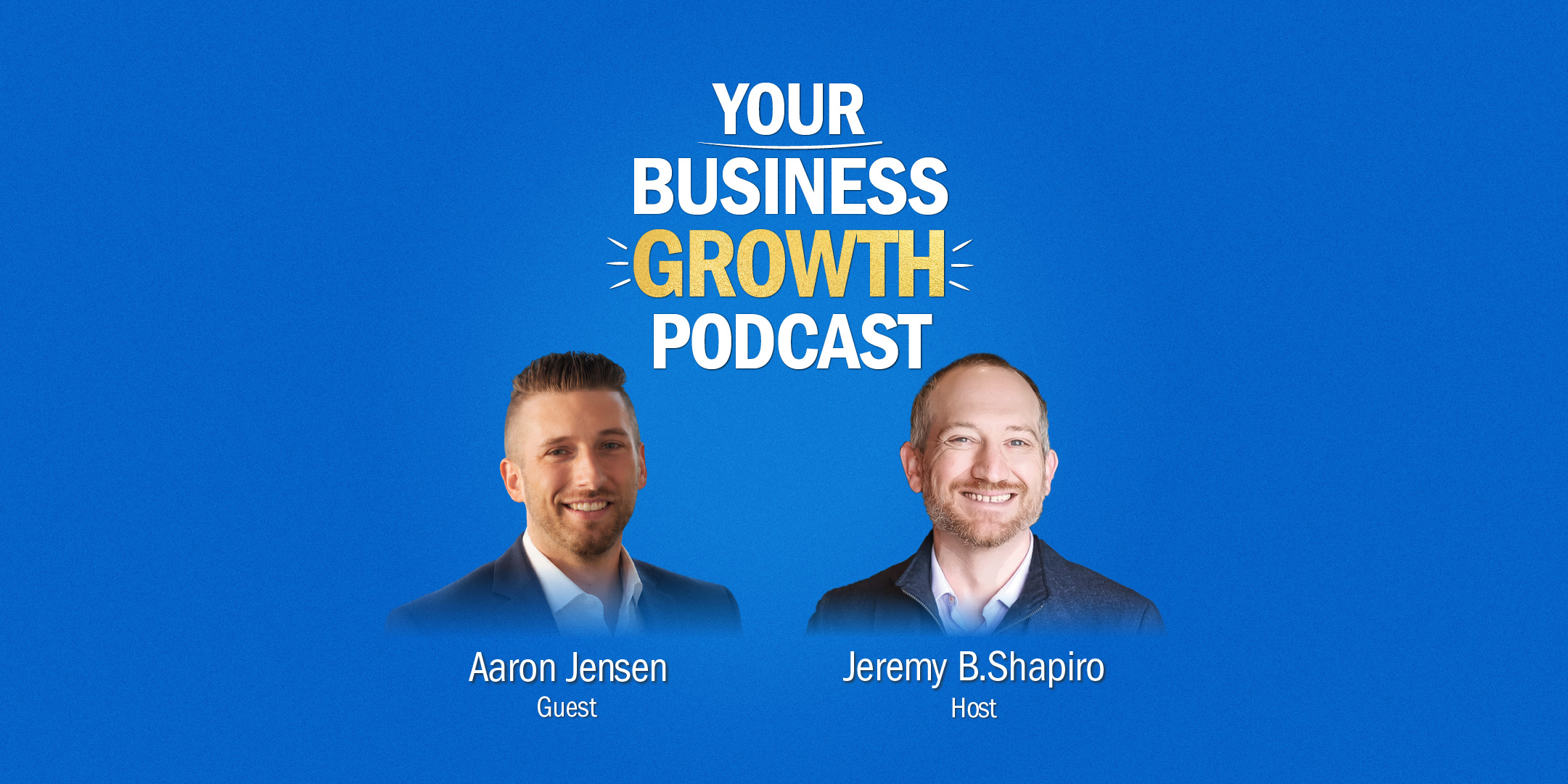
Welcome to today’s episode of Your Business Growth Podcast. I’m your host, Jeremy Shapiro, author of Your Business Growth Playbook, and my guest today is Aaron Jensen.
About Aaron Jensen

Aaron Jensen is a serial entrepreneur who began his career in the high-pressure world of door-to-door sales. This foundational experience in pest control and as a brick-and-mortar franchise owner eventually led him to launch an online marketing agency. His ability to scale rapidly earned him a spot on the Inc. 5000 list of fastest-growing companies and a place in the prestigious ClickFunnels 8-Figure Club.
Throughout his career, Aaron has specialized in the GoHighLevel ecosystem, where his agency became one of the top three providers globally. He successfully managed a portfolio of over 10,000 clients, driving more than $25 million in online revenue through innovative sales strategies. His expertise lies in transforming one-time transactions into scalable recurring models and managing large-scale fulfillment operations.
After leading his agency to a successful exit in late 2025, Aaron turned his focus to disrupting the insurance industry. He realized that many agents were under-monetizing their client books and treating high-value relationships like parking lots. He now applies the same sophisticated online business principles he used in the agency world to help insurance professionals maximize their revenue and build modern business infrastructures.
Today, Aaron is the force behind Ridgewell Insurance and Care Club, a client management and financial wellness platform. His work centers on helping agents move away from the grind for new leads by systematically working their existing book across multiple products. Based on his experience building and selling three companies, he remains a dedicated advocate for business model innovation and operational efficiency
Connect with Aaron Jensen
Speed Round Answers:
- All In Lead Source: Relationships and LinkedIn
- Books: The E-Myth Revisited by Michael E. Gerber, The Challenger Sale by Matthew Dixon and Brent Adamson, and Built to Sell by John Warrillow
- Unlikeliest Mentor: AI, Cole Gordon and Jeremy Miner
Like This Episode? There’s More!
Subscribe!
Your Business Growth Podcast is available on all major podcast platforms. Subscribe today!
Get the Book!
Pickup the #1 Best Seller, Your Business Growth Playbook today online or at your local bookseller!
Meet Jeremy!
Book your Blueprint Discovery Call with Jeremy today and get back to the growth you deserve!
Aaron Jensen Episode Transcript
The more we grew, the more staff we had to hire to fulfill for those clients. We had a lot of employees. At our peak, we had about 40 employees, and we were responsible for their families. It became almost this hamster wheel. Because we’ve scaled so fast and so aggressively, every single month we would basically restart from zero, where if we’re not signing on new clients, we’re not making a single dollar, and that was very stressful for us What if you reach the top three in your industry globally, generating nearly a million dollars a month, only to realize your biggest success was actually your biggest vulnerability?
Our guest today saw his primary market vanish almost overnight while his fulfillment costs were spiraling out of control. Instead of watching the business he built for a decade disappear, he executed a radical overhaul of his entire model, turning one-time customers into high margin recurring partners, and finding a goldmine in an industry others called a dinosaur.
Today, he reveals the specific shifts that led to an eight-figure exit. Welcome to today’s episode of Your Business Growth podcast. I’m your host, Jeremy Shapiro, author of Your Business Growth Playbook, and my guest today is Aaron Jensen. Aaron, welcome to the show. Nice to be here, Jeremy. Thank you. I love your journey, and so many of the steps you’ve taken along the way, but a lot of this goes back, as it does for many of us early serial entrepreneurs, to those businesses that got us started off the ground and that built the resilience that is so important and necessary in the world of entrepreneurship.
Tell us about those earlier days in pest control and knocking on doors, and what that part of your career was like. It’s interesting starting off in door to door, because that’s where I guess the entrepreneurial spirit in me really awakened, if you will. I, I always thought of myself as being someone who would climb the corporate ladder, someone who would schmooze their boss or whatever to go after promotions, and just climb the corporate ladder.
But it, it was doing door-to-door sales where I really learned that I could actually be successful just based on my own effort, and I took a lot of lessons from door-to-door sales that have stuck with me for years and years in my entrepreneurial journey. Now, how did that shape in your business building not just door-to-door sales business as an employee, but building your own multi-million dollar sales engine?
What were the connections between those two? Yeah, good question. I think the biggest thing is just the mentality behind it. Doing door-to-door sales, you get doors slammed in your face all day long. You get people that scream at you, that cuss you out, that are not very kind, and you have to keep going. I, I would work from 9:00 AM till about 9:00 PM every single day working in that hot summer sun, and it was excruciating.
The most important thing was the grit that, that it took to actually be successful with that. I did it for three years, and I wanted to quit every single day , but I had to keep going because that’s what it would take to be successful. Yeah, and you’re not the first entrepreneur to say that. I know many successful entrepreneurs who sold Cutco knives, for example, right?
Or did door-to-door sales or sold solar or any of these just really tough industries to hear no all day long. So that it doesn’t bother you. And then getting into a sales organization or building your own company where you’re doing founder-led sales earlier on is just a natural and easy next step th- because of that grit and determination.
Now- It is … this day and age, everyone, we’re all talking online businesses, and the idea of having a physical brick and mortar business is so foreign to many business owners. But you actually had a stint in the brick and mortar space. Tell us about the art studio and where that fit into your career. I did, yeah.
I had a, an art studio franchise where I did open up in a brick and mortar location, and it was so interesting to, to do that because running an online business is so, so much different than a, a brick and mortar business. My, my first big wake-up call was going through the lease agreement with the real estate company, and I still remember to this day, years later, that lease agreement was 127 pages long It was insane.
So just buried in attorney fees and whatnot, just reviewing that document and making sure everything was looking right. But it’s so much different because you get to, to utilize walk-by traffic, and location is so, so important. You have to utilize Google Maps reputation and reviews, whereas online businesses don’t necessarily have to do any of that, and you just approach it in such a different way.
Now, you went from being an independent rep for a company to getting into a franchise, which is a good step into the world of business, to then seeing this gap in the marketplace. And I see with us entrepreneurs, one of the commonalities we all have is we see a gap in a marketplace w- and identify the opportunity, and then we do something about it.
And you did. What, what was the gap you saw in the marketing space that got you into the whole world of GoHighLevel? Yeah, and th- this is where so much of my experience comes from, is in the online world and the marketing space, and I’m excited to share these lessons with you. But the gap that I saw was the offer that was being offered to real estate agents at the time.
That, that was our niche, that we worked with real estate agents. So what most marketing companies were doing at the time is they would charge 2 to $5,000 every single month to the real estate agents. They would often lock them into long-term contracts that lasted anywhere between three months to 12 months.
So real estate agents were very hungry for something that gave them more flexibility and didn’t handcuff them to marketing companies. So we recognized that, and we created a new offer, which I think is very important, creating an attractive offer. But we created a new offer built to specifically attack the monthly retainer model and the long contract model.
So what we did is we created an offer where we would give them every single marketing piece they would need for $2,000, and we would charge them that one time, and that’s it. We often referred to it as a marketing business in a box. They would just pay us once, and then we would wish them luck. So what I’m hearing here, Aaron, is you saw the opportunity in a market that was Paying in a way that maybe they didn’t like, and you could compete there and get rid of this whole recurring ongoing fee and give them a ton of value upfront one time.
And that really got you guys to some stellar growth. You got to the point where you guys signed on over 10,000 new clients and became, if I understand correctly, and probably some of your awards in the background there show, one of the top three in the world. Tell us about that journey to that scale.
That’s a, that’s… There’s a lot of, there’s a lot of resellers and marketing agencies out there. You’re pretty different in that space, yeah? Yeah. We were one of the biggest GoHighLevel resellers in the world, and that’s something I’m very proud of with that company. It is- How many resellers roughly were there at that time?
Oh, I don’t know. Thousands. Tens of thousands- Yeah … maybe. A lot. Top three’s big. We’re not talking about top three out of 10, top three out of thousands and beyond thousands. Yeah. It’s a very proud accomplishment of mine, and I’m happy to showcase those awards in my background and whatnot, and I love talking about that.
So it’s kind of interesting how it all came about. We, our original sales process was actually very old school until we modernized it. So our original sales process was just to walk someone through a contract on a screen share and w- and point out each of the noted terms, and then ask them to sign up at the end.
It was very boring, it was very dry, and it did not work well. And actually what gave us this idea to do this offer was one of our potential clients asked us, he’s, “Can you just set up everything for a few hundred bucks and then call it good?” And w- we didn’t know what to say to that at the time, but that kinda sparked the idea in us of, “Hey, maybe other people will want this too.”
And that’s when we started to go towards that one time $2,000 model. And GoHighLevel was baked into that. GoHighLevel is kind of the central software that we use to house the business in a box, the marketing business in a box. So every single client that we onboarded at that $2,000 price point, which we, again, which we changed later on to, to test out different price points, but every client we brought on, we set up with a GoHighLevel account.
So I’m hearing two things there that I want to hi- highlight for our listeners. One is there’s this idea we talk about in like services business or really any business that you can have the do it yourself model, right? The done with you model and the done for you. And as you ascend through those three tiers, the value you deliver is so much bigger and the amount you can charge is so much higher.
And so you guys did shift to that done for you because my gosh, your prospects were asking, darn near demanding you guys do something for them and pay you a bunch of money for that. And that you just saw that opportunity. The second thing I want to highlight that is really valuable there is that boring can work, right?
You guys were closing sales with a very boring, traditional, old, not exciting sales process that didn’t change the world, but you were still able to build a business with that. And sometimes I think business owners want to create complexity when sometimes boring and simple works, and the best businesses can be boring.
So talk to us about now, you hit this rocket ship growth. You’re moving towards top three or number three in the world, tens of thousands served. But revenue started to stagnate, and you were out there hunting, right? Every new client was this one-time fee, and you can’t make your numbers unless you get more clients.
So what was that moment of clarity, and what was the writing on the wall that you saw? Yeah. Great question. And this is kind of the start of the massive challenges that we faced with this business. Because the more we grew, the more staff we had to hire to fulfill for those clients. But then we have to feed that staff.
We had a lot of employees. At our peak, we had about 40 employees, and we were responsible for their families, right? We had to put dinner on their table every day and provide for their families through, through their jobs. But it became almost like this hamster wheel of because we’ve scaled so, so fast and so aggressively, we need to continue to scale so aggressively because we’re only dealing with that one-time setup fee.
So every single month, we would basically restart from zero, where if we’re not signing on new clients, we’re not making a single dollar, and that was very stressful for us. So there’s different models and that you can do when you have a SOP model that a person follows, right? You can hire, you can get contractors, you can outsource.
And, and you guys for a while were working with the outsourced model of having folks do this. Tell us about the decision process to, to go that route versus having, like you said, a team of 40. Like, how did you choose which way to go? Yeah. That was what we originally did because we would often consider ourselves a sales organization.
We were very good at selling, and we actually outsourced our fulfillment in the early days. As we scaled up, that fulfillment company scaled with us, and they did a great job of that, but they would charge us a lot of money. They would charge us about 6 to $8,000 per fulfillment rep Which is a lot for a basic fulfillment role, which should be around 4,000, maybe $5,000 per month.
Th- they were overcharging us. But they knew they could overcharge us because they knew we were in the hamster wheel of resetting every month, and we had to rely on them. So there were a few different ways that we tackled this. Eventually, we decided we needed to bring that all in-house, and we made some efforts to do that.
Had some failures, had some successes, but it was definitely a difficult time keeping up with that scaling and that growth. So what I’m hearing is at first you were outsourcing to an agency. They managed the hiring, the training, and all that. You just paid a fee per person, and you just had to keep them fed.
But it was this obligation to take care of them and overpay, but also outsource some of that. You also tried, if I recall, at one point outsourcing overseas to individuals and saving some money that way? Yeah. We tried going to the Dominican Republic and hiring overseas labor. They were very cheap, but unfortunately quality did tank, and we had issues when it came to reputation online.
So that proved to be unsuccessful, and we quickly brought our fulfillment back into the US. Real estate agents, I think they want to work with people in the US. They want to know they’re being taken care of. And when it comes to marketing especially, quality is very important. So the fact that we outsourced to the Dominican Republic and had that as our fulfillment center was not good for that quality focus that we needed to have.
So w- we eventually decided to completely bring it in-house, all of our fulfillment. We no longer did any outsourcing whatsoever because nobody could keep up with us. Nobody was able to fulfill the needs that we had, so we just decided we’d do it ourselves, which was a great decision because we were able to find some really great US support people that were able to keep up and help us scale and keep the business at the level we need it to be at.
I’m hearing a real Goldilocks story there, Aaron. At first you’re paying way too much, but the reputation was good, so you go to paying way too little and the reputation tanks. And so then you went to the middle of paying the amount that was just right and having that great reputation. I think there’s power in doing it yourself, and especially in the online world, there’s a lot of agencies out there that want to just fulfill or have, have all their fulfillment outsourced, have everybody do something for them, and I’m guilty of that.
My, my company was guilty of that. But we found a lot of success once we started to bring things in-house, and that’s the attitude that I’ve had as an entrepreneur ever since, is m- maybe there’s some things that are good to outsource for very specialty skillsets, but when you’re building a business that is meant to last, you can’t outsource the important parts of your business.
You have to have control over that. You have to have that in-house so that you can maintain control. The biggest issue we had, as I mentioned, was reputation, and that wasn’t within our control, yet that’s going to affect every aspect of our business. So I will never run another business where I don’t have direct control over the reputation, the fulfillments, and the main levers of my business.
Nice. That’s a really good takeaway. Are you enjoying this episode? Make sure you hit that subscribe button right now. That’ll help you get more episodes automatically as soon as they come out. So hit that subscribe button right now. And if you have a minute, leave a quick rating and review. That helps support the show.
I think sometimes, though, early on you can get quick scale by outsourcing things and letting someone else manage that and scale with you. But yeah, at a certain point, most businesses end up exactly where you are of bringing that stuff back in-house So, all right, so that’s one of those things that you are able to control, but some factors we don’t control.
You’re selling to the real estate community, and the real estate market has its cycles. Talk to us about what happened as we hit that 2023 timeframe. How close did the business come to actually shutting down? Yeah. W- we had a b- big real estate crash in 2022, 2023, and y- backing up a couple years, we really started to take off in 2020 and 2021, and there were a few things that really played to our benefit there.
COVID shut everything down, right? So we had a lot of people that were curious about making money online, and a lot of people got into real estate. So there were n- a lot of new real estate agents in the market that needed marketing services. Combine that with the real estate industry blowing up and doing very well, housing prices grew so much in those couple years.
We would have homes go for 300K, and then a year later they were selling for 400, 450K. Insane growth. So that was another element to, to the massive growth in 2021 timeframe. And then the other element to this, too, was there were COVID relief checks being sent out to people, and we were poised to be one of the solutions that people spent that COVID relief check on.
If you remember, people were getting, like, $1,200, I think is what it was, maybe 1,400 in those COVID relief checks, and they wanted to spend it on something. So we have the real estate market growing like crazy. We have all these new real estate agents coming in, and then we have all of those new real estate agents having all this excess income to spend somewhere, and we became the natural solution, and we just grew so fast.
Now, contrast that with 2023, where the market just tanked, and now we’re left with a struggling business. It was very difficult because we didn’t realize how much of a perfect storm it was just a year or two before, and we didn’t really have to be super creative in terms of how we were framing it to the real estate agents because it was such an easy sale to make.
So in 2023, we really had to take a step back. This is where all the fulfillment issues came about, was in 2023 when things started to tank, and we had to really reconsider how we positioned ourself in the market to real estate agents in order to recover and be successful again. So was it just a matter of repositioning yourself to the real estate agents, or did you guys start to explore other niches and see what, like, the insurance industry or other places might look like outside of real estate?
We did. We tried a few different things for real estate agents, and we tried a few different offers. We’ve always been a fan of the idea of crafting a unique offer. Alex Hormozi talks about that i- in his book, $100 Million Offers. It’s a great book. I recommend it, but it’s so important to have a unique offer that makes you stand out in the marketplace.
So we tried that again. We recognized that people didn’t have money to spend on marketing services as much as they did in years prior, so we tried to create other unique offers, such as free trials and a, and a small monthly subscription. But those didn’t work. So now we’re left with the decision of do we continue in real estate in a market that is v- very much struggling, and we can’t seem to find product market fit anymore, or do we potentially jump ship into a new industry and focus on that instead?
So what I did is I talked with my business partners, and we discussed what are some other solutions? What are some other industries where our model makes sense? We’ve worked with real estate agents for so long. They’re 1099. They’re independent contractors. They’re kind of business owners, but not business owners at the same time.
They need marketing so they can just focus on sales. What other industries make sense with that model? And we eventually settled on insurance. Insurance agents are very similar to real estate agents, even down to the fact that they have to get licensed in order to sell. They just wanna focus on selling conversations and not have to think about marketing.
They just wanna talk to good people. So our offer just made sense for that industry, and insurance was not struggling at the time. While real estate was tanking and really struggling, insurance was growing. So we found great product market fit in that industry doing the exact same thing that we were before.
So you had a model where you charged a high fee one time. When that wasn’t working, you experimented and tested as you should do and do really well, and tried the free trial with low monthly, right? And when that still wasn’t resonating, you’re playing with unique offers, and the theme here I wanna highlight for our listeners is that you tested.
And look, at the end of the day, we… I think everyone wants their tests to reveal the solution. But sometimes there’s an, a variable we’re not changing. In your case, it was the maybe our ICP has changed, or maybe our market shifts. And so you pivoted to a completely different industry, and that’s a pretty bold move that I think most business owners are loathe to make, but you guys did that.
So tell us about the new model and the unique offer you had to the insurance space, and how that varied from what you were doing previously in the real estate space. Yeah, and I wanna highlight on one other thing here too, Jeremy, that you, you just kinda touched on, is we changed one thing at a time. I, I think as business owners, w- we fall into the trap of wanting to change and change and completely toss our business model aside and come up with something new.
But it’s so important from a business owner perspective to just change one thing at a time. That way you can track effectively if that change is working or it’s not. And eventually, the biggest change of all, we changed industries. But yeah, so, so to your question about our offer and our model, how that changed as we got into, to insurance, it certainly did.
So we found the ground level of fit with our $2,000 one-time offer in insurance, and we got the thumbs up that worked, and we were super happy. But we wanted to continue to evolve on that and to tweak that offer to make it even better. So there, there were a number of things that we did All in mind of trying to escape the hamster wheel.
We didn’t wanna create that hamster wheel for us again, where we would have to reset every single month and chase new deals every single month. Th- that was very stressful for us, so we wanted to do something different. And what we eventually settled on was a few different revenue levers that we could pull.
We had a s- a what we called popcorn pricing, where we didn’t just sell a single $2,000 marketing package, but we had a $2,000 marketing package along with a $2,400 marketing package and a $3,500 marketing package. And sales process become, became a lot more of a consultative type approach, where we were helping the insurance agents to choose between one of those three packages rather than the yes or no decision of if they wanted it or not.
So that helped us to increase our average ticket price because we were then selling higher level packages, which of course involved more fulfillment and heavier support for those clients, but it was worth it because we were increasing our average ticket size. In addition to that, we were also then charging a monthly subscription as well.
And we did that in two different ways. We charged for the CRM, we charged a very low amount. It was $20 per month. But that adds up, right? ‘Cause we signed up over 10,000 clients. So 10,000 clients times $20 a month, that’s gonna add up to a pretty substantial amount. In addition to that, we also charged for support, and this was optional.
So if they wanted in-depth support where they could reach a, an account manager at any time they needed, we would charge them a small fee of 47 to $97 a month for that. But again, that’s gonna add up over the course of doing so much volume. So the net result of this is we have our big cash influx from our popcorn pricing packages and our average ticket size, but then we also have the safety net built in with the recurring revenue from both the support and the CRM charges.
So we don’t have to stress anymore about resetting from zero every single month. We’re basically at break even automatically every single month from the recurring, and then everything we sell on top of that is just profit. That’s so great. So a few things I wanna tease out from that, and then I wanna double-click into a, a question I have for you on that.
One is that just on this topic of testing, so often when I work with business owners and we’re talking about testing things in their business, most business owners I find don’t test. They do something, they ship it, and they’ve got a ship and pray model. They hope maybe this campaign works or it doesn’t, but they don’t actually do any testing The other extreme on that Goldilocks analogy is they go and they test everything, right?
They have two completely different landing pages with a million things different. Three completely different offers with 1,000 variables different. And so what do you learn from that? It’s hard unless you have a tremendous amount of volume and you’re doing true multivariate testing, which so many folks aren’t.
And that happy middle zone is exactly what you hit on. You A/B test. You test one change at a time iteratively, and we learn from that. So super well done. The other thing I wanna highlight is you talked about a number of things that helped on the revenue side. One, you moved to the three packages, right? So you’re able to try out like a premium, standard, and low tier and help someone pick the right one, not do I buy from you or not, but what do I buy?
The second piece is you had a recurring revenue component in there, and the third is beyond just those, you had upsells and add-ons in terms of the support. So you had all these things which dramatically helped on the revenue side. So I wanna go into that a little bit further, okay? The popcorn pricing strategy, which by the way, that’s a really cool term.
How did you go about implementing that, retraining the sales teams on using this pricing strategy, and moving your prospects and clients towards the right one for them or what might be the most profitable for you, or ideally both? Yeah. So popcorn pricing. I wa- I wanna tell you why we call it that, and maybe this is not unique, maybe it is.
We came up with it. Maybe other people have came up with it too, I don’t know. But if you go to a movie theater and you buy popcorn, there’s a small, medium, and large, right? And they price the small, medium, and large based on what they wanna sell the most of. So if they’re selling a small popcorn for $5, and then they price the medium popcorn for $8.50, and then the large popcorn is $9, everybody is gonna think the most value is with the large popcorn because they’re going up an entire size, but they’re only going up 50 cents, as opposed to a small to large is a $3.50 gap.
So there’s built-in value to going to the large popcorn just by the way the pricing structure works So we took that concept and thought, “How can we apply that to our three-tier pricing package?” $2,000, $2,400, $3,500. What do we want to move most of our clients into the most? And we decided we actually wanted to move them into the middle tier the most.
So what we did is we actually priced our, our middle tier package at $3,000 and then trained our salespeople to give a, a discount down to $2,400. So there’s built-in value because they’re getting a $3,000 package for $2,400, and it’s only a few extra hundred dollars from the small package. So they’re g- moving up an entire tier of package for only a few hundred extra dollars, and then that’s it.
So, so that way we were able to sell the most of those middle tier packages. Now, how we trained our salespeople to do that is we actually believe a lot in Not pressuring people and not being a stereotypical salesperson. Because a stereotypical salesperson is going to push a certain package or recommend something or just, they’re l- they’re like a hound dog just trying to get to a certain outcome.
But what we trained our salespeople to do was to utilize a lot of silence in our sales pitches. In fact, we would have them pull up a webpage that walked them through the entire offer, what’s included, and we would tell them to just put their phone on mute and just read through the document. And that’s it.
And what would happen is these insurance agents would essentially sell themselves on the idea of working with us because they’re not being pressured into it. It’s a matter of push, pull, right? So we, we trained our salespeople to pull, not push. Once they got to the pricing package, it was the same thing.
We, we tell them to put it on mute and let them take their time to really soak in what each package does, and then they take a consultative approach and talk to the person about what package might be best for them and their specific situation. Smart. I’m hearing a lot of really great sales tactics there, especially for higher ticket sales.
Let the silence do the work for you, right? Letting the client sell themselves on why they should choose. But a really big piece there is, again, these three packages and structuring it so that the one you want them to buy is the most logical, the best value, the best deal. And like when you talk about popcorn, I love the movies and popcorn is my love language.
So when you talk about that pricing, I am well aware of that. And the theaters nowadays will do it where the XL large popcorn has the free refill and is priced exorbitantly high, but when you’re the movie club member, it’s a reasonable price. And so why would you ever get anything else but the ridiculous giant bathtub size container of popcorn, right?
And so- Exactly … you guys over-delivered on the value there in just that same way, and so it’s a natural, a natural buy-in. Look, studies show us again and again when you give people the three choices, that anchor is high, they naturally choose the middle one, and you can even price adjust that top one during that sales conversation so they buy that premium one and that’s a logical choice.
But this is, when you have a blue ocean where there’s not competition and you don’t have a commodity, you get to decide what something is priced at, and a lot of business owners forget that. So super well done. One more thought on that too, Jeremy. W- as I mentioned, our third top tier pricing structure w- was $3,500, and then the next one down was the 2,400, right?
So we would train our salespeople a lot to say, “Oh, you don’t need the $3,500 package. You’re not to that level yet. We wanna focus on this one instead,” either the lower or middle tier. And what that does is it creates a lot of trust in the salesperson, because people are naturally and in- inherently not going to trust salespeople, right?
Because they’re in it for themselves. But if the salesperson can say, “Hey, we have this really expensive package-” But I don’t think it’s a good fit for you right now. Let’s focus on the more affordable ones for now.” That goes such a long way in the prospect’s mind. It’s huge, and the analogy I often use when teaching that exact concept is like when you’re at a restaurant and the server tells you, “Oh, my favorite is the most expensive item on the menu,” right?
You… There’s that immediate distrust versus when they say, “I really don’t like this one. That’s not for me. What I prefer is something else.” When they come back around and have the add-ons, the upsells, the desserts, the wine, whatever it is, you follow that recommendation all the way because they earn the trust by saying, “This thing is not great,” and that works so, so well, and kudos to your team on doing that.
Absolutely. Now, the insurance industry is a bit of an old-school, traditional industry, and you used a fair amount of more modern online scaling tactics to work with this industry. How did you bridge that gap to a traditional industry and modern technology, modern processes, and modern sales, s- sales cycles and all?
Yeah. So insurance agents have largely been programmed to think, “I’m gonna get my license, and then I’m gonna buy leads,” and then just pound the phone using a dialer, just talking to as many people as they, they possibly can. It sucks. And every person we would talk to on these sales calls, they would express frustration.
So in the sales process, we would say we would identify the pain points like any sales call, and it was often that, right? They’re spending hours a day on cold calling, and it, it sucks. So we would really lean into those pain points and make sure they understood that the offer that we were giving them was essentially becoming their own lead vendor.
Because what lead vendors do is they create the leads, and then they resell those leads, and oftentimes those lead vendors will resell the same lead to the sa- to, to different agents over and over again, and the quality is just down in the dirt. So we would really make sure that they understood they were becoming their own lead vendor.
That was core in our messaging, and people really tended to resonate with that. Nice. Now, as you made some of these changes that we’ve been talking about, we love talking numbers. You guys at this point, if I understand, were at the point of about $500,000 months, and you made some changes and moved towards this $800,000 months.
That’s a great growth, especially because it came from a pivot of this, like, dying industry that was no longer a fit. So- What do you think were the biggest factor is in driving that change from what we’ve been talking about or maybe we haven’t talked about yet? I’ll say one more thing about our pricing structure too that kind of led to this, is we actually utilized upsells as well.
So on the back end, after they became a client, we offered for them to have more services. At first it was just a $2,000 then done, right? But now we’ve increased our average ticket size through popcorn pricing. They become a client, we have the recurring, and we have additional upsells on the back end too.
So that was a key revenue lever as well that helped us grow. But I’d also say another element of this too was making sure that salespeople were performing to the best of their abilities. One, one thing that we started to do, what, was utilize what we called red light, yellow light, green light And that basically represents performance zones for salespeople.
So we would measure them based on KPIs, deals closed, revenue generated, close rate, et cetera, all of the typical KPIs you would think of. And we classified them whether they were in the green zone or if they’re at risk, maybe their KPIs are getting a little bit low, they’re in the yellow zone. Or if they get far too low, they’re in the red zone.
So green zone, obviously good standing, everything’s all good. At yellow zone, if they are in that zone for two consecutive months, then we have a conversation around potentially parting ways. And then same with the red zone. If they’re in the red zone, then we have a conversation about parting ways, and maybe it’s not a good fit.
I think it’s very important when you’re managing people to have built-in guardrails to how they’re performing in that role. And that’s what this green, green, yellow, red zone was, is it was guardrails to help us know how each sales rep was performing. So it’s important to understand the numbers and the KPIs, but it’s also important to understand the human element of it, too.
So there were times, Jeremy, when we had salespeople that were in the yellow zone or even in the red zone, but they had a really good reason, right? Like, maybe a family member died. Maybe they had a medical procedure that month that prevented them from hitting their numbers. So while these guardrails are important, you can’t treat them as gospel, right?
You have to look at it from both angles. You have to look at it from the numbers, and then you have to also look at it from a person perspective. Yeah, and I wanna highlight something really key there for our listeners that, A, is having KPIs, which is huge. So many businesses don’t. But B, there’s a huge difference between what we call KPIs or key performance indicators and vanity metrics.
And the difference there is a vanity metric is a number you track, but you look at it, you don’t do anything. A KPI should be an actionable number that you use that to guide decisions. So for example, to guide which team member- team members need coaching and management, which team members need to maybe be on a different seat on the bus, or which team members maybe just don’t need to be on the bus.
And so you were really using those KPIs very well, so super good job. One more thing, if I can add to that, Jeremy. We also implemented what we called end of day reporting So at the end of every single day, be- because we’re remote, salespeople are hard to manage, right? We don’t know what their actions are that they’re taking every single day.
So we would have them submit a very simple report at the end of every day explaining their KPIs, the actions they took, any follow-up plans they have for their prospects, and then it’s just a little touchpoint at the end of every single day where I as the manager or someone I hire as the manager can then go in and kind of monitor the situation.
So we would do that every day, at the end of every week, and at the end of every month as well. And every single one of those reports are setting goals for the next period, too. But as you’re running an online company, it’s just, it’s so important to have touchpoints, right? Because I can’t just go to the water cooler and have a chitchat conversation with my employees I could do that brick and mortar, but I can’t do that online.
So it’s important to create those SOPs or those systems to create that dynamic and create those touchpoints. Yeah, and what I liked, though, that you highlighted is this, this course correction, right? And if you think about, imagine if an airplane took off, we’re heading in the right direction, we’ll, uh, we’ll check in a few hours if we’re still on track, versus checking once an hour, versus checking every minute, versus checking every second, right?
The sooner you can course correct and get back on track, the better. So if you only go over these numbers at your annual meeting versus quarterly, versus monthly, versus weekly, versus at the end of every day, you can course correct so much sooner and get back on track. So that’s excellent. All right.
Absolutely. Strategies we’ve been talking about, just to put this, a little bit of this in perspective for our listeners, is you got the expenses under control, right? So replacing the outsourced reps at the 8K a month with in-house reps, keeping that high-quality work but at half the cost. You also added in upsells.
You also added in recurring revenue. You also added in multiple product options, and all these things really helped you guys grow not just revenue, but more importantly, that profitability from both ends. So excellent work. Now, Aaron, you’ve learned a lot of this the hard way in trying things out and testing, testing, which is great, and I think some of that comes from your grit and resilience from those early days.
But now you have all these lessons learned. Tell us how you’ve parlayed some of these lessons from prior businesses into your new ventures and what you’re doing in the insurance space now. Yeah, it’s kinda funny, my, my next venture that I’m working on now, because I sold the marketing company last year.
Yeah, so we, we decided we wanted to sell because we actually got offers to sell the company in 2022, in 2021, when things were just pumping in, in the real estate market, and we said no, because we thought it was gonna last forever. So we realized that hindsight is 2020, and we should have sold at that time because we got some very aggressive offers.
So we recognized this time around as we’re getting into insurance that maybe the opportunity here to sell is something we should take advantage of while we can. So we did, and we decided to sell. It took us about a year. It takes a long time to sell a company. But we did sell, and we’re very excited about that.
We had a seven-figure exit, and we had a great time. That’s excellent. Con- congrats. It’s one thing to- Thank you … to run businesses, but they, they only go three directions. You either pass it down to your kids, which no one does, right? You run it into the ground and close up shop, which is what most all businesses do, and then there’s those very narrow few that build it to sell it or get through and have that successful exit, and you guys did it.
So huge congrats on that. Thank you. So te- tell us about what the next was after that sale. Yeah, so it’s kinda funny. My next venture that I’m working on is actually an insurance agency. So I, the main reason I wanted to sell the marketing company was because of fear of AI. I felt very strongly that AI was going to- replace or at least cut into marketing companies quite significantly.
So what I wanted to do after exiting the marketing company was go into an industry that was not going to be replaced by AI, an old school industry, something that has a lot of potential for me to use my skill set because the agency space is, the marketing agency space is very competitive and you have to be very up-to-date with marketing trends and strategies and whatnot because it’s very competitive and cutthroat.
Now I can take those same strategies and that same mindset and outlook into an industry that is an old school dinosaur type industry, which is selling insurance. I sold marketing for insurance agents for so long that I’m very confident in doing that now for myself, right? So I’m building an insurance agency now And in fact, it’s going very well so far.
It hasn’t been very long, only a few months, but it’s going very well. I think one of the most important things that anyone can do when building a new company is start that company with the end in mind. A- as you just touched on, Jeremy, there’s only a few ways that a business can end, right? Like, you go out of business, you hand it down to your predecessors, you sell it.
So figure out what you wanna do with that business and then build it from the very beginning with that in mind. I’m un- I’m unsure what I wanna do with the insurance business, whether I wanna pass it on or whether I wanna sell it, but I am building it to sell if I want to. And what that looks like is having a lot of systems, having a lot of operations in place so that a new owner can come in and operate the business right away without it relying on me.
And I’ve been able to do that so far, and it’s been going really well. But there’s a book that I read one time called Built to Sell, which is a fantastic book. And- It’s on my bookshelf right behind me. Nice. I– fantastic. And for any listeners, I highly recommend it. But it’s all about structuring your business in a way where you build it to eventually sell through the right systems, through the right operations, and that’s very much the mindset that I’m taking into building this insurance ind- a- agency.
So I’ve heard it said, and I love this model, that when we look at wealth, right? Sometimes people think that’s about what you have. And that’s a piece of it, but there’s two other components to that triangle. There’s the, the what you have, that might be like the financial capital. But there’s also the what you know, which is the intellectual capital.
And there’s the who you know, right? That, that social capital. And so you left one company, and as you started your next, you looked at what do you know really well. You know this industry, the insurance space, so well from all the clients you worked with. You know the best of the best marketing tactics and techniques, what’s worked well, what’s not, and you parlayed that knowledge into this next venture.
And I think that’s a really common and great pivot to have of taking what you’ve learned along the way and leveraging that knowledge and reinvesting that into that what’s next. So- Yeah … if you’re talking to another business owner, and they’re looking at the customers they serve or the industry they’re in and having some of the same challenges or fears that you have in terms of is AI gonna replace my business or did the market change and it’s no longer good to sell to real estate or whatever it might be.
What would you advise or counsel a fellow business owner who’s looking at a dying niche but is afraid to pivot? Yeah. I think- You have to know yourself and your own strengths and weaknesses. To back up a second here and to get a little bit more into my story about the post-sale of the marketing company, I, I was feeling on top of the world, right?
I thought that I had made it as an entrepreneur and, like, I just had the sixth sense for being successful. I had a couple ventures after the marketing company that failed And that, that didn’t work. So it, I don’t think it matters how successful you are as an entrepreneur, you are always at risk of failing, and that is normal.
And if you haven’t had your first big success yet, maybe you’re just another fail away. You’re a couple failures away. But it’s important to understand yourself and where you will have the biggest opportunity for success. So what I did is I kind of had this moment where I was unsure about myself after these failures because I had just sold my marketing company for a lot of money, and then I had these failures.
I was like, “Am I actually a good entrepreneur? Do I actually have what it takes to be successful again in building a new company?” And what I did is I audited my life, my entire life of where I’ve been successful in my life, even backwards of thinking to my childhood when I was really good at what I was doing.
Maybe it was sports growing up. Maybe it was religion. For me, it was church. I was raised in a religious household, so for me it was church. And I was in flow state personally when I was operating in a certain way. And w- what I realized is there were certain periods of my life where I was just operating so well in, in just how I was running my life, and they all had one thing in common.
For me, it was I was plugged into a proven system where all I had to do was put my head down and follow the process. Every single time I’ve been in an environment like that, I have excelled like crazy. Think about door-to-door sales. All I have to do is go knock on doors, right? It sucks. It’s hard. But I was in flow state.
I loved it. It was great. And I was the top performing door-to-door salesperson in the nation. I was plugged into a proven system. With the franchise that we touched on a little bit earlier, it’s a proven system, right? It’s a franchise. I was the top performing franchise in the nation. Like e- every single time where I’ve been just in flow state, it’s been plugged into a proven system.
So I was only able to uncover that about myself by completely auditing my whole life. And now I’ve been able to plug myself into insurance. Insurance is a pretty proven offer, right? It’s a very proven thing. Everybody needs insurance. It’s a very simple thing. All I have to do is plug into it and then excel in what I do.
So for any of the listeners that are considering, “What’s my next move? A- am I good at this? Do I have what it takes to be an entrepreneur?” Audit your life. Audit your life and figure out where you’ve been in flow state, where you’ve excelled in your life, and then bridge the gap between those experiences and entrepreneurship.
Maybe those experiences work really well with certain industries or a certain way of running your business, and other ways it doesn’t. But understanding yourself and where you’ve been successful, I think, is the first step in understanding where you can be successful as an entrepreneur. Yeah, that’s beautiful.
I don’t know if you’re familiar with the Japanese concept of iki- ikigai? I’ve never heard of that, no This is really cool. For our listeners, you can go look this up, but it’s essentially imagine a Venn diagram of four circles, right? And so you can look at these different aspects of what you love doing, what you can be paid to do, right?
What brings value and all these different things, and at the intersection of these circles are different things. So one might be career, right? One, and so forth, right? But if you can find the middle of all four of these circles, you’ve found this ikigai. You’re doing something that’s fulfilling, that’s valuable to the world, that you can be paid to do and so forth.
And this audit you’re talking about resonates very much so with that concept. I, I also wanna touch on for our listeners that there, there are different kinds of entrepreneurs, right? And a lot of us are what I would call ooh shiny entrepreneurs. You see an idea, you chase it. You start something, but then you get distracted and you start something else, and there’s a lot of unfinished things.
But there’s also the operator archetype, and this is the person like you’re talking about, and like this is so you, Aaron. You get plugged into the system. You’re like, “Oh, I gotta go knock on 1,000 doors? Okay.” And you just knock them out one at a time. Yeah. You’re like, “Oh, I can buy a franchise, and, uh, it comes with the manual on how to be successful?
Okay.” And so you’ll step into and you’ll run a system and see success, whereas other kinds of entrepreneurs love the idea of a system for everyone else in the company, but not for them, ’cause they’re the visionary. They wanna look at the what’s next and the ooh shiny and all. And there’s space for both, but there’s a lot of value in the operator archetype where I think you so, so beautifully fit in.
Absolutely. And to your point, there are different types of entrepreneurs. There’s visionaries, there’s operators. There’s strengths and weaknesses to every entrepreneur, and a lot of times in my entrepreneur journey, I partnered with people, and I think that’s a very important thing to consider as an entrepreneur too.
I- if you’re a visionary, you have weaknesses when it comes to implementation. If you’re an operator, you have weaknesses probably when it comes to vision and forward-looking strategy. So having a business partner is something that m- is maybe worth considering if you feel like what you’re going into maybe doesn’t play to your strengths and weaknesses the way it should.
And when you are looking at those business partners, do find someone complementary that is strong where you are weak, and vice versa. The last thing you need is two visionaries. That’s not a great combo. Absolutely. So before we wrap, a few rapid-fire questions for you. If you were to start all over again, or even with this new business you’re starting now all over again, what is the one lead source that you’d go all in on?
Relationships. I think today there, there’s so much noise, right? It’s so easy to do marketing. And it’s funny I’m saying this as a marketer, right? But relationships are more powerful now than they have ever been. Because there’s so much noise, because it’s so easy to send out a million messages a day, relationships are so, so important.
But if you’re looking for a specific marketing channel, I’d say LinkedIn. Right on. And book-wise, you’ve touched on a few books already. So aside from, of course, your Business Growth Playbook, you’ve also mentioned Built to Sell. What are some of your top favorite business books? I really like The E-Myth Revisited.
That’s a great one. It’s all about being an entrepreneur and the basic principles of what it takes to be an entrepreneur. I love sales books as well. One of my favorite sales books is called The Challenger Sale, and it’s all about taking a perspective in sales where you are challenging the prospect on what they believe.
Not challenging them directly, telling them they’re wrong, but doing it from a more educational standpoint. I think every entrepreneur can learn a lesson from that in how we’re educating people and convincing people to sign up with our company. It, there, there should be an element of education and an element of challenging their mindset of what’s possible, and that book illustrates that really well.
Nice. All right. E-Myth is such a foundational book for me and my, my entrepreneurial journey. It is always a high- a highlighted, highly recommended book that I share with other business owners. So I love that. And the challenge approach on the sales side is great, and I love that book recommendation, thank you.
All right. Mentors. We all have common mentors, but who do you feel like is one of your unlikeliest mentors in your career or your life? Ooh, a good question. I’ve g- I’ve done a lot of this on my own, and it’s been hard. I would much rather have had a mentor And, and I think it’s been an uphill battle for me because I haven’t necessarily had a mentor.
But I do like to work a lot with online coach gurus or at least consume their content. And I think especially now with AI, I could consider AI my mentor a little bit too. It’s funny, I’m always on AI talking to AI, pacing around my house and just talking to AI. What should I do in this situation? What should I do here?
It’s, it’s a daily thing. So I’d consider that my, my biggest mentor right now. But there’s definitely the human side too, and it, it’s important to have a mentor. So when it comes to online mentors, I really like people like sales mentors like Cole Gordon. Jeremy Miner is another big one that I really like too.
He gives great sales coaching advice. So I’d recommend either of those guys. Nice. I bet if you asked your younger self who do you think is gonna be one of your most important mentors, you would not have said an AI assistant I walk around the house talking to. But Aaron, to recap for our listeners, you moved from the door-to-door grind to building a global marketing powerhouse that survived a niche collapse by bringing fulfillment in-house, adding recurring revenue streams, and successfully pivoting into a traditional industry to secure that eight-figure exit.
For our listeners who want to learn more about you, where should they go right now? Yeah. So you can look up my Instagram, it’s @aaronjensenx, or you can go to my website that talks about the opportunity to come and work with me. It’s climbwithridgewell.com, and it explains the opportunity to come and be an insurance agent at my insurance agency.
What we do is we take the complicated nature of things out of selling insurance. So insurance is very complicated, and we just simplify the heck out of it. So it’s so easy for new agents to come in. Low-performing agents are making about 100K, high-performing agents are making about 200K, and all you have to do is take inbound leads from TV commercials that we’re running.
So very simple role, and income is great. But go to that website and check it out. Love that. And is, would you say building with you on the Ridgewell Insurance side of things is for existing agents looking for a better way, or for people who are looking to get into insurance? Who’s the ideal best person for that?
Yeah. E- either one of those is great. It’s, our ideal- person to work with is someone who just wants to focus on selling, who doesn’t wanna deal with the complicated nature of the insurance industry. People who are already in insurance, they know how complicated it is, and they can see the value with that.
People who are not new, who are new to insurance don’t necessarily see the complicated side quite yet, but they will when they get into it, and they’ll see a lot of value in the simplicity of what we do. Thank you, Aaron, so much for joining us and sharing so much of your journey with us and those lessons learned.
You have done it. You have seen the other side of that rainbow, and you’re back at it again as a serial entrepreneur, and I so appreciate the lessons shared and the wisdom that you have for our listeners. Thanks for having me, Jeremy. Thanks so much for listening. Quick reminder, hit that subscribe button right now so you can get more episodes when they come out automatically, and remember to leave that rating and review right now.
Like This Episode? There’s More!
Subscribe!
Your Business Growth Podcast is available on all major podcast platforms. Subscribe today!
Get the Book!
Pickup the #1 Best Seller, Your Business Growth Playbook today online or at your local bookseller!
Meet Jeremy!
Book your Blueprint Discovery Call with Jeremy today and get back to the growth you deserve!