What if you lost your largest client – representing forty percent of your entire revenue – almost overnight?
Most founders would panic and start mass layoffs, but our guest today chose a different path. He asked his entire team to take a pay cut so he could keep the talent together, and then he made a high-stakes gamble: he hired a salesperson and paid that person more than he was paying himself.
That move didn’t just save the company; it fueled a decade of growth that transformed a one-man shop into one of the largest independent agencies in the world.
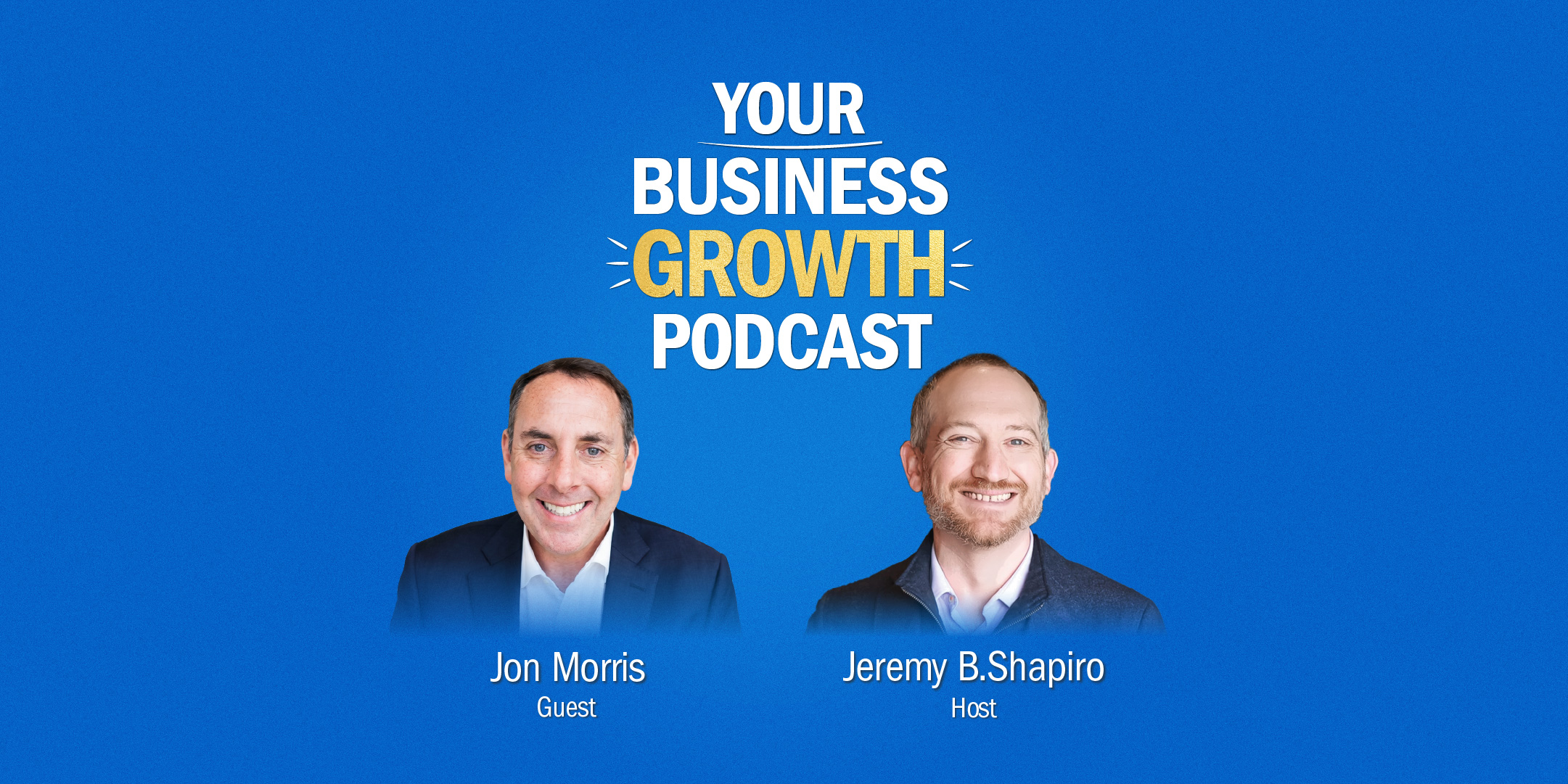
Welcome to today’s episode of Your Business Growth Podcast. I’m your host, Jeremy Shapiro, author of Your Business Growth Playbook, and my guest today is Jon Morris.
About Jon Morris

Jon Morris is the Founder and CEO of Fiscal Advocate Inc, a technology-enabled professional services company powered by EngineBI software. His entrepreneurial journey began in 2004 when he established Rise Interactive using prize money from his second-place finish in the University of Chicago’s prestigious New Venture Challenge. Over the following sixteen years, he successfully scaled Rise from a one-person startup into one of the largest independent marketing agencies in the world.
After selling Rise in 2020, Jon sought a new way to help fellow entrepreneurs grow their businesses. He realized that the insights-driven finance that was instrumental to his agency’s success could benefit nearly any professional service company. This led to the creation of Fiscal Advocate, where he utilizes a proprietary, tech-enabled approach to surface hidden financial insights that drive critical business decisions for his clients.
The innovative services provided by Fiscal Advocate are designed to help companies drive revenue growth, improve profitability, and strengthen their cash position. By offering tech-enabled financial management—including accounting, cash flow analysis, and annual forecasting via EngineBI—Jon helps other agency owners move past plateaus using the same financial discipline that fueled his own massive growth.
Outside of his professional life, Jon is an avid soccer fan who played for his alma mater, Kenyon College. He is fascinated by data-driven approaches to developing youth athletes and enjoys spending his spare time with his wife, three daughters, and two dogs. His work continues to sit at the intersection of high-level financial strategy and entrepreneurial mentorship.
Connect with Jon Morris
Speed Round Answers:
- All In Lead Source: Partnerships
- Books: Choose a theme you want to improve on, then read five books in that theme to build your own point of view.
- Unlikeliest Mentor: Jack Kraft
Like This Episode? There’s More!
Subscribe!
Your Business Growth Podcast is available on all major podcast platforms. Subscribe today!
Get the Book!
Pickup the #1 Best Seller, Your Business Growth Playbook today online or at your local bookseller!
Meet Jeremy!
Book your Blueprint Discovery Call with Jeremy today and get back to the growth you deserve!
Jon Morris Episode Transcript
I had a choice. I could go let go of some employees, uh, or what I ended up doing was cutting the payroll across the board. I remember walking to Starbucks with an employee. He’s giving me this whole pitch about what an amazing job he’s doing, and he’s asking me for a raise. I had to share the news that not only was he not getting a raise, but he was actually getting a 10% haircut in his pay.
I ended up losing that employee. What if you lost your largest client, representing 40% of your entire revenue almost overnight? Most founders would panic and start mass layoffs, but our guest today chose a different path. He asked his entire team to take a pay cut so he could keep the talent together and then made a pretty high-stakes gamble.
He hired a salesperson and paid them more than he was paying himself. That move didn’t just save the company, it fueled a decade of growth that transformed a one-man shop into one of the largest independent agencies in the world. Welcome to today’s episode of Your Business Growth Podcast. I’m your host, Jeremy Shapiro, author of Your Business Growth Playbook, and my guest today is John Morris.
John, welcome to the show. Jeremy, thanks so much for having me here. Really excited to be here. So rewinding in time, John, you had this really cool start that all began with some prize money while you were at university. Talk to us about what that was, where that money came from, and what you did with that.
Yeah. So I went to University of Chicago for business school, and they have an annual business plan competition called the New Venture Challenge. And a friend of mine asked me if I wanted to join. It’s basically a class and a competition. And so I just thought it would be fun to enter, uh, the class or the competition.
And, and honestly, all I wanted to do was win the competition. Like, I wasn’t looking to start a new business. I really thought of this as, this is a class, I get credit for the class. But then we ended up doing really well. We took second place in the competition. We won $10,000, which was our prize money, and it was the seed money to start Rise Interactive.
And I decided, well, if all these entrepreneurs and venture capitalists believe in us, why don’t we give this a try? And so Rise Interactive was born. Now, was Rise the business that you guys submitted into that business competition? So yes and no. It was the same entity, but the business model morphed probably five times over 16 years.
So the original company name was Internet Marketing Institute. And the original idea was to, uh, provide seminars or training on how to do digital marketing yourself. And as I was putting these two-day seminars on, uh, I found two things. The first thing is I found it very difficult to get new customers to go to these classes repeatedly.
And the second thing is everyone who was in the class just kept on asking, “Couldn’t you just do this for me?” And I decided that that was a better business model, and so we switched from teaching digital marketing to doing digital marketing. Yeah. One of the things we talk about in the book, and I work with clients on all the time, is this idea that you can teach people how to do it on their own, the DIY.
You can do stuff with them, like coaching, mentoring, and all that. And then there’s the done for you, where they just get a result and they pay you for that. And as you work through those, those are worth far more to the customer or the client, uh, and you can charge accordingly, but the value also goes up dramatically as well.
And that’s cool that you, you played in all those spaces, um, to find your way with Rise. Now, digital marketing is a pretty competitive space to be in from a teaching education standpoint and all. Um, this is back in, like, 2004. What, what was the landscape like then? Why did you choose digital marketing, and how did that space evolve over time?
So I chose digital marketing because that actually was my background. So I graduated college in 1996. It’s when I f- started my first digital marketing agency, and I didn’t know about the internet until January of 1996, and so I started my business in May or June of 1996. And so, a- and it only happened because I couldn’t get a job.
And so w- by not being able to get a job, I ended up creating a, what I’ll call is a computer company or a company that helped really with anything related to computers, and I started building the ugliest website you ever seen. And then people started asking me, “Well, can’t you just build this for me?” Or sorry, people started asking me, “Well, how are you gonna market my website?”
And it was 1996. I had no idea. No one had any idea. So I started researching all the best practices of digital marketing and truly became one of the pioneers and leading experts in search engine optimization, and so that’s really how I got started, and that’s how, uh, I came up with the idea. Now, the reason why 2004 was much more special than 1996 was there just wasn’t that many good places to advertise in 1996.
In 2004, massive amounts of money was leaving traditional advertising and moving over to digital marketing, and I happened to be at the right place at the right time. Yeah, that’s, uh, incredible that you were in that space so early. I mean, I remember the websites I was building in 1996, what was involved then, and the whole idea of digital marketing or even SEO.
Like, these weren’t even terms people were talking about, um, you know, outside of very, very small circles at that time, and, and you got in there nice and early. What did that early momentum feel like as you were now growing this n- newly minted name of digital marketing agency and, like, doubling the business every year?
It was a lot of fun. You know, I mean, uh, it’s funny, by the way. Yes, I was doubling it in my very early stages- But, you know, I, I did 12,000 in sales my first year. I did 80,000 in sales my second year. I did 350,000 in sales my third year. It wasn’t until, like, year five or year six till people actually started even believing in me.
You know, where, you know, growing from 12,000 to 80,000 isn’t, like, a, a major success story, but from my standpoint, I was proud. Like, I worked hard and I, I, I’m an incrementalist and I wanted to make investments that every year I kept on growing, and I, I felt like I did that. And … But I remember, um, a friend of my aunt’s, where it was probably when we got to the $2 million marker, and he was like, “You know, John, I, I used to see you at, like, you know, holiday parties and we would talk and be like, ‘What is this guy doing?’”
And I was like, “Well, clearly you knew more about what you were doing than I did.” You know, so it was interesting to see, you know, people’s belief in me and in the business change as we started to scale. You know, it’s funny. I think back to, uh, when my wife and I were dating in our earlier years, her parents and family, like, had no idea what I did or how my business worked.
And just as they would start to figure out what it was that I did, I had some new company or something else launching, and that totally just, you know, changed things like… And they’re like, “We just figured this out. What do you mean you have a new business?” Um, and it’s funny how, like, you know, folks with nine-to-fives, your friends and so forth, don’t always get it, but your fellow entrepreneurs and, and founders do.
So John, you used a word that I really like, incrementalist. Say more about that. That is such a cool word and identity. When I first started Rise, I used to do marathons every year. And if you ever do marathon training, takes 18 weeks, and every week you go on a long run. And, you know, your first long run is six miles, and then the next week it’s seven miles, and then it goes down to five, and then up to nine, then up to 10, then down to seven.
And I really… That was the model I took. I had a 20-year time view, except rather than miles, I looked at it as dollars, and then rather than weeks, I looked at it as years. And so the idea is I wanted to build a great business. I, I’m not focused on the exit or, you know, any of the flashy kind of things you learn in business school.
I just, every year I wanted to make investments to make it so that my business next year was better than it was this year. And, you know, those things compound. If you make small incremental investments and your competitors aren’t making those investments, you’re building something that is better and unique every single time.
I really like that comparison with marathon training and business. Um, I’m an endurance athlete myself, and like, like the, the overlaps and parallels between business and athletics are endless, right? And what you’re talking about there is, you know, we, we would say in training, training blocks, right? And you’re looking at training blocks for your business, and that is so cool, John.
So when we have businesses, right, you can have one end of the spectrum where you work with like, you know, three high-end clients that pay you a lot of money, but it’s really your revenue is pretty compartmentalized in only a small number of large compartments. Or you go the other way where you have millions of customers and lower dollar amount, and if you lose one or two, it doesn’t make a difference, right?
And you sort of had this hybrid middle space where there were customers across all revenue levels, but one particular stood out that was taking up y- 40% of that top line revenue. Walk us through how you got to that point and what happened with that client. Sure. So this is 2008 is when I got the news that I lost this client.
It was 40% of my revenue. They were one of the major players in the financial institutions. They became a victim of, you know, the financial crisis and went bank- bankrupt. So overnight, my largest customer no longer existed, and this was December of 2008 I got the news. Uh, my goal was to double in 2009 before I had that news, and I was talking to my, one of my employees, and I talked about how I, I wanted to double.
And he’s like, “John, it’s just not gonna happen.” He’s like, “But we can make the investments necessary to double,” which is what we did. And so I started the year off 40% down, but my cost was still, you know, where it was when I had that client. So I had to make adjustments very quickly to manage cash flow to make sure that everything was going smoothly.
So tell us about some of those decisions. You know, when we talk about leadership, um, that often comes down to making decisions, and they’re not always the most popular decisions. What did you guys do to get out of that hole of starting the year 40% down? We had to cut costs. Like, there was no rhyme or reason.
There, there was no two ways about it, like we had to bring down costs. So I had a choice. I could go let go of some employees and have a smaller team, uh, or what I ended up doing was cutting the payroll or across the board. So I, I cut everybody’s pay, including my own, uh, including my second in command.
Like, we all took a haircut in salary, and, uh, the idea behind it was that, you know, we would bring people back up when we got a chance. Uh, but that was the strategy I chose is I wanted to keep the team together. I love the team. I thought culturally it was the right thing to do. A- and there are some challenges with that, but, uh, you know, I remember walking to Starbucks with an employee, and right as we get to the door, he’s giving me this whole pitch about what an amazing job he’s doing, all the great work, and he’s asking me for a raise And I had to share the news that not only was he not getting a raise, but he was actually getting a 10% haircut, uh, in his pay And so, and I ended up losing that employee.
You know, it’s, which … That’s the one kind of key learning is when you reduce cost across the entire company, some people will choose to leave, and they might not be the people you want to leave. So it’s like you end up getting the turnover that you are gonna get anyway, but it, it’s less you choosing it and other people choosing it.
You know, it’s, um, it’s interesting when, when you share that. Like, it’s one thing to look at a spreadsheet or look at your financials, see the numbers, take out your pencil and red line some things or adjust and say, “We’re gonna cut this and change that.” But then when you get to the front line, like you’re talking about, having the conversations one-on-one with people or the company, you know, wide, like in all-hands for example, and sharing this kind of news, those are very, very different things.
And the realities of that, um, are challenging. Like, what was that like breaking the news? You shared that one story with the, the employee on your walk, but what was it like sharing the news with the rest of the team, and how did you, how did you in leadership get around this idea of salary cuts and doing all these things to avoid layoffs?
There were a couple things. I mean, the first thing is I made it very clear that we weren’t gonna fire anybody. I made it very clear that this will be short-lived, and that we’re gonna grow our revenue back, and that I will adjust salaries back after we do so. I ended up creating competitions. So for example, uh, we had prize money for people who wrote the best blog post, and we would measure it based on how much traffic each one of those posts got.
And we started all going to networking events together. So, uh, you know, there was probably nine of us at the time, and when you go to a networking event and nine people are there from the same company, no one thinks that that’s the entire company. You know? So it looked bigger than we were. We ended up doing really well in Q1 of 2009 from a new business perspective.
So by April, I actually was able to not only reinstate people’s salaries, but I was able to pay them back for the money that they lost by taking the pay cut in that first quarter. That’s amazing. That is such an incredible and short turnaround time comeback story. You know, we, we talk about this idea of failure is inevitable in various ways.
So it’s not about avoiding it. Like, look, we de-risk things, but when it happens, like, what matters is how quickly we get back up and what we do in that window. And like, John, you really turned that around so quick, and that, that’s incredible. Uh, on the content side, uh, I was in Washington, DC a number of years ago, and one of the cool things we did is we toured The Motley Fool.
We got, like, this really neat tour of their offices and meeting with their staff and all, and they did something really similar to what you’re talking about, is that they, their whole business model at the time was they got traffic from articles and content, and they would look at first cookie. So, like, what was the article that got someone in to convert them into a paying customer?
And so they had a literally like, you know, screens on the wall dashboard of content articles and the author, and they would bonus the content writers based on the content that brought in new customers. So it wasn’t like just crank out content. It was like, “No, get us content that actually gets us new customers and grows the business.”
And so you use this really cool, uh, contest model with your team as well. Not only that, but I, I did this several times throughout the company, and we actually launched our entire creative department based on that competition. So one woman on our team, uh, was on the SEO team, and she created this incredible infographic that was, like, gorgeously designed on, like, how SEO works.
I was just expecting, like, a, a regular blog. I wasn’t expecting, like, this masterpiece of artwork, and then we started selling infographics, and then we started developing websites, and then we started … I mean … And she ended up becoming the chief creative officer of the company, you know, over time, and turns out she had, um
You know, she went to design school, and she had this amazing talent. I never would’ve known about it if, uh, it wasn’t for that competition. Had you not given your team a chance to rise to the occasion, you, you never would’ve known. Now, I wanna just dig into the, um, the all hands on deck approach to getting the business back on track.
It’s interesting ’cause you have team members doing all kinds of things that are not sales related or growing the business, and suddenly you’re telling them, “Guess what? You’re going to a networking event.” What was the playbook you gave them, uh, telling folks, like, “You’re gonna go out to an event”? Like, what was the expectation?
What did you want them to do? Look, we were in startup stage. We were all very young. Uh, we were all, I, I would say fairly early, you know, like mostly in our 20s, maybe some in their 30s in our career. And so there was already an all-hands feeling. You know, if I compare that to when we had hundreds employees, that would never have worked, you know, at that stage.
And so it, it worked for the dynamic that we were in, but also, you know, when I interviewed people, I was very clear. Like, my very first hire- We’re in my 1,300 square foot condo. I’m having a one-on-one conversation with the person. That condo, by the way, was my office for our first seven employees. And I said to him, I was like, “My goal is to be the largest independent digital agency in the world.”
And I told him about the whole marathon thing. I said, “I have a 20-year time horizon. We’re gonna make incremental investments. Uh, but I’m looking for people where they understand this is gonna be the hardest job they have ever had. I’m not looking for someone to work 9:00 to 5:00.” And so, like, I set the stage very early on of what I was expecting this company to be, and that this wasn’t a lifestyle business, that this, this is gonna be hard.
And so anyone who took that job, that expectation was set from the beginning. So they were all in. They were open to doing blog posts. They were open to doing networking. There was, there was no complaining about, you know, long hours at that moment in time. Later on there became… You know, as, as you became bigger, that philosophy fell apart.
Got it. Are you enjoying this episode? Make sure you hit that subscribe button right now. That’ll help you get more episodes automatically as soon as they come out. So hit that subscribe button right now. And if you have a minute, leave a quick rating and review. That helps support the show. So what I’m hearing there is you made it clear from your team at the point of even interviewing and hiring that we are a scrappy startup.
We do whatever it takes to grow from sales, content, all of it. Not just a scrappy startup with high ambition. If I take my current company, I’m not looking to build a rocket ship. I want slow, sustainable, repeatable growth i- is the approach for this business. I’m not looking for people to work 80 hours a week.
I am looking for them to work really intense hours for the hours they work, but I’m okay w- it, it’s just a different strategy for this business. One last question I have for you on sort of the, the team and layoffs and all that before we move on. Y- you had a lot of different ways you could have approached this.
You guys got back to growth pretty quickly. You could have taken on some debt to get there. You could have laid off team members. You chose the, uh, reducing payroll direction. Like, given all the options and ways you could have approached this, why did you choose the haircut in salaries versus other approaches to get back to growth?
A couple things. If I was to go back in time, I probably would have done it a little bit differently. Like I mentioned that one person who left, that person was a superstar that we lost. I, I would have absolutely reduced costs, but I probably would have not done cuts across the board, and I probably would have preserved, like, the core team I wanted to build upon.
That being said, I really like debt when it’s for cashflow management, meaning, like, you win a huge client and they pay their bills slowly. Uh, I don’t like debt for building growth, u- unless you have a really proven pay book. Debt’s not patient, meaning it charges interest. You have to make payments every, you know, month.
There’s no guarantee that I’m gonna grow that business back. So that’s one re- way. I owned 100% of the company. I wasn’t looking for outside investors. Uh, that’s the second thing. And then, uh, the third one is, you know, the hardest part of running any professional service company, you know, so a marketing agency, a law firm, an accounting firm, is 80% of your costs are people.
And you know, like, when I look at my first agency which failed, the one I started right out of college, I was petrified to fire people And when I started Rise, I, I really looked myself in the mirror to say that I’m going to make decisions with my brain, but operate with my heart. And I’m going to make the tough decisions.
And you know, I used to tell people all the time that no one is safe within the company, including me, that I would fire myself in a heartbeat. And I remember one employee said, “You know, John, I know you say that, but it rings a little hollow. Like would you really fire yourself?” And my answer was, “Absolutely.”
Like there’s two versions of me. There is me the owner of the company that owns 100% of the shares, and I’ve hired me as the CEO. And founders fire themselves all the time. Like if, if your income statement’s not looking good, you know, like if I had… 2009 was my asterisk year. We were flat that year, which basically we started down 40%.
And you know, if 2010, 2011, 2012 I was flat every single year, I would either be evaluating is this the right business or am I the right person to be running this business? And what I’m hearing there, John, is like really smart cashflow management is what that comes down to. So bravo. All right. So speaking of cashflow management, you’re in the middle of, uh, the financial crisis.
You’re not laying off, but you’re reducing salaries, and at the same time you’re also making one really big key hire. Tell me about that hire, what le- led you to that decision, how you justified that, and what, what all went into that. If you remember, I had this high ambitious goal, right? I want to grow from nothing to a, this really large business.
Well, the only way you’re gonna do that is if you invest in sales and marketing. I had a client of mine that was flat out phenomenal, and he was running the sales and marketing for one of my clients, and everybody I met I compared to him. I was like, “You know, I, I wanna find a Howard.” And, um, eventually Howard wanted to leave, and I didn’t have to find a Howard.
I could just hire a Howard. Uh, the other part was I wasn’t able to afford him. For three years. And because we did so well in that first quarter and we were able to stabilize the business, it was a big gamble. A- and the gamble was we were gonna pay this person more than everybody, including myself, in the company.
We ended up hiring him, and he was a massive home run. It worked incredibly well. What was the definition of success at the point you were hiring? Like, how, how were you gonna determine if he was earning his keep and doing a good job or not? So a couple things. I tried multiple, you know, commission-only salespeople.
I tried hiring a couple other salespeople. Uh, I happen to be fairly good at sales. I have good sales infrastructure. Phase one was just, is he following up on leads? You know, so I would have something in the CRM, and even though it was assigned to him, I kept track of, like, when we’re supposed to get back to people, and I’d be like, “So how did he follow up on so-and-so?”
He’s like, “Yep, already updated, already in Salesforce.” I was like, “What about so-and-so?” “Yep, already sent an email, updated it in Salesforce.” Like, he was just on top of everything. Then, uh, it really came down to closing. Like, could he close deals? And it got to the point where he was a better closer than myself.
So when you think about the success of a salesperson, ultimately, you know, are sales growing? Like, that’s the most important thing. But when you are in the early stages of a salesperson, you gotta judge them based on their activity And their intensity. Uh, so the first thing that I care about is just speed and follow-up.
How quickly, if someone raises their hand, do you get back to them? If you say that you’re gonna call them in three weeks, do you call them? And so when Howard started, although I assigned leads to him, I really was keeping track of all the leads myself, and I’d be like, “Hey, did you follow up on so-and-so?” It was like, “Yep, followed up with them, already in Salesforce.
Yep, followed up with them, already in Salesforce.” And so once I felt comfortable that I didn’t have to worry about something slipping through the cracks, the next thing then was could he close? How well did he understand our business? You know, he was on the client side, so he understood digital marketing, but he had to understand why we were great, what made us unique.
Ultimately, I consider myself a really good salesperson. He was a better closer than me. Like, he just … You know. And he studied sales. You know, he really f- focused on, like, it as a craft and read books and went to seminars and got certified in Sandler. So you had someone who understood digital marketing, who had the intensity, who had the, um, you know, the desire to learn and grow.
Um, and ultimately, you know, uh, I used to … Like, when I would show a presentation, I had all these little stars of, like, milestones, and I had … My first star was when I hired him, and our, our sales was like a hockey stick right after that. So getting the right salesperson is a massive thing for the success of your organization.
That’s fantastic, and I, I wanna point out for our listeners a few key things you touched on there. One is this concept we talk about of leading indicators versus trailing, right? Trailing is like, oh, look, there’s money in the bank. Leading is those checkpoints along the way, like you’re talking about. Is he getting the leads in the system?
Is he following up? Is he having the calls? Is he closing? Like, all those numbers. And that really falls into Knowing your numbers and having each of those funnel steps mapped out like you s- you so well did, and now you’re able to manage by that and improve by that and compare by that. So huge kudos on that.
Something else you did there, John, too, um, is you guys started to diversify up the revenue in terms of what it was you were selling and how you guys, how you guys made money. How did you look at customer quantity and customer pricing and that kind of stuff? So a couple things. You know, I lost my largest client.
It was 40% of my revenue. My first business went bankrupt because of customer concentration. I lost three clients that represented 80% of my revenue in one month and was not able to recover from that. I never wanted that to be my problem again. And so, you know, Rise’s goal was to have 50 great customers, and every year those customers would get bigger and bigger.
But I was always very worried about customer concentration, so I invested very heavily in sales and marketing to grow and win my next big customer. But I also looked at how do you expand your revenue stream so that you have more services and you don’t become too dependent on one service line as well.
My original model, so, you know, I started teaching digital marketing. I then decided to start doing it ourselves, and we really focused on search marketing And our tagline was the agency search agency. And what we would do is we would basically white label our services to larger mar- digital marketing agencies, web development companies, and be their search partner behind the scenes.
Uh, and that’s how we grew. But then people wanted more services. We started to go direct to customer. Uh, they wanted programmatic … Actually, before even programmatic media buying, they wanted display advertising. Uh, programmatic didn’t exist when I first started Rise. Then they wanted affiliate marketing, so we, we eventually built a full, what I’ll say, digital media offering.
So if you wanted to advertise on the web and there was a method to do so, we wanted to be able to deliver the whole holistic strategy. That actually became a big part of our differentiator. Our … We, we created something called interactive investment management, and the idea is just like you manage a stock portfolio, we would manage your digital media portfolio, and we would really understand the ROI to all the different places you advertise and make adjustments accordingly.
And so that, that won us a lot of business because it allowed us to shift if something wasn’t working well, and it also was a unique perspective as opposed to being like, “I’m just great at one thing.” Yeah, so what I’m hearing there for our listeners is instead of being too concentrated on high-end services for a few clients, you had additional service tiers as well as product line to service a wider ideal customer profile, as well as offer more to the existing customer base you had, ultimately delivering the result they’re looking for, not just education information or, you know, one narrow, narrow niche service.
That’s a good summary. Cool. So on the sales side of things, you started out like many companies do with founder-led sales. You’ve dialed in your sales playbook. You did a good job, and then you brought on, uh, Howard, and he was doing a great job in terms of closing even better than you were. But tell us a little bit more about how you stepped out of that role in sales and started to now grow not just another you, but a sales team.
Yeah, so couple things. One, I do have an ego, and I do think I’m really good at sales. So it, it took a while to accept that someone might be better than me at sales. But the other part is, and this is something every founder should understand, you will never be a full-time salesperson You have to meet with employees, you have to meet with clients, you have to, you know, do your taxes.
Like, you have… Like, there’s just stuff that t- eats up time away. So, you know, uh, there’s a few things that philosophically. So the first one is if you wanna scale and grow, it’s not gonna happen by accident. Uh, there’s one key number, there’s many key numbers, but one of the key numbers that I really look at is what percent of your revenue do you spend on sales and marketing?
And if you’re listening to this, no matter what industry you’re in, there is a benchmark, and I want you on the higher end of that benchmark, not the lower end. Meaning, yeah, I’ll use marketing agencies. The average marketing agency spends 8% of their revenue on sales and marketing. Well, if you know this and you wanna grow faster than the competition, you can try to spend more as a percent of your revenue.
So that was one of the things that philosophically we try to do. We spent between 15% to 20% of our revenue on sales and marketing. And so as we scale, we have more money to invest, so we went to Beyond Howard and we hired multiple salespeople. We hired a marketing team. We started sponsoring events. We did paid media.
We did all sorts of things that do to help fuel growth. You know, when we look at things like investing in sales teams, you know, each sales rep usually has, like, this bathtub curve for their ROI. Like, initially day one, they’re not ma- not making money, but, you know, at a certain period, you know for a rep for your company when it is they start to break even and start to make money.
And so you can go sequentially, bring on one rep, get them profitable, bring on a second. Or like you said, if you know your numbers, you can stack it, go deep, and know you’re gonna go deep, deep down a very deep bathtub curve, but rock it out the other side of that. Um, and I wanna highlight for our listeners something really valuable you shared there, which is that Sales and marketing isn’t a nice to have.
It is a must have, and that there are benchmarks for your companies, for your industry. And I love, John, that you highlighted you wanna be on the upper end of that spend if your goal is growth, because it gets you there faster. A lot of my competitors that were smaller than Rise, like, over time kept on asking me, like, “Well, how would, how’d you do it?”
And I always follow up with a question. I was like, “Well, what percent of your revenue do you spend on sales and marketing?” They’re like, “Oh, we don’t spend anything. It’s all word of mouth.” And I was like, “Well, then you shouldn’t be surprised that you’re not growing.” And the, the w- worst part about it is they’re marketing agencies.
Like, how come they don’t believe in marketing if that’s what they do for a living? It’s the cobbler’s kids, right? It’s the marketing agency’s marketing. So now let’s go towards sort of the, the other end of the spectrum on Rise’s story here. You know, you were at the point where you guys are at $12 million in revenue, and in that final stretch you scaled to 40 million.
What got you from that 12 to 40, um, and what’s sort of the, the end of the rainbow on that journey? So a few things. One, when you think about growing, there are only three numbers that matter. It’s how well do you hold onto your customers, how well do you upsell your customers, and how well are you at winning new business?
I always tell people your number one sales goal is never lose a customer due to performance. Uh, so if you lose a customer, I want it to be for, you know, I, I did not cause the financial crisis. You know, I had nothing to do with my client and some of the risky bets they made, and they went bankrupt. So, you know, although I lost them as a customer, I didn’t lose them due to performance.
And so, uh, if you can hold onto your customers, that’s the number one thing you wanna do. We were really good at that, and we constantly invested in making our services better. So the idea is that every year your services are better than the year before. And so, you know, you grow and you hold onto your customers.
Second one is, I’m gonna say just a little bit of luck. One of our clients went on a massive growth spree, and so we did two things really well. The first thing we did is we held onto them. Uh, to give you an idea, they were about 60,000 a year in fees in year one, and they were mid-seven figures by the time we ended up parting ways.
Um, so that, that is, um, one thing that picking the right customers and growing with them. I would say we were decent up- upselling, and I’m gonna give you two different ways that you can upsell. Uh, the first one is we had a day-to-day contact at all of our clients, and oftentimes they managed more things than we offered to them.
We were really good at upselling that customer. Where we, in my opinion, were not good Is when other people in the company, our clients, were responsible for, you know, a different service. Uh, give you an example. Uh, one of our clients had six business units, and we worked with one business unit. I don’t think we ever got into the other five business units.
Uh, and then the third one was we were really good at winning new business. We were really good at responding to RFPs. We were really good at top of funnel, middle of funnel, bottom of funnel. We invested really heavily in sales and marketing. And so the combination of doing a great job with keeping our customers and doing a great job of winning new business I think is really what fueled our growth.
Nice. So to recap for our listeners what we hear, hearing there, John, is those three numbers are your retention, your account growth, expand, and new business, land. So if you’re landing new business, expanding existing business, and keeping your customers, um, those are three great high-level KPIs in your mind.
Yes, those are the only KPIs that fuel growth, but what I would say is of those three, your most important one is what you, your existing customers and getting them to renew and holding on to them. How did this insights-driven, like, financial approach and the strong look at cash flow and performance and all lead to the successful exit of Rise?
I think there are two critical things. Uh, the first one is do you have a decision-making framework? I believe there are only three KPIs that matter. And those KPIs are year-over-year revenue growth, profit margin, and cash relative to monthly overhead. If you grow your cash, you create optionality. You get to go buy businesses.
You have a rainy day fund, so when you lose your largest client, you have a time period to weather the storm. As you mentioned earlier, really good cash flow management’s really important. Yeah, the second one is profit margin, and there’s industry benchmarks, and you can use that as performance. You know, in the professional service space, 20% of your revenue should be profit.
If it is not, it means you’re investing in something, and you need to make sure that investment is paying off. Uh, for many, many years, I had a 5% profit target as opposed to a 20% profit target. That means that I had 15 extra points to invest in the business, and I used my annual growth, the third one, year-over-year revenue growth, to determine if I was doing a good job.
Uh, there’s mainly in the SaaS world, there’s this concept of the rule of 40, and it says your annual growth rate plus your profit margin, does it equal 40% or greater? And if the answer is yes, then you’re doing something right, and you wanna keep on making those investments. And the last one is year-over-year revenue growth.
Like, uh, and by the way, as anyone listening to this, if you’re the CEO, you’re gonna be judged on those three KPIs. If you do an amazing job of those three KPIs, you’re gonna build a career for yourself. You’re gonna build a career for your employees. Uh, if you don’t, you’re not gonna build a career for yourself.
You’re not gonna build wealth, and so those are the three KPIs to follow Now, the second part is that requires tough decision-making. So once you know the decision that you needs to make, your profit margin is not what you want it to be, your revenue growth is not what you want it to be, well, then you have to figure out why.
Oftentimes you have to make adjustments. You’re gonna have to make cuts in one area to invest in another area. We were very good at being disciplined and not only knowing what decisions to make, because we had a data-driven framework to make decisions, but we were willing to make the tough decisions, even if sometimes it meant letting go of people we loved and we cared about and were in the trenches with, to reinvest in other areas.
Now, if you were working with, uh, a founder who faced some of the same challenges you were facing, um, and they lost their biggest account, like, looking back now, what advice would you have for a founder in that situation? So the first thing is accept the reality that you have to live with the revenue you have, not the revenue you want.
So there’s benchmarks in every single aspect of your spending. So you should have a 50% gross margin. You get 30% of your revenue for all of your non-client related expenses, 8% to sales, 15% to your back office, 7% to your executive team. Uh, and so if your revenue is down You know exactly how much you should spend in every area.
Then what you need to do, with a massive sense of urgency, is make the adjustments as quickly as possible. A- and by the way, like, you know, people always worry about the culture, they worry about the team, they worry… A- and those are all things that you need to worry about. Your team will start understanding, like, the way you operate and the way you run your business, you know, where it- it’s when you don’t make those decisions.
You know, you, you lose 40% of your revenue, and all of a sudden you’re losing money, and all of a sudden your cash gets depleted, and all of a sudden you’re making decisions based on the fact that you’ve gotta make payroll as opposed to what’s right for the business. And so, uh, those are my key recommendations are, you know, get to the numbers, have the right sense of urgency, have the courage to make the tough decisions, and I promise you you’ll come out ahead, not just in terms of the profitability of the company, but from the respect of the people that stay within the organization.
Yeah, one thing that’s really standing out to me here, John, is that you know your numbers so well, but more importantly, you also know your benchmarks, right? I think earlier stage founders sometimes have pie-in-the-sky’s ideas of what their budget numbers should be, and there’s not a reality check there of what they should be for the industry or for the kind of business model they have and so forth.
So really, really good job on knowing your numbers and the benchmarks. Before we wrap, um, a few quick rapid-fire questions for you. If you were to start the agency all over again from scratch, what one lead source would you go all in on? Uh, partnership marketing. So, um, it- it’s what we did in the early stages and, you know, I, I think of an example where I had a massive opportunity and I completely missed out on it, is remember that client I told you about that went from five figures to seven figures?
So they were referred to me by Amazon, and Amazon had these comparison shopping engine, uh, services, and they were referring leads to me, and it wasn’t a core part of my service offering. And I, I look back and I’m like, “What an idiot I was.” Like, I had one of the largest companies in the world sending me leads at volume, and I didn’t, like, stop everything I was doing and go all in on that.
And so I, I think a lot of times about that was a massive miss on my part. Uh, so partnership marketing and, and specifically Amazon was something I, I should have gone all in on. I would’ve grown faster even though I grew really fast. Partnerships is a, a, a great lead source, uh, especially for launching, so love that.
All right, uh, you and I both love, uh, reading. You know, aside from your business growth playbook, what are some of your other top favorite business books? So I’m gonna give you a different answer than probably any other answer you received There is no best business book. Instead, there are best business books in very specific themes.
And what you have to figure out is what is your pain point? Let’s just say you wanna focus on lead generation. I want you to identify the five top books on lead generation. I want you to read all five. Uh, if you wanna focus on leadership, I want you to focus on five books on leadership, you know? So for example, I read about Elon Musk, Satya Nadella, um, Bill Gates, Steve Jobs.
Uh, you know, I did a whole series of 20th and 21st century tech leaders. Uh, I’ve read, you know, Atomic Habits and Grit and Checklist Manifesto and when you’re focusing on, you know, uh, how to build the right habits and the right infrastructure. And so my, my answer is, um, you’re, you’re never gonna have, like, that one book that, you know, is, like, the best book that teaches you everything.
Pick your theme, go deep on it, and then go on to your next theme, and then go five books on that, and then keep on going. That’s really, uh, you’re right, a different take on it. Um, an advice I’ve heard before that I enjoy is that if you do wanna learn a subject, you go get, like, the 10 books on the topic, you read them all, and you’ll find conflicting advice within those, uh, and different frameworks and approaches, but you will also now know a subject very well.
Yep, and then you get your own point of view, right? Yeah, you’re not just repeating one author’s perspective. Exactly. So mentors are so important to all of us in business. Who would you say, though, was one of your unlikeliest mentors? A person named Jack Kraft was my pretty much major mentor for the enti- the vast majority of my adult career.
When I started my first agency, it was in the mid-1990s, which was in the dot-com boom. And I was 22 to 24 years old during that time period. And it was amazing how many people were excited and interested in talking to me because I was in the, you know, internet world and in my early 20s, and everyone thought, like, this could be the next, you know, Mark Zuckerberg-type person.
Turns out I was not the next Mark Zuckerberg. But, uh, so my lawyer, uh, who, um, was, you know, I never even knew him. It was, like, my, my mom’s first cousin’s husband, you know, uh, was the chair of Winston & Strawn’s intellectual property, and he made all these introductions to me, and one of them was to Jack Kraft.
And Jack was the former CFO and CO and vice chairman of Leo Burnett, and he took a liking to me, and he met with me every single week for no compensation for around two years in my first agency. And then in my second agency, I ended up hiring him, um, and talked to him on a daily basis. And so much of, like, the benchmark numbers I share, the, the way that I ran the business, the fact that we focused on 50 great customers, all these different things really came from him and his model, and, uh, was a huge driver of the success I have today.
Love that. Sometimes looking back, we don’t know who those names will be. Uh, it’s only in the rear view do we see it, but in the moment it’s, it’s not quite there. So that’s awesome, John. All right. So to recap for our listeners, you move from this devastate, devastating client loss that threatened the entire survival of the business to a strategy of extreme financial discipline and an aggressive investment in sales talent, which ultimately built one of the world’s largest independent marketing firms.
That is a phenomenal summary. Love it. And for our listeners who wanna learn more about you, John, where should they go right now? Uh, so you can go to fiscaladvocate.com. Uh, you can follow me on LinkedIn. I post every week. Uh, and send me an email, jon@fiscaladvocate.com. I’d love to hear from you. Fantastic. So that’s fiscaladvocate.com or john@fiscaladvocate.com.
Thank you so much for sharing so much of your journey and your growth and all the things you did to double and grow and build and recover and create the company that you create. Big kudos, and thank you for sharing. Absolutely. Thank you. Thanks so much for listening. Quick reminder, hit that subscribe button right now so you can get more episodes when they come out automatically, and remember to leave that rating and review right now.
Like This Episode? There’s More!
Subscribe!
Your Business Growth Podcast is available on all major podcast platforms. Subscribe today!
Get the Book!
Pickup the #1 Best Seller, Your Business Growth Playbook today online or at your local bookseller!
Meet Jeremy!
Book your Blueprint Discovery Call with Jeremy today and get back to the growth you deserve!