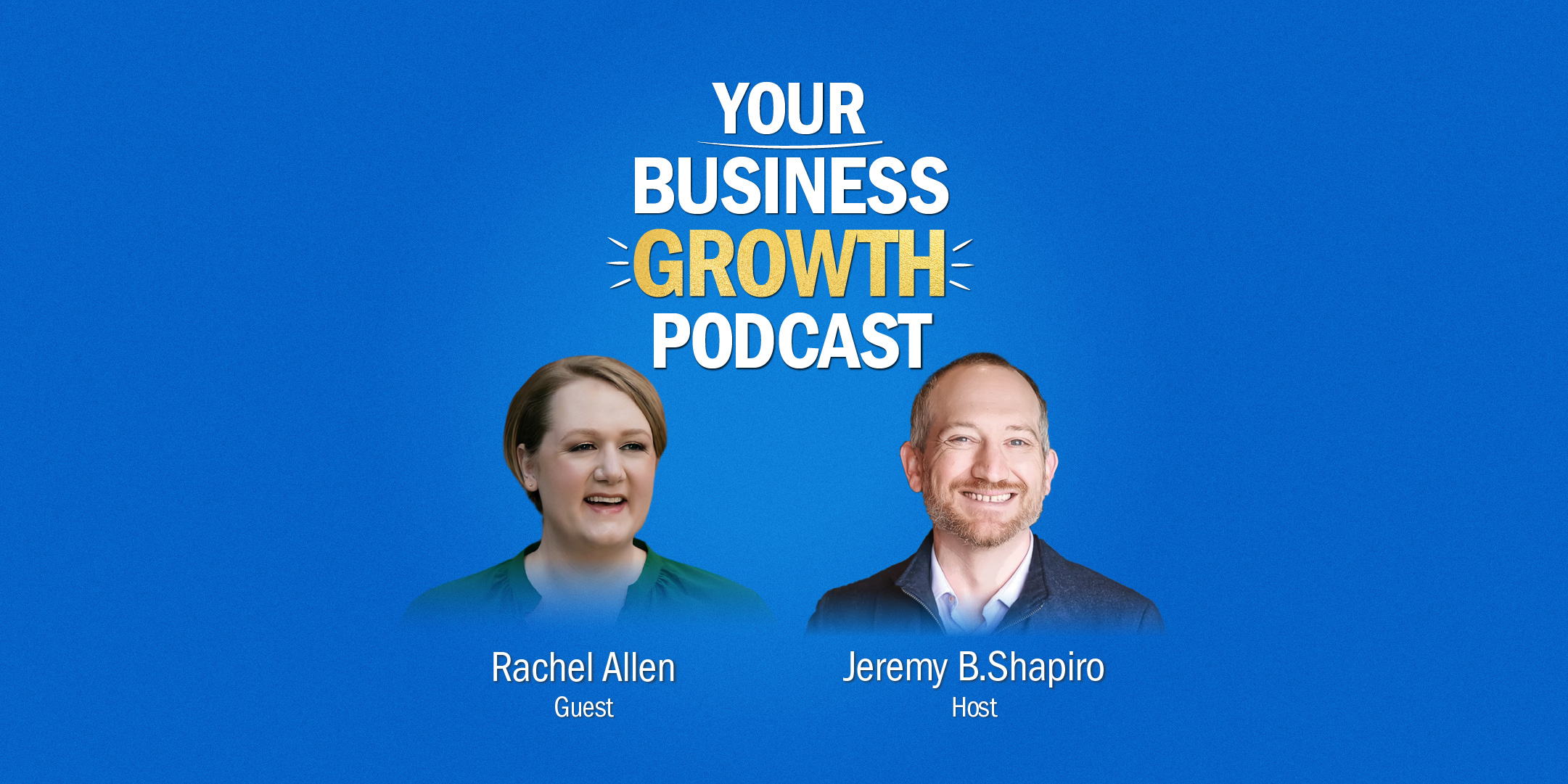
For six long years, our guest today was stuck at a solid six-figure ceiling, feeling the exhaustion of running an agency that she eventually dismantled just to stay sane.
Following a terrifying six-month stretch with zero new leads, she retreated to a cabin in the woods and asked herself a question that most business owners are too afraid to even whisper.
By making one radical change to her pricing structure and fundamentally shifting how she presented her expertise, she didn’t just find a new client – she landed the biggest contract of her career within weeks and transformed her business into a multi seven-figure business.
Welcome to today’s episode of Your Business Growth Podcast. I’m your host, Jeremy Shapiro, author of Your Business Growth Playbook, and my guest today is Rachel Allen.
About Rachel Allen

Rachel Allen is a fast-thinking, deeply nerdy marketer with broad-ranging experience across both the for-profit and non-profit sectors. Over the course of 17 years, she has mastered the art of making words make money, specializing in marketing that remains equal parts data-driven and human-centered. She has written for a diverse array of businesses, from the smallest local ventures to some of the biggest names in global industry.
Working with clients in more than 21 countries, Rachel has supported top-tier entrepreneurs, influencers, and brick-and-mortar organizations. Her strategic contributions have led directly to high-ROI launches, significant leaps in audience engagement, and prestigious industry awards. She has also helped her clients secure relationships with top venture capital firms and achieve national-level honors.
Rachel possesses a unique ability to extract complex ideas from people’s minds and translate them into effective marketing with “freakish frequency”. She excels at ensuring marketing operations run on time while never losing sight of the bigger picture of a brand’s goals. Her expertise is particularly valuable in high-context industries such as legal, finance, engineering, and medical sectors.
Whether she is explaining the value of a fractional CFO department or selling equitable estate planning, Rachel thrives on sinking her teeth into seemingly unsolvable problems. She is dedicated to creating curricula and messaging that explore the deeper meaning of a good life while delivering tangible financial outcomes. Today, she primarily works one-on-one with founders and their teams to provide a unique perspective on indirect, relational marketing.
Connect with Rachel Allen
Speed Round Answers:
- All In Lead Source: Referrals
- Books: Indirect Work by Carol Sanford
- Unlikeliest Mentor: The Library
Like This Episode? There’s More!
Subscribe!
Your Business Growth Podcast is available on all major podcast platforms. Subscribe today!
Get the Book!
Pickup the #1 Best Seller, Your Business Growth Playbook today online or at your local bookseller!
Meet Jeremy!
Book your Blueprint Discovery Call with Jeremy today and get back to the growth you deserve!
Rachel Allen Episode Transcript
I had this massive dry spell of about six months where just absolute crickets, like nobody in my inbox, nothing was landing. And I had just this real crisis of confidence in myself and in my decision-making, and I really considered it. So I went to this cabin in Mississippi and wandered around and walked around in the woods.
And one day, this little voice came into my head and was like, “Well, what if you just quintupled your prices?” And I immediately dismissed it ’cause I was like, “Well, that’s the dumbest thing I’ve ever heard.” But then I landed my biggest client to date, and it’s really changed the entire trajectory of my business.
For six long years, our guest today was stuck at a solid six-figure ceiling, feeling the exhaustion of running an agency that she eventually dismantled just to stay sane Following a terrifying six-month stretch with zero new leads, she retreated to a cabin in the woods and asked herself a question that most business owners are too afraid to even whisper.
By making one radical change to her pricing structure and fundamentally shifting how she presented her expertise, she didn’t just find a new client, she landed the biggest contract of her career within weeks and transformed her business into a multi-seven-figure business. Welcome to today’s episode of Your Business Growth Podcast.
I’m your host, Jeremy Shapiro, author of Your Business Growth Playbook. And my guest today is Rachel Allen. Rachel, welcome. Thank you so much for having me. Yeah. I’m excited to dig into some of this backstory. Um, I’ve really enjoyed our conversations learning more about your journey to not just starting your business, but what got you to and through that plateau.
But let’s rewind back in time. Uh, we’re going back to, like, the 2008 recession era. You had a journalism degree. Tell us about what got you from the world of journalism into marketing with just $200 to your name. Yeah. Well, um, it’s a journey that most people think is really cool, and it is, but it was mostly terrifying during.
So I, uh, had a degree in journalism, and just to date it even more, I got a degree in new journalism, which get this, it was journalism on the internet. Woo. So very exciting. Um, and I graduated at the ’08 recession. Of course, no one was hiring, particularly not people from rural Tennessee, which is where I was.
And so in my 22-year-old brain, I was like, “Well, what’s the furthest I can get away from Tennessee?” And it turns out that’s Hong Kong. So I bought a plane ticket, um, and I left, but I didn’t do a couple of crucial things, including getting a work visa before I left. So I landed there and had about $200 in my bank account.
I needed to make rent. And so I’m googling, like, how to make money online, which is only marginally less ridiculous then than it would be now. And I saw all the scams, and then this thing came through, and it was like, oh, it’s a copywriting job. And I’m like, “Copywriting? I don’t know what that is, but I know how to write.
Let’s see.” And I gave it a try and, um, they paid me and I was hooked. Nice. So that one freelance gig turned into a whole business. W- was there, like, a gap you saw in the marketplace or something you were filling? ‘Cause, like, copywriting, given even how that was advertised, is a sort of competitive space.
What were you doing differently or how did you differentiate? I mean, the first thing I did was just, like, born out of utter desperation, which is I worked really, really, really fast. Um, this was back in the day of content mills, and so it was all about quantity over quality. Um, one of the very first jobs I actually got was people would pay me nine cents per question to come up with questions for other writers to answer, and I was like, “Sure, I can ask questions.”
So it was all volume in the beginning and I wasn’t treating it like a real business. It was just like, how much money can I get in as quickly as possible to pay my bills ’cause I don’t know what’s happening? Now, that business built up beyond just these gigs and, you know, pay per question, um, to something a little more substantial.
Tell us what that business was when you were at that, crossing through that six-figure territory. What was the business model? Who you were serving? How were you helping these businesses on the communication side? Yeah. So when I first hit that level, I was working, um, still solo. I was, um, as I guess you would call a senior copywriter role.
So I had done, uh, all of my chops. I, you know, built up the expertise and started working with clients who had really fallen in love with the way that I shared their voice. Um, and I ended up differentiating myself in the market in that they would feel like nobody else understood them like I did, and nobody else could present them like I could.
So I built this beautiful little boutique practice that was working super great, and then I was like, “Well, what if I changed everything and built it into an agency?” Um, mostly because that was what you were supposed to do, right? It was all about, like, you gotta scale, you gotta build a team. That’s the next step.
So I didn’t think a lot about it. I just did it. Um, and it actually, like, it worked out fine. I ended up expanding my market. I was, um, working with people in all these different places. I had a team. It should’ve been great, uh, but I really, really just hated it. I found it very exhausting. But I stuck with it because, of course, you know, you have the sunk-cost fallacy, and then I was like, “Well, one more year, and then it’s gonna be easy.
One, just, just one more. This one, next one for sure.” And eventually, I had to finally come to grips with the fact that it was never gonna get easier, and I just didn’t really like it. So what was that initial growth like, though, as it was building up, you know, to that level, before you got, you know, sick of it?
Tell us about what that was like as you’re landing new clients, finding your voice, and hearing what your clients loved about their work with you. Yeah. Um, well, I think it was a lot of, honestly, a lot of mindset shifting on the back end because this is so, it’s so natural for me, almost compulsive, to write.
And so the thought that anyone would pay me to do such a thing and find it really valuable was just mind-blowing to me. So I had to work through that and then realize, like, oh, like, you know, I can charge more than $15 for a blog post. Oh my goodness, people will pay me five, six figures for this? What are we even doing?
So it was a lot of that. And as far as just business model, it was figuring out, like, who do I actually like working for, you know? I’d taken on some contracts with larger companies, and they were fine, but I found that I really enjoyed the one-to-one interaction with people, um, ’cause it fed my very introverted soul.
And also, I love having, like, longer term relationships with people, where I really get to know their business and grow with them. I mean, my oldest client right now, I’ve been working with for 15 years, and I love having been a part of that whole journey of her business. Yeah, that’s beautiful to have that longevity, m- that, the longer term relationship there.
That can be limiting in some ways, too, but, uh, despite that, you, you found that growth. Um, and all this time, you were, you were traveling during that time still, or living in Hong Kong, or what was the situation? Yeah, I ended up moving about six months, or every six months for 10 years. Um, so I lived all over Europe, a little bit in South America, just kind of everywhere.
Was that visa related or just travel bug related? Uh, both. I think it was, you know, it’s always, uh, fun playing visa roulette, getting in and out of places. And a lot of times, well, most countries you have, like, six months to a year before you have to either leave and come back or, you know, get serious about it.
But also, you know, it was exciting. I had a bunch of money coming in. I was living this, um, life that I never thought would be possible for me, so I was like, “Sure, why not go live in Bulgaria for a while?” You know, it, it’s interesting. I’ve talked to, you know, many business owners, worked with many clients over the years who have gone the nomad route.
And, uh, sometimes it’s a six-figure business, right? Seven. I’ve even worked with eight-figure business owners who, you know, take a year or two to travel the world with their family while running an eight-figure business from afar, sometimes, you know, only an hour or so a week. But, you know, that all depends on where you are in this journey.
But in your business, you spent six years sort of stuck at the same revenue level. What was that all about? Like, what was, you know, that, that just one more year, maybe this will be different. Like, bring us there. So, um, I had reached … I, I had felt so excited when I first reached six figures, ’cause that’s, like, that’s the big dream, right?
And statistically many businesses never get there. They most fail in the first two years. So I was already like, “Oh, I’ve reached, I’ve reached the unicorn status.” And so I had to really do some thinking of, like, do I want more than this? Do I … Am I happy with this? What do I want my life to look like? And what metrics out of this are vanity metrics for me, and what do I actually want?
So I went through the process of thinking that through, and then, um, I, I sort of fell back into, I guess, well, I don’t really know what I want, so I guess I should do what everybody else is doing, which, you know, critical error. But that’s how I got into this agency model. And, um, I think as many people know, but I didn’t going in, ’cause I didn’t bother to research it, I just tried it, uh, you have to have a lot of things in place for that to work.
One of which is you have to be really great at managing a team, which turns out I’m really much better at managing other people’s teams than my own. Um, you have to have your pricing margins correct. You have to have the right offer. And you have to be able, as the leader, to step into that leader role as opposed to, like, “I’m the leader, but also I’m gonna, like, rewrite everything and touch everything and, like, get all up in my team’s business.”
And, um, I was bad at most of those things, and … ‘Cause it’s not what I really, I was really wanted to be doing anyway, you know? Yeah, it’s funny. I f- I don’t know if you’ve heard this phrase, you know, don’t shit all over yourself. But, like, very often we see other business owners and what they’re doing and we think, “We’ve gotta do that,” right?
Everyone, everyone appears to be scaling, so I’m, must scale to be this unicorn, you know, decacorn of a company. Or everyone else manages or has team or does this thing, so that just should be what I do, and that’s not always the case. Like, I, I love that you found there were things that you enjoy doing and things that you didn’t, things that you were good at and things that you weren’t, and didn’t fall into the trap of I must be better at the things I’m not good at.
We can also just work around that or hire for that or, or, or build out. So, um- So at, at some point, Rachel, you got to this point with your agency where you decide maybe we scale the agency back even though it’s successful. Like That is a, an interesting decision point. What was that decision process like for you?
How did you decide which way to go? Well, it took place over the course of about two years, honestly. Because as soon as I started having the whisperings of like, “But what if I shut it down?” And I was like, “Don’t be foolish, brain. Come on. Like, of course, like we’ve, we’ve decided this plan. We have to follow it.”
And I, um, kept having these nudges of like, oh, but what would it be like if I were able to work, um, you know, with hiring clients one-to-one over longer contracts? What if I did less writing? Because that was one of the motivations that got me into the agency. Oh, I’d like to do less writing. And at no time did I think, well, maybe I should just do less writing.
So I had that keep coming up over and over again. Um, and then I went through the whole decision of like, oh, but you know, I’ve invested so much time. I built this structure. I have this team. People are relying on me. You know, all the things that we do. And eventually I, um, kind of out of nowhere, I had a friend who, um, made it possible for me to go up to the Arctic for a polar tourism thing, and it was, it was incredible.
Yeah, it was super cool. But while I was up there, I realized that for the first time in four years, my stomach didn’t hurt when I woke up in the morning. And I was like, oh, it’s ’cause I don’t have my phone. It’s ’cause I’m not responsible for this business right now. And I went back and I was like, I, I gotta shut it down.
I can’t live the rest of my life being like mildly uncomfortable, even just physically. And, um, that was what finally sort of pushed me over the edge of, all right, I need to figure out a way to scale this back. Um, and I did that over the course of about 18 months after that, sort of slowly, uh, working through projects, working with team members and closing it out.
And as I did it, I mean, part of me was like, this is the biggest mistake you’re ever gonna make. Because I had something that worked. If I was willing to make myself kind of unhappy most of the time, I could make it work. Um, and it was all of this money that I put into it, and I did take a big financial hit in the business.
It took several years to recover after that, but it was absolutely worth it, and it was definitely the right call. So that’s a, that’s a hard decision to make. You know, sometimes I’ve talked to business owners who have like these golden handcuffs to their business of, well, the cash flows, right? It’s outwardly successful.
There’s identity and ego often tied up in this too, uh, and that can be a, a tough decision to make. But I, I love that you … It, it wasn’t this theoretical approach of like, maybe this is better for my health. You physically felt that visceral, literally visceral difference, um, and were, and were able to do that.
So what happened coming out of that period of like winding down clients? Like that led to this dry spell of nothing new coming in. That’s, that’s gotta be tough. How’d you set up for that, and did you expect that? Not at all. I, um, I thought that things were just kind of going to go back to the way they were before I had the agency, but I would just charge more.
Um, and things had shifted. It was, you know, now 10 years later, and, um, the market wasn’t the same, the clientele wasn’t the same, and I didn’t wanna be doing the same kinds of things. So, um I had this massive dry spell of about six months where just absolute crickets. Like, nobody in my inbox. It didn’t matter what I did, nothing was landing.
And I had, um, just this real crisis of confidence in myself and in my decision-making, ’cause I was like, “Well, I had this thing that kinda worked, and now, like, nothing is working. Is it time to maybe get out of entrepreneurship?” And I really considered it. Um, but I told myself that I was gonna go away and, like, just really put it out of my mind for a week and see what happened.
So I went to this cabin in Mississippi and, uh, just, you know, wandered around and walked around in the woods. And one day, as I was, uh, laying out there sunbathing, deliberately not thinking about the business, this little, like, voice came into my head and was like, “Well, what if you just quintupled your prices?”
And I immediately dismissed it ’cause I was like, “Well, that’s the dumbest thing I’ve ever heard. Come on.” But it just … And then I was like, “Okay, but, like, what if?” You know? And then I started really considering it, and what it ultimately came down to, I was like, “Well, what’s gonna … You know, what’s the worst that’s gonna happen here?
Are people gonna not hire me harder than they’re already not hiring me? No.” You know? And so, um, I did, and it took about six weeks after that of me still being like, “Well, this is just absolute foolishness,” but then I landed my biggest client to date, and it’s really changed the entire trajectory of my business.
Yeah, I was looking at something yesterday, and there was this graphic about, like, you know, growth mindset, you know, versus fixed mindset. And there was a little flowchart, right? And the flowchart was like, you know, you, you try something, and either it works or it doesn’t Or you don’t try something and it just definitely doesn’t work, right?
And so y- y- you had the spot where it was like, “Well, the clients aren’t coming in, so I can try this,” and, like, what’s the worst that happens? Still no clients come in, right? Or maybe something different happens. So w- what do you think was behind that? Like, so you, you increase these prices, like, dramatically, not like a 10%, you know, 20%.
You dramatically increased. Why do you think that was such a game changer for attracting new and better clientele? So I think part of it came down, um, to the timing of it. That was around, gr- ’22, ’22, something like that. So, um, I hit that period of time wherein it was, like, a year and a half after COVID, a bunch of people who had previously not been in entrepreneurship had flooded in.
So there was a lot of ready cash. There were a lot of people ready to take some more risks. We also had the EIDL loan, so everyone had, like, chunks of money to play with. So I think that’s one reason why it was successful. Um, I think another is simply the energetics behind it, of showing up and saying, “Nope, I am actually worth this.
I can get you 10 times even what I’m charging you for your business, and nobody can do it quite like I do it, so you want me to be the one solving your problems.” Um, and I think part of it, too, is just positioning, right? When you position yourself as a luxury or a boutique offer, you attract a different type of clientele.
Are you enjoying this episode? Make sure you hit that subscribe button right now. That’ll help you get more episodes automatically as soon as they come out. So hit that subscribe button right now. And if you have a minute, leave a quick rating and review. That helps support the show. I wanna point out, like, a, a really important part here for our listeners that Rachel’s touched on.
It wasn’t just a, “Let me increase the price,” right? You also repositioned even what it was that you were offering. So walk us through that position change of sort of the before offer and the after offer. Yeah. So the before offer, um, was I positioned myself as I’m a really good copywriter, which is true, but that is also a very specific, um, sort of task-based offering, as opposed to what I do now, which is marketing strategy, and that’s much more of a, like, problem-solving.
It’s higher level. Um, it works at a different, um, part of the project process, and it still allows me to do those parts of writing that I love without positioning me in the, um, like, kind of service provider space as opposed to a consultant space. And the, the funny thing about it is people have been telling me for years, they’re like, “I hire you because you’re my second brain.
Like, you can keep up. You get this in a way nobody else does. You see things nobody else does.” And I was like, “I guess I’m just a really good writer then.” And I didn’t even think about, like, oh, no, I was actually doing strategy the whole time. I just didn’t know how to position myself. So you were really shifting here from, like, this commodity copywriting to a much higher level offer that obviously is, in turn, is worth far more.
A- a- and it seems like you were, you were doing a fair amount of that work before anyways, just not calling it what it was. Yeah. It’s, um… That’s been a bit of a trend actually in my entire business history, is I, I do things and I guess I just don’t talk to enough other people who do them because I think that I’m doing the same thing everyone else does.
And then I’ll have a client say to me, like, “No one has ever approached this like this before.” Yeah. I, I wanna highlight again for our audience here, like, something really valuable there, that if you are alone in your industry and your space and not talking to other folks, like, you’re missing out on industry perspective that may be really valuable.
Um, a- and I know it, it can be easy to think, yes, but, but we’re different, and you are and you should be. That being said, it’s good to know from your customer’s perspective or your prospect’s perspective how you stack up against the perceived competition, even if it’s not really there. Um, so I love that you connected with other folks in the industry and realized, wait a minute, like, I actually do things dramatically differently and, and, and far better.
So there’s an interesting, uh, you know, split opinion-wise in the industry, um, for higher-end services. Um, we’re, we’re used to buying an item off the shelf for e-commerce, and you see the price for it, add it to your cart, check out now, and you’re done. But on the higher-end service side, many providers will hide behind, um, the pricing and not have the pricing even visible, and they wanna cover that in a discovery call or pitch that later on in something and, and not talk about numbers up front.
Other folks are like, “No, no, no. Let’s put the pricing out there up front and use that to qualify/disqualify people, and that way they know, know what they’re getting into.” What was your thought process around sharing pricing up front versus not, and what did that do for you? I have almost always shared mine up front.
I think I experimented for a little while with not having it, um, but I found it just created confusion. And so I … What I do, um, I don’t have a full menu of services with pricing on my site, but I do have a starts at. So that way I can, as you say, qualify, disqualify people. I don’t have to spend time answering emails where people are like, “I would like to pay you $35 to solve my problem.”
And I’m like, “Yeah, no, no thank you.” Um, and equally, it makes sales conversations much easier because no one’s surprised when I go in and drop the big number. And it just makes it psychologically easier for me as well, ’cause I don’t have to be like, “Okay, here’s the price.” It’s like, no, you already kinda know the ballpark we’re playing in.
You know the types of people I work with. You’re not gonna be surprised. Yeah. It’s, it’s interesting. I’ve found that same thing in my businesses and with clients I work with as well that especially for the higher-end services, if you have a fair amount of that up front, I even, like in an online flow, will recommend at times putting that on the confirmation page, thank you page, and confirmation email.
So even though they’re moving towards like a discovery call/sales call/qualification call, whatever you wanna call it, right? They know in three different pri- three different points before you’re even on the call where your pricing is at. So that’s not a question or a surprise. It’s already known. And i- in fact, like I find you know you’re doing a call right when it sort of gets to the point in the conversation where there’s not even a price presentation.
It’s just a matter of like, so like, “Any other questions?” Like, “Well, no. How do I move forward?” You’re like, “Well, great.” Here’s the cards we take. So, all right. So y- you made this change, and you now got this, you know, large tech client, like, just weeks after that shift. Where did that come from? What doors did that open?
How did that help you out validating this model and moving forward, you know, at scale? Yeah. Uh, so this client came to me through a referral, and they had initially hired me for a much smaller, just copywriting thing. And, um, then they mentioned to me some things that they were looking at doing for a new initiative they were launching.
Um, they had this, this really innovative platform, and, um, they were completely new to this industry space because their expertise was in law. And so they came in and were telling me about someone they had hired to build a website for them, and this person had charged them an egregious amount of money to build a website.
Like, I don’t have a problem with anybody earning as much money as they want to, but this was, uh, you know, essentially theft. Someone could have done a much better website for much less. And so I was upset that my client was being taken advantage of, and I was like, “Hey, this is, you know, just what you should know about this from someone who’s been doing this much longer.”
And they were like, “Wait, do you, like, do you consult with people? Do you solve problems?” And I was like, “Oh yeah, absolutely.” And that’s how they brought me in as their fractional CMO and launch support for what ended up splitting into two businesses, ’cause they, uh, they got halfway through and realized, oh, we need to found a legal firm to actually service these people.
That’s really cool. And so you got that, you made a difference, validated your pricing model and your value model really, right? And this is a key theme we talk about a lot in the book. It’s not just about charge more or sell more stuff, it’s make sure you’re always over-delivering on the value such that it, it’s a no-brainer to do business with you.
Um, and you certainly did that. Um, so at some point, scaling wise, as we all do, you can’t do all the work yourself. Like, how did you transition your clients from this very high touch relationship where you do the work yourself, they work with you one-on-one, to starting to work with the teams, like their teams even?
Yeah. Well, part of it is that I, um, I don’t take on that many clients at a time, so I do like to keep as much high touch relationship as I can, and I always make sure that they spend a lot of time with me, particularly in the beginning as I’m getting things set up. I also like to spend a lot of time with their teams in the beginning so I can get to know what’s going on, because a lot of times what they think is a marketing problem is actually an ops problem or an HR problem.
And then I can go to the founder or the CEO and be like, “Look, I can fix this, but what we really need to do is fire this person, or you really need to hire this or move them somewhere else,” you know? And, um, after that, I create systems and have these, uh, periodic check-ins where I can still kind of keep my finger on the pulse of what’s going on, but I make sure the trains are running on time, everybody’s doing what they need to be doing.
And as long as I’ve done my job right, that tends to work really well because people are really clear on the vision of where we’re going. They know they can come to me if they get stuck on something, but they feel empowered enough to actually take responsibility for whatever it is I have them doing, that they feel excited.
‘Cause a lot of times the work I’m doing are kind of like skunk works projects, you know? I get to pull people from different parts of the company and be like, “Hey, you wanna do something weird?” And it’s exciting, so we get to do something cool together. I love that. It’s, it’s not often you see someone move from a services model to like, “Hey, let me just help your team do it,” uh, and have that significantly high-level role.
This also moves you from, like, working with solopreneurs and- drastically changing your ideal client pro- pr- profile. We talk about, you know, ICP is your ideal client profile, uh, but your avatar, right? And sometimes we can change niches, right? This is a strategy we cover in the book in a number of different ways, and a lot of my clients and guests do this exact strategy.
But you, like, went from one extreme of solopreneurs to $50 million companies. Like, that is not a small shift or a little bit different of a niche. That’s, like, very different sides of the market. What were, for you operationally, you know, anything else, the bigger hurdles in that drastic of a niche shift?
Hmm. So I think, um, the largest things were just, like, process differences between the way, um, that companies move versus individuals move. And, um, the timing is different, the cadence is different. Um, they wanna pay on different schedules. So I just had to kind of figure out, like, okay, what do you need to make this work, and how do I speak this language?
But I think the reason that it… I was able to actually swing it was that I did still approach it by looking for, like, the founder within the business, you know. Even if they’re not the actual founder of the organization, I’m like, “Who’s the entrepreneur here? Who speaks my language?” And then I can talk to them and be like, “Okay, like, what paperwork do I have to fill out to make this happen?”
Nice. Yeah, there’s certainly operational changes, um, and, and, and workflow processes that change there. Uh, great. So you’ve gone from, like, this plateaued six-figure business to a burn-it-all-down, phoenix rising, reborn, and now, uh, at the multi-seven-figure, uh, business. What, you know, what have profit margins looked like now that the revenue’s changed as well, and, and how do you look at, you know, your business financially?
Yeah. Um, well, it’s … The margins have de- have definitely changed now that I don’t have, um, quite so large of a team to manage, and I’m able to sort of, um, leave most of that with the organizations that I work with. Um, another element that I’ve brought in is while I do have my marketing thing as my main thing, I’ve got several other revenue streams that really contribute to all of that.
So I do, um, essentially a super group offer where we do brand design and legacy, um, brand for ultra-high-net-worth, uh, businesses and people. And, uh, I write books as well. So I’ve got a couple of things kind of feeding all into this, which keeps me interested enough to do it, you know? Love it. And, you know, we started the conversation talking about, you know, $200 and a suitcase and heading off to Hong Kong, um, and some of your travels around the world.
And that’s, you know, for many business owners, a dream to be able to have that freedom to do that. What’s been the impact for you on your personal freedom now that you don’t need to manage your own large internal team? What does life look like for you on a day-to-day? Oh, it’s so much more restful. I get … I feel like I have much more control over my day even though, you know, I, I could’ve changed things before, but it was just this self-imposed stress of like, “I don’t really know what I’m doing, and I feel like I have to do it a way that’s not a fit for me.”
But, um, I get to structure my day around, um … I spend a lot of time talking to interesting people. I do a ton of podcast interviews. Um, and I get to focus on projects that I really enjoy because I’m kind of the only person it impacts if I move something around, and I really love that. Yeah. I, I think it’s interesting that oftentimes business owners have this idea that as they get bigger that’ll just mean busier and more work, and, like, as the business scales, so does your personal chaos, right?
And that’s not always the case. Uh, you’re sharing that just now. I’ve a, a guest on a previous episode, um, for folks who caught that one, that was talking about their business, like, rolled up and acquired some other businesses, and I think they were like a $6 million level and working really hard. They acquired a business that just instantly added on f- $4 million.
They became a $10 million business, and suddenly, like, everyone had less to do, and that freed people up more. And, like, the economies of scale almost let people niche and specialize, and the business owner got so much time back by having a larger company. Um, and so in your case, your revenues are higher, but you’ve shifted that from managing your own teams to having a different offering entirely that is so much more fulfilling.
So big kudos on that. Um, you touched strategy-wise on, um, that first big client coming in as a referral. Um, and I know that a lot of your business comes from referrals, which is wonderful. How has this change in your niche or your positioning strengthened or changed your referrals and the conversations that happen in your network?
I mean, part of it is I, um, I’m moving in different networks than I was before, which is really exciting, and also pretty validating because I was pretty sure, like, when I was still on the outside of that, I was like, “You know what? If I bet- I bet if I can talk to one person here, then I can talk to a bunch of people here,” ’cause that’s how it always works.
You get in with one group and you can go, and it, that’s how it worked. Um, but I’ve also become much more deliberate about my, uh, networking and my referrals. So I spend, um… Like, the two main ways I get business in are podcast interviews and straight-up referrals from this network I’ve built up over the past 17 years and change.
And it, um, it kind of freaks me out sometimes ’cause I’m like, “I’m just talking to people and making friends.” But I do have a deliberate system for streamlining that and making sure that I’m showing up as generously as possible, making sure I’m regularly asking, and that’s led to this beautiful, like, almost, um, garden-like process of people coming in that just keeps growing.
You know, a, a friend of mine broke down, um, like, wealth once in a really interesting way and was talking about how there’s, like, the financial capital. That’s what we always think about, right? Like, it’s, it’s the what you have. But there’s also the intellectual capital or intellectual property, and that’s, like, the, the, the what you know, which is really valuable.
But the third piece is, like, the social capital, like, the who you know. And so as you build up these networks over the year and as you go to conferences and meetings and events and work with clients and just build relationships, like, that is often the most valuable thing that can be so hard to be taken away, but also can take a lifetime to build.
So the earlier and sooner you put yourself out there and get to know folks, just like you did, the more you can rely on that and sort of, um, enjoy the fruits of, of that labor. So, um, that’s really great you’ve, you’ve done that so well. Yeah. Um, funny enough, I do have a bunch of people ask me, like, “Well, how have you automated that process?
Like, do you put them through a funnel?” And I’m like, “Here’s my process. Anytime I meet with someone, I schedule an email to myself and the subject line is check in with Jeremy, and then it sends me an email in three months, and I’m like, ‘Oh, I guess I’m gonna check in with Jeremy.’” That’s the big secret. Yeah.
E- everyone’s always looking to, to automate something that’s not even working manually. It’s like, you can do things manually. Prove it out first. I love proving, like, when, you know, I work with clients and they wanna put in some big old system or big funnel. I’m like, “Hey, before we put this operational SOP in place and automate and invest in software systems and all that, can we, like, test this with three-by-five index cards and a pen?
And if it works, maybe we move towards automation,” right? Or, “This amazing, huge 94-part funnel you wanna build, can we just test if you can get the front-end sale? And, like, if that has legs, then maybe we add an upsell and then add a, you know, a follow-on and build from there. But, like, let’s, let’s get an early win and build,” right?
It’s the whole MVP concept. So for other business owners, Rachel, you know, what piece of advice do you have for them if they’re feeling afraid to like raise their prices, like maybe that will scare away their customers? Like what would you, what would you advise folks in that situation? So, um, I think it is almost always a good idea to raise your prices, and my caveat is it depends on your business model and what you actually wanna get out of something.
So there are definitely industries and spaces where it makes sense to go with a lower price product model. Um, there’s lots of different ways you could go with it. But as far … I think if it… We’re just looking at the like, “Oh, I’m scared about it,” I mean, you gotta talk that stuff out. You gotta think about it and realize that it’s not really about you being scared about scaring your customers off.
It’s, it’s a value thing, and it’s a, a fear about your own value and visibility. Well said. Yeah, one of the things I, I cover in the book is when you increase your prices, one of the most challenging parts is being comfortable saying that. Like once you are able to say it in the mirror and not cry or laugh or stutter, then you’re off to the races.
Like you know, then I can try that out and see, see how that goes. So knowing what you know now, looking back at that period of six years stuck at that six figure mark, what would you do differently? Well, I wouldn’t start an agency, if we can go back that far. I would talk to myself and be like, “Look, you don’t really want this.
Just like be a consultant instead.” Um, but if I was already in that and I was still looking for things, I would close it earlier and I would focus more deliberately on networking, um, as opposed to just kind of hanging out and hoping that people find me. You mean hope’s not a strategy? Gosh, I wish it was.
I really tried that one out, but I have the data. It does not work. Well, that’s a beautiful segue. So speaking of data, uh, what are the KPIs or metrics you look at in your business today to make sure your marketing strategy’s like say both data-driven but also still like human-centered? Like what, what are your key metrics you look at?
Oh, I love… Nobody ever asks me about this, and I love it so much. So I track, uh, between 13 and 24 metrics every single week in my business, uh, across different areas, and, um, probably two-thirds of them are the, the standard number stuff, right? Um, my email opens, my list size, social media following, engagement, blah, blah, blah.
All the stuff everybody knows to track. The things that I do that’s different and valuable is I also track qualitative metrics, um, which is like how do I feel about this area of my business? Do, does it exhaust me? Do I feel excited? I look at things like what have I been putting off for a while and why?
What’s, what’s up with that? What do I need to do? What decision do I need to make? Um, I also ask myself the same question every week, which is what is the dumbest possible thing I could do to move this forward? Because a lot of times we try and overcomplicate it, and I’m like, no, like what is the absolute stupidest thing I can do?
And a lot of times it’s like, oh, well, that’s easy, and then it just moves the needle. You know, sometimes in our family when we’re stuck making a decision, like I’m like, “What do we wanna do this weekend?” Or, “Where do we wanna go for dinner?” Like this and that, and we’re sort of not getting a- anywhere. We’ll flip the question like, all right, what are the three worst ideas?
And sometimes those spark the like, oh my gosh, I know what we should do, and that sort of unblocks just by asking the three worst. So I love that what’s the dumbest idea. All right. So I love that you have a bunch of metrics, but- I find oftentimes there’s a difference between, like, a vanity metric and a real important number, and that is, like, how actionable is it?
Are you gonna do something based on the number, or do we just look at it and say, like, “Okay, there’s a number. It went up, it went down, but, you know, now we know”? So what would you say are those key numbers that, like, drive you to make decisions differently? So, uh, the first one is how many people are emailing me because their friends told them to?
That’s, um, a really important one because that’s how I know that my referral network is working, and that’s usually how I get new clients, so that’s kinda my pipeline measurement. I also look at, um, if there’s something that has continuously annoyed me week after week and I haven’t done anything about it.
That’s another one where I’m like, “Okay, that’s the pro- whatever that is, that’s my ops problem,” ’cause that’s what it always comes back to. And finally, I look at, um, what do I care about that I really shouldn’t? So if I’m like, “Oh, I wish my email list was bigger” or I wish whatever, then I’m like, “Okay, well, that tells me where my mindset is,” and then I can look at what I wanna make, uh, different about that.
That’s really cool. I, I, I’m… You know, we talked earlier about note cards. I, I still use little, you know, little sticky notes. It’s how I jot down, uh, what needs to get done. Um, I can slap it on a laptop and take it with me to a cafe. I can put just the few items down, and at the end of the day, like, whatever is not done that I needed to get done, like, I have to by hand write again for my list the next day.
And, like, one of my rules of thumb is, like, if I’ve written this again and again and again, there’s a block there. Like, why am I not getting done this thing and that I keep kicking that can down the road? And that is, to your point, you get to ask that question of, like, th- this, what’s the ops problem here?
Like, what’s the mental block, or is this really important? Should someone else do it? Do I need to just buckle down and get it done? Do I need to not get it done? Like, why is it here and what can we do? So, all right, before we wrap, Rachel, a few quick rapid-fire questions. If you had to start all over again from scratch, what one lead source would you go all in on?
Referrals again. It’s always people for me, ’cause like I, I’ve seen so many businesses come and go, and what always holds them through is the quality of their relationships with other people. Nice. Aside from, of course, Your Business Growth Playbook, what are some of your top favorite business books? Hmm.
The one I’ve been recommending like crazy lately is Indirect Work by Carol Sanford. Have you ever heard of it? It’s like a pamphlet, a tiny little pamphlet of a book, but it like reconstructs my thinking every time I read it. So her, um, focus is we have this kind of behaviorist, um, linear thought about change, which is if you imagine it like a billiard table, you hit the ball with a cue, the ball hits the other ball, it goes in the pocket, right?
But her thing is like, yeah, but what if you could move the whole table? And she does this work of like how you can work with the unmeasurable indirect forces that affect everything that happens to us and all of our decisions, and you can actually have some control over those. That, that reminds me of like in The Matrix there, there, there’s that scene where the kid’s like, you know, “Do not try and bend the spoon,” you know?
“There is no spoon,” right? Uh, total paradigm shift. That’s great. Um, cool. Okay, that is now on, on my list to check out. All right, um, we always talk about like the, the mentors we expected or sought out and all, but who would you say was one of your unlikeliest mentors? You know, somebody asked me the other day like who my copy- my original copywriting mentors were, um, and the only quest- the only thing I could say was the library, because I didn’t really know anybody early on.
So when I was learning about this I go- I went out and I got a bunch of books. So I don’t know if I can call that my unlikeliest mentor, but that’s where I’ve learned so much of my business stuff, even before I was brave enough to work with a business coach or talk to anybody about it. I just read everything I possibly could.
I have yet to meet a business owner who is not also a voracious reader, audiobook listener, conference attendee, student of life and of business. Every single person I’ve talked to in business that’s seen some success is a really good lifelong learner. So, um, that’s really cool. And the libraries, by the way, are fantastic, so I love that you do that.
So to recap for our listeners, you moved from a stagnant six-figure agency model through a radical cabinet retreat breakthrough where you quintupled your prices and repositioned your expertise, allowing you to land high-value clients and scale to a $3 million business while maintaining the freedom you originally set out to find.
That’s how it happened. Love it. And for our listeners who wanna learn more about you, where should they go right now? Uh, you can find me at boltfromthebluecopywriting.com or connect with me on LinkedIn or Instagram. Fantastic. Rachel, thank you so much for joining us and for sharing so much of your journey with us.
Um, I know I learned a ton, and I always look forward to our lessons learned wrap-up that we do after every episode, where we pull out those, you know, those biggest pieces from this, um, because that’s the stuff I go back to again and again, and I appreciate you sharing so much of that journey. Thanks so much for having me.
Thanks so much for listening. Quick reminder, hit that subscribe button right now so you can get more episodes when they come out automatically, and remember to leave that rating and review right now.
Like This Episode? There’s More!
Subscribe!
Your Business Growth Podcast is available on all major podcast platforms. Subscribe today!
Get the Book!
Pickup the #1 Best Seller, Your Business Growth Playbook today online or at your local bookseller!
Meet Jeremy!
Book your Blueprint Discovery Call with Jeremy today and get back to the growth you deserve!