You spend over a decade building a global powerhouse that reaches $20 million in annual sales, but then you suddenly find your company unable to grow any further.
The product is world-class, but you realize your customers are struggling to actually get the results they paid for—it’s like you’ve sold a high-performance race car to a teenager with a learner’s permit. Most founders would just try to refine the software or spend more on ads, but today’s guest realized the problem wasn’t the tool; it was the expertise required to drive it.
By completely flipping his delivery model and focusing on building his clients’ internal capabilities, he unlocked a growth engine that added ten million dollars in new revenue and transformed frustrated users into high-performing advocates.
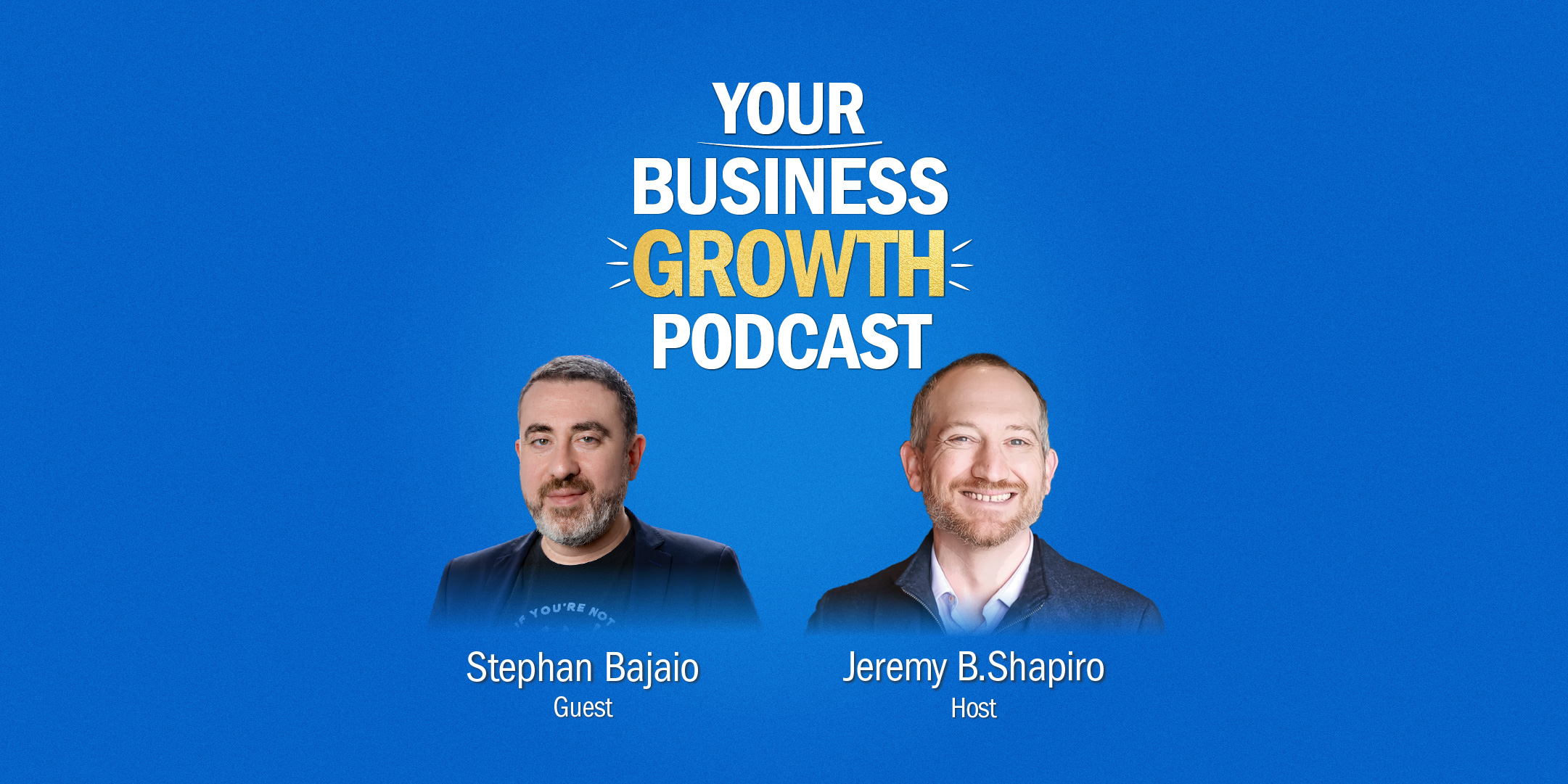
Welcome to today’s episode of Your Business Growth Podcast. I’m your host, Jeremy Shapiro, author of Your Business Growth Playbook, and my guest today is Stephan Bajaio.
About Stephan Bajaio

Stephan Bajaio is the Co-Founder and CEO of VibeLogic, a digital strategy firm helping businesses understand their presence across the modern search and AI landscape. He is widely recognized as one of the original co-founders of Conductor, one of the world’s leading enterprise SEO platforms. Over 14 years, he helped scale Conductor from a scrappy startup into a global organization with over 400 people, Fortune 500 clients, and a $500M valuation.
Throughout his career, Stephan has demonstrated a deep expertise in SaaS, digital marketing, and professional services. He successfully built multiple internal teams, including a professional services organization that grew from zero to 65 global SEO experts. He has navigated high-stakes business transitions, including a sale to WeWork and a subsequent founder-led management buyout that returned the company to independent hands.
With 25 years in the digital marketing industry, Stephan has seen every version of how businesses get found online and what separates those that grow from those that plateau. He most recently served as the CMO at Turno, where he doubled customer acquisition and led a full brand transformation. His current work at VibeLogic combines decades of go-to-market experience with a belief that business performance must start with genuine human connection.
Stephan is an energy-first leader known for galvanizing teams and translating complex vision into actionable traction. His leadership philosophy is deeply rooted in customer-centric innovation, advocating for strategies that anticipate and shape audience needs. He lives in northern New Jersey with his wife and daughter, where he continues to focus on leading with both strategy and soul.
Connect with Stephan Bajaio
Speed Round Answers:
- All In Lead Source: PPC to quickly validate
- Books: Anything by Simon Sinek, especially Leaders Eat Last
- Unlikeliest Mentor: Wil Reynolds (client and friend)
Like This Episode? There’s More!
Subscribe!
Your Business Growth Podcast is available on all major podcast platforms. Subscribe today!
Get the Book!
Pickup the #1 Best Seller, Your Business Growth Playbook today online or at your local bookseller!
Meet Jeremy!
Book your Blueprint Discovery Call with Jeremy today and get back to the growth you deserve!
Stephan Bajaio Episode Transcript
Your business unit there hit this $20 million revenue mark, and growth flattened out We thought people had it more together. Even with the right keywords, people are like, “What do I do now?” They’re left in this cockpit not knowing what any of these dials really mean. Our NPS at the beginning, negative 17.
That’s when we realized we can’t just keep letting them choose what to do. We switched it to a 42 positive NPS by coming with definitive recommendations, and then we held them to account. The actual way you wanted SEO was more culturally than it was strategically, or I should say tactically. You spend over a decade building a global powerhouse that reaches $20 million in annual sales, but then you suddenly find your company unable to grow any further.
The product is world-class, but you realize your customers are struggling to actually get the results they paid for. It’s like you’ve sold a high-performance race car to a teenager with a learner’s permit. Most founders would just try to refine the software or spend more on ads, but today’s guest realized the problem wasn’t the tool, it was the expertise required to drive it.
By completely flipping his delivery model and focusing on building his clients’ internal capabilities, he unlocked a growth engine that added $10 million in new revenue and transformed frustrated users into high-performance advocates. Welcome to today’s episode of Your Business Growth Podcast. I’m your host, Jeremy Shapiro, author of Your Business Growth Playbook, and my guest today is Stephan Bajayo.
Stephan, welcome to the show. Hey, thanks for having me, Jeremy. So I wanna rewind the clock here and talk about when you first got into your business. What sparked this initial idea to build this, like, enterprise platform back when the market barely even knew what SEO or search or any of this kind of stuff was?
It’s a great question because I think it’s where most great business ideas come from. It’s from need, right? So, um, just to rewind the clock, I was at a small company. I’d moved from Yahoo with some of the best folks in my division, actually. So you know, that typical, like, one person goes over to this company you’ve never heard of, and then a bunch of people follow suit, and I was one of the follow suits.
And I went to a company called Link Experts, and what it was was paid link-building, which is a no-no. But at the time, it was very effective, and we were dealing in very high-level relationship link-building. So we were, you know, Forbes and AT&T, right? Marriott. And they were going after, like, you know, iPhone back when…
Now this is dating it, but back when literally they had a lock on iPhone. You could only buy it from AT&T. Um, and, and Marriott was looking to have stuff on, you know, on publishers that were travel blogs. And so we were creating these relationships and placing these links, and people were essentially leasing them on a monthly basis.
Now- The bigger issue there was that all these Fortune 500 internet retailer 1000s, which by the way, I had the privilege of talking to everyone charged with SEO at each one of these companies, and I could feel their pain, right? Each one of them was sitting on his or her own, like, lonely island with one palm tree and, like, a few coconuts, and didn’t know the rest of the world existed.
Like, didn’t know there were other people on other islands. I just happened to be the one who’d call them, and, “Oh, wow,” I’d say this, and I’d learn about SEO, and then I’d talk to the next person, tell them a story, and it would go back and forth. Anyway, so we were delivering to these folks spending upwards of, you know, 20, $30,000 a month and more, um, Excel spreadsheets as reports.
And that was literally, like, tracking the rankings by hand, sort of, and if the URL changed, we had to put a new URL in. It was ridiculous, in all fairness. And, you know, Seth, our original co-founder, kind of looked at this and said, “I mean, what are we kidding here? Like, you’re telling me this is a… We, we got to a million-dollar recurring monthly business, so we were, we were doing good money.
But by year two, it was like, what are we doing? This is a million-dollar business, but we need… SaaS was up and coming, and we’re like, “Why isn’t there a product that does this for those big guys? They have to have a better way to track the effectiveness of what we do, let alone SEO in general. If it’s so important and such a big deal, how come nobody has the software to do it?”
And, and there were little point solutions and whatever, but nothing that was enterprise-grade, right? There was nothing that could really handle, like, the large data and, like, you know, security and all the stuff you had to do in order to build something, like, significant. So we had the clients, we had the luxury of having these Fortune 500 internet retailer 1000 clients.
But we didn’t necessarily have the solution, so we had to build that from literally nothing. So it was a lot of vaporware at the beginning and trying to figure it all out, and then we migrated people over and, and, and started building. I’m not sure if you’re familiar with the book Little Bets. I think it’s Peter Sims.
Um, yeah, it’s, it’s a great book, but it touches on what you were sharing there, this idea that, like, the next billion-dollar idea, right, you can’t discover that from an already established strong market. That usually comes from this little bet that’s an unknown, right? And so when companies, like, I think HP had a mantra for a while of, like, “Look, if it’s not a billion-dollar idea, we don’t wanna talk about it.”
That doesn’t allow for that real innovation, whereas conversely, a company like Amazon, right, that says, “No, you should be experimenting all the time. You should be looking for new ideas, trying things out,” because that’s where we get things like, you know, one-click purchases, right? That’s where we get failed experiments like Amazon Auctions, right?
But at least we’re trying things out, and we don’t know what that next billion-dollar idea will be unless we take that little bet, and you guys did. Yeah, I mean, listen, the pain was palpable. We felt it on the, on the delivery side, and we could tell that the clients felt it on the other side. And, and that was, that was what you really needed, right?
There was clearly a need on both sides of the phone, so, uh, uh, because this is pre Zoom calls and all the stuff we’re on now, right? So yeah, it, it existed and we, we just, you know, we saw that opportunity and took it. So from a differentiation standpoint, and you’re, you’re a marketing guy, like, how did you differentiate this high-end product in this enterprise market when, like, the industry, the space didn’t even really have a name yet?
Like, h- how did, how was that communicated to your prospects? See the long sigh? That long sigh is about 14 years of fighting uphill. I believe, what is it? Is it Sisyphus? What is, what is the, the Greek, uh, mythology of the guy pushing the boulder up the hill? Yeah, that’s definitely Conductor. That’s definitely me.
Uh, that’s definitely a whole bunch of folks there, right? The first thing we were doing, honestly, was- Paid and organic. We were showing that, hey, if you’re willing to spend all this money on paid, which you already were, and people were already spending the dollars in paid, w- we realized, you know, why in the world wouldn’t we also focus on showing them the value from organic side?
So it was a whole educational process. It did require not just selling the value of your product. And at the beginning, we were selling the value of search. We were saying, “Hey, this is a channel. It’s not free.” I– We had to constantly… Oh my God, at the beginning, how many times I had to explain to people that it wasn’t free, that it didn’t just n- Yes, it’s happening naturally, but if you actually want to impact it and change it, you have to do something to it.
And then I had to explain that, you know, SEO was a 401versus paid was day trading, and that, like, you wouldn’t see the results of your 401on a week-to-week basis, so if you were trying to, like, day trade your 401portfolio, good luck. But, like, that this was gonna last longer. You’d have to show them historical of what had gotten them to where they’d gotten to, and then show them where they could go, explain to them the competitive landscape.
There was a lot, you know. Um, you’d be shocked at the number of people that didn’t exist in these organizations to do SEO, and the ones that did were frankly like, “Oh- I hate to say that guy, but it tended to be males ’cause it was a very strange time. Um, “Oh, that guy knows HTML, so here. Website’s yours. You take care of this search engine stuff,” right?
Um, the name didn’t help, by the way. I used to joke it was Stefan’s Employment Opportunities, but, like, search engine optimization made it sound like you were optimizing the search engine, not actually your own content. And for people that didn’t understand, which was, like, every executive, um, you were… It really wasn’t helping.
It wasn’t, uh… There were so many things that were required of it, actually, that were not in your control, that it made it very, very hard. Like, I, I literally had commiseration sessions with multiple clients at the same time. In fact, I started a little conference over it that turned into, later on, thousands of marketers getting together.
But it was usually just to commiserate on, like, “Hey, you know what? I can’t get my… I can’t get anyone to focus on this stuff.” Like, you know, the, the fact that we sold them a product was already a miracle. Like, so weird place, right? One person using a potentially $100,000 plus solution, uh, a year is… I mean, it’s…
You gotta make the case for that. It’s, it’s an uphill battle. Well, y- you talk about, like, this Sisyphean challenge of having to explain this again and again. You know, we talk about, like, the stages of awareness, right? You have, like, the most aware, meaning someone knows your brand, they wanna buy from you, they know what you’ve got, and they’re ready to go is great, right?
But before that, having your product aware, solution aware, problem aware, these are these earlier stages, and the, the further back you go, man, you guys had to do some education, so, so prospects even knew what the problem was. Yes, but there was an advantage to that. So, and I think it needs to be said, right?
I’m, I’m saying it from the woe is me kind of approach because it really was an uphill battle, and we had to teach into the industry. And it actually built my love for the industry to the point that later on in my career at Conductor, I become the chief evangelist, who wasn’t just evangelizing Conductor the platform, but rather search within organizations.
But, um, because I was just… I, I wanted to fight that battle. Um, but when you think about it- We weren’t just selling our platform, we were selling the value of organic, and organic was valuable, still is, right? And, um, and so we kinda had wind at our backs. If not you, then who? Are you okay with the idea that someone else will show up?
When was the last time you searched in Google and there were zero results back, right? Uh, if these terms are worth this much in paid, why would you ignore where most of the clicks are happening, organic? You could show that 85 or 90% of clicks would happen in organic versus paid, and there were stats on that and reports and studies.
So we really were not just selling the platform and the features because in all fairness, like, they wouldn’t know whether this feature or that feature. To your point about the race car, they didn’t know when to shift, how to shift, what button did what, turbo boost. Now I’m talking about like, you know, Night Rider for anyone who knows.
But like, they didn’t know or need as much of that. Even if their one person charged with search did know and need those things, trying to translate that into exec wasn’t really gonna work. Focusing more on the concept of like, what are we trying to accomplish here? Search is important. How are you not going to invest in this channel that brings this much traffic currently to your website?
If it were to disappear, it would hurt you badly, right? We didn’t wanna play the scare tactic. Tried more to use the carrot than the stick, which was like, “Hey, look, other people are doing this. Other people are showing up. Here’s how they’re performing. Are you all right with that happening?” I often like to say ignorance isn’t bliss, it’s your competitor’s market share.
I’m always shocked when like a fort- This happened the other day, and I was like, “Oh!” I’d been saying this one statement, that statement I said, and usually I follow it up with the next sentence, which is, “And you won’t find out about it until they run a Super Bowl ad.” And so I literally had a major public company the other day, their new head of marketing tell me, “Yeah, our competitor ran a Super Bowl ad, and everyone was freaking out here.”
No one knew how that happened. And I’m like, “Because for the last year and a half that I’ve been trying to get into this business and tell you guys, like- Your, your avoidance of the problem was their opportunity. You gave them the opening. They just decided to go after it, and you weren’t there to compete.
It’s that simple, right? And, and that happens so much in this space. So much. That is a, a great little quote, and I love that. It, it combines the carrot and the stick. Um, so le- let’s talk scaling for a second. In these early days, founders love this idea of scale to the moon, right? Not always realistic, not always a great plan, but certainly you proved market fit and you guys grew.
You got to the point you had hundreds of people on the team. You’re working with all these Fortune 500 clients. Like, what was that period like to go from a scrappy startup to established, strong, growing business? Well, what was amazing was- We held our culture. We evolved our culture, obviously, but, like, we held our culture.
It was pretty amazing when you think about it because Link Experts, right, that company that became Conductor, essentially what happened, and this is important to the story, we sold off the people and the product, and about 20 of us remained to move on to Conductor. At that point, the original co-founder, Seth, decided we’re making everyone a co-founder, right?
We all got a a celebratory pin. We got some, you know, token shares of the new company. Uh, and, you know, and Seth was always very people first, and I take after him in that respect. And, um, and you know, we had it in title. Now, most people kind of saw that as a potential ploy to keep you at the company so people wouldn’t go away and so forth.
I leaned in. So I saw that as an opportunity for me, and I’ll get right back to your question in a second. I saw that as an opportunity for me to earn the co-founder title. Like, it actually hung over my head like an apple I couldn’t reach, and everything I did was to justify being a co-founder. Even though I had not fallen into the moment of, I was there at the inception of, and everything I would then do and build from that point was done from the perspective of ownership.
So we had a very owner culture in general. We did– Everyone had shares in the company. We were very much a, um, you know, it was amazing to me that we were able to grow in, let’s say, the first five to six years as much as we did, and ultimately, at, in, in the people sense, and keep the culture. We, we won Crain’s best, best, uh, place to work in New York.
We’d get all these culture awards. We did a lot of things differently. I mean, we were the place that had, you know, the kegs, multiple, with the tap, with the, you know, thing on before it was cool. Uh, we had Razor scooters everywhere in the office. We, uh, you know, we had spray-painted walls. Like, it was, like, we were, we were, we were fun.
We were, we, we were even– Like, we went as far, and this might scare some companies, but we went as far as to have an ethics committee. Our ethics committee would decide whether or not we would or wouldn’t work with particular customers Like we had actual feedback at the time when a lot of their, there was a lot going on politically, and a lot of folks were, were getting upset about companies and who they work with and all this stuff.
And yet we actually built a m- multiple sets of groups that ultimately came together and made decisions on how we would decide and a framework to decide whether or not the companies that we were working with, we would wanna help rank well in Google so that we could sleep better at night. Are you enjoying this episode?
Make sure you hit that subscribe button right now. That’ll help you get more episodes automatically as soon as they come out. So hit that subscribe button right now. And if you have a minute, leave a quick rating and review. That helps support the show. A few really key things there for listeners. One is that even with that dramatic scaling, you intentionally were able to keep that culture, which is not always the case.
Um, second thing, and I love this, is that the team, and you specifically here, really had that ownership mentality, right? And when you bring that to work every day, you’re not looking at the clock trying to punch in, punch out. You are, even just as an employee or team member, running it like it’s your own business with that same passion and ownership.
So that can still stay with scale. And for smaller business owners who are worried about, like, “Yeah, but who’s gonna care about the business as much as I am?” Like, y- team members absolutely can. And the third thing you just shared that I love there, Stefan, is you guys knew who your ICP was, which is good, but you also knew who it was not.
And so you could clearly attract the right clients and repel the ones that you didn’t wanna work with, and that’s a, a good position to be in. I think to the point you just made, it’s, it’s really important to mention, I think part of that is the founder-led aspect, is that it was still founder-led, so we never brought in a new CEO to take over.
Not that I always think the founder should be the CEO. There’s a whole theory on that one that I actually believe otherwise. I think the founder can be more of a change agent in the organization, let someone else deal with all the admin aspect of CEO-ing. But I will say, I will say that one of the things we did incredibly well at Conductor is hiring.
We didn’t just hire great talent, we hired great passion. And I always made it a point on my teams, and I grew teams from zero to 65 and all sorts. I built four or five teams when I was at Conductor. And every time that I was hiring, I wasn’t the person asking the questions about whether they had the skills.
I never asked skill questions. I wanted to know whether or not this person was gonna get excited on Sunday night or have the Sunday night scaries, right? I think that’s the whole reason, by the way, HBO succeeded the way it did is because all of its big shows were on Sunday nights when people were willing to give up one more hour of sleep to a show just to avoid Monday, right?
And so people have that mentality about work. We’ve socialized that as part of the norm, right? Oh, working for the man, and like, oh, another day grinding it out, right? But what if you were actually excited to go to work? What if you enjoyed what you did? What if you were fulfilled by it? What if, what if you felt a sense of ownership, like you said?
So I had this co-founder title, and by the way, I leaned hard. I leaned so hard, in fact, the industry, maybe because I’m Stefan Bajio and he’s Seth the Smartnik, literally felt like I was the owner of this company, and later on more so when I become the, uh, y- the evangelist, right? I am clearly, um, you know, associated as a brand with this, which by the way, talks about the idea of identity as a founder, guys.
That whole concept of like, is the company you or is the company you? And so I was, I was actually just saying this concept to Jeremy earlier. Is it by you, so B-Y, or is it buy you, B-U-Y? The B-U-Y difference is literally the letter U, and it’s you, the individual. If you are what they’re buying, which, uh, there’s a lot of founder-led companies that you buy into the cult of personality, right?
But you don’t get that on the other side, so you get disappointed, right? But there’s also the idea that if everyone who shows up, right, at those sales calls, at the customer service por- portions, that this has this sense of like excitement and enjoyment in what they do Crazy fact, and I, I didn’t even think about it until now.
We had an inordinate number of clients who ended up coming to work for us. Inordinate. Like, like, I can’t even count the number. We’re talking, if I say more than 20, it might have been 40 over the span of 12 to 14 years, if not more. Oh, exactly, and it wasn’t just like we… We weren’t out there poaching them, by the way.
They just saw this thing they wanted to be a part of, and they said, “How the hell do I go over there?” Right? “How do I be part of that?” And, and I think that’s what brought WeWork frankly to buying us, and what’s helped us buy ourselves back and all that good stuff. It was, it was… We were still family business.
Like, that may have been hard in some ways, and we clung onto that, and Seth would probably argue we clung onto it longer than we probably should’ve for numerical reasons. But I would say, as someone who loved and only wants to work in those kind of businesses, uh, because I, I love that human connection. I don’t like when it becomes too corporate.
It’s why I didn’t go with the corporate route anymore. Um, I feel like that’s, that’s a magic there, and you can let people fail, and you can let people be passionate, and you can let people share their experiences and, you know. And, and a great way to measure that by the way, cultural dipstick if you wanna know, go look at how a company runs its town hall.
Go look at how a company runs its town hall. It will tell you so much about what kind of culture they have Is it a celebration? Who do they bring to the surface? Do they talk about their new employees? Do they celebrate anniversaries? Do you sit on the call for five minutes waiting for it to start in silence?
Like, are decks prepared and they look nice, and it looks like people took the time to put some thought into this sort of stuff? How much do they communicate? Are they transparent or very l- you know, behind the vest? Uh, you know, is it meant to be informational or is it meant to be a conversation? In which case, like, are you taking questions?
What’s the follow-up like? These are all things that are amazing, undervalued dipsticks to understanding the, the, the true, I guess, culture and build of a company. Yeah, what I’m, what I’m hearing you say here is, uh, you’ve touched on culture a few points here, but it says so much about a company. Um, not just in terms of how the culture sticks as you scale, but what that culture is.
And I forget where I got this quote, but I loved it about culture. This idea that if you don’t create a culture, it doesn’t mean it’s not there. It’s just being established by the status quo. It’s whatever is currently going on in the company. So you can either be intentional about it, right? Hire, manage, and fire by it, or you can let it just evolve and be its own thing.
And given those options, it’s often better to figure out what you want that culture to be. Culture’s gonna happen. Culture’s gonna happen. Yeah. Culture’s gonna happen. It is gonna happen, right? Whether you like it or not, it’s going to happen, so you can either be driving it or you can be at the mercy of it sometimes, and that’s not always great.
No, uh, because it’s, like you said, it’s gonna happen. Now, I also wanna share for our audience here this idea of, you know, a lot of the happiest business owners I know of, it’s not them running everything. That’s usually the stressed out, burnt out business owner. The happiest and most successful, I would say, are the ones that have passionate team in place.
Um, I know for me, when I, when I have a number two running one of my businesses and they run it like an owner, right? Like it’s their own business. It’s good for the business, it’s good for me, it’s good for them. Everyone’s happy, right? So for our listeners who might feel stuck in their business, like, “Oh my gosh, it all falls on my shoulders,” like, no, you absolutely can hire folks who are just as, if not more passionate than you are in your business with that same sense of ownership.
That is possible. I’ve said this in interviews and people have– My current head of operations even said this was, like, the, the, the line that landed the most with her, and I promise you it was done in the most professional manner. But- I want you to think about me in the shower. Now, I don’t mean that as in I literally want you to think about me in the shower.
I mean, when you’re at your most relaxed and you’re not stressed. It’s not because of, “Oh, anxiety is getting me, and I don’t wanna think of…” I want you to not be able to help yourself because just like a founder, these thoughts, they’re not considered work. They’re just considered, like, what you do and what you enjoy, so when they come to you at sometimes driving or a shower, that’s where I get my best thoughts, you’re excited.
And, and, and they empower you, and, and you think, like, you just wanna grab the phone and call someone and be like, “Hey, I know it’s, like, 10:00 at night, but I’m so excited about this idea. Can we hop on a call?” Like, and text them, and, like, that’s… I love that. Honestly, I miss that to some degree now as I build out my own organization.
When you touched on that word before, the Sunday scaries, that was a relatively new term to me that I had not heard before. My favorite day of the week has always been Monday. I’ve always loved Mondays. Uh, and I’m that kind of business owner, like, you know, I know many folks are. You wake up and you’re excited.
You have an idea. You wanna get working on something. You’re, you know, that free time, like you said, that’s where your mind goes because you’re excited about it and you love it, and that’s, that’s not a bad thing, right? What you do with it is a different story. Yeah, and, and to your point, who does it is also important.
If you don’t give yourself the freedom of that, which, by the way, that’s to Jeremy’s point ear- earlier, which I think is just spot on. Um, if you can founder your way out of the founder position, I know that’s a weird thing to say, but if you can go be your head of strategy, go be the one who’s… You know, they say work on the business, not in the business, right?
This is a little bit of, like, work in the business on the business, right? And on your business. The things you enjoy the most, the things you get the most dopamine out of. I don’t know anyone, and maybe there are some people that get up in the morning and go, “I’m gonna worry about headcount today. I’m gonna worry about payroll.
I’m gonna worry about all the things, the stressors of the market.” I, I, I get zero dopamine out of that. If someone else wants to come take that off my plate- Here you go, right? But I wanna be able to go in and say, “Oh, wow, how come we’re not doing this? And what if we did this differently?” And, “Oh, wow, look, these reports could actually be a product,” right?
That’s literally how Conductor started. So you, you have to be aware enough and in it enough to know what’s going on and be a part of it and, like, get your hands in the mud in order to build the sculpture, right? And, and that’s, if you’re not in that and you’re gonna ivory tower it, that’s fine. Some people wanna do that, and all good.
Personally, I didn’t get into the business to just, like, sit over here and watch it get, watch it happen. That’s more of an investor. I, I’m not an investor. I’m, I’m an entrepreneur. I want to try things. Like Jeremy said, I get excited. I want us to work on things and see what happens. There’s different archetypes, right?
So, um, what you’re talking about and I love is that visionary role, right? And that is powerful, and that is good to have. There’s also many entrepreneurs, these are more like your technical founders, right? They’re the inventor. They wanna tinker in a garage. They absolutely don’t wanna be doing these other parts of the business.
But those businesses rarely grow unless you have someone in there who gets excited about actually selling the thing, right? So there’s all these different archetypes. There’s no right or wrong, but there is balance we need to be aware of. I’m laugh- Guys, I said that because obviously the organization I started now is called Vibe Logic, but it’s that idea of the art and the science, the, the, that you need a balance of both.
SEO definitely needs that, so that was the driving force behind it, but I’ve realized more and more business needs that, right? Culture needs that. You need the, the, the, the logistics of the do and the, and the creativity, uh, of the vision in order to do anything, right? And, and you really just… And people do fall more on one side or the other of that, of that seesaw.
And there’s not a, again, not a right or wrong, but knowing where you are and how to balance it i- is important. So, all right, Stefan, I, I wanna fast-forward here in your journey a bit. You guys grew this business. Um, your business unit there hit this $20 million revenue mark, and growth flattened out.
Customers saw this race car, sophisticated tool you guys had, but implementation was often the challenge. And this, this comes up oftentimes in higher end product businesses, whether physical, soft, et cetera, um, where implementation becomes the issue here, right? They can get a great result, but they gotta do it.
So what happened in the business when you hit that plateau and you had that realization you’ve got this race car of a product, the Ferrari, right, and the clients couldn’t use it? W- what did you shift? What did you do differently? What was that moment like? Yeah, I think that was, you know, a, a SaaS model That doesn’t, that goes one year isn’t much of anything, right?
That’s, that’s a movement of cash from one account to another, but it doesn’t build valuation. So you have to build something that’s gonna be repetitive and something that’s gonna actually have some legs. The problem was we were breaking ground every single time we were deploying this. This wasn’t a replacement technology.
We weren’t coming in and replacing anyone. We were setting the stage for something net new. Now, the first thing that happened was we came to terms with the idea that, like, we thought people had it more together. We thought these folks would know what keywords they wanted to track and what they want to put into the system because, unfortunately, our system is crap in, crap out.
We weren’t doing it for you. The funny part is, I, I turned to, to Seth, our original co-founder, and said, “Listen, I, I, I think we need to create something called acceleration.” And it was meant to accelerate people into using the product better. So literally with two folks straight, almost straight out of school, maybe one job out of college, we started keyword discovery, and we just started researching keywords that would be relevant for these businesses.
And it was an add-on price, right? And we would, we would just say, “Hey, do you want us to choose the keywords we think are most relevant for you to put into the product?” And 87% in the first quarter signed up. So immediately they were like, “Okay, listen, you know what? We gotta make this part of our onboarding process.
Like, this is crazy. Like, we’ll just tack on the price into the, into the cost of setup and, you know, we’ll just do it that way,” right? So we definitely hit a nerve, and that was great. But then what we had found was even with the right keywords, people were like, “What do I do now?” Now, the problem you have with a product that is incredibly elastic is it can be used in many, many different ways.
And if you don’t f- force the user and say, “It’s gotta be done A, B, C, D or one, two, three, four in your process,” you leave it to them to decide. And a lot of the time they’re left in this cockpit not knowing what any of these dials really mean. And you can take your customer success, and you can try and teach them, and you can do that stuff.
And by the way, if you ever do that, the only way you train is have the person on the other side driving. Literally, you have them go and move the mouse as you talk them through it. There’s muscle memory to it. It’s very important in SaaS, trust me. You going for an hour moving your mouse and then hoping they remember or sending them now some Loom after the fact, mm, not really helpful.
So We end up in this situation where we’re like, “Okay, this isn’t working.” The product s- has a bunch of stuff that needs to get fixed. We have tech debt. Like, we definitely need to, to, to get it together. Um, we’ve got lots of features, and we’ve tried lots of things to get people adopted, but, like, it feels like we’re gonna have to do some driving for them.
So at first, we start managed services, and, you know, I hire some really good SEOs, and we start this group. This group would later, four years later, be, like, 65 people globally. It became a really big team. Um, and I’ll tell you a little story afterwards that was kind of my, like, moment of coup de gr- grass, so to speak.
But, um, I… We built the team out, and we started managed services, and I had all these smart SEOs going with these really big companies, and they would get on the call and say, “Okay, guys, so what are you trying to accomplish? What are you guys doing today?” And it was right intention, wrong delivery. What would happen was they didn’t want that.
They wanted to be told what to do. They wanted that as part of what they, they felt, right? We wanna be careful ’cause if we were the only ones using the product… But first we had to show them what using the product meant and what the outcome looked like. Like, “If you guys go do this on your website, here are the things you can see, and here’s how it affects it.”
Our NPS at the beginning, negative 17 Yeah. That’s when we realized, ooh, something’s wrong here. We can’t just keep letting them choose what to do. Most of these folks, exceptions here and there are some really smart SEOs on the other side of the table, but again, most of the time these people were not amazing SEOs, they fell into the role.
There wasn’t thousands of SEOs to take these jobs. So when they were in that position, they were like, “Save me. Help me. I don’t know how to do this,” right? “And we, we signed up for this product and now I, I have this big number on my head.” We gotta go after it. So we switched it to a 42 positive NPS by coming with definitive things we would do, definitive recommendations.
Um, content recommendations, technical recommendations, strategy recommendations, and then we held them to account. We held a, an implementation-to-recommendation ratio so that they would literally know, are you on track? If not, what’s stopping you? Because those obstacles, 9 times out of 10 were not in their own control.
They were either the content team or the dev team or the executive team or the rest of the marketing team. So we had to have some number we could bring back and say, “Hey, guys,” to the rest of the org, “This isn’t a one-person thing. I understand you thought it was.” A race car can go around the track maybe once or twice.
If you go down, if this was a drag race, it’d be a different story, but it’s not. It’s multiple loops, and if we don’t have a pit crew here to help manage and race together, it doesn’t matter how good your driver is. You could literally be the greatest driver to ever set pedal to the metal, and you are not gonna win.
You’re not gonna win. You’re not set up to win. No one is switching the tires, no one’s gassing the car, no one’s cleaning the windshield. Like, you need to come together as a team, and that was the next evolution of Conductor, and it was also the next evolution of SEO. We started pushing that search was a culture and not a role, and that changed the dynamics of the way the product should be used.
Hey, why aren’t we making it so the writers have access? Hey, why aren’t we making it so the devs have access? Hey, why aren’t we creating workspaces for each one so that they can actually start seeing stuff that matters to them? Why isn’t the executive in here looking at this stuff at a high level, right?
We changed the dynamics of what we were selling because we realized that the actual way you wanted SEO was more culturally than it was strategically, or I should say tactically. So y- you could have all the right answers, the answer to the algorithm, but it wouldn’t matter because in most companies, even today, especially big ones- They are their worst enemy.
They are their biggest competitor. They keep thinking it’s out there on the web. It’s not. It’s the dysfunction within your marketing department that 9 times out of 10 is stopping you from being successful. Yeah, I wanna highlight something really important you touched on there, Stefan, as well, which is that the result at the end of the day for any of our clients i- is what they care about.
Your product is like the what, right? But if they don’t use it, they’re not gonna get the result. And you know how to use it, you know how to get them the result. And so one of the things I often talk about is you can have like the DIY model where you give someone the software, the self-onboarding. You know, they can go use it and get a result maybe if they use it, right?
They can get the book, read the book, implement it if they get around to it and so forth, right? Or you can move up that tiering To a done with you, right? This is usually more coaching and consultative. Or at a highest level, a done for you, which is like, “Look, let’s, let us just get the result for you,” right?
Because all three of those are helping someone to get a result, but with varying degrees of hands-on. And so I, I really like that you guys shifted from just being a product and a thing to helping them to really get the result, which is obviously far more valuable. By the way, you just made me think of one quick thing, Jeremy, which was we also started creating what we called enablement services, and the way that we even pitched managed services was we are a set of training wheels.
We do not intend on being your agency. We weren’t in the model to compete with agencies. We didn’t want that. In fact, if you’re a SaaS software, there’s some rule somewhere defined by someone who I don’t know, that I was told one time your revenue driven out of the professional services team should not be more than 13% of total revenue, or else now all of a sudden we’re starting to reduce the valuation of the organization.
Whatever. The point simply is we actually said, “Okay, well, we’ll come in and, for a fee, we’ll go on site and train the content people. We’ll train the devs. We’ll have… We’ll do the, the, uh, the brown bag lunches and explain why search matters and help this person evangelize search.” Because at that point, right, step one was to get an SEO in place so that a product would get built.
Step two was to democratize the data in a way that allowed more users to be available to it, so the product’s value could now be decentralized. And the more you do that, the more you move towards a Salesforce model, which is more of a critical infrastructure that has its hooks throughout the organization.
And honestly, the only way it was gonna work for them anyway was for that to happen internally, and that would never happen naturally. It had to be driven by something and someone who had a reason to do it. And unfortunately, the SEOs, as much as I love them, they were, A, not the best evangelists, and B, they were too focused on trying to get their own world in order than to think about bigger than their own lane, and that’s where, you know, we came in very often.
And that’s why evangelism ended up being something I fell into and, and, and grew as a practice because I was tired of, you know, I wanted to call it what it was. I’m here to tell you that organic data is worth a lot more to your company than a channel, and that you need to start thinking about it in your product naming conventions and throughout your marketing, throughout legal, HR.
I was able to find lots of examples of how that works, um, and, and kind of diversify the value so people understood what was really at stake here, and that the learning opportunity was huge This was an audience intent understanding. Like, no one lies to their search bar. They’re putting stuff in there they wouldn’t share with their spouse, their best friend, their rabbi.
Like, they’re putting their thoughts and needs and wants in this box, and then businesses are like, “The only thing we do is try to own that as, like, an answer”? That’s a little bit- infantile in all fairness, and it’s a bit navel-gazing. You are probably not the answer to everything, but you know what? And this is where what Vibe Logic does, Web Presence Intelligence, which is, uh, ’cause we needed another acronym in the world, we look at what else is showing up in order to figure out where to place your bets, where to start getting into a conversation.
You cannot be the answer to everything, but you can be aware of where the conversations are happening and then infuse yourself into those conversations. Unfortunately, that’s a multi-channel kind of approach, so it doesn’t happen naturally, just like SEO didn’t evolve culturally naturally. But once you do that, your organization kind of like realizes that, like, publishers are important, and PR probably doesn’t know who wrote this article that’s showing up frequently in the LLMs and in the search engines about a topic that we would want to show up for.
And, uh, oh yeah, there’s a partner here. Has anyone in the partnerships team even known about this company and thought to partner with them? Did anyone even realize that there’s a Reddit thread here with a conversation? Where’s our subject matter expert to go talk? Don’t sell, provide value. Like, why aren’t we in this conversation?
Again, that doesn’t happen naturally because our marketing departments are siloed, our businesses are siloed, and this is why an enterprise moves like a cruise ship and a smaller startup needs to remember to move like a speedboat. You have the advantage of size and speed and decision-making. Do not get caught up trying to replicate what the big boats do.
17 people to make you turn port or starboard is not helpful, okay? It’s, it’s hindering. I’ll often see, like, six-figure business owners talking to an eight-figure business owner sharing really good strategies of wor- of what works at their scale. Those strategies are not to be used in a six-figure business, right?
Just because it works and it’s helping them, what you want is the advice that applies to a business your size in the state you’re in, so. How you can take that, that knowledge and put it into your world, right? Sometimes you can translate that, but, like, if, if you’re talking about operationalizing, you know, an eight-figure business, like, that is often something that a six-figure business is not working on just yet.
So, all right, um, I wanna just recap for our listeners here an important piece that, uh, one of the big levers you guys pulled is you added this professional services piece on, right? Which was powerful ’cause not only did that let you get additional revenue from existing customers, this also lets you close more deals and also at a higher price point, so it was a huge win all, all around.
Now, adding this specific strategy on, the managed services component here, um, was now new revenue, which is huge, and that got you guys up to that $50 million mark? Yeah, I mean, I wouldn’t say it was just that, but yes. I mean, it definitely put us on the road to getting there, and again, it was a unique value proposition we could bring to the table.
And I think because we were being very transparent and not trying to sell you, “Hey, listen, if you wanna continue on with us, that’s fine, but my intention is not to be your agency.” We were very open and honest about that, so people didn’t see that expenditure as something they had to continually do, right?
So it was a way in, it was a way to get their feet under them. It was a way to augment a team that needed help, but ultimately it wasn’t meant to be a forever thing. Some people did treat it that way, but that was the few and far between. So yeah, it really did allow for us to, to get in and start growing the concepts that we needed to educate.
They paid us to educate them, which was kind of great. Well, it’s a win though, because they’re able to use that education now to get that result they want, and oftentimes the best education is worth investing in. So speaking of, you know, that, that, the wisdom there, right? Sometimes founders are in this spot where, like, they’ve had past successes and there’s, like, a playbook they’ve used, but they have some different new vision, right?
Like, what’s advice you’d have for a founder who’s hiding behind those past successes and they’re afraid to sell that new vision and be that evangelist for this, this new idea or thought that they have? Ooh, that one touches close to home. Uh, I would say, um, one is Recognize that identity crisis that you might be going through, right?
Which is, and I went through this definitely after leaving Conductor, which was, you know, am I the Conductor co-founder? Am I, uh, who really am I? I became a CMO for a little while. Am I a CMO? Is that what I’m supposed to be? And once you, once you kind of circle around the point, I think it’s bring it back to the passion.
So if you’re passionate about what your company is, then you can share that passion and it will be palpable. What I have never understood is when, and I, I, this is like my biggest pet peeve, a salesperson will be on a sales call and they sigh. I don’t even know how to deal with that. Like, I have been so angry getting off calls.
I won’t say anything directly to them, ’cause I don’t wanna lambast them for, they could just be tired, right? But y- you can see when someone has passion. If y’all haven’t realized how much passion I have around search and SaaS and whatever, then I really didn’t show up today. But I tend to show up even when I’m feeling sick, even when I’m down, even when I’m depressed, even when I’m, even when the world is freaking falling.
If you can get on a podcast and talk about your favorite thing, if you can talk about your passions, if you can do that, that carries, and that’s something that I think people forget, and they try and use a playbook, a previous thing that worked in a context in particular. Listen, it was an embarrassment of riches at Conductor, okay?
I had a sales team that would bring me the biggest names that they had already done the biz dev on, had the discovery call with, and brought them primed and ready to have a conversation about what search, how search mattered to them and what they could do. Have us look at their site and find fun things they could change and do that, it was fun to us, that could move the needle, right?
That was awesome. Now, gotta fight for attention. Very different world, right? Very different world. So the point is, don’t use the situation or the playbook in the same way, but, and this is a big but, huge but You should try to memorialize as much of the things that were a part of the success of your previous endeavor as actual widgets almost In a document.
Case in point, how to do a town hall. I am 47 years old. I have, this is humble brag, I forget and only recently have come to the terms of my gray hairs and realized that I’ve forgotten more marketing than many people know, right? I’ve forgotten more culture building than many people know. So for me, it’s like a, it’s like a, a, a forgotten thing that a town hall should have all of these things to it, right?
Yet there’s a company out there that doesn’t have the foggiest notion of how that can impact their culture, right? That is a small essence of something I did along the way, but it was, it was foundational to help build other companies, the company I was CMO at, all that stuff. Like, it was palpable. It made a difference.
It was huge. But again, these little things, these things along the way. So I’d say most of us don’t sit there and do that reflection. Take the time, even I’ve even considered going back to friends at Conductor and so forth and kind of having, like, a jam session. Do you remember when? Play the Drew … ‘Cause 14 years in, there was a lot of stories.
There’s a lot of stuff, right? A lot of things that went right, wrong, and in between. The more you can capture those little things and think through them and kind of memorialize them, the more you can even turn them into value proposition. I took that culture thing, by the way, for the town hall. I took a bunch of that, I went to Claude, and I started building a calculator from corporate to people first, and depending on how you
‘Cause I knew if I wrote the blog, no executive’s gonna read it. So I turned that blog concept into something interactive, because I know that if I now share that with an executive, they’re far more likely, you know, unfortunately they’ll be like, “Oh, I guess he just did it all in, you know, in AI. It must be…”
No, no. It’s my insights framed in a way that I don’t know how to code, so I did it this way, that now allows you to use this in a way that can help you provide a better solution. So all of that wisdom sits in every single one of the founders that are in second, second mission, or we’ll say second bite, whatever.
Um, your second bite at the apple, I guarantee you, you have those wisdom pieces and those nuggets in you. You just have not archived or, or created, um, you know, some context around them that you can literally build off of. Go do that. It’ll probably be the best weekend spend of time you’ve done. The takeaway I’m hearing there as well is, you know, document, right?
Diary, journal, capture in some way. I, I know many people who’ve taken their years or decades of journal and shared it with their AI platform of choice and asked for some of the recaps and takeaways and, you know, lessons learned and all, and it’s there, but even just reading back through your own words in a physical paper jour- paper journal is a powerful thing.
1,000%. I wish I’d, I wish I had done more of that, and also as a hiring practice, what I try to tell people, and don’t be scared of this, you really should do it, tell your folks to update their resumes, not in bullet points, but in actual paragraphs. Because a quarter moves pretty q- f- fast, and especially at a smaller company.
One year is really three, right? So my, my tenure at Conductor was, like, 30 years or more, right? Even though I spent 14. It was actually more like 45 years i- in, in other companies’ worlds, because we were moving fast, and Q1 by Q4 was a, an eternity ago, right? So capture that stuff, not because they’re looking for another job, but because there’s value to that, to that knowledge, to be a- able to look back and recognize what you did right, what you did wrong, and, and, and how you got to where you got to.
And I, I’ll share a, a variation of that, too, as well, Stefan. That, um, when I meet with business owners, you know, I run mastermind groups and get business owners together on a regular basis, and one of the things we talk about is, like, you know, “Hey, what are the big accomplishments and wins over the past month?”
Because as entrepreneurs, we always see the mountain in front of us of things we still have to do that can feel overwhelming. We don’t take the time to look back and see what did we actually accomplish, and there’s so many great wins. And then to be around other folks who can celebrate that with you and acknowledge the hard work you’ve done is powerful.
And then I actually capture those down, and so we have this wonderful, you know, record of all these big wins for you individually. By the way, side note, have you heard that story of the two climbers for Kilimanjaro? I’ll do it as fast as possible. Uh, you can. I’ve climbed Kilimanjaro, so now I wanna hear this.
So then you know this. Okay, so two… This is a supposed story. I don’t know how real it is, but it sounds great, and actually it tells the fable, so to speak, that you should take away, right? Which is two, two folks, m- two, two men meet each other at the training for Kilimanjaro. It takes how many days to summit, two or three?
Worst case, on the Coca-Cola route, you’re on a four-day journey. Uh, you can also take, you know, more. Okay. So basically what happens is they both learn together. They’re both, you know, a bunch of scientists are watching them supposedly, and, um, and they have all the same capabilities. Same knowledge, same thing.
They decide they wanna climb together. Great, so they go off climbing. There’s climber A, climber B. Now, they get to base camp one at end of first day, I think it is, and they l- and they, one of them is ecstatic. Climber A is so stoked to summit, and climber B wants to give up, but yet they have the same exact experience, right?
So why? What is the moment that changes the dynamic there? And it’s said that it’s a micro moment. It’s said that climber A looked over, back over his shoulder, recognized everything he’d had to overcome to get to where he got to, and then looked at the future, the mountaintop, with exhilaration because it was now something It was not seen as an obstacle.
It was seen as something that he had already, to some degree, conquered and could now conquer more. Versus the opposite happened with climber B, which was really just saw the summit, then looked back and didn’t recognize, you know, only saw the problems ahead of him that he had had to overcome to get to where he got to.
So as real or as fake as that is, it, it’s meant to just bring to bear the idea that reflection is key, and the more you can build that into your model… By the way, companies don’t do this either. I, I, I’m shocked that there’s no historian in companies, and maybe now there should be products that do that.
But like the tribal knowledge that gets built in companies so that generation two and three and four don’t replicate what the, the mistakes of generation one, and you only have one founder or someone who’s been there the whole time who’s trying to say, “Don’t do that. We’ve done that before.” Or maybe they’re unaware of that and they can’t be in every room and every conversation.
It’s an exact example of like the more we can memorialize and recognize, the more we can be excited about where we’re going and celebrate what we’ve accomplished. There’s so much knowledge there, and I think what you’re touching on there with that, the mountain climbing, um, parable i- is this idea of framing, right?
And so there’s a framing I love in business. Um, some business owners wake up to face the day with dread of all the challenges and fires in front of them, right? And that’s a solvable problem, right? Whereas the framing I love is how lucky are we that we get to play this great game of business. And in any game, right, there’s challenges, there’s pitfalls, there’s setbacks, there’s don’t pass go, there’s all these things, but that’s just part of the game, and that’s okay.
We can’t expect all green lights and all successes. And with that framing, it’s a game. You win, you lose, you adjust, you course correct, you modify strategy. You can be far more excited about playing a thing you love to play. So, all right, Stefan, we’ve gotta wrap up. Before we do, a few quick rapid-fire questions, um, that I’d love your thoughts on in like, you know, a few words.
If you had to start all over again from scratch, what one lead source would you go all in on? Depends on the market I, it really depends on the market. Like, I can’t tell you that this one thing will win. Um, I, I think things are very noisy right now. It’s very hard to know which, which lead source I would choose.
I would try to diversify as much as possible till I could figure out which lead source was the best. Smart. So apply a, a research approach to the current market for the model and figure it out. Paid is the easy execution to that answer because it can be the canary in the coalmine to quickly figure out whether or not something’s gonna convert or not.
And then once you have that knowledge, you can use a better channel that’ll give you better ROI. Got it. Pay to validate. I like that. All right. Um, aside from, of course, your Business Growth Playbook, uh, your top favorite business books. Now you’re, you’re calling out my illiteracy, so that’s gonna be a little tough there.
I don’t read as much as I should. I love anything by Simon Sinek, so everything Simon Sinek kind of does, and that’s more, it’s a combination. I don’t know if we’d say it’s just business. It’s much more personal. But I will rewatch, um, this one video every single year. Um, I think it’s Great Leaders Eat Last, I believe it is.
Look that up. It’s, uh, a 99U, uh, 45-minute talk he did on that that talks about leadership. I, I, I, I constantly rewatch it every year as almost like a, a revisitation of, because I just think it grounds me as a leader and it’s very important. Beautiful. All right. And we always, you know, think about mentors and who’s mentored us, but sometimes we get unlikely mentors.
Who would you say was one of your unlikeliest mentors? I think one of my unlikeliest mentors was probably the owner of an agency that we worked with. At first they were a client. And, uh, Will Reynolds, if you don’t know him, Will with one L, Reynolds, uh, Seer Interactive out of Philadelphia, probably one of the best humans I think I’ve ever met in my life.
Like, literally, genuinely, one of the best people inside and outside of work. He’s built a, you know, I don’t know how many, maybe a $50 million agency, um, in search and paid and so forth. But just he has accomplished all the things I wish I could. Let’s put it to you that way. And, and he has done it with a sense of humbleness and a sense of, um A sense of desire to want to help that is just something I, I admire, and I think I’ll, I’ll always admire.
I’m lucky enough to call him a friend, but I just… Yeah, he is, uh, someone who blows my mind. You should all watch and listen to his stuff. It’s just awesome. Love it. So to recap for our listeners, you moved from leading a global software firm that hit a major revenue plateau to a strategic pivot that prioritized managed services and client education, allowing you to add $10 million in revenue, and ultimately scale past that half billion dollar valuation.
For our listeners who wanna learn more about you, where should they go right now? Uh, definitely LinkedIn, as long as you’re not gonna sell me something. So Stephan Bajajo at LinkedIn or on LinkedIn, it’s literally the name. You can look me up in Google obviously, and you’ll see my personal websites and so forth, or vibelogic.com.
That’s another place. Feel free to reach out there. I am very interested in helping people. I, I often wear a T-shirt that says, “If you’re not helping people, you’re just selling stuff.” That’s not verbatim. So, uh, reach out. More than happy if I have the time to consult and give you ideas and so forth. It scratches the dopamine in my brain.
Fantastic. This was wonderful. Thank you for sharing so much of your journey and your wisdom learned along the way. Um, we could talk for hours more about so many of these great stories and adventures, um, but this is a wonderful, I think, uh, bite-size view of some of the powerful lessons learned, uh, especially around that pivot that you made in your business, and I appreciate you sharing that.
Thank you for having me, Jeremy. This was awesome. Thanks so much for listening. Quick reminder, hit that subscribe button right now so you can get more episodes when they come out automatically, and remember to leave that rating and review right now.
Like This Episode? There’s More!
Subscribe!
Your Business Growth Podcast is available on all major podcast platforms. Subscribe today!
Get the Book!
Pickup the #1 Best Seller, Your Business Growth Playbook today online or at your local bookseller!
Meet Jeremy!
Book your Blueprint Discovery Call with Jeremy today and get back to the growth you deserve!