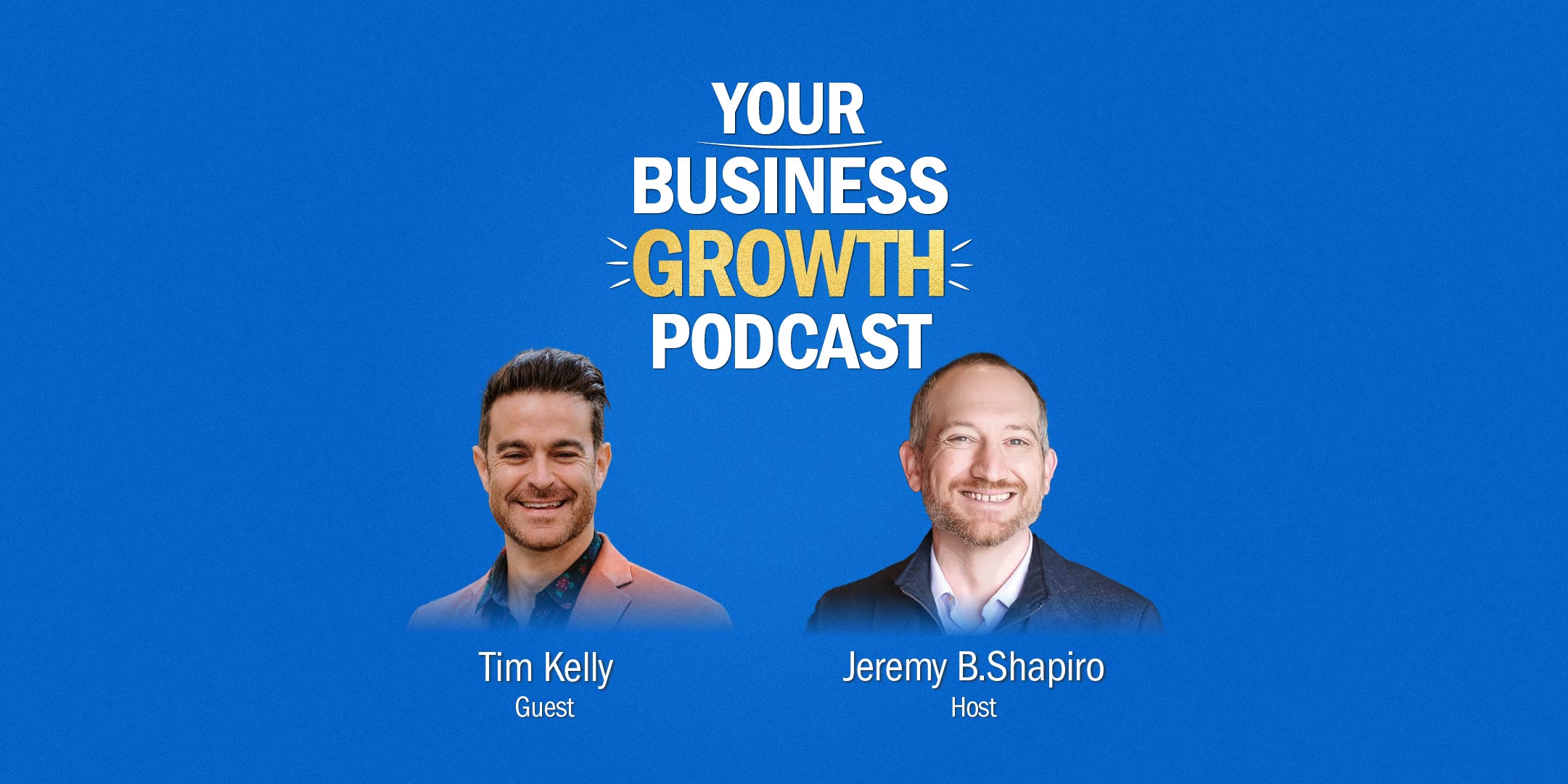
What happens when a team of high-achieving founders builds a multi-million dollar business, only to watch growth grind to a halt because they’re spread across four different companies at once?
Our guest today helped build Active Duty Passive Income into a premier real estate education platform for military veterans, but as they added a mortgage brokerage, insurance agency, and investment fund, their focus fractured and revenue plateaued.
At the same time, transitioning out of the military led him into a personal crisis of identity and mental health that forced him to confront the dark side of sudden freedom.
After recovering and returning to the helm, he made three critical changes that skyrocketed the company by more than 10x into an eight-figure powerhouse – all without adding additional sales channels.
Welcome to today’s episode of Your Business Growth Podcast. I’m your host, Jeremy Shapiro, author of Your Business Growth Playbook, and my guest today is Tim Kelly.
About Tim Kelly

Tim Kelly is a founding leader at Active Duty Passive Income (ADPI), a Certified High Performance Coach, seasoned real estate investor, and former active-duty military service member.
Through ADPI, he has helped thousands of military members and veterans achieve financial freedom by investing in residential and commercial real estate. After overcoming a severe growth plateau and a personal identity crisis following his transition out of active duty, Tim helped lead a strategic pivot, narrowing ADPI’s core focus, and bringing in an external sales organization that scaled the company by more than 10X into an eight-figure business.
Today, Tim serves on the board at ADPI and provides elite 1-on-1 coaching and small-group retreats for CEOs, entrepreneurs, and high achievers. His coaching framework combines military discipline, strategic real estate investing, and mindset optimization to help leaders master decision-making and build sustainable momentum. He is also the author of an upcoming book focusing on identity, mindset, and the principle that “with freedom comes responsibility.”
Connect with Tim Kelly
Speed Round Answers:
- All In Lead Source: Speaking
- Books: How to Win Friends and Influence People by Dale Carnegie, The Masculine in Relationships by GS Youngblood, andWild at Heart by John Eldredge
- Unlikeliest Mentor: Jesus
Like This Episode? There’s More!
Subscribe!
Your Business Growth Podcast is available on all major podcast platforms. Subscribe today!
Get the Book!
Pickup the #1 Best Seller, Your Business Growth Playbook today online or at your local bookseller!
Meet Jeremy!
Book your Blueprint Discovery Call with Jeremy today and get back to the growth you deserve!
Tim Kelly Episode Transcript
I got out. Dude, I had that level of freedom that I never thought I would. I did not have the level of responsibility or discipline to handle the freedom and steward that freedom that God gave me, so he took it all away from me, man. I went into a very dark place. What happens when a team of high-achieving founders builds a multi-million dollar business only to watch growth grind to a halt because they’re spread across four different companies at once?
Our guest today helped build Active Duty Passive Income into a premier real estate education platform for military veterans. But as they added mortgage brokerage, insurance agency, and investment fund, their focus fractured and revenue plateaued. At the same time, transitioning out of the military led him to a personal crisis of identity and mental health that forced him to confront the dark side of sudden freedom.
After recovering and returning to the helm, he made three critical changes that skyrocketed the company by more than 10X into an eight-figure powerhouse, all without adding additional sales channels Welcome to today’s episode of your Business Growth podcast. I’m Jeremy Shapiro, author of Your Business Growth Playbook, and my guest today is Tim Kelly.
Tim, welcome to the show. Jeremy, what’s going on, my man? Really been looking forward to our, our conversation, brother. Thanks so much for having me. Yeah. I am delighted to dig into this. In doing all my background research and prep for this, it is an incredible growth journey you’ve had, personally and of course, you know, professionally.
And I wanna go back to sort of the beginning on the business side for our listeners. You know, how did you transition just coming out of the military and getting into this whole world of business and starting Active Duty Passive Income? Yeah, man. So, you know, in the United States Navy, in the back of my mind I knew I didn’t wanna do 20 years, but it really hit me when it…
I was around 10, my 10-year mark, and I just got off this long deployment. And Jeremy, I got off this long deployment, I was like, “Dude, I don’t know if I can do another 10 years of deploying and leaving my family. I’m trying to start a family, like, just to get this pension.” And so that’s when I got the real estate investing bug because I used my VA loan to buy a home a few years before that.
It turned into a house hack and a live-in flip, and I’m like, it, like, planted a seed. And so when I was in this predicament I was like, “Dude, I gotta figure something else out.” My mind ru- went right to real estate investing. I just immersed myself in how I… You know, how do people actually make money in real estate?
So the books, the podcasts. I had spent some money on courses and education and coaching. I went right into apartment complexes and mobile home park investing while I was active duty, and I saw where that was going and I saw, like, what the potential was. And then so I just, I leaned in and started partnering on apartment complexes and mobile home parks and through joint ventures and syndications.
And then I connected with a few other service members who were also in real estate building and also were passionate about helping other service members and their families. And we… Then that’s when I was on a podcast sharing my story, and the founder and co-founder of Active Duty Passive Income heard me on that podcast.
We immediately connected. That was back in 2018, and I’ve been part of the, the Active Duty Passive Income leadership team. Now I’m a co-own- uh, a member of the board, and we definitely scaled it. But there was a lot of ups and downs, so that’s sort of how I got that connection. And then, like, a few years later of us building the community, building my portfolio, still active duty, I’m like, “All right, 15 and a half years in, I, I gotta get out,” you know?
I just, I can’t spend another five years of deployments. I wanna focus on this other stuff. And then I ended up getting out in, in 2020 to fully focus on apartments and, and mobile home park investing, and then building the Active Duty Passive Income community. Well, first off, on behalf of our listeners, you know, and myself, thank you for your service.
We’re curious, when we talk about, you know, business owner versus self-employed, one of those big tests is, like, can you step away from the business, uh, and have it still run? And y- you’re on deployment while you have, you know, active large scale real estate investments. Just briefly, tell us how was, how were those running successfully without you being there all day, every day, like some business owners feel they’ve gotta be?
That is one reason why I was so attracted to commercial assets, because it requires a team, Jeremy. You can’t just, you can’t do it on your own. So when I was in and out to sea or whatever, I had operators, I had asset managers, I had numbers guys, like the deal analysis, where I was really the one on the acquisition side connecting with the brokers and sharing what our deal criteria was and what our buy box was, connecting with potential investors and sharing it with my friends and family.
So I was really on the acquisition side with working with brokers and then connecting with investors and raising capital. And so when I was in and out to sea or I wasn’t, you know, uh, there was a manager in place, and the asset manager was managing the property manager. Uh, and so there was other roles.
And so I figured, I realized not only could I add the most amount of value on the acquisition side, but that fit my lifestyle. Because I was still active duty going in and out to sea, so I just was on the acquisition side s- and the team held it down when I was in and out. You know, one of my favorite kinds of business owners are the ones who get into an industry that they know nothing about, and so they are, like you said, forced to have a team.
Like the founder who has a software company that’s never touched a line of code. But by definition at that point, they have to have developers and other team members. And so you’re instantly a true business owner versus the solopreneur who’s trying to do everything themselves. So that’s a great spot to be in.
Now, you mentioned this community a few times. Tell us more about, like, this Facebook group you had and what that grew to and what you were doing to build that up. Yeah, I mean, when I was first on the podcast sharing my story and the, and the founder, the co-founder, um, you know, heard me on the podcast, at that time, there was a, a Facebook group, maybe like a few hundred people.
There was a, two courses. One was a free VA loan mastery course, and then the initial residential investing course, which was called the Military Real Estate Investing Academy. So the, we had a small Facebook group, we had a VA loan mastery course, we had a, a single family and residential investing course, and then we had a podcast that was just launched, brand new And so then I came in, and since I was focusing on commercial and, you know, multifamily, that’s…
I, I s- essentially, like, established the commercial investing arm of Active Duty Passive Income, where we would teach and train and mentor and walk people through how to partner with teams on these large assets. You know, and then, and then from there, a lot of ups and downs, a lot of partnerships, you know, a lot of failed partnerships, a lot of, you know, even prior owners, you know, litigation, uh, a lot of legal fees, a lot of restructuring, you know, but it grew a lot because especially during that time in the macroeconomy, like, a lot of people were really wanting to get into commercial real estate.
They just didn’t know how, didn’t know people, didn’t know that you don’t need hundreds of thousands or millions of dollars or a huge network to go own an apartment building. Like, you know, you could put the pieces together, you could fill a role. And so it was just like real- a lot of things kind of came together, and I was really excited about sharing and my story and sharing m- my lessons learned.
And then me and the other, you know, owners kind of just built that commercial arm, scaled the residential arm, and then as you know, we like… we’re like, “Well, what are all the things that our members actually need? Well, they need lending. They need insurance. They maybe want to invest us.” So we created a fund, and then, you know, that, that took us down a, d- down a crazy direction.
But, but yeah, that’s kinda how it all, uh, started on the commercial side. So you guys started with, like many, you know, content course creators, the VA Loan Mastery course and the Military Real- Military Real Estate Investing Academy. And then you followed a strategy I love, which is you guys worked up the supply chain.
You looked at what are all the other things our buyers need, and you started doing all of those, which can work, but it can also be dangerous because it’s that classic thing us entrepreneurs do of chasing the ooh shiny and what else is there. Uh, and that can lead us to some challenges. So, like, at what point did you realize that- The community had grown into this massive thing, and it was a little more unwieldy than you might have liked.
I mean, we al- we always knew the mission, and I think we were just so dialed into the mission of helping three million military families achieve financial freedom, like, this decade. Like, we were so dialed in that we were just willing to do whatever it takes, you know? And we didn’t have enough business acumen to know that, look, you gotta focus on one thing, get really, really good at it before you stretch yourself thin and try to create, like, six businesses at once from the ground up.
But so, like, we were, we were always, like, listening to our members. What do they need? What support do they need? You know, how could we help them? Um, what services do we need? We knew we were overwhelmed when we weren’t getting traction anywhere. We were kinda just stagnating. It was like we had all these things that were in startup phase, but n- we weren’t getting traction in, in anything, especially our core focus being the best military real estate investing education community.
That, in and of itself, is we’re, we realized was our core focus, and then once we said no to everything else and we just leaned into that, that’s when, like, magic started happening. Um, but, like, we, we kinda realized that after about a year of stagnation where there was really no traction, and then we realized we had to do something about it and figure, figure it out.
I think, you know, hindsight being 2020, when any of us goes through that arc personally, we can look back and see all those obvious signs, all the things that told us, like, “Hey, this is a problem. Revenue’s stagnating. You can’t do all these things. You’re spread too thin.” But in it, like, in the moment, can sometimes be hard to see.
So I’m curious, like, for our listeners, as you look back, what were some of the earlier signs that you guys were doing too much, you’re spread too thin, revenue was stagnating? What would you look out for now going forward? It tru- it truly is. Like, are you thriving in your core focus, like, the, like, one thing?
I’m not saying it’s gotta be, like, one specific offer, one specific product or service, but it’s gotta be, like, that is who you are. That is what you’re known for. That is what you’re best at. We thought we had the right connections to grow, uh, a lending branch where we could create our own loans and help, you know, and then get overrides on all the loans, but then really help fund all these loans for, for service members on both residential and commercial.
And but, like, we were… We didn’t have the right partnership, and we didn’t realize how much it re- would really take to succeed and flourish, not just in our- education with our courses and our mastermind and, like, our community where we have structures where we are seeing success. We were trying to build that, and we didn’t get traction in that.
And we’re like, “Oh, well let’s just, let’s just create this mortgage branch, and then let’s create an insurance brokerage, and let’s create a fund.” And we literally had, like, a real estate brokerage too. Like, we had a team of agents who are experts of… I mean, I’m telling you, man, you know, uh, there w- it was over the course of about a year where we real- we were, like, trying all these different angles, trying to hire the right people, you know, trying to get things dialed in.
And then partnerships started dissolving, and restructuring had to take place, and we really lost focus from what our core focus was, and we were just spread way too thin. And so the takeaway is, until you get really, really good at your core focus, don’t try to create other arms and other profit streams and other revenue streams.
Even if you know and think it could serve your community or serve your audience in a way, like, you gotta get really good at the one thing first before you move on to the next thing. You know, I, I like to ask folks, uh, especially, you know, the smaller business owners who are trying to do everything themselves, I’m like, “Look, do you wanna learn how to be a lawyer, or do you hire a lawyer to help you out?
Do you wanna learn how to be a CPA, or do you hire an accountant?” Like, there’s a lot of value in hiring expertise, where someone else just does that one thing as a business, and you get the benefit of all their knowledge and experience and all the rest of it. We don’t have to do everything ourselves in our business for ourselves or our customers.
And the, the story you’re sharing about you filling these different pieces reminds me of, uh, the Acquired podcast, if you’ve ever listened to that. They have an episode about F1, and just every single piece that they jumped into across that entire supply chain from not just organizing the races, but also let’s transport the vehicles, and let’s negotiate, and let’s create the events, let’s create the media, let’s bup-bup-bup-bup-bup-bup.
The whole range of everything in the industry rolled up under one company. But that is a tremendous undertaking, and that’s not for the faint of heart. So you tried it. What was that personal toll of trying to manage all this complexity, while at the same time doing one of the most difficult things out there, transitioning out of active military service?
I was also so, like, passionate about helping people and mentoring and, and coaching, and I was coaching so many people, even, like, outside of the ADPi community for free for, like, four or five years. And I’m like, “I, I really need to see how I could serve people at a higher level and really dial in my coaching and then actually start charging people for my coaching.”
And this is, like I said, separate from, from ADPi because I was helping so many people as, as, coaching them for free. And then that’s when I became a certified high-performance coach, and that gave me a lot of framework on how successful people think and who are able– people who are able to sustain superior performance over long periods of time without sacrificing their relationships and their health and their mindset and their sanity and all the things because we’re so clouded by, you know, just accomplishment, that one thing and that, that, those numbers, that data, the more money in the bank account.
And so that really kind of kept me grounded on the habits that I needed to practice and the conversations that I needed to have, the relationships that I needed to let go of, the relationships that I needed to harness. And so that not only was I able to, like, really help people as a high-performance coach in their lives, but I kinda knew deep down what I needed to do and what I needed to practice and involve and to really become the person capable of handling, you know, what, uh, the freedom and the abundance that I was asking for.
And, and as you know through our last couple conversations, bro, like, it– to be completely vulnerable, when I got out, because I had all this freedom and because I knew I just wanna build commercial real estate and build ADPi and be a high-performance coach, I got out. Dude, I had that level of freedom that I never thought I would, and I did not have the level of responsibility or discipline to handle the freedom and steward that freedom that God gave me, so he took it all away from me, man.
I went into a very dark place. I really like that connection of words you had there, steward the freedom. You know, when people go out and hang their own shingle and get into business, I always like to say, like, “Hey, the good news is you’re your own boss, but the bad news is you’re your own boss.” And so that freedom is not for everyone, and it comes with a lot of those challenges.
So you facing this dark period is one thing, and founders racing towards burnout is one thing. But tell me about the team. Like, how was the, the, the team during this time? Were they heading towards burnout? Were they thriving under this kind of leadership? That’s the crazy thing about partnerships, man.
We’re all, like, you know, maybe working on a similar mission, but we’re all on our own journey, you know, personally, professionally. We’re all paving our own, you know, path and journey. And so the craziest part was, dude, like, when we were building this thing, we were all still active duty, or it was a full… It was not that…
It wasn’t, like, our full-time thing, you know? Like, two, three, four of the original five owners were active duty, um, you know, as we were building it. And then, like, s- then I got out, then a couple o- a couple other of them, like, stepped out. So this was always, like, a side hustle from the very beginning when it was the hardest.
And then we started, like, seeing, like… A- and initially, you know… And this is something I haven’t really shared with most… with a lot of people, you know. But, uh, originally, the culture was kinda just like we just wanted to help other service members and their families create wealth and, and freedom in real estate.
We weren’t thinking about building a structured and efficient business, you know? We were just building a community, doing everything we could. Like, we were taking it seriously, but we weren’t really taking it, like, business seriously. And then that’s a huge… That was a huge turning point for us when we realized, like, “Look, we’re not getting anywhere.
We actually have to look at this like a business and w- we have to really put systems in place.” And that’s when we, that’s when we initially integrated EOS, which was… really helped us get to, get us to the next level. All things in our business, structured everything to how we wa- structure our meetings, our mission, our vision, like, all that stuff, how we hire and fire people.
That really, really helped us. But, but dude, like, everybody was on their own journey. Everybody was still dialed into the mission And I, I say everybody who’s left right now because half the owners are no longer even part of the company. But the, the main core owners and founders are, and we all, we’re, we were all just supporting each other.
There was a couple different times where CEO and, and co-founder, like, had to take a step away, you know, um, for their own reasons. Um, where we, we… That’s the beautiful thing about a team. Like, the right team picks you up, you know? There was a lot of tough conversations, but we all just had our own things going on, like having babies, and raising families, and deploying, and, like, a spouse, you know, is just going crazy.
Whatever it was, like, there was so many things happening, but we were all on our own journeys and… But I think the mission really kept us together that whole time. I love that, that the mission gave you focus, not just obviously on the military side, but you translate that beautifully over to the business world as well.
So through a lot of this, you guys realized we’ve got to dissolve the mortgage, the insurance, and the fund entities instead of fixing them, and then you went down a direction I love and I write and talk about a lot, which is looking at the leaky funnel. Where do we have leaks? What can we do better? And you had some, I think, really good insights on the sales funnel side of things, and you chose to go a direction that is great.
You could have built an in-house sales team, but you guys, maybe this was a lesson learned from trying to do everything yourself earlier you decided to bring on outside sales company. Tell us more about what that was all about, what drove that decision and, and what the, uh, the mission was there with that relationship.
Yeah, like we… Initially, we, we know that we had to, to go to… Like, the best way to harness our, all the leads and the community that we built to find the, the, the people who were really serious about it was to just have a real sales engine. And we started internally with that, where we had a, a couple setters and, like, one closer, right?
Where, you know, we, we would have marketing go out, or we would have inbound DMs or whatever, all the, all the different social media platforms, all, you know, our entire community. And… But, like, the people internally who we were essentially… who were, like, the sales director had no idea what they were doing.
They were also wearing four other hats. They were also doing marketing. They were also designing, like, our initial, like, AI infrastructure due to… And, and that’s, like, the craziest part about startups, y- you know, is, like, everybody’s running around, like, just wearing multiple hats trying to figure it out and so, you know, create an environment where we could hire the right people.
And at that point, like, no- there was no single person building out the sales team where that’s all they did. That’s it. Like, hire the setters, hire the closers, manage, maybe take some closing calls. And that went on for, you know, probably a year or two, um, and then we realized, like, look, we- If we really wanna make the impact that we’re trying to make, we need to go external.
We need to bring on an external sales team that already has setters and closers and systems and processes. Like, they’re experts at this. This is all they do. And I mean, that one That one shift really 10X’d everything about what we were, what we were building, especially ’cause at the same time we, like, we dialed in.
We, like, we said no to all the other, uh, lines of effort and, and revenue streams and went all in on our, our, our academies and coaching and mentorship. So that’s all that was being sold. It’s not like we were selling all the other things. We were just selling, like, the things that we were really, really good at.
Now, I think when people hear about bringing on an outside sales organization, the red flags go up of concerns around, like, but they’re gonna be in our CRM and our customer data and, like, what’s gonna happen with that? How do you have that kind of trusting relationship? What did you guys do to structure your relationship with the third-party company to protect your company data, your customers, and all the stuff that you’d spent so much time, energy, and effort building?
Yeah, I mean, it was always… We always owned the sales process. We always owned the CRM, the leads, everything. But we just kind of brought the sales team in that already knew how to use all the tools that we were using. And then a year or two ago, then we just developed our own internal CRM and all that flow using AI, right?
Where we weren’t, like… Before, we were using, like, GoHighLevel, now HighLevel, and that’s what they, that’s what they knew, that’s what they knew how to use, and that’s, that’s what everything was based on. It’s still like a, like an ever-going, ever-changing sort of agreement, um, because as we grow, as we have more leads, as things change, as offers change, it’s like a, it’s not, like, a very clear distinction, you know, of where all, where all of those parts and pieces are and who owns them.
But at the, like, overall, we own the entire sales process and all the tools that are being used, but the people that are executing and selling are, is, is, was brought in by a third-party company, and, and that partnership is always, you know, ever, ever-changing because of the evolution of where we’re headed now.
So it’s not, like, clear-cut or defined, but in the beginning we knew we had to own the process, we knew we had to own the leads and the CRM and all the tools. The third-party company had to come in and use our stuff that we already had in place, our infrastructure and everything like that, and that’s really how it’s always, uh, how that’s always been.
Are you enjoying this episode? Make sure you hit that subscribe button right now. That’ll help you get more episodes automatically as soon as they come out. So hit that subscribe button right now. And if you have a minute, leave a quick rating and review. That helps support the show. And I think that’s really well done.
I think back to one of my earlier companies, we brought in a third-party sales company, and they didn’t even wanna use the CRM. They’re like, “Just give us, like, Excel sheets.” We’re like, “That sounds terrible.” You know, uh, they’re trying to manage their leads, their, you know, uh, sales process phases, everything- In a spreadsheet, like not even like a shared Google Sheet kind of thing.
And it was a mess, and so we couldn’t work with them because it was just… It’s way too complicated. We needed them in our systems with the proper protections in place. So there’s a few strategies I love that you guys, uh, also did. One is pricing, you know, figuring out what a premium price offering is, and the second is to help the close rates on a leaky funnel is finding the right way to put a guarantee in place that, that reduces that risk for prospects looking to come on board.
How did you guys design your high-ticket offers, and how did you put a conditional guarantee in place that can attract more customers but also protect the business? I’ll preface this with saying, like, I was never the chief marketing officer. I was never the one to decide on our specific offer. However, it took time, and for the…
what is still our flagship product and offer, it is the Military Multifamily Academy, which includes, like, a 13-week cohort program and then access to our mastermind, where, I mean, you get access to all the commercial and multifamily investing education tools, all the knowledge and, and stuff and, and resources you would ever need.
But then it’s a… It walks you through the academy in a 13-week process where you have weekly check-ins with heroes who are essentially the coaches who were students, and now they’re successful, and all they’re doing is giving back. And so that, that program in and of itself, I remember when we fir- man, when we first launched, uh, the Military Multifamily Academy, you know, just the course and then, like, weekly mastermind calls, it was like…
It was, like, 697 or 597 or something like that. And fast-forward till today, it is over $10,000. You know, so obviously it took time to refine, people to have gone through the process and have succeeded, now come back as the coaches and instructors, you know. Uh, so it definitely took a lot of time. And how do you guarantee success when it takes a good amount of time and work, right, to find success, to, like, actually get into a large, like, a multimillion-dollar commercial real estate deal?
How do you say, “Oh, if you go through this, we guarantee that you’ll, you’ll close on a deal”? So what we ended up doing, um, was called a conditional guarantee, where if you follow this process and you actually show up to the calls, to every single weekly session- And you, there’s actions, specific action steps in every single module.
And, you know, where like if you s- if you do those things, if you actually take those steps and show up and put in the effort, we guarantee that you’ll be in a team, in a deal within six months of completing the training. And if not, we’ll work with you one-on-one until, until you are. And, you know, just to be very transparent This is the whole entire online education industry.
Only like 20% of people actually complete the coursework, right? So it just unfortunately rules out a lot of people who say that they’re ready to do it, like pay the 10, over $10,000, go through it, and they simply just will find some reason to just not finish or not put the effort in, or their life takes them in a different direction, or they have different priorities that pop up.
Whatever the case may be. But the people who actually put in the time, show up, they get into a team, into a deal. Like, and the cool thing about the cohort, like we actually put you into your first team. We assign you to a team. We help you get into your first deal. And so like it is… Bro, it is as done for you as it possibly could.
Like, there’s no way someone could hand it to you, you know, any more on a platter where you just go do- go do it. Do the thing. But it like, it requires effort. You have to… Like, we can’t do it for you. You have to do it. So that’s why we say it, it’s a conditional guarantee where if you do these things, we guarantee that you’ll be in a team, in a deal within six months.
For our listeners who have, uh, coaching clients or you create courses, like at the end of the day, we want our students and customers to, to succeed, right? Just like a gym can certainly make money on people paying the membership and never showing up, what we want is for our customers and clienteles to use and leverage the services and see a result.
I remember there was a copywriting course I took years ago where it was $500. They changed the pricing to 1,500. But here’s the deal, when you finish the online course, they wrote you a check for 1,000 bucks. So the net for them would be the same for people who finish the course. Those who don’t, they get a lot more money, but for everyone else who’s buying, you feel that motivation of like, “Yeah, I wanna finish this.
I get paid 1,000 bucks to finish it?” Yeah, you get paid 1,000 bucks of your own money but at least, you know, that carrot is there. Um, and it was brilliantly done, so everyone of course jumped in, took the course, and finished it, which is all that creator wanted, was for people to actually go through the course start to finish.
So I love that you guys found the g- the good carrot for it. Was that Russell Brunson? Uh, no, that was Bill Glazer’s course. Oh, okay. If Russell did that, he probably got it from Bill. Russell and I were both in the room when Bill offered that. I know a copywriting sequence like kinda w- got b- be, you know, kind of blew up, and I never personally went through it.
Um, but it sounds like something that Russell might do. I mean, in fact, I believe Russell owns the rights to that course now because that was a GKIC course. So that would be, uh, that would be his now. Got it. Interesting. So let’s talk about like lead generation for a moment. You guys were heavy on ad spend And you then realize you had this existing network.
When did you shift lead strategy from running ads to bring in brand new folks who’ve never heard of you to focusing on this massive audience you already had? You know, I will say, again, as a disclaimer, I’m not the CMO. I don’t make marketing decisions. I’ve just been part of a lot of the conversations and have seen what gives us the best results.
I mean, it, uh, even to this day, it’s a, it’s a very big mix of, of both continuing to nurture the community and the people who have been in our ecosystem for a long time, for many years, a lot of them, and, you know, new leads and, and social media and, like, appearing in people’s Instagram or Facebook feeds f- uh, every day for a week.
Then they’re finally like, “All right, I’ve seen you show up a lot on my feed. I’m gonna click on this and see what it’s all about.” And so many people initially are just so, like, are so turned off by it. You know, especially, you know, the founder and his wife, it’s usually him and her. She’s a very attractive girl, and they’re, like, around one of their apartment buildings.
And he’s actually a marketing guy. He’s actually here in St. Pete near, near me. And so he’s like, “Hey, if you’re, if you were ever in the military and, and you wanna buy an apartment building, we could show you exactly how to…” You know. And so, like, anybody who says th- that kind of stuff, you gotta, like, always have that, like, skepticism, you know?
So, but then when people see it, and they actually, like, get on calls with our team and join our community, and then, like, we just hosted… Well, we host the biggest military investing, um, conference in the US. It’s the Military REI Con, and that was last month in, um, San Antonio, Texas. So that gives people an opportunity to actually get in person with hundreds of other people from the community, and that obviously says, speaks volumes ’cause you get to meet people.
You get to see me. I, I’m on stage. I did a keynote. Like, you get to interact with other people who have been through the process. It’s like, “Wow, this is not all fake. This is actually a real community, real service members and their families building and helping each other.” So but, like, since we’re a 100% remote company, dude- We had to, you know, tap into social media marketing in order to make the impact that we’re really trying to make because we d- we, we host an annual conference, and then each individual local meetup, certain markets have, like, regular monthly meetups.
Um, but not everywhere in the US or world, wherever there’s a military base, like, has those active. So being 100% fully, you know, online based, you know, we, we have to take advantage of, of, of being online. And, and we found it’s worked really well to do, um, social media marketing on mostly Facebook and Instagram.
Um, you know, build that up and kinda just le- leverage that to attract a lot of new… Then the newer people who are service members who wanna get into real estate, but they don’t have a community around them, they don’t, they don’t know how to do it. And so it’s, it’s been, like, a pretty easy mix. And what’s crazy is that we…
I think we’ve had more challenges tapping into our existing community and monetizing our existing community than monetizing brand-new leads. All right, so you guys figured out lead gen You guys figured out the outsourced sales side of things. Once you got those locked in, what’d that do to the business?
You know, once, once we said no to everything else, we’ve hel- dialed in our core focus after we implemented EOS, and then, you know, we started our own sales thing, and we were… It was hit or miss, not really getting too much traction. But then we brought in the third party, you know, the outside external sales org.
I mean, it, like, was an immediate… Like, within a few months, we really started growing and thriving. You know, everything 10X’d within that year, and it’s, it’s been steadily growing ever since. Um, I get to see, like, every time we bring on, like, a new setter or a new closer, I’m seeing, like, these, these new people join the team.
I’m like, “That must mean we’re g- You know, we- we’re- we need… We have more calls. We have more people that are booking calls with us. We have more people who are seriously qualified and interested in joining, um, so we need more, more people to help them and serve them and onboard them.” And so steadily growth, man, over the last couple years.
And for our listeners who just need a little clarification on the terminology, the setters are setting appointments for your closers to then close the sale. And especially for our listeners, if you’re doing founder-led sales where you’re the one who’s setting your own appointments and then having sales calls, getting a setter or a sales development rep, an SDR, in the mix is gonna free you up massively to just do sales and closing calls while someone else spends their entire day filling up your calendar.
And once you get that playbook in place, that is so scalable, just like you guys have done. So you mentioned earlier this bigger mission, this BHAG, big hairy audacious goal, of helping out, I think you said 300,000, or no, 3 million veterans did you say? Yeah. We wanna, you know, help 3 million military families achieve financial freedom this, this decade.
That is such a wonderful BHAG. What has been that broader impact for you now that you have been helping out thousands and thousands of vel- veterans achieve financial freedom? You know, when you think- When you have that type of vision and you, and you truly just go after it relentlessly, it’s crazy what you experience along the way, and the opportunities that open up, and kinda like what’s really presented to you.
You know, and, and while we were doing that, we also partnered with Veteran Community Project, um, which, you know, now we have an initiative to end veteran homelessness this decade, along with our mission. Um, and Ve- Veterans Community Project is the biggest tiny home builder for veteran communities. So they build, they build tiny home communities for transitioning veterans and, um, to help homeless veterans transition into, you know, sustainable, uh, quality of life.
And so we partnered with them and, you know, raised over seven figures, um, to help end veteran homelessness. That’s just like one, one thing that like sort of happened along the way, you know? And, and it also just teaches you so much about like just business and life and growth and leadership. And so it’s like who, who do you become in the process is like the thing that I’m talking about more now than anything else.
And, you know, whenever I do keynotes, it’s, it’s, it’s like, look, you… Financial freedom is not a finish line, brother. It’s an amplifier. Like, so you have to grow to become the person who could handle the freedom and steward the freedom that you’re asking for. So you don’t just ask like, “How do I get more freedom?”
Like who do I need to become to handle that freedom and with- withhold it and sustain it and grow it? Uh, because I learned the hard way that I, I achieved financial abundance and freedom before I was responsible enough to handle it and, and steward it well, and God took it away from me. Now that’s really my focus, is to help purpose-driven, ambitious people become the person that everyone thinks they are and become the person that could handle the freedom and, and abundance that they’re asking for.
And so that’s like really where my work is, is pointed at now, and that’s just really been my core message that I’m most passionate about because I… It’s really, I’ve lived it, you know? And I think we all become someone so much greater on this journey than we ever imagined. I, I again come back to that word you used about stewardship.
I think that’s so powerful. You know, I’ve not talked to a single business owner who got into business and had a vision of like sipping mai tais on the beach. Like I think on the outside, people think, oh, that must w- be what people are chasing. The reality is nobody who is a true business owner really wants that, and in fact, the ones who achieve that try it- It sometimes lasts like a day to a week.
Once in a while, people have like a year of bumming around and trying that out, and they’re like, “I, I gotta get back into it.” Uh, and there’s so much more we can do in the world beyond just mai tais on the beach. So for other founders out there, Tim, who are facing an i- an identity gap after leaving a high-structure environment, you know, for example, the military, you know, what advice would you have for them about seeing their identity, shifting their identity, and, and managing that change?
Know thyself, number one. Improving your level of self-awareness so you could really deep down know and feel who you are underneath the title, underneath, “Oh, I’m an investor,” “I’m a CEO,” “I’m an entrepreneur,” “I’m a…” Whatever the title is or whatever your role is, who are you underneath that? That is your identity, right?
Knowing who you are, where you are going, and why that matters, that’s called clarity, right? Clarity and to align with your purpose. And so you have to know how clear you are, and, uh, this is why something, again, I created this cool interactive free assessment called the… It’s a clarity assessment. It’s on my website, where it allows you to assess your level of clarity.
It allows you to assess your level of energy that you have, physical energy, psychological energy. It allows you to assess your level of courage that you have been, not in just business, but with your family and, and, uh, how long have you been avoiding important conversations. That’s the courage that we’re talking about here.
And so knowing yourself, assessing yourself so you could expose the gaps and understand where n- what needs work and what needs practice, you know. And again, I learned so much of this through the high-performance coaching training, where I know what practices the highest performers who are the happiest, who haven’t sacrificed their relationships or their health, like what do they practice?
They practice their clarity, their energy, their courage, their productivity, and their level of influence. And so I have this, this really cool interactive free assessment that’s on my website where you could go and look and assess yourself. It’ll send you a cool resource to show you where the gaps are, what the next steps are.
And knowing thyself and, and having that level of self-awareness is the number one thing you have to do because you have to expose the gaps before you start randomly working on things that you think need work, but you ro- really don’t even know where the gaps are. You have to expose the gaps first to really figure out who you, what you need to do so you can become the person that can handle and steward that freedom.
I had a follow-up question for you that you totally tackled beautifully. I was gonna say, like, look, okay, you wanna figure out what, you know, get that clarity, how does one go about that? And boom, you got the tool. And we’ll get to that URL in just a moment, folks. And before we wrap up, got a few quick rapid-fire questions for you.
Would you rather work up the supply chain and capture every stage of the customer journey, or focus 100% on one single core offer? You gotta make the core offer work first. Like, key, like, the best way to say it is earn the right to expand. I, I understand, like, oh, we need to do this. Well, should, just do this.
We’re… It’s another revenue stream. It’s another revenue stream. But until you have that first revenue stream dialed, you feel good about it, there’s systems in place, it’s growing, like, without you, then you could move on to that next thing. Definitely one core offer. Love it. All right, real quick. Building and managing an in-house sales team or partnering with an external sales org?
I’m not qualified to answer because it really, it, like, what fits your stage, your ability, and the abilities of your current team, right? If, if you have someone who could build a team and run a team where that’s all they do, and they know how to hire setters and closers, and they know how to set and close themselves, and they know how to not just do the thing, but lead and run the team and scale the team, then they might, like, say, “Okay, cool.
Build it internally,” you know? But from my experience, if you don’t have a sales team expert or a director of sales who’ve been there, done that, maybe looking to, you know, towards an external team that can help you with that will be, will be beneficial. All right. If you had to start all over again from scratch, what one lead source would you go all in on?
Honestly, dude, like, especially from where I’m at personally, it’s speaking. Like, getting on stages and getting in front of people to share your message, share what you’re doing, share how you could serve them in a, uh, from a very vulnerable place so they know you’re human. That’s why I love getting on stages.
I love doing keynotes, you know, where I could move people in the audience. They could get… They could see me, they could feel me, they could, they could… They understand how to take action immediately. And then, you know, every- th- like, you could get overwhelmed with leads if you’re in the right room, but, like, if you’re 100% online, you know, like, like ADPi was as we were growing, I mean, the leveraging social media marketing is, is probably gonna be the move.
But I, I had to mention, like, speaking, like, getting in front of people personally, ’cause I think more now than ever, people are looking for in-person, like, interactions. Yeah, AI is not coming for in-person. Yeah. Real quick, you got a great big bookshelf behind you, as do I. Many of us successful business owners are avid readers.
Aside from, of course, your business growth playbook, what are some of your top favorite business books? Oh, man. Dude I would ha- like a, a must read is How to Win Friends and Influence People by Dale Carnegie. Like 100%, like y- that is just no matter what Right there on my bookshelf behind you. Oh yeah, there you go, dude.
And, you know, and then there’s, there’s a lot of books that I’ve been reading lately that would not be considered business books. You know, but especially for, for the men listening, I’m telling you man, like The Masculine in Relationships by GS Youngblood, absolute game changer. And even this one right here is Wild at Heart.
Um, like, you know, for the men, and again, they’re not specific business books, they’re not tactical or, you know. But dude, the business is 20% mechanics, but 80% mindset and who you become in the process, right? And so the, the mindset and who you are, your identity and, and growing into the person to handle what you’re asking for is way more important than how do you, you know, scale a business tactically, like step by step.
Anybody can learn that stuff. There’s tons of books out there that show you that stuff. Um, but I mean, the ones that have, have really had a big impact on me were, were How to Win Friends and Influence People. Uh, and then one more I’ll mention is the, is the, um, The Compound Effect by, I think, Darren Hardy.
That was a, that was one that just kinda came to mind too. But there’s so many, you know? There’s so many good ones. So many. I love that. That’s why I always ask like the, the top favorite. All right, last question before we wrap. Um, who was one of your unlikeliest mentors? Um, I was thinking, dude, I was thinking about this.
Uh, you know, that who, who do you not expect? Uh, honestly right now in, in my season of life, and I think probably for a while, it’s gonna be, it’s gonna be Jesus. Um, I’m in, in holy hour every single morning reading the Bible and, you know, talk about becoming the person that’s gonna handle the freedom, like surrendering to him every single morning and reading his word and obeying hi- and like being able to hear him and feel him and be able to obey his word.
Um, I mean, that, there’s no better mentor than, than him and the, the disciples. And reading his word every single morning has really completely profoundly changed me. Outstanding. I love that. All right, so to recap for our listeners, you moved from a plateaued seven-figure business spread across four entities to 10X into an eight-figure powerhouse by cutting side businesses, leveraging the external sales team, and monetizing your 80,000 member community.
And for listeners who wanna learn more about you, where should they go right now? Man, the best place you can go right to my website is thetimothykelly.com. You’ll be able to take the clarity assessment that we were talking about, where you could assess yourself in the five high-performance pillar areas, um, to just see where you’re at, expose the gaps.
And if all that, you know, resonates with you, and if this conversation struck a chord with you, you’ll be able to book a 30-minute Zoom session with me, um, once you take the clarity assessment so we can get to know each other a little bit, see how I can support you, see what your next courageous move might need to be.
Um, but then, um, all the socials, man, is @thetimothykelly. LinkedIn, I’m, I’m pretty active. Instagram, I’m pretty active. Facebook, uh, even TikTok and, and YouTube @thetimothykelly. Well done on getting that single handle across all the platforms. Timothy Kelly, thank you so much for joining us and sharing so much of your journey and what you’ve done for the community at large, for our veterans, and really having that BHAG that keeps you on mission and driving towards that, and appreciate you sharing everything you did today.
Yeah. No, you’re very welcome, man. It was my pleasure. Thanks so much for listening. Quick reminder, hit that subscribe button right now so you can get more episodes when they come out automatically, and remember to leave that rating and review right now.
Like This Episode? There’s More!
Subscribe!
Your Business Growth Podcast is available on all major podcast platforms. Subscribe today!
Get the Book!
Pickup the #1 Best Seller, Your Business Growth Playbook today online or at your local bookseller!
Meet Jeremy!
Book your Blueprint Discovery Call with Jeremy today and get back to the growth you deserve!