What if the very hard work you’re putting into your business is actually the thing keeping you stuck? Our guest today led a third-generation company through 10x growth from a six figure plateau to over two million in revenue, only to discover that massive growth can sometimes mask a complete lack of profit.
He was drowning in complexity and stress until he realized that the “brick wall” he hit wasn’t just an operational one—it was a plateau of awareness.
By flipping his perspective and taking control of a hidden part of his industry’s ecosystem, he transformed a stagnant family legacy into a high-performance machine that caught the attention of Harvard Business School, and led to a successful exit.
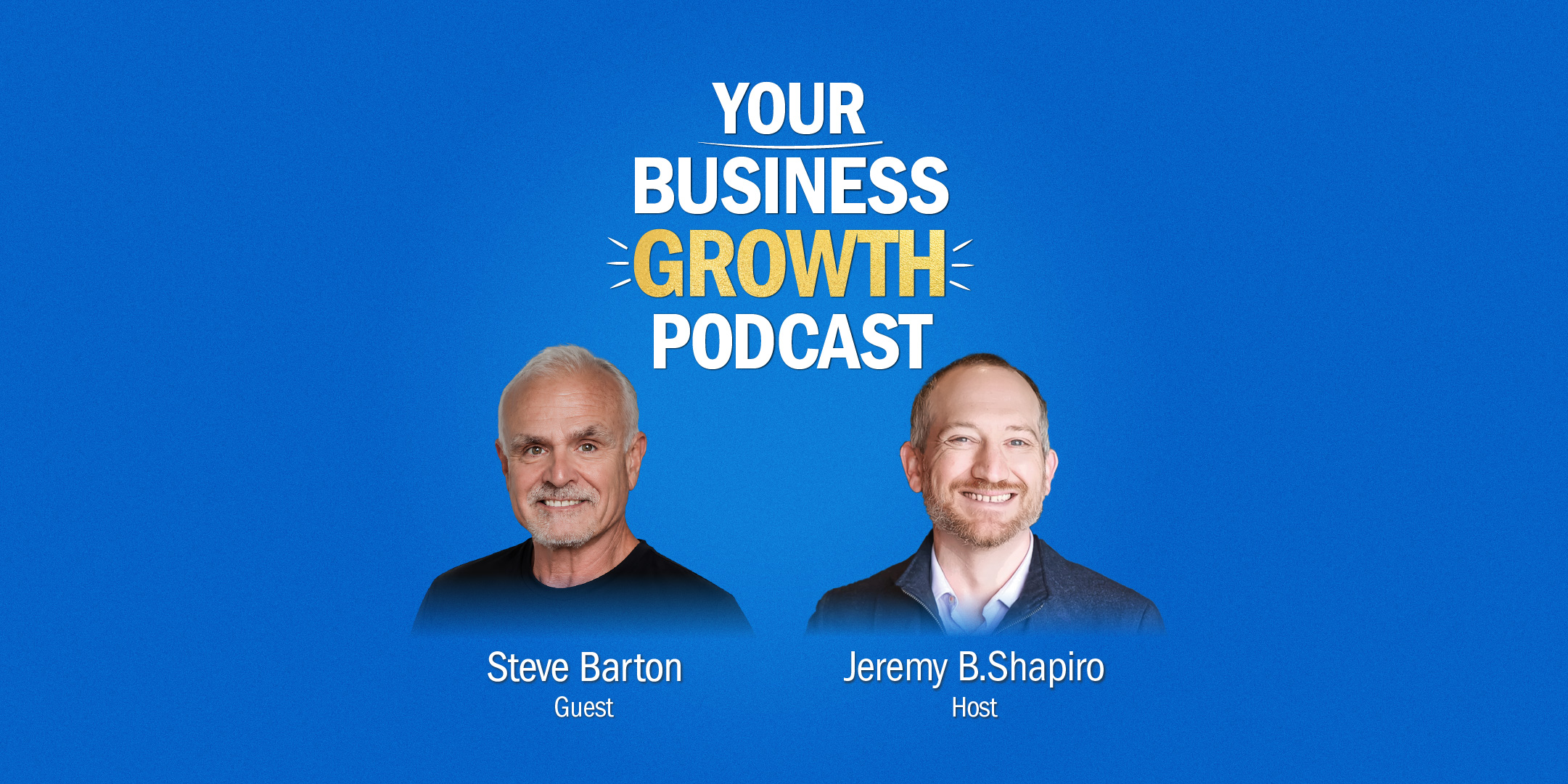
Welcome to today’s episode of Your Business Growth Podcast. I’m your host, Jeremy Shapiro, author of Your Business Growth Playbook, and my guest today is Steve Barton.
About Steve Barton

Steve Barton is the founder of Steve Barton Coaching and the creator of The Game of Ten®, a registered awareness-based leadership and performance framework. Designed specifically for entrepreneurs, executives, and high achievers, his methodology helps leaders move beyond conventional methods to lead with greater clarity, confidence, and purpose.
With more than 47 years of deep-rooted business experience, Steve has a proven track record of scaling enterprises. He famously grew his family-owned floral company from $200,000 to over $2 million in annual revenue. This extensive background in operational growth eventually transitioned into a career focused on executive coaching and transformational leadership.
In 2015, Steve formalized his process with the U.S. Patent Office, establishing The Game of Ten® as a unique system for operating from awareness rather than internal noise. His expertise in this field has earned him significant recognition, including an invitation to present his framework at Harvard Business School.
Beyond his coaching practice, Steve is a published author who co-authored The Father, the Son, and the AHA Moment with his son. Today, he remains dedicated to helping leaders strengthen their intuition and reduce internal friction to create greater success in business, relationships, and life through intentional living.
Connect with Steve Barton
Speed Round Answers:
- All In Lead Source: Variety is best
- Books: Stephen Covey’s The 7 Habits of Highly Effective People, The One Minute Manager by Ken Blanchard, and A Course in Miracles, The Power of Now by Eckhart Tolle
- Unlikeliest Mentor: Marianne Williamson for her tapes, teachings, and Miracle Minded Coaching
Like This Episode? There’s More!
Subscribe!
Your Business Growth Podcast is available on all major podcast platforms. Subscribe today!
Get the Book!
Pickup the #1 Best Seller, Your Business Growth Playbook today online or at your local bookseller!
Meet Jeremy!
Book your Blueprint Discovery Call with Jeremy today and get back to the growth you deserve!
Steve Barton Episode Transcript
I vowed that day, I’m gonna build this business up to the point we can sell it for a really good profit. And what I didn’t realize was it is very well protected in New England, and you don’t get into that market. I just had to change my mindset that I was a wholesaler. Who’d I sell to? Myself. How do you get a wholesale license in Maine at the time was it costs $5, and you get a sales permit as a wholesaler.
So the best investment I ever made- What if the very hard work you’re putting into your business is actually the thing keeping you stuck? Our guest today led a third-generation company through 10X growth from a six-figure plateau to over 2 million in revenue, only to discover that massive growth can sometimes mask a complete lack of profit.
He was drowning in complexity and stress until he realized that the brick wall he hit wasn’t an operational one, it was a plateau of awareness. By flipping his perspective and taking control of a hidden part of his industry ecosystem, he transformed a stagnant family legacy into a high-performance machine that caught the attention of Harvard Business School and led to a successful exit.
Welcome to today’s episode of Your Business Growth Podcast. I’m your host, Jeremy Shapiro, author of Your Business Growth Playbook. And my guest today is Steve Barton. Steve, welcome to the show Jeremy, thank you for having me on the show, and I’m looking forward to some great questions, and hopefully I can offer some advice to your audience and add some value there as well.
I love it. Well, you know what? I often talk about how your business can only go one of three directions. You can pass it on to your kids, which, like, never really happens, you can shut it down, or you can sell it. And so given those choices, which direction would you go? And you are one of the very, very rare folks that fits in that first bucket, that this is actually a third-generation family business.
What was it like growing up in a family business, um, and starting to really be involved as early as eight years old? Well, I, I mean, I didn’t know any different. So my father worked at the S.D. Warren paper mill in Westbrook, Maine for 14 years, quit and, uh, took over the greenhouse. Actually he didn’t take over the greenhouse.
My grandfather started the greenhouse in 1950, and I think in 1967 is when my father opened up a retail flower shop connected to it. And that was a time during FTD was starting to get big. Maine is an outgoing, uh, sending fl- uh, area for people who can get out of, uh, the winter, they go to Florida. So Mother’s…
So V- Valentine’s Day and, and birthdays and anniversaries and, um, and Mother’s Day would be, we’d be sending to Florida and any place warm. So we became, um, through the years even, we were top 100 in FTD. Um, I think after I took over, we became top 100 out of 26,000. And to clarify for our listeners, Steve, you know, you guys had just a retail storefront of a flower shop.
Yes. We were a retail flower. And then we eventually bought another one, um, competitor in, in downtown Portland, and that’s when the growth started happening. And just for our listeners, uh, explain what FTD is. FTD is Floral Trans World Delivery. I don’t even know if it’s still in existence. So it was Interflora in Europe.
But anyway, it was, um, it was kinda like 1-800-Flowers. Uh, you’d call us up, and we’d send it, um, via rotary phone when I started, and then it was bit through computers, and, and now it’s something that is- Mostly automati- automated So you guys had the retail storefront like most florists did historically and sold direct to your local consumers.
FTD expanded that out and let your customers buy from you, but deliver anywhere in the world. And on the flip side, people anywhere around the world to deliver locally in your market, yeah? Yeah. I think that FTD’s right now doesn’t even … If it does exist, it’s online. I was on, um, the advisory board for the CEO one time and I think I was sitting there and he’s saying, “We know how to run your business better than you do,” to everybody.
I said, “They are done.” Okay? Because it was a, it was a, uh, basically a co-op of florists and when, um … Actually, I met Meg. Meg Whitman was the CEO so I got to meet Meg and her team, uh, when, uh, the venture capitals, uh, came in and bought FTD from the association. So I did get to meet a lot of cool people and, um It was a great experience for growing up in a flower greenhouse to a flower shop to hanging out with some major players in, in business.
So that was pretty exciting. Before all that, like, how did your dad build the foundation for this business? Like, bring us back to where the business started and, like, what that early growth was like before you got far more involved. Well, he, he actually did a good job growing it to 200,000, from nothing to 200,000, so, uh, kudos to him.
It’s 1967 to 1980 when I came in. So it was, it was growing, but it just started exponentially growing when I started doing marketing. I remember, uh, being at an FT- uh, meeting someone at an FTD convention who was from Natick, Massachusetts, and he was doing direct mail. So I said… And I’m a really good drawer, so I was doing pen and ink drawings of arrangements.
We were sending out 10,000 direct mail pieces that looked pretty good. I’d take them down to the local paper. We’d do a half-page, uh, ad in the local paper, and they did the type setting. We took it to the printer, had 10,000 direct mail pieces. That’s when direct mail was worked. You know, we’d get 5% return, and, uh, that was, that was big, and that was…
It got our name out there. I’m curious, like, environment-wise, working with family so closely, um, what is that like? What are some of the challenges? What are some of the benefits of working in a closely held family company? Well, one day when I did take over, uh, the flower shop, I asked my father, “Do you wanna be my father or my boss?”
He said he wanted to be my, my boss. So, so if that tells you something right there. It’s, uh, strategic, it’s not intimate, and then it oftentimes gets mushy and, uh, intimate and strategic. And the good news is, um, I had it r- in writing that none of my siblings were able to come in and, and if they lost their job, take over.
So that was a good thing that I give my father credit for, that he protected, um, the work that I was putting into it because I think, uh, family businesses are so unique because we are dealing with intimate and strategic emotions, and there’s really very, not a lot of room for re- emotions other than respect, you know, for business.
So when did you realize after coming into the business that it seemed stuck at that, that six-figure plateau and wasn’t growing on the profitability side or revenue side? Like, what was the first indicator to you that there was a, there was a problem there? Uh, I think when my father took me downstairs when I first took over, he says, “This is where I put the, um, slips for the month.
So use these figures for to-” Use these figures to, uh, report to the state. I said, and I said, “No, I’m not going, I’m not going to jail and I’m not gonna start out, uh, my career, uh, like this.” So I just knew that we- I had to just, like, take, take it by the horns and just do it the right way and really grow it with mar- I, I, I graduated from business school.
Uh, I was leaving for Europe for, um, one-way ticket. I was gonna study floral design ’cause I knew, always knew I wanted to be in, in the flower business, but I, I really knew I couldn’t work with my father. So I was leaving for Europe and wasn’t coming back, and three days before, my parents were at, uh, Kansas City, Missouri, and get a phone call from my mother saying that my father had a full-blown stroke.
Half of his body was, uh, paralyzed. He recovered 89% back, feisty as ever, and, uh, um, but he- I ran- I star- I started running the company since then because he did have difficulty with one of his hands for, uh, intricate work, certain design and, and then, then we started, uh, computers started coming in and digital phones started coming in.
And so it was just too much for him to, to handle. So it sounds like you were originally splitting and moving away from the family business, but then, then it pulled you back in. I just didn’t… I lost my ticket, and it was just like, “Yep, I’m running the business at 22 years old.” Now, at 22 coming into this, did you feel like you were running the business or the business was running you?
I had no clue what I’m doing. I had somewhat of a clue what I was doing, but I was half the age of the youngest employee. And so it was, I was the boss, and there w- there was always every once in a while, “I’ve been doing this since you were in diapers,” uh, phrases and things like that. So it was, um… And then the other part was my father was so well-known in the community that, you know, “Is Enoch there?
Is Enoch…” His m- his name was Enoch, and I had to just get over that, say, “Well, he’s, he’s not running it now. He’s had a stroke, and so can I help you?” So it was really that transition, too. Yeah, so it’s interesting. I wanna just click into that a little more. On the leadership side, you came into a role that, you know, you weren’t groomed from internally or you weren’t leading your way up from the ranks and all, but you came in as a 22-year-old managing folks twice or more than twice your age.
How did you get the team to respond to you, work with you, uh, and all that from a leadership standpoint? Well, I’d been designing since I was eight years old, so I pretty much went into the basement, did, did my designing and, and did what I had to do and let them do what they did. So I pretty much left them alone.
They knew what they were doing, and I think that was the best form of leadership, is let them do what they do and let me do, focus on- Some of the stuff that I did full designs in the basement, artificial flowers. We, we started out with plastic flowers, then went into silk flowers, dried flowers, wreaths, and we had a sh- a decent showroom.
So I would do a lot in the basement and plan in my mind how we’re gonna grow the business. Now let’s talk about that growth. You know, uh, we talk about you can grow top line revenue, you can grow profitability, you can grow both, and they’re not the same thing. How did you look at daily operations through the lens of revenue and profitability?
I knew we had to do it through growth because I was supporting my father and mother, and I was looking to support myself too. So I started out very low on the money, and I just like, “I can’t, I can’t do this for the price you’re paying me.” And I knew I had to grow the business to substantiate my income.
So I was really just more growth, growth, uh, focused entirely. How to do that? That was the learning curve. How do I, how do I get into the, break into the wedding market? We didn’t do weddings, so I started with the wedding market. Uh, did this, started then the direct mail, and then it just started- I was, um, um, I love marketing.
It’s probably the best part of any business is not selling, but marketing. I love sales too, but marketing, the creative end of it. So I’m very creative, and I love… I don’t believe in a box, so I don’t think outside the box. What box? You know? You can’t do that. What? So it’s, it’s… That’s how I’ve always looked at business, and I don’t, and I don’t believe there’s any…
I don’t want a piece of the pie. I’m baking my own pie, and, uh, that’s how I look at business. I love that, that shift in perspective. The two things that you said there that I like is that, um, it’s not about thinking outside the box. There is no box, and we don’t need to expand the pie or take more of the pie.
You can bake your own pie. Like, those are just, like, really good, I think, mental shifts. Now, um, I wanna get back to the sales and marketing side of things in a bit, but before that, there’s a story that I love, which is about how you started to work up your supply chain in a way that the industry didn’t want to.
Um, tell us more about Miami and what all happened with you moving up that supply chain. Well, that was towards the last seven years. Um, my, I… We had a general manager. We bought the store in Portland. We were doing probably 1.2 million, maybe even… Yeah, probably about 1.2 at that time. My father had a fight with the general manager.
I was going to the gym every day. In the afternoon, I’d have had a wedding, a bridal appointment, booked that. Uh, oh, nothing else for the rest of the day. Bye. He had a, so he had a fight with my general manager and he just walked out. And I was, so I’m back in. I’m back in, and I vowed that day, I’m gonna build this business up to, to the point we can sell it for a really good profit.
So that was my motivation, was to sell because I, uh, I love my father, and I never was able to work with him, and it was time that I can’t do this anymore, and I’m gonna just really create a high margin. And that’s how we, um… I decided to go figure out how to be a wholesaler And what I didn’t realize was it is very well protected in New England, and you don’t get into that market, and because of the shipping and the growers and, and, uh, they considered me a retail florist, and I just had to change my mindset that I was a wholesaler.
Who’d I sell to? Myself. And anybody else who wanted to buy from me, mostly my competitors who didn’t wanna buy f- support me. So, but a few did. And, um, so yeah, and I found out that I love finding out stuff, and usually it’s just so simple and such an illusion. You know, th- how do you get a wholesale license in Maine at the time was you had to…
It cost $5, and you get a sales permit as a wholesaler. So it’s the, the best investment I ever made, plus it w- I went out on a limb, and then I… Then the next step was how do you get on the phone with Miami, uh, California growers? Um, those were the two primary local ones. And, and just say, “Are you a wholesaler?”
“Yes.” “Who do you sell to?” “I sell to, uh, we have a store in Harmon’s Flowers in Portland and Barton’s Flowers in Westbrook.” “Okay, we’re just…” I just said, “We’re just starting out.” I didn’t lie, but I didn’t tell them the whole truth. And, and they said, “That’s fine. Uh-” Uh, we’ll put you on cash for the first few times, and then once you develop, when we get to know you, when you’re paying on time and everything, then, then I, I established credit.
Uh, w- I’ll tell you one thing about my father, he always paid his bills, and that’s, I think, the best thing I ever learned about business. And I- we always pay our bills ’cause… And we’d also get the best discounts because we paid our bills. Wholesalers loved us, and we got the best prices. But what I realized too is they were marking them up, their s- product up 100%, and then I’d have to mark ours up 300% to, for the retail.
So you guys stepped into a situation where there was 100% markup one supplier up at the wholesale level. So you went and became the wholesaler to yourself with the possibility of wholesaling to others if they wanted to go that route. But regardless, that was an immediate boost on the profitability side.
Yes, and the supermarkets were doing the same thing. They’d buy at the wholesale level from Miami, California, and they’d double it. Okay? You, you hear the profit margins f- is 4% at the supermarket. Well, it might be at the end of the day, but they double their, uh, at least the flowers I knew, because I knew what they were selling them.
They were selling for my wholesale price, and customers are coming in, “I can buy this for basically my wholesale price.” I said, “I can’t compete with that.” So when I went to direct myself, I was paying half the price that they were- Paying at the, retailing for at the supermarket. Whole Foods was coming in, uh, at the time we left.
They were doing… Yeah, a lot of c- my customers were comparing, uh, prices and getting just as good a product, so the compet- it was hard to compete with price. So what I’m hearing there, Steve, is that on, um, what we could say is a commodity product, if it truly was coming from the same channels, that by going up a level in your supply chain and working, um, as a wholesaler yourself, you got back a tremendous profit margin.
You could then price against the competition. So now the grocery stores that were previously able to outprice you, you can now outprice them and make a significantly higher profit margin. And I could out-compete them with service, and that was the, that, you know… Brides would come up to me. I… They said, “Then buy them at the supermarket.”
You know? “What if I buy them at the supermarket and have you do them?” “Okay, then I’m a contractor. I’m like a carpenter. You know? You buy the lumber, and m- this is what I charge a hun-…” At the time, “I, I’m gonna charge you 150 bucks an hour to, uh, to put your flowers together.” “Okay. That’s fine.” Are you enjoying this episode?
Make sure you hit that subscribe button right now. That’ll help you get more episodes automatically as soon as they come out. So hit that subscribe button right now, and if you have a minute, leave a quick rating and review. That helps support the show. What an interesting twist on sort of the, the traditional, uh, space.
So you also had additional services outside of sort of the core product. I love that. All right. So you touched on marketing and sales before, and you’ve done some really creative, innovative things on the marketing side. I wanna get into your story about the not a billboard and, uh, what you did with the Yellow Pages.
Tell us, uh, the backstory on the not a billboard. Yeah, that came first. Um, in about 19… Well, we bought the building and the business on Congress Street in 1980, and we ran the two stores as Harmon’s Flowers in Portland and Barton’s Flowers in Westbrook, and that was a nightmare to r- to do two direct mail pieces, to do…
You know, everything was separate. The bookkeeping was separate. So finally, uh, I knew I wanted to consolidate the two names. Uh, my wife at the time, uh, and I went to London, and we saw a tea house called Betjeman and Barton with palace letterings, and I brought it… I said, “That’s, that’s it. That’s how I’m gonna do it.
I’m gonna combine the two names. I’m gonna have an HB.” And then I brought it to a graphic designer and put a rose down through, um, like a- At an angle. Red rose with Palace lettering, black letters. And then we had Harmons on one side, Barton’s on the other. And so we did that, got the, got that consolidated.
In the building that we owned, bought, and had a, almost like a movie, outdoor movie drive-in theater s- uh, size screen or side to it that overlooked a, probably the second-largest square in Portland, Congress Square. And in the meantime, there was lots of murals going up in Portland. There’s one guy named Tony Taylor.
He, um, was putting up murals. I’d see him, um, I’d drive by in the flower van delivering or doing something, and I’d see him and I, I pulled him over one day and I said, “Hey, I’ve got a, I’ve got a place I might want to put a mural. Can you come take a look at it?” He said, “Sure.” So next thing I said, “Okay.” Uh, he gave me a price.
He charged me. It was $5,000 it cost to put the mural up, to have it lit, uh, with high-powered lights, almost like shining it up on a s- movie screen, and created this beautiful, um, uh, watercolor version, rendition of what we had planned to do. And then I knew I had to bring it… I called the city hall and I said, “What’s, what’s the process of putting up a mural?”
And the same year was the Billboard Act happened in Maine, and it was… And so there was… It was pretty hot topic because certain, there was maybe one or two billboard companies in the state, and they were just out of business. You know, they just like that, unless they diversified and there, there was nothing diver- diversify.
There was no really internet at the time. And, um, so they went out, I believe. And so they said, uh, the city hall said you had to go to the planning board. “The planning board meeting’s gonna be Thursday night at 6:00. Show up, state your case. We’ll take a look at it.” So Tony Taylor, myself, and I… Tony Taylor and I went to the planning board meeting, and there were probably four people in the city planning board.
And that’s when our turn came up. He says, “We’d like to put, we, uh… I see that you want to put a billboard up on Congress Square.” And I said, “No.” I said, “We want to put a mural up on the building that we own on Congress Square.” “Well, this is a billboard.” I said, “No, this is a mural.” And they said, and they, they looked, looked up like they didn’t know what they were dealing with, and they said, “Well, it’s a billboard.”
I said, “Well, to me it looks like a mural because it’s a mural. We own the building. It’s painted on the building. We own the building.” And it was all this moss green. It was chipped and everything, and it was an eyesore for the, for the community. And by about the fourth or fifth time around, we just… both of us were just laughing.
And they said, “Okay, we’ll let you do it if you don’t put your name and logo up on it.” And I said, “I’ll let you do it if I don’t put my name and, and, and logo up on it.” And that, that just like, they just, that… They just started laughing, and, uh, they said they knew they’d met their match with me, ’cause I really didn’t care, you know?
Put, put, you do it. You spend, um, that, uh… It was, it was 10,000, it was $10,000 worth of lighting. So you spend $10,000 and do it, make, you know, beautify Portland on, on your dollar. Fine. I’m good. And, um, so they said, “We’ll let you do it if Tony Taylor is the artist who’s doing it.” And Tony said, “Here he is.” And, uh, that was the story of that.
And then once I had something established, the, the only billboard in the state of Maine, I can say it now, but, um, I never did say that while I owned the business. It’s a mural. So and, um, even to this day, there’s a billboard law of no, no billboards in the state of Maine. So, so I once had that established.
Now I’ve got something to work from. And this is before the internet and websites and all this, so… And people who called up, they didn’t know what they’re gonna get. You know, the average phone- the typical phone call was, “What would you like? Do you want a floral arrangement? What price range? 30, 40, $50?” And that right now it’s like f- f- 50, 75 and 100.
But, um, we’d give them three prices. Uh, any special colors or flowers you were looking for? You had like this, this is it, blah, blah, blah. So now I decided… And this was during the time digital printing was coming out. So I would… W- we had a catalog from FTD, from the FTD selection guide, and we could buy these, uh, or have them sh- sent to us on CD-ROM, and we could download them from there.
So I would pick out, uh, about 10 arrangements, give them three prices so people knew that what they’re gonna get, and they could say the, the lower price, the middle price, or the higher price. And, and I tell people that in the picture is the middle price. So they would… If so, typically they’d, they’d always buy the middle price anyways.
You give them three choices, they’re gonna buy the middle price. They don’t wanna be cheap. They don’t wanna be, be too ex- too extravagant. So- That was that. That really boosted our sales So there’s a, a few pieces I wanna dig into there. Um, one, just to highlight for our listeners, um, a f- a few things I like from the story you shared on the billboard side, right?
One is that much like, uh, you had the philosophy of there is no box and I can bake my own pie, there’s also this matter of like, there’s no billboards, so I’ll make a mural. And it’s this creative approach to problem-solving to get what you like in business, still staying within the letter of the law and what you’re supposed to be doing and everything else, but finding solutions, and that is a really, really great entrepreneurial head space to be in.
So I love that. Um, the second piece is that once you had this bigger branding piece in place, this mural, um, that was leading to, you know, more, uh, prospects calling in looking to buy from you, and you recognized the challenge in customers not knowing what they wanted, and so you put these packages together.
So I wanna dig into it a little more about how you, by using the Yellow Pages and everything else, made it easier for customers to buy. You know, research has shown again and again, when you have something like three tiers and you show your most popular, the anchor of that higher priced one makes the sale of the middle one so much easier.
Customers also now know what they’re getting, and they’re not choosing from 35 options. They’re choosing from three within a category. Um, how did you get to the conclusion that this is what you should do with the Yellow Pages advertising? What were the results you saw from, uh, having that approach? And like really walk us through, through the success you saw with the packaging.
That’s when, that’s when we went from probably 600,000 to over a million dollars, because we were outshining the c- the competition. There was no competition. You know, y- you’re gonna get what you asked for, you’re gonna get your money back. You know? So or we give you a call if we didn’t have those flowers in that arrangement.
We’d tell them right up front, “Hey, uh, the person who took your order, we don’t have these colors or these flowers,” and, “That’s fine. We’ll do this one. Thank you.” And so there was that. Um, it just took, it took us at a different level of marketing, and that’s all I can say. That’s when, that’s when the sales really took off.
Uh, yeah. And then, oh, then, so we were doing half-page ads in the Yellow Page, colored mind you, okay? And so if you can… Now there’s n- not even a phone book, is there? And so if there is, nobody uses them. So- Um, the, at the time too, during this time, lawyers were able to, uh, market. So the lawyers were buying the back covers of the phone book.
They were buying the half pages. So one law firm had the whole, uh, had half a page. So once one of those half page ads on the back cover, which is glossy, um, postcard, um, material, shiny color, uh, I bought the half page. So we had the half page, and that showed that that’s when it really sales went up. So when I got a phone call from the Yellow Page rep and says, “Hey, so-and-so’s not renewing the other half.
Do you wanna buy it?” I said, “Yep.” And once again, whoop. And you had a 50/50 chance in houses. P- most people’s homes had two or three phone books in them. Businesses had a lot more, and had a 50/50 chance that that’s was, uh, upside down on the, um, someone. And we just got known. Uh, our top of mind awareness, I was at a, um, a local newspaper.
The major newspaper did a, um, a- Did a, um, but I don’t know what you wanna call it, a, they called people up in, like, a chamber event. They had an event that said, “We want to do some, um, education on marketing.” And the guy knew that I was in the audience or somehow found out, and he, uh, when they took a break, he pulled me aside.
He goes, “Do you know you have the high- highest recognition rate of any logo in the state of Maine?” I said, “Doesn’t surprise me. I have the only billboard. Don’t tell anyone.” That’s fantastic. Um, I, and I love that you, you got that third-party validation and recognition from that. When I’m working with especially earlier stage businesses, maybe they’re getting business by, you know, founder-led sales or referrals, word-of-mouth and so on.
The numbers-wise, if you look at the financials, don’t typically have much money being spent on the marketing side, forgetting that any business, to grow, typically has a good amount of money being spent on marketing, because that is what gets your name out there and gets those prospects coming in. But then converting those prospects is the job on the sales side, and you really, I think, brought so much of your expertise there to close that gap up so that, A, you were recognized very widely, um, and then, B, when you did get the prospects in, you made it easier for them to transact and buy from you.
Yeah. You know, they say a picture says a thousand words, and when it comes to flowers, you know, they c- it has to be pretty. It has to be in color. It has to give them some idea what they’re spending the money for. So I guess that’s what that did, and gave them confidence in the, the sale that this, they’re gonna get something that looks p- it better look pretty darn close to what I bought, or I’ll be calling you up and saying, “That’s not what I ordered.”
So I’m hearing about a few plateaus here. You know, one is when you came in and the business just wasn’t growing, but you managed to get it to that, you know, that 600,000 level. This marketing, branding, and the whole awareness campaign and making it easier to buy got you guys up to that 1.2, and then that 1.5 level, the breakthrough came from working up the supply chain, um, and becoming a wholesaler.
Like, you’ve had a number of these plateaus and used different strategies to get yourself back to that growth and move towards that exit. I wish I, I wish I could say I knew exactly what I was doing, but I didn’t. It just made sense, you know? As entrepreneurs, right, like, there’s not a roadmap in front of us.
We- we create a best guess map. We follow that plan. It doesn’t always go according to plan, but the difference, I think, is that successful entrepreneurs try something. They do it despite not knowing everything about it or being an expert. You- you do it and you learn from it. You get back up from your failures quickly, and that’s how we figure out what works and what doesn’t.
Pretty much. Pretty much. So Steve, let’s, let’s go forward in time. You, you had this conversation with your dad, and it came down to the idea of like, “All right. Let’s grow this thing to sell it.” Um, I wanna hear a little more about that conversation I don’t think he knew that ’cause I was his gravy train and he had a good thing going.
So that was be- in me and my mind, and I knew what I was doing, and I did not wanna work with him any longer. So seven years I gave it. I’m gonna build this business up to sell it. He did not know And, um, and that’s how… And then that’s when I said, “I gotta make it profitable,” because I know they’re gonna be buying a m- a multiple of profit.
That’s what a business is worth, and flower businesses don’t sell on high multiples. And we, in the meantime, I didn’t tell you this, but we bought up about three or four flower shops in the area, and I paid, like, $10,000 for the, one of them and $20,000 for another one. You know, they don’t sell for much because they’re basically the, um, the husband and wife or, or the single proprietor, and you bought their phone number, basically.
We bought their phone number. So, we, we get these calls in directed to us, and so we… That was an easy way to… And they’d gone out of business, so they really didn’t have a lot of choice unless they had a friend or family that… I don’t know. But we got a- we also got some business from that as well. Love that.
So you also went the acquisition route, doing a few key things. Your acquisitions, one, got you their customer base, right? So any of their existing customers, you got that revenue now. But secondly, you got rid of that competition, and you now got all those sales and margins, everything else. And three, you now commanded the entire market, owning basically all the shops in town?
We owned most of them. There were, there were about three left. And then you always have the, the water and canning and knife, the kitchen floors, who’s just wonderful, who’s gonna change the world and great. I’d say great, you know, good… You know, and a year later, they’re gone. And yeah, so. And then we also expanded the wedding, I mean, we- the wedding business.
So we had relationships with the funeral homes, the, the wedding venues, the hotels, the, uh, destination, uh, facilities. Maine is a destination wedding, so that was also another area that I focused on. I was really focusing on weddings and high-end weddings, and, um, that’s where the… You could do 5, 10, 20. One weekend we did $60,000 in weddings in a weekend, and that was 20 weddings.
And that was… I remember the date, August 6th. I think it was 199f- uh, what year was that? 1996, I think, two years before we sold. I can remember it. And, um, it took me a month of planning that, that weekend. It was just like… And I had no room for anything. So I hired people, called in pe- ex- some, uh, former employees.
And, uh, that was, that was something. That’s, to do 20 weddings. I think there was one minor screw-up, and gave them the m- a portion of the money back and said, “We’re good.” That’s a- a- amazing you’re able to handle that volume, um, with that scale. Three years ago, that was 20. So that would be $100,000 wedding, a $100,000 weekend today.
Easy, easy. So that’s great to look at in today’s numbers. So bring us forward in, in time, Steve. You then had this idea that you’re gonna sell this. Your dad didn’t know the plan and you focused on how do we increase the profitability so that we get that maximum sale price given the multiples for the industry.
What are some of the biggest things that you did to increase profitability? You touched on, you know, becoming a wholesaler. What else helped you to, to, uh, improve the margins? I kept the regular retail florist prices So I, I was typically a florist at that three or four time markup. I was doing six and seven time markup.
What did you do to command that premium pricing? Because I was, I was in line with what the other florist was selling for, but I also had a lot of leeway with brides coming in, “Hey, I can buy these on…” This is when online came in. “Hey, I can buy a rose for a dollar apiece.” And I knew they n- needed like four or five, 600 of them.
I said, “Well, get your best price online. I’ll see what I can do.” And they were doubling them. So all I had to do was … I was paying 50 cents a rose, and they said, “I can get them for a dollar.” I said, “Really?” And so, “Well, the best price I can get was $1.20.” I said, “Well, I can do it $1.15.” So that’s very … So, you know, I just had to beat them by a little bit.
And, and I d- finally, when I tried that for a bit, and the la- I think the last time that I did that was, uh, “I’m gonna have the f- f- um, I’m gonna buy my flowers online, roses online. Can you come up and make the bouquets?” Well, I get to a, an inn, and I go, “Where are the flowers?” They go, “Oh, they’re in the h- the room.”
They’d been sitting on a radiator for, uh, two days. Yep, yep. So I spent about three hours cutting the stems, putting them in hot water, cutting the stems, putting them in hot water. Eventually, I got them t- to back, and I said, “Never again.” But I use that story when someone says, “I’m gonna have them deliver…” “No.
Here’s the, here’s the story, okay? This is what happened.” “Well, well…” “No, I’m not doing it.” I said, “No, never again.” So you learn, and those are just some … You know, having fl- You know, the worst thing in … Worse than the flower business or r- you know … I think the restaurant business, at least you can put the flower- uh, food in the f- refrigerator, make soup out of it.
But can you imagine a restaurant saying, “Sure, bring us your food, and we’ll go ahead and, uh, we’ll put something together for you”? Like, what a, what a different experience that would be. Get out of that space real quick. And yeah, we’re gonna charge you three times what’s on menu prices to do that. Sure, we’ll do that.
Yeah, and we can’t guarantee the quality. So, you know, Steve, knowing what you know now, you know, what would you have done differently the first time you saw that growth was becoming, like, unmanageable and that you were, were in this challenging spot? What could you have done differently? Well, I don’t know if it was unmanageable.
It was always, it always seemed to be manageable. So we, it grew, and I, I loved the growth. I love to see grow- I love to, I love sol- problem-solving. That’s just something that excites me, and I love putting together people, hiring people. Um- And, and really developing and growing. So I love growth and, and I’m doing the same thing now with my coaching business.
So it’s… I’m finding it’s a whole, that’s a whole… I’m in the same position I was when I was 22 years old, at 70, thinking, “How am I gonna do this? What’s gonna…” You know, “What’s gonna make me different than the others? How do I… Where’s my pie? What’s…” Uh, when there is no box, you know, but where’s the pie? So it’s, that’s…
So I’m finding the same thing and it’s, I love the challenge, and I’m patient. Now, speaking of that growth, um, what are some of the core metrics or indicators that you were tracking or looking at to make, to make sure your business was healthy and staying, you know, ahead of some of those future plateaus on that way towards the exit?
Well, I think the difference was I had a business background, so I knew how to read a profit and loss statement, and that put me way ahead of … I mean, one of the biggest flower shops in Portland, um, the, the owner died and her brother inherited it, and he, uh, he came up to the flower shop, said, “Steve, can you…
Do you know how to read a profit and loss statement?” I said, “Yep.” And he didn’t. And it, and he didn’t… I didn’t even think I told him how to do it, but even then, he just couldn’t even read a profit and loss. So I knew from a very young age I needed my numbers. You know, each month I needed to know where we stand, um, for especially with payroll, um, and cost of goods.
Those are my two key indicators of how, if we’re gonna be profitable or not. And it was e- everything we had. And I stayed usually right in line with it. But cost of goods went way down when I, when I bought direct. So that was, that got us to the finish line and to sell. And when I’d had enough of working with my father, I said- I’m out You know, there, there’s that quote about, like, you know, what we measure, we can improve, and I love that you highlighted that you were watching payroll and your cost of goods, cost of goods sold, or COGS.
And simply by being able to measure those, you’re able to improve that COGS dramatically to hit the numbers. And for most businesses, payroll is their biggest expense. You guys having a physical good with high cost of good sold, that obviously is, is a really key metric. So r- really well said. Now, Steve, you’ve learned so much in your business over the years.
You’re now helping others in their business. Tell us what you’re working on these days, what’s exciting you, and how you’re helping folks. Well, I don’t do manufacturing or, of flowers, but I’m helping people grow, okay? And become beautiful beings. And so I, I’m a mindset coach, an executive coach. I developed a process called the Game of 10, presented it to Harvard Business School case study team.
So, and I say this only because, you know, someone said to me, uh, the other day, uh, “What did that ever bring you by presenting to Harvard?” I said, “Bragging rights.” You know, it’s my billboard, okay? It’s, it’s my billboard. So, you know, you gotta do that in business. You gotta stand out and you gotta prove that you got something good, you’re showing it, and, um, and that takes…
That puts you aside. I think that’s what puts an entrepreneur, separates them from the rest. I had the guts, got to know the director, um, of the school, and, um, and asked her. And she… It was about a year and a half worth of nurturing that relationship, and we tried to do something together, tried to do something.
“Steve, would you, um, would you mind presenting the Game of 10 to my team? I’ve got a new team. I think they’d really like it.” I said, I’m going, “Hell yeah.” And so, uh, that was, that was a co- It went over really well. I had a, I had put together a small team of a producer for the Uh, hour and, uh, had another person there doing the brain science behind it ’cause I knew there was, there were a lot of thinkers there, and the stuff I present is from the heart and not from exactly from the head most.
It’s not heady, it’s hearty in both. So it’s flow. I was very well prepared. They loved it. One of the women in the group was, used to be head of, uh, team, uh, meeting planners at this school, and she sent me a nice email saying, “That was the best presentation we’ve ever seen.” And so that, that was good. That was a win.
That’s fantastic. And you, you’ve touched on so many different mindset, um, frames in our conversation. Um, can you touch on just super high level what the Game of 10 is? Well, the Game of 10 is a, a game of ca- basically you can call it the game of life. And m- most of the time people are playing the game often played, one through nine versus the game of 10.
So it’s based on the premise or assumption that we are all born at a level of 10 in our awareness. Our natural awareness, uh, consciousness. And through life’s disappointments, we get locked down. We get disappointed, disappoint- s- and chronically disappointed, and sometimes traumatized. And if it’s repeated, these become patterns of trauma.
And typically, oftentimes they’re generational traumas as well, carried on by o- one parent or both parents. And, um, so I bring common sense to business, to relationships, to spirituality, and it just, we attract who we are. And if we’re operating from a lower level of awareness, that’s what you’re going to attract magnetically into your life.
And these… And you can’t convince, it’s like their life is any different than what they’re attracting because, “No, I have proof. This happens all the time to me.” Well, yeah, because that’s what your level of awareness… I can’t say that to them, but I know get your level of awareness at 10. How do you do that?
Uh, you have to let go of those past disappointments and traumas, and that’s hard for a lot of people to do. And you’ve gone through that curve yourself over time. So I’m curious, like, you know, looking back, if you had to do all this all over again, um, starting from scratch. Like, you know, we, I like to look at the lessons learned and all, but lead source-wise for the business, is there one lead source you’d go all in on to grow the business?
No, I liked the variety. The, you know… No, ’cause we had to, we, we figured it out that the slowest time of the year, my father used to take off to the lake in the summertime. I mean, that was my… I developed the wedding business, so I was b- balls to the walls from June through October. So, so we, we didn’t end up with very…
January was the time I’d take off, right after Christmas and just before Valentine’s Day. So I would go someplace fantastic every January, someplace warm, and, uh, so that was my usually two-week vacation to the Caribbean or, uh, someplace warm, so. But no, I, I like to, I like, I like variety. I like Yeah, it is.
In summertime you don’t wanna leave here. So I, you know, most of the weddings, a lot of the weddings I did were on the coast, so I got to hang out in really great, uh, destination weddings. Sometimes stay overnight too, um, or for the weekend. So I’d, I’d do the wedding for three or four hours, five hours, setting up, and stay overnight and hang out and it was fun.
So I’ve, I’ve got… I’m a, I’m a pure AD- ADHER, so I love variety and I love, I love chaos and organizing the chaos. And so to me, I love the, every aspect of business. Got it. So a variety of lead sources. All right. And then rapid fire. Aside from, of course, Your Business Growth Playbook, what are s- uh, your, your top favorite business books?
Stephen Covey’s Seven Habits of Highly Effective People, Ken Blanchard, One Minute Manager. I’m a psychology junkie. S- personal development, self-help stuff, but they also apply to business. I like Flow, I like A Course in Miracles. You know, I, I, I look at this- Business as a s- as a spiritual or personal development.
So to me, that’s, that is what I put, putting my heart into business, that it’s really the passion behind it. So there are some great business books out there, but I think Stephen Covey’s my favorite, uh, business book. It really hits home. And s- I love, um, uh, Ken Blanchard’s, um, O- One Minute Manager. It’s simple.
I like simple business books because business is simple. Life is simple. Make it simple, and, uh, those are your best business books. They all say… They’re all great, and but f- I usually get one or two things out of any book I read right now, and that’s worth it to me, when I get one or two things. It’s funny.
I find, you know, when you go back and read a book on your bookshelf again that you’ve read before and gotten value from, you often get different value and different insights from the second read-through because you’re at a different place in life, different place in business and so on. And so you don’t need every page to be life-changing.
You need that one golden nugget, and it’s often a different nugget each read. You’re exactly right. One of my other favorite books is The Power of Now by Eckhart Tolle. I was listening to a tape of his. I think I listened to it 30 times, and it was a t- it was a, on my iPhone. I go, “He didn’t say that last time.”
I was convinced. I knew he did, but I, the u- the truth is, I didn’t hear it last time. And we, when we’re ready, we hear it, and when we’re ready, we see it. I think that’s the best thing to know about awareness. I like to joke that, you know, with physical books, sometimes it seems like someone snuck in the night to your nightstand and added new pages into the book that weren’t there the last time you read through the book.
So, um, that’s funny. Y- y- you see the exact same thing with those re- re-listens and rereads. So all right, last rapid-fire question. Who was one of your unlikeliest mentors? I think Marianne Williamson. 33 years ago, I went through a life change, and I was listening to her tapes. I was reading A Course in Miracles.
She’s been s- uh, lecturing on it for 40 years. During COVID, I took Miracle Mind, my second coaching course from… First was with Estelle International Studies Center. I took Miracle Minded Coaching with Marianne Williamson. I finished the course in a month, and then there was 175 people on the online course.
So, uh, same company that was sponsoring her is a publishing house, so I, I noticed on Facebook, write a book. So that’s when I said, “I want to write my Game of 10 book.” And I called up the, um… I applied online, and I get a c- call from the owner, and she was sponsoring Marianne for Miracle Minded Coaching, and she also was doing this first-time book-writing, um, course.
So she goes, “Uh, Steve, you’re in a pile on my desk. We don’t know what to do with you.” I said, “Welcome to my world.” And she g- “You wanna write a book, and you’re taking, uh, Miracle Minded Coaching?” I said, “Yeah.” And she s- and I said, “I finished all the homework.” She goes, “Yes, I know. We know. We- I wouldn’t be on the phone with you if you hadn’t.”
She goes, “What’s the name of your book?” I said, “It’s called The Game of 10.” She goes, “Well, no one’s gonna buy it.” And I said, “Okay.” So she played that game, and eventually, uh, “What else you got?” I said, “I’m writing it with my 18-year-old son.” And, “Oh, a parenting book.” So for your audience, you get a free parenting book.
It’s on my website. I can share that with you. So, but it’s actually The Game of 10. It’s a Trojan horse. But it’s kinda like… The Game of 10’s like Chicken Soup for the Soul, you know? It’s kind of like common sense, everyday universal principles that you can use in everyday life And, um, yeah. So Marianne, uh, so, I, she was my writing coach, too.
Didn’t know that I’d get her ’cause during COVID, so she was grounded in, in, uh, Washington, DC at the time, and so I got to meet her directly. There was 20 of us writing a book, and I was the only white boomer male, and, uh, in a whole group of, uh, 19 other women. So I stood out like a sore thumb and was the cause of all their problems.
So anyway, that was fun. And I, and I behaved, and I have two… Yeah, yeah. That’s great, Steve, and, and I, I love that you saw that, you got in, and you found that in book writing, much like teaching or anything else, you know, what the student needs sometimes is the broccoli, what they want is the ice cream. And so how do you reconcile that difference of getting them what they need while they’re going after what they want?
And so your parenting book, which is really about that game of 10, um, is a, is a nice way to Trojan horse that, like you said. Well, it’s also the best thing ever, father-son thing I could ever imagine doing with my son. As I look back, uh, any- did you do any neat, uh, projects with your son while you were, he was growing up?
“Well, we wrote a book together.” A parenting book. That’s pretty good. So, so Steve, to recap for our listeners, you moved from a high-stress plateaued family business into a high-profit model by working up the supply chain and implementing awareness-based leadership and some pretty innovative marketing, allowing you to scale past that $2 million mark before successfully exiting on your own terms.
Thank you. And for listeners who wanna learn more about you, where should they go right now? Go to my website. I’m coaching now. Uh, download the, the parenting book disguised as the, the game of 10. In the p- in the current pr- uh, the… I just got a… I’m co-writing the game of 10 with a professional writer. So I’m, she’s, um, we, she’s interviewed me throughout the te- process, and, um, I’m gonna spend five days really doing some deep editing and making it mine.
And, uh, so we’ll co-author that. That’s coming out in probably three months. Go to the website www.stevebartoncoaching.com, scroll down to the bottom, and, uh, just put your name and email address, and you’ll get a book. Um, it’s, I think it’s a good book. It’s, it’s rated five star on Amazon and, and got some great reviews on it, and it’s c- it’s common sense that’s not very common.
I love that. Common sense that’s not very common. Uh, and folks, that was stevebartoncoaching.com. All that is there. Steve, thank you so much for joining us. I appreciate you sharing your journey, your wisdom, the lessons learned, um, and so much with our audience, um, and for indulging me and my curiosity about your business and how you got to, uh, got to where you are today.
Well, thank you so much, Jeremy. I really appreciate it, and, uh, thank you for having me on your show. Thanks so much for listening. Quick reminder, hit that subscribe button right now so you can get more episodes when they come out automatically, and remember to leave that rating and review right now.
Like This Episode? There’s More!
Subscribe!
Your Business Growth Podcast is available on all major podcast platforms. Subscribe today!
Get the Book!
Pickup the #1 Best Seller, Your Business Growth Playbook today online or at your local bookseller!
Meet Jeremy!
Book your Blueprint Discovery Call with Jeremy today and get back to the growth you deserve!